The Right Way to Give and Receive Feedback
First of all, stop using vague adjectives and start giving people actionable advice and suggestions.
First of all, stop using vague adjectives and start giving people actionable advice and suggestions.
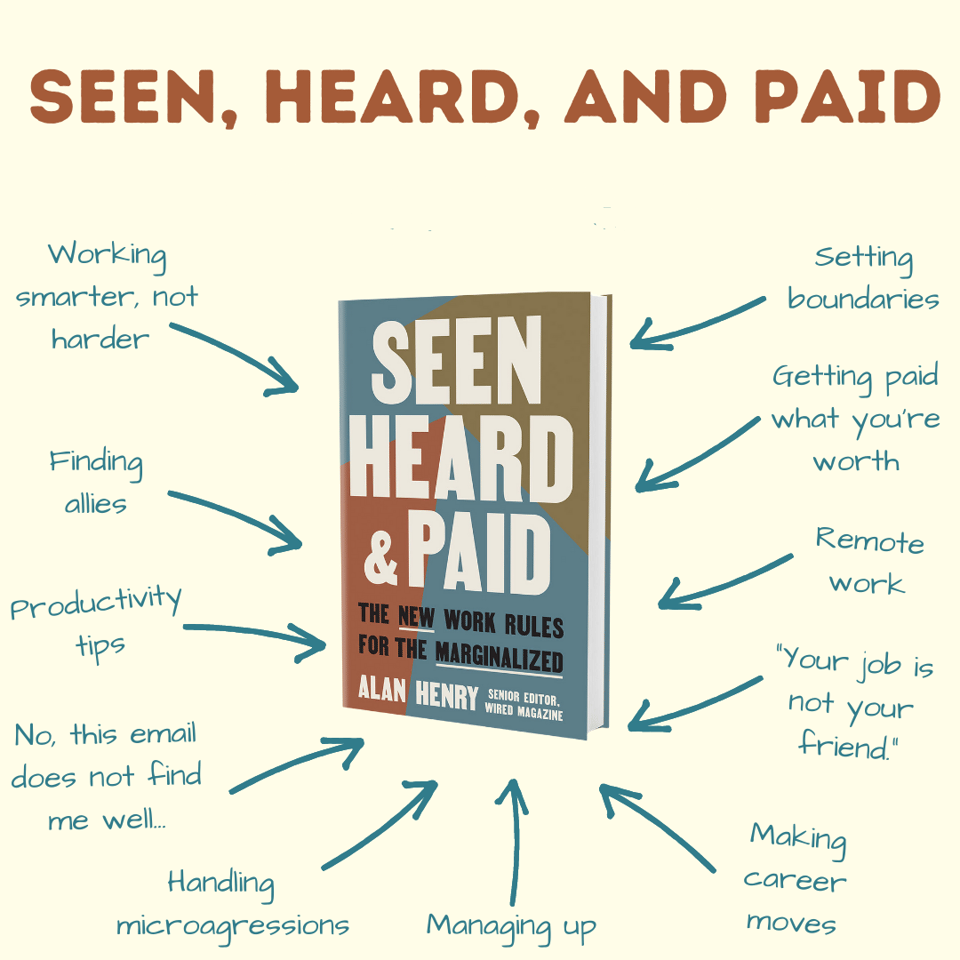
Hello and welcome back to Productivity, Without Privilege! My name is Alan Henry, author of Seen, Heard, and Paid: The New Work Rules for the Marginalized, which you should absolutely buy for anyone fresh out of college and entering the workforce for the first time, or for yourself, if you’ve never read it. If you already have a copy, consider supporting me and this newsletter by either sending me a tip or subscribing to my Patreon! I appreciate you being here. Can I get you a drink?
In this edition, I want to talk a bit about feedback. Ah, dreaded feedback. Everyone has to get it at some point, and ideally, you’ll be in a position to offer it to the people who work with you. But for some reason, no one ever teaches us how to deliver it in a meaningful way that’s focused on the work at hand and doesn’t come off like a personal judgment or attack. Much like management in general, the people who focus on teaching it usually stick to tried-and-true curricula, like encouraging people to take risks, make mistakes, and do all of the other things you’ll hear about at some overpriced corporate leadership camp, or an offsite rocks-and-ropes course where everyone does trust falls into each other’s arms.
So let’s back up a little bit and focus on what the point of offering feedback is, or at least should be.
Feedback should be tailored to the person receiving it and intended to make the work as excellent as possible, while also offering the encouragement needed to make the changes you’re asking for. That’s it.
Creatives know how frustrating it can be to get vague, completely unhelpful feedback from clients and managers. Things like “make this pop more,” or “can you make it more jazzy and modern?” without the said client actually explaining what any of that actually means. I see it in journalism too, where editors and managers often deliver feedback that’s well-intentioned, like “this needs a buzzier headline” or “we should make this more clickable,” which has a clear goal, but no practical instruction on how to go from where you are to where you need to be. It can be even worse if you don’t have the kind of relationship with the person giving the feedback to even understand what they consider “jazzy” or “buzzy” in the first place.
So my first bit of advice for people who give feedback in the first place is to understand that giving feedback is as much a part of your job and part of the creative process as anything else. You need to take it seriously and develop relationships with the people you work with so they understand exactly what you mean when you say what you say. And you should also encourage them to ask questions, seek clarity, and do what they need to do in order to understand you without shaming them for it.
So when someone comes to you and says, “What do you mean by ‘buzzier,’ exactly?” You shouldn’t throw up your hands and blame the person who’s asking for not understanding what it is you’re asking for. I can understand frustration if you’ve explained yourself several times, or if you’ve worked with someone on these expectations clearly in the past, but if you haven’t, and you know you haven’t, you should accept those questions as part of your job.
I’ve been an editor for a long, long time, and I’ve worked with a lot of different writers. All of them require slightly different communication styles, because they’re all different human beings, and deserve a basic modicum of respect. I’m sure each of them has had to adapt a bit to my management and editing style as well; that’s how working with other people works. So here are four simple pointers for the feedback givers:
- Tailor your feedback to the person you’re delivering it to. Even if you’re busy, even if you’re a manager. Everyone deserves at least that if you expect them to deliver on what you’re asking for.
- Provide actionable, concrete tasks that, if you were in their shoes, you could execute on.
- Give examples and avoid vague language. If you have an idea how something should be done or how it should look based on your feedback, offer it. Be clear that it’s an idea, though, and not something they should just take and run with.
- Encourage questions, clarifications, and understanding. Nothing is worse than being told to change something and then working in fear because you’re afraid to ask for more information. Plus, and this is the killer for managers, it leads to re-work.
Those last two are my favorites. I love editing copy and then making a comment to say, for example, “let’s make this stand out more,” which would be bad feedback if I left it on its own, but I always try to add, “maybe something like this…” and I offer an example or two to get the person I’m working with thinking on the same path that I am. I often say something like “but in your own words, of course,” because I generally don’t want the person to just take what I said and apply it, but to take the idea and make it their own.
The last point is equally important. I know what this is like from both sides. I’ve been the one struggling with a task that someone gave me vague instructions on, working in silence and worry, my fingers crossed, hoping that my next attempt is what that someone is looking for. And when it inevitably isn’t, that’s when I get the detailed feedback that they should have given me the first time. I try to avoid this myself whenever possible: the last thing I want is for someone to spend time working on something without knowing exactly what it is I asked for, adjusting it based on my bad feedback, and then having to go back to it to adjust it some more because I wasn’t clear the first time. It’s a waste of time, energy, and frankly, money.
On the feedback receiver’s side, there are some things that you can do when getting that feedback to help you avoid re-work and wasted time, and energy. A lot of it starts with asking for clear, actionable feedback when you get it and asking clarifying questions when you’re not sure of something, but it’s a little more nuanced than that. After all, you have to take into account that, for many people, questioning feedback is seen as a personal attack or a rejection of their authority. So you, too, have to be mindful of the person you’re interacting with, and make it clear to them that you, like them, simply want the finished product to be as good as it can possibly be.
- Ask up front if you can ask clarifying questions when you start working. This one sets you up for potential stumbling blocks in advance. Always do this, even if you think you understand the feedback you’re getting, because the last thing you want is to be neck-deep in work and suddenly realize you’re not sure what you need to do at this point. Always give yourself the opportunity to get clarification, so you don’t get too far ahead of yourself. Then, ask your questions freely.
- Make your goals clear to the person giving you feedback. As I said above, remind them that the point of the feedback is to make sure the finished product, whether it’s a feature article, a work of art, a stage play, or a business card, is as perfect as it possibly can be. You want everyone to leave the experience happy.
- Give yourself some breathing room. Don’t treat feedback like failure, even if the person delivering it makes it feel that way. You’ve done work you should be proud of! The fact that it needs more work, or that it needs more work to meet someone else’s specifications, doesn’t invalidate that. So make sure you meter yourself, watch your energy, and try (when you can) to avoid working so long and so hard that you become reactionary. Malicious compliance is real, and I’ve been guilty of it many times. Take a breather and come back with fresh eyes, even if you’re still irritated in your heart.
- Remember, feedback is not, and should not be, personal. The same applies to how it’s delivered and received. This one’s tough because, despite how it may not feel, feedback can feel personal, depending on how good (or bad) someone is at delivering it. Try to separate the task at hand from who you are and what you’re capable of doing. Often, the people delivering feedback are folks who wish they could do what you do, but for whatever reason, can’t. That can get them in their feels sometimes, and while they shouldn’t take it out on you, you don’t have to help them on that front if they do. Similarly, if you feel the feedback is getting too pointed and personal and isn’t about the work anymore, redirect the conversation back to the work. I’ve had the difficult displeasure of sliding into someone’s DMs to ask for specific, actionable feedback, only to get defensive responses. It’s a risk you have to take, but you also don’t have to take someone else’s nonsense.
The one nut I’ve never really cracked when it comes to taking and receiving feedback (and believe me, I’ve been writing about this topic for many many years,) are the people whose feedback is bad not because they don’t understand what they’re asking you for, but because they really have their own idea of what this finished product looks like and what they would do if the project were their to work on. You probably know the type: the kind of manager who’s delegating a task because they have to, but it’s really their idea, their baby, and if it doesn’t come out the way they would have done it, they’re unhappy with it.
Those types of managers are difficult to please in general, mostly because they’re not looking for people with their own thoughts and ideas, especially when it comes to creative work. They’re looking for little versions of themselves that they can order around—the type that would just clone themselves to do everything if they had the chance, and not work with other people at all. In short, there’s no pleasing them, only working around their egos. If that sounds familiar, sometimes all you can do is find a safe space and shout about it.

300,000 Black Women Have Left the Labor Force in 3 Months. It’s Not a Coincidence. by Katica Roy: The pushback against “DEI” was never about hiring people on merit. I’m pretty sure everyone here understands that. It was, and is, about encouraging and safeguarding mediocrity while pushing out any and all marginalized groups. And the fallout has proven it. Not only have businesses and government agencies en masse seen the kind of procedural breakdowns that they’re scrambling to AI to help offset, but, as Katica Roy reports for NBC, hundreds of thousands of Black women have left the workforce entirely, taking their skills, experience, passion, and knowledge with them.
Whether they’ve left because of corporate purges of anyone who isn’t white and male or because they chose to leave rather than suffer at the hands of those managers who are eager to be rid of them, the result is the same, and entire industries are poorer for it. Katica points out that much of the reduction is because of the abject gutting of public service and federal agencies, which have long been home to well-paying, high-skilled jobs for people of color, obviously a target for the gaggle of white supremacists who currently run the US government.
Why Did National Geographic Disappear Its Own Documentary About A Queer Climate Scientist? by Eva Holland: Why indeed, publication-that’s-now-partially-owned-by-Disney? Defector has the full story here, but I will point out that it’s particularly infuriating to watch businesses, who have no obligation to be so petty as to disappear the work of individuals and force-closet or mask the individuals who do important work for them, do so in order to make the current administration happy, in a way that they never have for any other administration.
A mutual on Bluesky rightfully pointed out that it’s not so much that they’re bowing to external pressure so much as that they’re just doing now what they’ve always wanted to do. The only difference is that now they feel comfortable doing it with impunity, and don’t even respond to questions about their own discrimination when called out on it.
The West’s Winter Has Been a Slow-Moving Catastrophe, by Rebecca Boyle: It’s no secret that I live in NYC, where we just got a breather from one massive snowstorm, and another one is on the horizon. But for the folks further out west, this winter has been exceptionally warm and dry. That’s not a surprise, either, since the Rockies especially have been dealing with a series of the warmest, driest winters in hundreds of years. And that means the snow that communities out west rely on to melt and water farmlands and communities come spring and summer just isn’t there. And when the water isn’t there, well—in a capitalist society like ours, whoever has the money to buy what is available gets first dibs. That means huge farms will probably be okay (although they’ll likely struggle, too), small farms will struggle a lot, and communities will almost certainly be under historic water conservation measures. It’s a bad scene, one that I’m surprised hasn’t been more widely reported nationally, but I’m glad that Rebecca wrote this, and I’m glad The Atlantic ran it.


If you, like me, watched the systemic destruction of valuable data and statistics from the federal government at the beginning of this year with horror, I have something that’s at least a little inspiring. The folks at Emory University have backed up a bunch of those databases and files and are making them publicly available, the way they should be. Even if the programs and data supporting them are gone now, at least the historical data is available for use.
So if you’re doing research, writing about a topic, or just want access to public information that’s been stolen from you by the current administration for no reason beyond the fact that the truth is inconvenient, hopefully that database can help. I’m sure others are doing similar things, and I’ve heard that the Internet Archive has also backed up a lot of that data. Part of my hope here is that, even if it’s a patchwork of sites and databases, the information is still available to people who need it and can be cited by researchers, journalists, authors, and activists. It pains me that so many of these resources are vanishing, especially so quickly.
***
That’ll do it for me this time around. I hope this has been helpful and that you’ve found it useful and interesting. If you love what I’m doing here, send this newsletter to a friend and tell them to subscribe! If you really love what I’m doing, feel free to support me by dropping me a tip here, or by subscribing to my Patreon here for early access to this newsletter, as well as some other treats.
Take care of yourselves, and I’ll see you back here soon.


