Concave vs. Convex: Leaders That Protect vs. Marginalize
We need to discuss what effective leadership looks like and what it definitely does not.
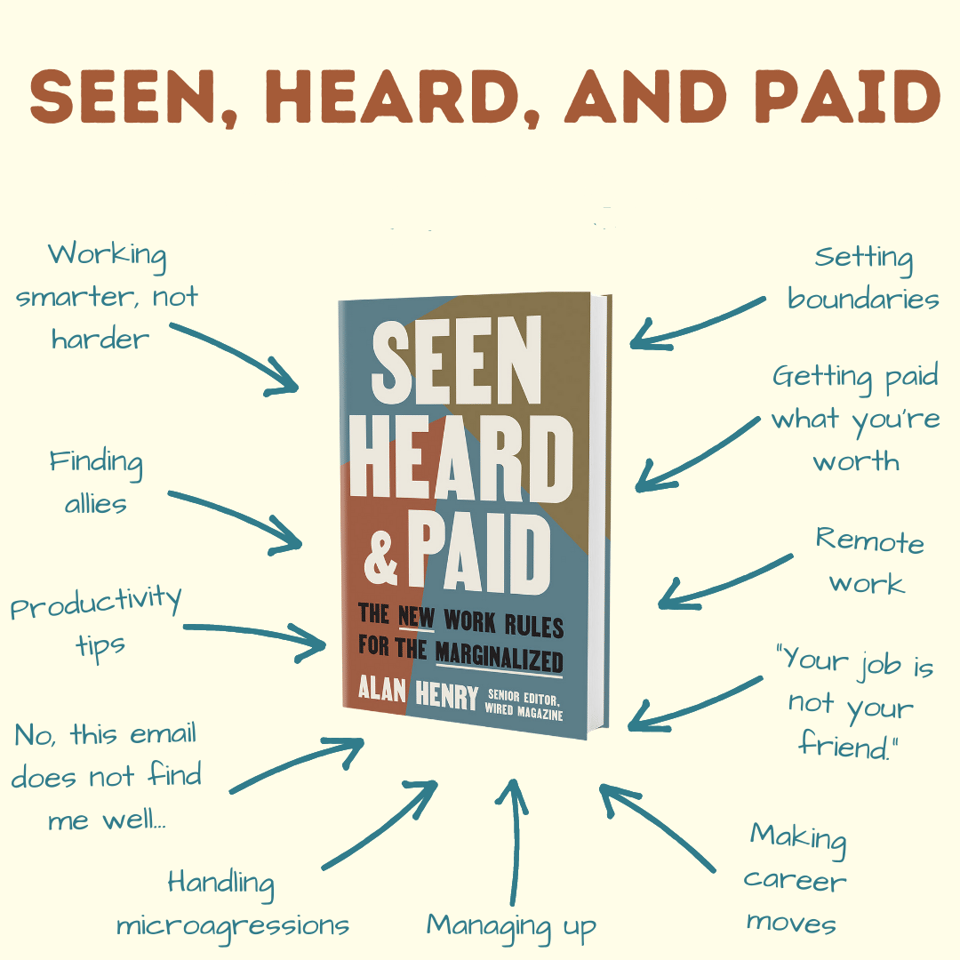
Welcome back to Productivity, Without Privilege. I’m your erstwhile host, Alan Henry, author of Seen, Heard, and Paid: The New Work Rules for the Marginalized, which is still available wherever books are sold and is available in paperback on demand. If you prefer the paperback over the hardcover, you should be able to grab one! If you enjoy these newsletters and want to support me, consider sending me a tip on Ko-Fi or subscribing to my Patreon for early access to the newsletter (among other things). Regardless, thanks for being here!
As we head into the holiday season, the media world is more or less on fire, and you probably don’t need me to dive into the nuances of the Epstein files, the elevation of an extremely problematic writer to a prestige position while the same organization is responsible for destroying the journalism they claim to protect (largely because that journalism was produced by journalists of color and queer journalists). I doubt you even need me to comment on how horrifically misogynist it is for the President of the United States to continue his trend of insulting female reporters by calling one “piggy” when she dared ask a question he didn’t like.
No, all of that stuff is pretty clear, and you don’t need me to rehash the obvious. However, one thing that has stood out to me is the quietness of many journalism leaders in the wake of all this. That said, being a leader in this field doesn’t come with a responsibility to speak up in defense of your industry: That much has been obvious to anyone paying attention as outlets downsize, reorganize, get sold to private equity, lay off all of their journalists who aren’t white, cis, and straight, die brutally in Gaza, speak out against racism, or do anything else our field is supposed to do. But it’s still disappointing, nevertheless.
So in this edition, I want to talk a little bit about two leadership styles that have always been clear to me when I see them, how you can identify them too, and why one is a sign that you have someone willing to stand up for their principles and protect their people, and why the other is a sign that someone’s in the job for influence, access, a paycheck, or even worse, power.
***
Before you start a new job, you probably have at least one interview with the person who’ll eventually be your manager. You already know it’s essential to pay attention and ask questions when you do, to ensure that this person is someone you think you’ll be comfortable working with. Unfortunately, the usual questions often fall short of telling you how this person will respond when you actually need them.
I’ll offer some questions you can ask in those moments in a moment, but first, let me explain what you’re trying to unearth. I’m sure there are other names for this observation, but I’ve grouped managers I’ve seen and worked with into two groups: concave managers and convex managers.
***

Concave managers are generally the protective type. Imagine an organizational chart, and above a specific manager and their team is a massive bowl, keeping their entire part of the organization protected from anything falling from above, but slowly filling up over time.
They’re the ones who see themselves as a bulwark between their teams and the pressures of the business. These managers generally see their role less as individual micromanagers or people responsible for picking and choosing who on their team thrives and who is pushed aside. Their primary focus is on allowing their people to do their jobs and helping them work toward their personal and professional goals.
They’re also the type to take on the needs and changes in the business themselves, which also leads to that bowl filling over time. A concave manager without good compartmentalizing skills, management skills, or at the very least a healthy way of dealing with stress, is very likely to be the kind who burns themselves out quickly, and is missed terribly by their people if they choose to resign or leave for a new opportunity.
These managers are best served by a strong deputy or second-in-command, someone who can help offset the stresses of the business (or their own managers), bounce ideas off, and, most importantly, commiserate and serve as an extra set of eyes to ensure they’re not missing anything. But above all, this type of manager is less worried about what someone in the C-suite is thinking, they see their role as one to enable people to do their best work and find success—both for themselves and for the organization as a whole.
***

Convex managers are the opposite. Imagine that same organizational chart, and instead of a bowl over their head, imagine an umbrella.
To them, their job as a manager is less about the cohesion of their team and the needs of the people who work for them, and more about managing in the strictest sense of the word. These are the types of managers who micromanage and contradict other managers or team members because of their own judgment (or because of what they have heard from someone else). They see themselves more as executionary arms of the business than as responsible for the individual well-being or success of individuals on their team. The success of the business is their success, and the needs of their own managers are their needs. In short, and not to be too rude about it, but these are the folks who love to say things like “well, shit rolls downhill,” when you tell them that they’re asking you to do something unreasonable because a C-suite resident’s priorities just changed.
These managers are also the type to impose the needs of the business on their teams, and if their teams struggle, they believe their role is to assign blame in the name of accountability and remove themselves from the situation. They’re the “well, I told you to do this, the fact that you struggled is your own problem,” type of person. And also—perhaps crucially—they’re the type who are quick to marginalize people they dislike or disagree with in favor of a closer clique of people they adore, pulling their preferred team members to the center of the umbrella and pushing the ones they dlslike to the edges to suffer both being on the outside and being more vulnerable to the whims of the business as a whole.
If you ever wonder how some highly-praised leaders end up with no people of color or queer folks or disabled people on their teams, why they conveniently lay off or isolate those people, or why some people sing their praises (often the same people, over and over) and others groan when they hear the name, you’ve met a convex manager. They have their favorite people, and they’ll move heaven and earth to pull them into their sphere of influence, especially (and willingly) at the expense of everyone else around them, especially if they’re not familiar or friendly with them. To them, those people are collateral damage to whatever mission they feel their own management has entrusted them with.
***
I think it’s fairly obvious which type of manager I both prefer and aim to be, and I think I’ve certainly shared stories of the other type more than once. However, both types have their place, and both can excel or fail brilliantly, depending on the organizations around them.
Businesses and industries that love abusive managers are more likely to attract and prefer convex managers because they’re more interested in success (as demanded by upper management) than the well-being or happiness of their employees. That may result in layoffs and disgruntled workers, but ultimately, it will lead to increased profits, more subscriptions, and upward trends, to the pleasure of other managers.
Concave managers, however, may struggle in those environments because they assume the stated values of a company are things they’ll put their authority and action behind, when in reality, as I’ve said publicly, companies don’t have values, no matter what they say. They’re focused on the humanity of their work, and less on the whims of the people above them, or worse, may absorb those whims until they can’t avoid them anymore.
Meanwhile, in diverse, inclusive, and cooperative industries and businesses, concave managers will thrive because their primary focus is on their people and helping them do their best possible work. They’ll feel a strong sense of identity (a risky amount, frankly) around their work, and they’re the type that people love working with and for.
Convex managers in those same environments, however, may feel stymied, unable to make the moves they want, or react quickly to the needs of managers above them because they have to care too much about the people under them. They may feel that their teams are a hindrance more than a help, and all of that empathy keeps them from being nimble enough to navigate a changing environment.
***
So, how do you determine which type of manager you’re about to get before you start working for one?
First, keep in mind that some companies and industries vastly prefer one over the other. Lean in to your whisper networks (and if you’re not tapped into one, find one, whether it’s a professional network for people in your field or a smaller group specifically for professionals in your field who also share your identity). It’s incredibly powerful to be in a space where you can speak freely about your lived experiences without worrying that somehow they’re going to come back to harm your future career prospects.
Next, here are some interview questions you might want to ask when you have the opportunity:
Describe a situation where you had to defend or support your team when faced with management challenges.
How do you judge who on your team is a “high performer” versus someone who isn’t?
What do you do with team members who aren’t “high performers?”
How do you set the priorities for your team, both as a group and individually?
Do you feel like your management understands what the people on your team do, and whether that work is important?
How do you handle the pressures of managing a team?
How do you prefer getting feedback from your team members?
Those are just a few, but you can (and should) adapt these as you see fit. With some of them, the answer is less important than their reaction to you asking. You can tell a convex manager instantly if they’re surprised at the very notion that someone on their team would dare give them feedback or advocate for themselves. You can tell a concave manager instantly if they have plenty of stories about times they’ve had to push back against management.
Who you opt to work for is ultimately up to you, but as someone of a marginalized group and who has suffered for it at work, make sure you’re acutely aware of what you’re getting yourself into before you sign on the dotted line, and subject your mental health, physical health, and career health to one of those people. And if one of them appears to manage you based on organizational change, and you hear warning bells in your mind, listen to them and make a plan for the future. Always, always, always protect your peace.

Black-Owned Farms Fill Gaps Left by SNAP Funding Delays, by Aallyah Wright: My love for CapitalB as a news source is well documented in this newsletter, and this story is a beautiful reminder of why. It’s entirely the kind of story that a legacy news outlet would never pick up, but it’s important and empowering nevertheless. It’s a beautiful story of community rising together to meet the needs and challenges of their neighbors, and to fill in where the people we collectively trust with power inevitably choose to fail. Give it a read. I know it’s certainly reinvigorated my desire to get involved with a community garden.
There Are No Weird Blogs Anymore Cause It’s More Fruitful to Drive Them Out of Business, by Megan Greenwell: I’ve sung Megan Greenwell’s praises before, and included her excellent book in my summer reading list, but I’ve also worked with her. She’s a brilliant journalist and a good friend, and this story, which continues the conversation that she’s led about how private equity is single-handedly responsible for [checks notes] the general decline of everything good in America, is a great primer on why the web feels barren of interesting things to read, unique perspectives from niche corners and interests, and why even the good stuff feels incredibly samey, engineered more for robots than humans, and devoid of voice, passion, or criticism.
The Internet Is on Fire and the FCC Just Walked Away With the Extinguisher, by Alan Henry: Yes, I am including a story that I wrote, whyever would you ask? On the one hand, I wanted to highlight the fact that if you enjoy my writing, you can get even more of it over at my employer, PCMag, where in addition to being managing editor, I also write a weekly column wrapping up both the infosec news that we’ve covered that week, but also highlighting some interesting infosec stories around the web that I’ve read that week. We’re also working on turning it into a newsletter, so if you'd like even more of me in your inbox, stay tuned for that. But in the meantime, check out this week’s story, where I highlighted the fact that on the same week that saw breaches at DoorDash and Logitech, as well as a record-breaking DDoS attack, the FCC decided to gut rules designed to improve security at the telecom level.

One small joy when I scroll through my Instagram feed, which in general I’ve tried to carefully curate, is a series created and hosted by my friend Bethany Brookshire, author of several amazing books, including Pests: How Humans Create Animal Villains, which forced me to think very critically about our relationship with animals we dislike, from rats to bugs (even if the latter still squick me out a bit.)
But in addition to being an incredible author, Bethany also regularly posts a series on Instagram and TikTok called Insomniac Anatomy Academy, where she can’t sleep, so she studies anatomy.
As of this writing, she’s up to episode 376. I’ve learned some truly amazing, interesting, and disturbing things about my own body just by following her, and I encourage you to do the same on whichever platform you prefer. One of my recent favorites was episode 286, about the sciatic nerve, where I learned exactly why I’m so much more comfortable sleeping with a body pillow. Oh, and there’s episode 209, about the anal canal, where I learned that there are actually two sphincters in your butt!
I’m being flippant here, but every episode is short and sweet and perfect for a quick view in between other things, whenever you would normally be doomscrolling, and I’ve learned a ton about virtually every part of the body thanks to following along. If you’re new, there’s a massive backlog to explore. Simply scroll through and find an interesting anatomical diagram thumbnail, then tap to learn something new.
***
That’s all for this edition of Productivity, Without Privilege. If my scheduling is correct, this is going out right around the Thanksgiving holidays in the United States, so if you’re reading it around then, I hope you have the happiest Thanksgiving, no matter where you are, and if it’s not Thanksgiving where you are, I hope you have a wonderful week.
If you enjoyed the newsletter, consider supporting me by dropping me a tip or by subscribing to my Patreon here for early access to this newsletter, as well as some other treats. The $5 tier gets you not only early access to this newsletter, but also Twitch stream VODs so you can watch if you can’t make it live, and first crack at any art I get, polls I run, or other activities I might take on. I’ll see you back here soon.


