[AINews] Mistral Small 3 24B and Tulu 3 405B
This is AI News! an MVP of a service that goes thru all AI discords/Twitters/reddits and summarizes what people are talking about, so that you can keep up without the fatigue. Signing up here opts you in to the real thing when we launch it 🔜
Open models are all we need.
AI News for 1/29/2025-1/30/2025. We checked 7 subreddits, 433 Twitters and 34 Discords (225 channels, and 7312 messages) for you. Estimated reading time saved (at 200wpm): 744 minutes. You can now tag @smol_ai for AINews discussions!
In a weird twist of fate, the VC backed Mistral ($1.4b raised to date) and the nonprofit AI2 released a small Apache 2 model and a large model today, but they are not in the order that you would expect to go in funding.
First, Mistral Small 3, released via their trademark magnet link, but thankfully also blogpost:
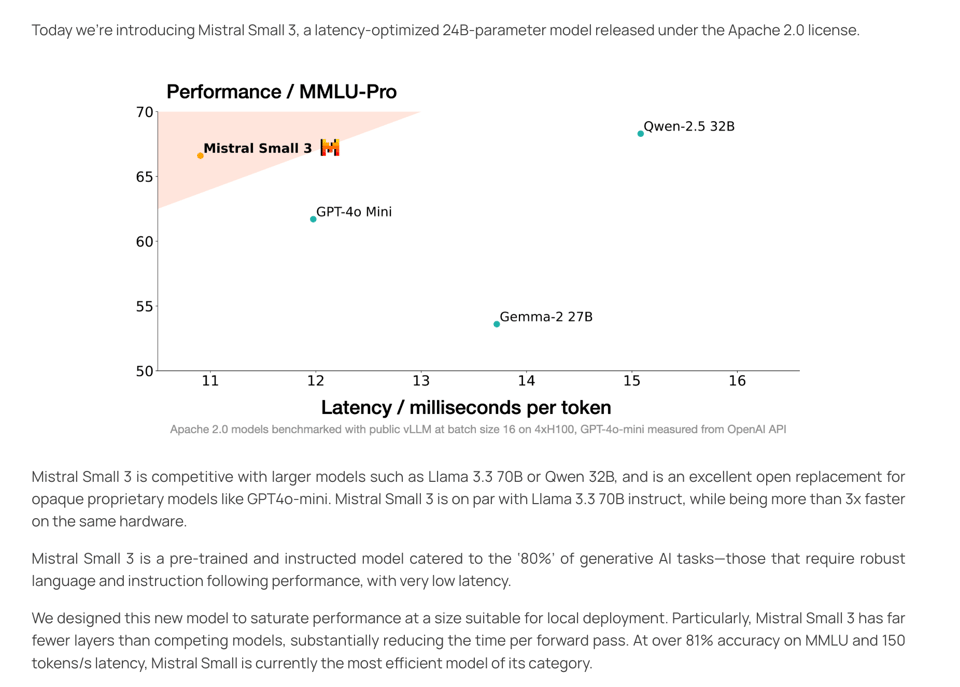
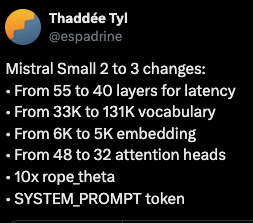
A very nice 2025 update to Mistral's offering optimized for local inference - though one notices that the x axis of their efficiency chart is changing more quickly than the y axis. Internet sleuths have already diffed the architectural differences from Mistral Small 2 (basically scaling up dimensionality but reducing layers and heads for latency):
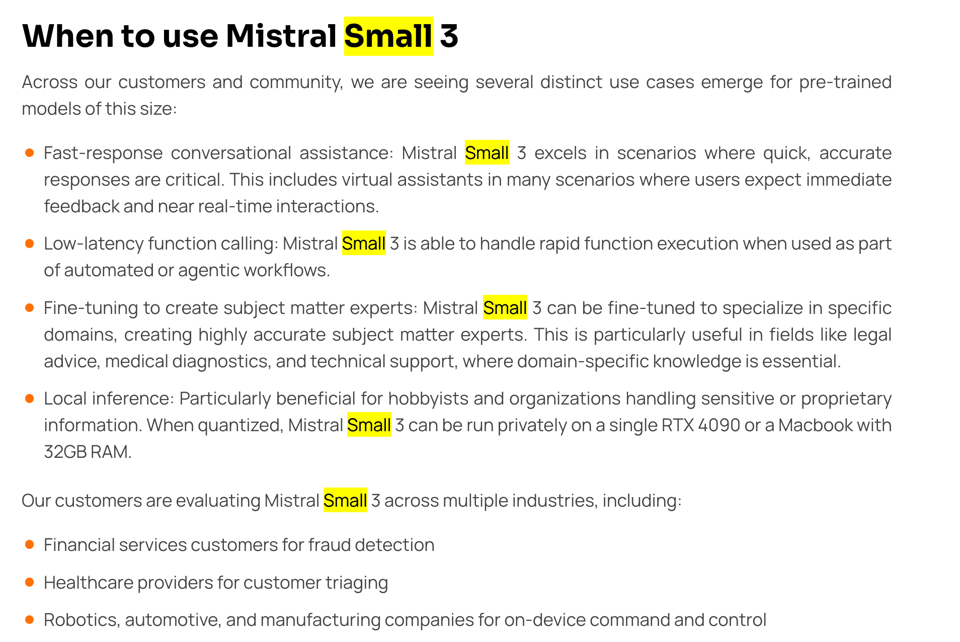
Their passage on usecases is interesting information as to why they felt this worth releasing:
Next, AI2 released Tülu 3 405B, their large finetune of Llama 3 that uses their Reinforcement Learning from Verifiable Rewards (RVLR) recipe (from the Tulu 3 paper) to make it competitive with DeepSeek v3 in some dimensions:
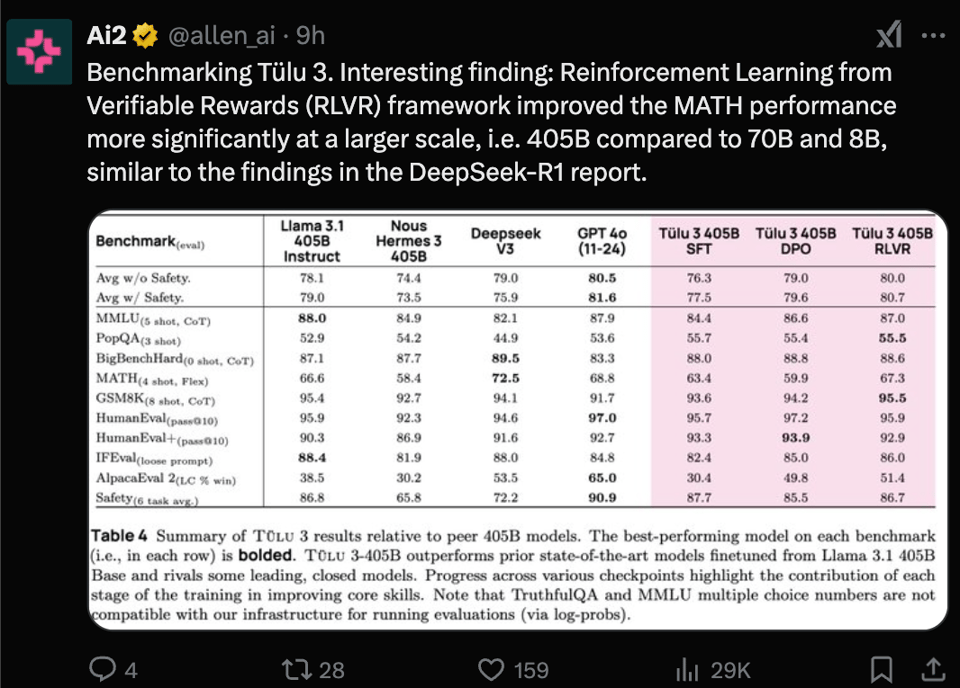
Unfortunately there don't seem to be any hosted APIs at launch, so it is hard to try out this beeg model.
Table of Contents
- AI Twitter Recap
- AI Reddit Recap
- AI Discord Recap
- PART 1: High level Discord summaries
- Unsloth AI (Daniel Han) Discord
- Perplexity AI Discord
- Codeium (Windsurf) Discord
- OpenAI Discord
- LM Studio Discord
- aider (Paul Gauthier) Discord
- Cursor IDE Discord
- Nous Research AI Discord
- Yannick Kilcher Discord
- Interconnects (Nathan Lambert) Discord
- Eleuther Discord
- OpenRouter (Alex Atallah) Discord
- Stackblitz (Bolt.new) Discord
- Stability.ai (Stable Diffusion) Discord
- GPU MODE Discord
- Nomic.ai (GPT4All) Discord
- MCP (Glama) Discord
- Notebook LM Discord Discord
- Modular (Mojo 🔥) Discord
- Latent Space Discord
- LLM Agents (Berkeley MOOC) Discord
- LlamaIndex Discord
- tinygrad (George Hotz) Discord
- Cohere Discord
- DSPy Discord
- Axolotl AI Discord
- OpenInterpreter Discord
- Torchtune Discord
- LAION Discord
- MLOps @Chipro Discord
- Gorilla LLM (Berkeley Function Calling) Discord
- PART 2: Detailed by-Channel summaries and links
- Unsloth AI (Daniel Han) ▷ #general (1053 messages🔥🔥🔥):
- Unsloth AI (Daniel Han) ▷ #off-topic (16 messages🔥):
- Unsloth AI (Daniel Han) ▷ #help (202 messages🔥🔥):
- Unsloth AI (Daniel Han) ▷ #showcase (2 messages):
- Unsloth AI (Daniel Han) ▷ #research (13 messages🔥):
- Perplexity AI ▷ #general (993 messages🔥🔥🔥):
- Perplexity AI ▷ #sharing (12 messages🔥):
- Perplexity AI ▷ #pplx-api (4 messages):
- Codeium (Windsurf) ▷ #announcements (1 messages):
- Codeium (Windsurf) ▷ #discussion (65 messages🔥🔥):
- Codeium (Windsurf) ▷ #windsurf (707 messages🔥🔥🔥):
- OpenAI ▷ #ai-discussions (474 messages🔥🔥🔥):
- OpenAI ▷ #gpt-4-discussions (68 messages🔥🔥):
- OpenAI ▷ #prompt-engineering (25 messages🔥):
- OpenAI ▷ #api-discussions (25 messages🔥):
- LM Studio ▷ #announcements (1 messages):
- LM Studio ▷ #general (308 messages🔥🔥):
- LM Studio ▷ #hardware-discussion (203 messages🔥🔥):
- aider (Paul Gauthier) ▷ #general (430 messages🔥🔥🔥):
- aider (Paul Gauthier) ▷ #questions-and-tips (45 messages🔥):
- aider (Paul Gauthier) ▷ #links (11 messages🔥):
- Cursor IDE ▷ #general (456 messages🔥🔥🔥):
- Nous Research AI ▷ #general (295 messages🔥🔥):
- Nous Research AI ▷ #ask-about-llms (1 messages):
- Nous Research AI ▷ #interesting-links (2 messages):
- Yannick Kilcher ▷ #general (170 messages🔥🔥):
- Yannick Kilcher ▷ #paper-discussion (39 messages🔥):
- Yannick Kilcher ▷ #agents (7 messages):
- Yannick Kilcher ▷ #ml-news (64 messages🔥🔥):
- Interconnects (Nathan Lambert) ▷ #news (65 messages🔥🔥):
- Interconnects (Nathan Lambert) ▷ #ml-drama (28 messages🔥):
- Interconnects (Nathan Lambert) ▷ #random (26 messages🔥):
- Interconnects (Nathan Lambert) ▷ #memes (9 messages🔥):
- Interconnects (Nathan Lambert) ▷ #rl (11 messages🔥):
- Interconnects (Nathan Lambert) ▷ #reads (65 messages🔥🔥):
- Interconnects (Nathan Lambert) ▷ #posts (2 messages):
- Interconnects (Nathan Lambert) ▷ #policy (13 messages🔥):
- Eleuther ▷ #general (31 messages🔥):
- Eleuther ▷ #research (178 messages🔥🔥):
AI Twitter Recap
all recaps done by Gemini 2.0 Flash
Model Releases and Updates
- Sakana AI released TinySwallow-1.5B, a small Japanese language model trained with their new method TAID (Temporally Adaptive Interpolated Distillation), achieving state-of-the-art performance in its size category. The model can run entirely on-device, even in a web browser. A demo is available to try, as well as the model and GitHub repo. A self-contained web app with the model weights is also available for local execution.
- Mistral AI released Mistral Small 3, a 24B parameter model, under the Apache 2.0 license, with both base and instruct versions, designed for low latency at 150 tokens/s and 81% accuracy on MMLU. It is presented as a competitor to Llama 3.3 70B, Qwen-2.5 32B, and GPT4o-mini. It is available in la Plateforme, HF, and other providers, and blog posts provide details. @ClementDelangue also noted the release and the availability of base and instruct models. Ollama and llama.cpp have released support for it as well.
- Alibaba_Qwen released Qwen 2.5 Max, their largest model yet, achieving performance comparable to DeepSeek V3, Claude 3.5 Sonnet, and Gemini 1.5 Pro with an Artificial Analysis Quality Index of 79, trained on 20 trillion tokens. They also released Qwen2.5-VL Cookbooks, a collection of notebooks showcasing various use cases of Qwen2.5-VL, including computer use, spatial understanding, document parsing, mobile agent, OCR, universal recognition, and video understanding. The API for the model has been updated to $1.6 / million input tokens and $6.4 / million output tokens.
- Allen AI released Tülu 3 405B, an open-source post-training model that surpasses DeepSeek-V3 in performance, demonstrating that their recipe, which includes Reinforcement Learning from Verifiable Rewards (RVLR) scales to 405B, and performs on par with GPT-4o. @ClementDelangue noted the release as well, highlighting the availability of the models on HF. @reach_vb called it a "cooked" release, and noted that it beat DeepSeek V3 while being 40% smaller.
- DeepSeek-V3 is beaten by Tülu 3, with @Tim_Dettmers noting this is achieved with a 405B Llama base, and that solid post-training plays a role. He emphasizes the importance of the fully open-source nature of the recipe.
- DeepSeek R1 Distill is available for free on Together AI. Together AI also offers a 100% free API endpoint for this model.
Tools, Benchmarks, and Evaluations
- LangChain introduced a bulk view for annotation queues in LangSmith, allowing users to manage large datasets for model training. They also added a waterfall graph to visualize traces, to spot bottlenecks, and optimize response times. A video was released on how to evaluate document extraction pipelines.
- @awnihannun notes that Qwen 2.5 models can be used to generate or fine-tune code with mlx-lm on a laptop, reporting the 7B model runs pretty fast on an M4 Max using the mlx-lm codebase (16k lines) as context. A guide on efficiently recomputing the prompt cache is also available.
- @jerryjliu0 shared a sneak peek of LlamaReport, an agent to create complex, multi-section reports from unstructured data.
- @AravSrinivas notes that sources and reasoning traces make a massive difference in AI products' UX and trust. He also states that Perplexity will make the native assistant on phones (android) accomplish tasks more reliably. He offered Perplexity Pro for free for one year to all US government employees with a .gov email.
- @_akhaliq has Perplexity Sonar Reasoning available on ai-gradio with DeepSeek's models. They also released Atla Selene Mini, a general purpose evaluation model.
- @swyx ran their report agent on several models, and concluded that Gemini 2.0 Flash was more efficient at abstractive reporting than O1, while being 200x cheaper.
- @karpathy explains a textbook analogy for LLMs, comparing pretraining, supervised finetuning, and reinforcement learning to textbook exposition, worked problems, and practice problems, respectively.
AI Infrastructure and Compute
- @draecomino notes that Cerebras makes AI instant again with 1 sec time to first token for DeepSeek R1 70B.
- @cto_junior notes that 2000 H100s are good enough to train a dense 70B model on 15T tokens in a fiscal year quarter, costing around 10M$. He also mentioned that Yotta has access to 4096 H100s.
- @fchollet stated that $500B number is bogus for AI, estimating that at most $150B is realistic.
- @mustafasuleyman argues technology tends to get cheaper and more efficient. He also argues that AI is moving from a world of imitation learning to reward learning.
- @teortaxesTex notes that the R1 drop has led many to conclude "you can just build things." They state that DeepSeek has done this while having less compute power compared to others.
- @shaneguML noted that test-time compute scaling favors fast inference chip startups like Cerebras and Groq.
AI Reddit Recap
/r/LocalLlama Recap
Theme 1. Mistral Small 3 Released: Competitive with Larger Models
- Mistral Small 3 (Score: 643, Comments: 205): Mistral Small 3 is referenced in a tweet by @MistralAI dated January 30, 2025, featuring a URL that likely links to resources or details about the release. The tweet has garnered 998 views, indicating interest in the subject.
- Mistral Small 3 is a 24B-parameter model released under the Apache 2.0 license, optimized for low latency and efficiency, processing 150 tokens per second. It's noted for its robust language tasks and instruction-following capabilities, and it's over three times faster than larger models like Llama 3.3 70B on the same hardware, achieving over 81% accuracy on MMLU.
- Users appreciate the human evaluation chart for smaller models, highlighting the importance of aligning models with human perspectives rather than just benchmarks. This model can be fine-tuned for various domains, including legal, medical, and technical support, and is suitable for local inference on devices like RTX 4090 or Macbooks with 32GB RAM.
- The community is enthusiastic about the Apache 2.0 licensing, which allows for wide distribution and modification, and the model's performance compared to others like Qwen 2.5 32B and GPT-4o-mini. Discussions also include the model's speed and efficiency on different hardware setups, with users reporting speeds of 21.46 tokens/s on RTX 8000 and 24.4 tokens/s on M1 Max 64GB.
- Interview with Deepseek Founder: We won’t go closed-source. We believe that establishing a robust technology ecosystem matters more. (Score: 298, Comments: 41): Deepseek's founder emphasizes their commitment to remaining open-source, prioritizing the development of a robust technology ecosystem over closed-source strategies. The interview suggests this approach is vital for innovation and collaboration in the AI community.
- OpenAI and DeepSeek: Discussions highlight skepticism towards OpenAI's initial open-source intentions, contrasting it with DeepSeek's current open-source strategy. Users express concerns about the potential shift to closed-source once adaptation occurs, as seen with OpenAI.
- Hedge Fund Strategy: There is speculation about DeepSeek's financial strategies, with some users suggesting they operate like a hedge fund by releasing open-source models to influence market valuations, a tactic described as a form of information-based market manipulation.
- Technical Curiosity: Interest in DeepSeek's technology is evident, particularly regarding their FP8 training code. Users express a desire to access this code to potentially accelerate home-based training, emphasizing the technical community's interest in leveraging open-source advancements for personal projects.
- Mistral new open models (Score: 128, Comments: 7): Mistral has released two new models, Mistral-Small-24B-Instruct and Mistral-Small-24B-Base-2501, with recent updates and a user interface that includes a search bar and sorting options. The models are part of a collection of 23 available models, with the Instruct model having 50 likes and the Base model having 23 likes.
- Mistral Small 3 is highlighted for its competitiveness with larger models like Llama 3.3 70B and Qwen 32B, being more than 3x faster on the same hardware and open-source. It's considered an excellent open alternative to proprietary models such as GPT4o-mini. More details can be found here.
- There is curiosity regarding the differences between the Base and Instruct models, though specifics are not detailed in the comments.
Theme 2. Nvidia Reduces FP8 Training on RTX 40/50 GPUs
- Nvidia cuts FP8 training performance in half on RTX 40 and 50 series GPUs (Score: 401, Comments: 93): Nvidia has reportedly reduced FP8 training performance by half in the RTX 40 and 50 series GPUs according to their new Blackwell GPU architecture whitepaper, with the 4090 model showing a drop from 660.6 TFlops to 330.3 TFlops for FP8 with FP32 accumulate. This change may discourage AI/ML training on Geforce GPUs, reflecting a pattern of performance limiting since the Turing architecture while maintaining full performance for Quadro and datacenter GPUs.
- Many commenters believe the reported halving of FP8 training performance in the RTX 40 and 50 series GPUs might be a typo in the documentation, referencing the Ada Lovelace paper where FP8/FP16 accumulation was confused with FP8/FP32. Some suggest testing with old and new drivers to verify if performance has indeed been altered.
- There are accusations against Nvidia for engaging in anti-consumer practices, with references to chip etching and firmware limitations potentially used to restrict performance. Discussions include the possibility of legal actions, comparing this situation to previous cases like Apple's iPhone throttling settlement and Nvidia's GTX 970 false advertising fine.
- Users highlight the importance of CUDA for machine learning tasks, noting difficulties encountered on non-Nvidia hardware like Apple Silicon. The discussion also touches on the unhealthy state of the AI/ML GPU market, with comparisons to Quadro and datacenter GPUs' full performance capabilities, which are not mirrored in consumer-grade GPUs.
Theme 3. DeepSeek R1 Performance: Effective on Local Rigs
- DeepSeek R1 671B over 2 tok/sec without GPU on local gaming rig! (Score: 165, Comments: 57): The post discusses achieving 2.13 tokens per second on a DeepSeek R1 671B model without using a GPU, instead utilizing a 96GB RAM gaming rig with a Gen 5 x4 NVMe SSD for memory caching. The author suggests that investing in multiple NVMe SSDs could be a cost-effective alternative to expensive GPUs for running large models, as their setup showed minimal CPU and GPU usage, highlighting the potential for better price/performance for home setups.
- Users discuss the practicality and limitations of using a 2.13 tokens per second rate, with some expressing that a minimum of 5 tokens per second is necessary for effective use, and others pointing out that 2k context is insufficient for certain applications like coding.
- There is interest in improving performance by stacking NVMe SSDs into RAID configurations or using an acceleration card, with a suggestion that for around $1,000, one could achieve 60 GBPS theoretically, enhancing the speed and performance of running large models.
- Requests for detailed replication instructions and specific command usage indicate community interest in experimenting with similar setups. A user shared a gist with llama.cpp commands and logs to assist others in understanding and replicating the setup.
- What are you actually using R1 for? (Score: 106, Comments: 134): The author questions the practical utility of DeepSeek R1 models, noting their focus on reasoning and generating extensive thought processes, even for simple problems. They express skepticism about the rush to adopt these models for everyday tasks, suggesting they may be more suited for complex problem-solving rather than routine interactions like GPT-4o.
- Users highlight DeepSeek R1's utility in various technical tasks, such as coding, math problem-solving, and data analysis. Loud_Specialist_6574 and TaroOk7112 find it particularly useful for coding, with TaroOk7112 noting its ability to convert a script to a newer version without errors on the first try. No-Statement-0001 describes a complex problem where R1 provided a solution involving a shell script for handling Docker signals.
- Several users mention the model's effectiveness in creative and theoretical applications. Automatic_Flounder89 and Acrolith note its usefulness in theoretical experiments and creative writing, respectively, while a_beautiful_rhind appreciates its roleplaying capabilities. Dysfu uses it as a teaching assistant for math, enhancing the learning experience by avoiding direct solutions.
- AaronFeng47 and EmbarrassedBiscotti9 discuss challenges with R1, such as logical errors in code and occasional oversight of specifications, but acknowledge its potential for complex tasks. AaronFeng47 contrasts the experience with other models, finding R1 less reliable than o1-preview.
Theme 4. Mark Zuckerberg on Llama 4 Progress and Strategy
- Mark Zuckerberg on Llama 4 Training Progress! (Score: 154, Comments: 85): Mark Zuckerberg emphasizes Meta's progress on Llama 4, highlighting its potential to lead in AI with its multimodal capabilities and upcoming surprises in 2025. He also discusses the success of Ray-Ban Meta AI glasses and plans for significant infrastructure investments, expecting Meta AI to become a leading personalized assistant used by over 1 billion people.
- There is significant interest in model sizes and configurations for Llama 4. Users express the need for models that fit a range of hardware capabilities, with suggestions for intermediate sizes like 1B, 3B, 7B, and up to 630B to accommodate various VRAM capacities, avoiding the gap between 7B and 800B models.
- Discussion around Meta's multimodal capabilities highlights excitement about native omnimodality, with expectations for models excelling in text, reasoning, visual understanding, and audio. Users are eager for models that support audio/text, image/text, and video capabilities, crucial for applications like vocal assistants and visual synthesis.
- Comments reflect skepticism about the timeline and strategic decisions of Meta. Concerns include the delayed release of Llama 4, the focus on fine-tuning post-training, and the potential for a limited range of model sizes. The debate also touches on the broader implications of Meta's AI developments in the context of privacy and competition with other tech giants.
Other AI Subreddit Recap
/r/Singularity, /r/Oobabooga, /r/MachineLearning, /r/OpenAI, /r/ClaudeAI, /r/StableDiffusion, /r/ChatGPT
Theme 1. DeepSeek-R1's Impact: Technical and Competitive Analysis
- No Hype DeepSeek-R1 [R]eading List (Score: 196, Comments: 9): The author shares a reading list compiled from their research paper club, focusing on foundational papers in AI/ML that lead up to DeepSeek-R1. Aimed at providing a deeper understanding of the technology, they invite readers to explore the list on Oxen.ai's blog.
- Low rank matrices approach with attention was discussed, with a question about whether it could be retrofit into existing models using their existing weights.
- Interest in joining the research paper club was expressed, with requests for more information on how to participate.
- Positive feedback on the reading list was shared, with anticipation for the upcoming Paper Club meeting.
- [d] Why is "knowledge distillation" now suddenly being labelled as theft? (Score: 256, Comments: 87): Knowledge distillation is being controversially labeled as theft, despite being a method to approximate transformations by mimicking outputs. The post argues that this label is unfounded since the architecture and training methods differ, and the process does not necessarily replicate the original transformation function.
- Several commenters highlight the distinction between copyright law and Terms of Service (TOS) violations, emphasizing that while using outputs from OpenAI models may breach TOS, it does not equate to theft under copyright law. ResidentPositive4122 notes that OpenAI's documentation clarifies they do not claim copyright on API generations, only that using such data to train other models breaches TOS.
- Discussion around OpenAI's reaction to potential TOS violations suggests a strategic move to maintain their status, with proto-n suggesting that OpenAI's claims against DeepSeek are a way to assert their influence and importance in the AI field. batteries_not_inc and others argue that OpenAI's response is driven by dissatisfaction rather than legal standing.
- The debate also touches on broader themes of regulation and ethics in AI, with H4RZ3RK4S3 and others discussing the impact of EU regulations and the contrasting perceptions of US and Chinese tech practices. KingsmanVince and defaultagi express skepticism about both US and Chinese approaches, indicating a complex landscape of ethical considerations and public perception.
- State of OpenAI & Microsoft: Yesterday vs Today (Score: 154, Comments: 27): DeepSeek-R1 is now integrated into Microsoft Azure services, marking a shift from previous controversies involving alleged data exfiltration from OpenAI's API. The recent launch on Azure AI Foundry and GitHub highlights the platform's trustworthiness and capabilities, contrasting with earlier security concerns reported by Reuters.
- DeepSeek-R1 is now available on Azure, and users express interest in testing it as an API option. There is skepticism about Microsoft's motives, with some suggesting they are capitalizing on previous controversies.
- The model is free and open source, which is a key reason for its widespread support, despite some users not understanding the distinction between the model and its applications.
- Discussions include references to Microsoft's historical strategy of "embrace, extend, and extinguish", hinting at concerns about their true intentions behind supporting DeepSeek-R1.
Theme 2. Copilot's AI Model Integration and User Feedback
- o1 now available free of charge in Copilot (Score: 253, Comments: 56): Copilot now offers OpenAI's reasoning model (o1) free for all users, as announced by Mustafa Suleyman on Twitter. The announcement showcases a conversation about ocean currents, illustrating o1's capability to provide detailed responses, and highlights user engagement metrics.
- The majority of users express dissatisfaction with Copilot, describing it as the "worst" AI for Microsoft products, with several comments highlighting issues related to wrong answers and poor integration. There is a sentiment that Copilot's quality has deteriorated, especially since changes made around August last year.
- Some users speculate that the reason for Copilot's perceived decline is due to strategic decisions by Microsoft and OpenAI to drive users back to OpenAI subscriptions, or to collect data for future offerings such as "virtual employees." Microsoft's 49% ownership of OpenAI is noted as a significant factor in these strategies.
- Technical issues are blamed on super long system prompts and prompt injections for "safety reasons," which disrupt model performance. The focus seems to be on corporate users, as companies are more comfortable using Copilot with their data, despite the perceived decline in product quality.
Theme 3. ChatGPT's Latest Updates: User Experience and Technical Changes
- ChatGPT got some nice, incremental updates (Score: 171, Comments: 61): ChatGPT has received incremental updates in the GPT-4o model as of January 29, 2025, including an extended training data range for more relevant knowledge, enhanced image analysis capabilities, and improved performance in STEM-related queries. Additionally, the model now responds more enthusiastically to emojis.
- There is skepticism about the incremental updates to GPT-4o, with users suggesting that OpenAI lifted previous constraints to upsell higher pricing tiers, and some users are noticing a return to the initial quality of responses. The discussion also mentions the anticipation of o3-mini as a potential short-term response to current limitations.
- The use of emojis in the new updates has been polarizing, with some users appreciating the enhanced formatting and others finding it excessive and disruptive, especially in professional contexts. One user mentioned the first versions of Copilot as a comparison to the current emoji usage.
- The "Think" button feature is discussed, with some users having access to it and noting its potential to add a reasoning chain to GPT-4o. However, there is concern about how it might affect message limits, particularly for those with limited quotas.
AI Discord Recap
A summary of Summaries of Summaries by Gemini 2.0 Flash Exp (gemini-2.0-flash-exp)
1. DeepSeek's Rise: Speed, Leaks, and OpenAI Rivalry
- DeepSeek Defies Expectations, Leaks Data: DeepSeek models, especially R1, show strong reasoning and creative potential, rivaling OpenAI's o1, but a database exposure on Hacker News exposed user data, raising privacy concerns. Despite that, many see it outpacing OpenAI's performance for creative tasks and code.
- R1 Performance Varies: DeepSeek R1 1.58B runs slow (3 tokens/s) on basic hardware, needing 160GB VRAM or fast storage per this doc for better throughput, but some report 32 TPS on high-end GPUs. Users also report that the quantized versions can struggle with instruction following.
- OpenAI and DeepSeek lock horns: While some note that OpenAI criticized DeepSeek for its training data, they are also using DeepSeek internally for data retrieval. This rivalry has intensified, with questions raised about censorship, open access, and data collection practices.
2. Small Models Make Big Waves: Mistral and Tülu
- Mistral Small 3 Shines Bright: The new Mistral Small 3 (24B parameters, 81% MMLU) is lauded for its low latency and local deployment capabilities, running 3x faster than competitors per the official site, offering a sweet spot between performance and resource use, and is licensed with Apache 2.0.
- Tülu 3 Topples Top Dogs: Tülu 3 405B, a 405B parameter model with open weights, outperformed both DeepSeek v3 and GPT-4o on benchmarks, driven by its Reinforcement Learning from Verifiable Rewards (RLVR) approach, with open post-training recipes.
- Quantization Tradeoffs Discussed: Developers are experimenting with model quantization, noting that it reduces model size and VRAM usage, but can also degrade instruction following, causing users to evaluate its effectiveness on various tasks.
3. RAG and Tools: LM Studio and Agent Workflow
- LM Studio Supports RAG: LM Studio 0.3.9 now supports RAG with local document attachments, described in the docs, allowing documents within context window to be used in chat sessions, and also now supports Idle TTL and auto-update, which has improved its efficiency.
- Aider Goes Local With Read-Only Stubs: Users are exploring methods to integrate Aider with local models like Ollama for privacy reasons and the new YouTube video highlights the use of read-only stubs to manage large codebases.
- LlamaIndex Integrates Advanced Agents: LlamaIndex's "Mastering AI Agents Workshop" has introduced advanced AgentWorkflow concepts for multi-agent systems, with robust architectures leveraging LlamaIndex as shown here.
4. Hardware and Performance: GPUs and Optimization
- Blackwell's Power Boost: The new Blackwell architecture with sm_120a is set to shake up GPU performance, offering stronger compute capability for consumer GPUs, as per NVIDIA documentation, with discussions highlighting possible 5x speed boosts in FP4 tasks on new RTX 5090, though some tests show only 2x gains.
- PyTorch 2.6 Performance Knobs: The newly launched PyTorch 2.6 adds
torch.compilefor Python 3.13, introduces FP16 on X86, and uses Manylinux 2.28, but drops Conda support for distribution. - GPU Pricing and Availability: Users note that new 5090 GPUs are very difficult to obtain, selling out rapidly while Jetson Nano prices have surged to $500-$700, as opposed to listings at around $250.
5. Funding, Ethics, and Community Buzz
- Dario Amodei’s AI Safety Investment Criticized: Community members express skepticism about Dario Amodei's bold $1B push toward AI Safety, with some labeling his claims as fraudulent marketing, and questioning large-scale AI fundraising efforts.
- SoftBank's Billion-Dollar Bet on OpenAI: SoftBank is reportedly planning a massive $15-25 billion investment in OpenAI, as another major bet on AI and its future potential, adding to its existing commitments.
- Community Engages Across Platforms: Members actively share findings and ask questions, with strong engagements about various AI models, frameworks, and tooling, including discussions in many Discords on how different methods are influencing the field.
PART 1: High level Discord summaries
Unsloth AI (Daniel Han) Discord
- DeepSeek R1 Speeds and Snags: DeepSeek R1 1.58B runs at about 3 tokens/s on limited hardware, with this official doc suggesting 160GB VRAM or fast storage for higher throughput.
- Community members flagged potential issues on Windows and recommended Linux for improved quantization performance.
- Mistral-Small 24B Breezes In: The newly shared Mistral-Small-24B-Instruct-2501-GGUF offers an Apache 2.0 license, features closed weights, and promises reduced latency.
- Contributors referenced Mistral's site citing 81% MMLU, seeing it as a compelling addition to open-source options.
- Online DPO Spark with Unsloth: A user confirmed online DPO worked using Unsloth repos after applying partial hard coding to handle memory constraints.
- They included a LinkedIn post about lowering DPO memory usage and asked for real-world feedback.
- MusicGen Fine-Tune Foray: A newcomer aims to fine-tune facebook/musicgen-medium or musicgen-small with
.WAVand.TXTfiles, focusing on epoch and batch size as seen in this guide.- They considered leveraging vllm for generation but also examined Unsloth and GRPOTrainer, seeking a stable fine-tuning path.
- vllm vs. Unsloth: Shared Goals or Splitting Paths?: Community members compare vllm's neural magic benefits with Unsloth's quantization approach, uncertain about future alignment under Red Hat.
- Some floated partial integration to curb GPU downtime, while others viewed each approach as distinct due to speed differences.
Perplexity AI Discord
- O1 vs. R1 Rivalry & Perplexity's Toggle Troubles: Users questioned O1 vs. R1 reliability in Perplexity Pro, noting default switches to R1 despite choosing O1. Many felt O1 offers better reasoning, but recent reliability issues prompted concerns.
- In a tweet from Aravind Srinivas, Pro users were promised 500 daily DeepSeek R1 queries, yet confusion remains on its consistency, with some users calling it annoyingly unstable.
- Alibaba's Competition Chaser Model: Alibaba introduced a new model to strengthen its competitive position, possibly realigning market dynamics. More details appear in this link, highlighting advanced algorithms for faster user experiences.
- Community members anticipate further enhancements, with some hinting at possible synergy with existing open-source frameworks, though no official statement has been made.
- DeepSeek Gains Traction & Shakes Up Data Retrieval: OpenAI clarified its usage of DeepSeek, praising its query handling for complex datasets. Many praised DeepSeek's stable privacy features, even as they noted occasional downtimes.
- Deepinfra’s DeepSeek-R1 Demo was cited for fulfilling similar tasks as OpenAI-O1, sparking lively debate over token usage and performance benefits.
- Sonar-Reasoning's Surprising Shortfalls: Testers of the sonar-reasoning model API questioned its real-world performance, seeking details on improvements over other models. Some reported lengthy, repeated answers that wasted tokens and ignored new prompts.
- Others argued it still outperforms in certain tasks, but direct side-by-side comparisons in the playground indicated the model’s thinking might be diminished in API responses.
- GPT-4, Sonnet, and Gemini Showdown: In an ongoing debate, users covered GPT-4, Sonnet, and Gemini 2.0 for advanced queries, including calculus and coding tasks. Sonnet earned acclaim for more natural-sounding text, while GPT-4 and Gemini remain powerhouses for raw accuracy.
- Some highlighted that pairing Sonnet with O1 yields clearer outputs for complex tasks, motivating a shift away from partial Claude subscriptions and rethinking paywalls.
Codeium (Windsurf) Discord
- DeepSeek's Dynamic Duo: Windsurf introduced DeepSeek R1 and DeepSeek V3 for Pro-level accounts, each requiring distinct credits per message.
- Developers highlighted R1's first-ever coding agent usage, referencing the changelog for more updates.
- Cascade's Quick Fixes: Community members reported input lag reductions and fixes to stop the Cascade panel from reopening on reload.
- They also discussed new web search capabilities via
@weband@docs, pointing to URL-based context handling.
- They also discussed new web search capabilities via
- DeepSeek vs. Sonnet Showdown: Users compared cost-efficiency and performance between DeepSeek and Claude 3.5 Sonnet, with many testers preferring R1.
- Others described Sonnet perpetually editing files, while R1 demonstrated steady behavior in coding tasks.
- Credit Confusion Clarified: Members debated whether DeepSeek R1 uses 0.25 or 0.5 credits per message, citing variable documentation.
- They pointed to the Codeium Docs and support page for precise details.
OpenAI Discord
- DeepSeek Dares to Duel with OpenAI: In guild talk, participants highlighted that DeepSeek R1 outshines OpenAI's o1 for creative tasks, referencing a Raspberry Pi demo and potential rivalry from Gemini Pro and Grok.
- Someone claimed 'DeepSeek censors results' in a YouTube critique, setting off speculation about data collection and open access.
- OneClickPrompts for Swift Setup: A new tool named OneClickPrompts was introduced for constructing personalizable multi-part prompts, with a shared GIF highlighting simplified usage for repeated tasks.
- Users praised the extension's modular approach but noted 'smart prompt combos' are still essential to achieve deeper results.
- Fine-Tuning Ollama Gains Ground: A user sought methods to fine-tune Ollama for domain-specific tasks, raising hopes for future expansions or official workflows.
- Others pointed to scattered references on GitHub, adding that streamlined procedures could unlock 'next-level adaptability' in Ollama.
- GPT's Memory & Context Windows Collide: Members criticized GPT's memory for losing crucial details over lengthy chats, sparking renewed interest in bigger context windows from open source projects like DeepSeek.
- They argued that inconsistent recollection hinders production usage, with calls for 'stable context retention' as a must-have feature going forward.
LM Studio Discord
- LM Studio 0.3.9 Gains Momentum: LM Studio 0.3.9 added Idle TTL, separate reasoning_content in API responses, and auto-update for runtimes, with official installers here.
- Community members recognized improved memory management and cited simpler auto-update processes for Hugging Face model downloads, referencing the docs.
- RAG Rolls Out in LM Studio: LM Studio now supports RAG with attached local documents in chat sessions, described in the docs.
- Users observed that if a document fits within the model’s context, it can be included in full, sparking interest in leveraging local references.
- DeepSeek's GPU Performance Surges: Discussions revealed 6-7 tokens/sec on a GTX 1080 and Ryzen 5 3600 for DeepSeek models, with a focus on VRAM management to prevent slowdowns.
- Others reported i9-14900KF, 128GB RAM, and dual RTX 4090 setups reaching 30-40 tokens/sec on 70B models, emphasizing the significance of fitting the entire model into GPU memory.
- Jetson Nano Pricing Raises Eyebrows: Members noted the Jetson Nano hitting $500-$700 or being backordered, making it less appealing compared to standard GPUs.
- A few found listings around $250, but many leaned toward more conventional hardware for superior performance.
aider (Paul Gauthier) Discord
- DeepSeek R1 Soars & Database Spills: Members reported DeepSeek R1 hitting around 32 TPS on a 4090 GPU, praising its performance while also noting issues with quantized variants. A leak on Hacker News revealed a DeepSeek database exposure that raised user privacy alarms.
- Some participants voiced skepticism about relying on a service with a potential data breach, referencing privacy nightmares as a reason to explore local solutions.
- O3 Mini Hype & Quantization Quirks: Many expressed interest in O3 Mini as a potentially faster and smaller alternative, anticipating improved experiences over existing large models. They discussed how quantization can hamper performance and instruction-following, with some calling it a tricky trade-off.
- A few joked about waiting impatiently for O3 Mini to address their model woes, while others shared varied results with prior quantized releases, highlighting the unpredictability of sizing models down.
- Aider Gets Local & Read-Only Stubs: Users explored integrating Aider with local models like Ollama for privacy reasons, expecting a solution that avoids sending data to third parties. A new YouTube video showcased read-only stubs designed to handle large codebases more efficiently.
- Some encountered confusion using multiple endpoints (e.g., Azure AI) but found references to advanced model settings helpful, with others praising stubs as a welcome step to keep code modifications under tighter control.
- O1 Pro Debates Spark Pricing Talk: Several devs championed O1 Pro for coding tasks, but they criticized its cost and usage constraints. They weighed these factors against local open-source models, noting that censorship concerns occasionally hinder productivity.
- A few participants described O1 Pro as a strong coding ally despite the price tag, while some remain committed to local models for freedom from potential policy shifts.
Cursor IDE Discord
- DeepSeek R1 Surfs the West: Windsurf announced that DeepSeek R1 and V3 are now live with tool calling capabilities, enabling R1 to run in coding agent mode for the first time.
- Users noted that it's fully hosted on Western servers and referenced Cursor's community forum for ongoing discussion.
- Token Tangles in Chat & Composer: Some users expressed confusion over the 10k token context setting, reporting difficulties tracking usage in chat and composer.
- They questioned whether the beta settings genuinely provide extended contexts or if messages get truncated without warning.
- MCP Setup Gathers Steam: A bash script approach lets people add MCP server configurations quickly, as shown in this GitHub repo.
- Developers shared the MCP Servers site to encourage trying different servers in tandem with Cursor.
- Model Security Storm Warnings: Concerns arose about potential hidden code execution in ML models, referencing a post on silent backdoors in Hugging Face models.
- Some recommended using protectai/modelscan for scanning local setups to unearth any suspicious payloads.
- Local vs Hosted Showdown: A lively debate broke out over self-hosting compared to relying on solutions like DeepSeek R1, citing privacy and cost trade-offs.
- While local enthusiasts hope for better offline models, others point to the performance benefits of hosted servers as they evolve.
Nous Research AI Discord
- Nous x Solana Sunset Soirée: The upcoming Nous x Solana event in NYC is brimming with attendance requests, focusing on discussions around distributed training in AI models.
- Participants anticipate in-person demos and specialized Q&A, hoping for synergy with the new Psyche approach.
- Mistral & Tülu Tussle: Community members shared excitement over Mistral-Small-24B-Instruct-2501 on Hugging Face and Tülu 3 405B from this tweet, both positioned for top performance in smaller-scale LLMs.
- Several pointed to R1-Zero’s blog analysis for benchmark comparisons, fueling debate on which model truly excels.
- Psyche Paves Paths for Distributed Gains: The Psyche distributed training framework aims to handle large-scale RL with a modular system, drawing praise for its ability to scale model training.
- A tweet showcased excitement for open sourcing this framework, with focus on GitHub accessibility and a possible consensus algorithm roadmap.
- China's Ten Titans Tower Over Europe's Models: A chat revealed China has TEN top-tier AI models rivaling Europe’s biggest, including Mistral, per this tweet.
- Participants noted the US boasts only five major AI labs—OpenAI, Anthropic, Google, Meta, and xAI—highlighting a fierce global race.
- CLIP-Driven Generation Gains Ground: A member inquired about autoregressive generation on CLIP embeddings, typically employed for guiding Stable Diffusion.
- They stressed a gap in references for direct CLIP-driven generative processes, indicating interest in merging multimodal inputs with decoding tasks.
Yannick Kilcher Discord
- Dario’s Daring $1B Venture: Community members discussed Dario Amodei and his $1B push toward AI Safety, raising questions about financial transparency and ambitious claims in his blog post. They highlighted unease over what some labeled fraudulent marketing, reflecting deeper skepticism toward large-scale AI fundraising efforts.
- Several technologists argued that funneling such large sums into sweeping safety initiatives may neglect other pressing AI research, while others insisted it could catalyze more responsible AI development.
- Mistral’s Middling-Sized Marvel: The newly unveiled Mistral Small 3 packs 24B parameters, nets 81% on MMLU, and runs 3x faster than bigger competitors. Developers praised its local deployment capability, citing a sweet spot between performance and resource efficiency.
- Enthusiasts contrasted it with models like Llama 3.3 (70B), suggesting Mistral’s tight design could spur more accessible, specialized solutions.
- Tülu 3 405B Triumph: Researchers at AI2 released Tülu 3 405B, boasting an enormous 405B parameters and defeating both DeepSeek v3 and GPT-4o on multiple benchmarks. Its Reinforcement Learning from Verifiable Rewards (RLVR) approach propelled the model’s accuracy and consistency in test environments.
- Participants noted the model’s training recipes and open-weight policy, citing potential momentum for even bolder open-research collaborations.
- Framework Face-Off: LlamaIndex vs PydanticAI vs LangChain: Developers reported PydanticAI’s neat interface and internal temperature settings but lamented its frequent broken JSON outputs. LlamaIndex yielded more consistent structured data, while LangChain drew criticism for complicating error tracing with its pipe-based architecture.
- Others highlighted high CPU or GPU usage in certain UIs as a sticking point, fueling calls for streamlined agent tooling with robust logging and performance metrics.
- Prospective Config’s Bold Brainchild: A Nature Neuroscience paper introduced prospective configuration as a foundation for learning beyond backpropagation, sparking fresh speculation on next-gen neural training. The method claims improved efficiency and better alignment with biological processes.
- Community conversation suggested potential synergy with RL approaches, while some questioned if the approach might overpromise, given the field’s rapid pace of technical leaps.
Interconnects (Nathan Lambert) Discord
- Tülu 3 Topples Titans: The Tülu 3 405B launch shows superior performance compared to DeepSeek v3 and GPT-4o, as described in their blog.
- Enthusiasts highlighted open post-training recipes, with excitement swirling over its scalability and massive 405B-parameter footprint.
- Mistral Small 3 Masters Minimal Latency: Mistral Small 3 debuted as a 24B-parameter model at low latency, claimed to run comfortably on typical hardware (details here).
- Community feedback praised its knowledge-dense architecture, positioning it as a strong competitor for local generative AI tasks.
- DeepSeek Leak Sparks Security Fears: Wiz Research revealed a publicly accessible DeepSeek database, exposing secret keys and chat logs.
- Discussions centered on privacy concerns, prompting calls for stricter control measures in AI infrastructure.
- SoftBank Showers OpenAI with Billions: Reports emerged of SoftBank planning to invest $15-25 billion into OpenAI, supplementing its existing pledge of over $15 billion.
- Analysts see this as yet another massive bet on AI, raising the stakes in an already fierce funding race.
- DeepSeek v3 Experts Go Parallel: New Mixture-of-Experts design in DeepSeek v3 uses sigmoid gating and dropless load balancing, letting multiple experts respond without direct contention (paper).
- Contributors discussed fine-tuning those expert layers and applying MTP to forecast two tokens at once, fueling speculation on inference acceleration.
Eleuther Discord
- Deepseek Dilemma: OpenAI's Double-Edged Ethics: Community members noted that OpenAI criticized Deepseek training while ironically using data from similar sources, raising questions about their motivations. They suspected OpenAI used legal claims to bolster a confident image in a crowded field.
- Some participants felt the Deepseek debate highlights potential hypocrisy, fueling doubts about whether OpenAI truly safeguards collaborators' interests.
- RL Revelation: Less Tools, More Talent: LLM enthusiasts discovered that using reinforcement learning (RL) can reduce the size of tool usage instructions, letting models pick up essential skills with minimal guidance. They worried that overreliance on specific tools could undermine core problem-solving abilities.
- By balancing RL with selective tool exposure, they hope to preserve a model’s reasoning prowess without letting it drift into rote tool dependency.
- Hyperfitting Hype: Big Gains from Tiny Data: New results showed that hyperfitting on a tiny dataset can catapult open-ended text generation, climbing from 4.9% to 34.3% in human preference scores. A paper confirmed these dramatic improvements, prompting a reexamination of traditional overfitting fears.
- Critics debated whether such narrow training jeopardizes broader generalization, but many welcomed these surprising boosts in text quality.
- Critique Craze: Fine-Tuning Beats Blind Imitation: Researchers proposed Critique Fine-Tuning (CFT), teaching models to spot and correct noisy responses rather than merely imitating correct solutions. They reported a 4–10% performance jump across six math benchmarks, as documented in this paper.
- The community expressed optimism that teaching models to critique mistakes might produce more robust reasoning than standard supervised fine-tuning.
- Backdoor Buzz & Llama2 Config Confusion: New warnings about undetectable backdoored models arose in this paper, casting doubt on conventional loss-based detection strategies. Meanwhile, developers questioned the significance of 32768 in Llama2’s config when setting gated MLP dimensions.
- Some pointed out that this number isn’t divisible by 3, leading to a reset toward 11008 and stirring further discussion on how to export model configurations cleanly.
OpenRouter (Alex Atallah) Discord
- DeepSeek's Double-Dose Distills: OpenRouter introduced DeepSeek R1 Distill Qwen 32B and DeepSeek R1 Distill Qwen 14B, each promising near-larger-model performance at $0.7–$0.75 per million tokens.
- The 14B version reportedly scored 69.7 on AIME 2024, with both models accessible via the OpenRouter Discord.
- Subconscious AI & Beamlit Big Moves: Subconscious AI showcased causal inference and market simulation potential on their website, stressing 'guaranteed human-level reliability.'
- Meanwhile, Beamlit launched a free alpha that accelerates shipping AI agents up to 10×, offering GitHub workflows and observability tools.
- OpenRouter Pricing Tiffs & Rate Limit Rants: Users debated the 5% fee for OpenRouter, attributing it partly to underlying Stripe costs.
- Others reported frequent 429 RESOURCE_EXHAUSTED errors with Google's Gemini, advising personal API keys to avoid timeouts.
- Mistral's Small 3 & Tülu 3 Teasers: Announced via tweets, Mistral's Small 3 (24B, 81% MMLU) and Tülu 3 (405B) both promise expanded training and faster throughput.
- Community chatter suggests these new releases may pair well with DeepSeek for bigger gains in speed and accuracy.
Stackblitz (Bolt.new) Discord
- Bolt’s Big Binary Break: Bolt stops generating binary assets, significantly reducing token usage by hundreds of thousands and improving output quality, according to a tweet from bolt.new.
- Members praised the shift to external assets, noting faster execution and celebrating it as “a major performance leap” in community talk.
- Community System Prompt Surprises: Dev discussions turned to the Project and Global System Prompt, with one user employing it for changelog updates and hoping to see expanded creative uses.
- A tip emerged to share specific files and confirm correct views, showcasing deeper usage potential beyond everyday tasks.
Stability.ai (Stable Diffusion) Discord
- ComfyUI Gains Crisp Control for Inpainting: Some participants shared manual approaches to inpainting, referencing examples on Streamable for advanced ControlNet setups in ComfyUI with accurate touches.
- They praised flexibility for specific adjustments instead of relying solely on automated methods.
- Hardware Hustle: GPU Chatter Heats Up: Users debated their GPU options, with the Intel Arc A770 LE pitched as comparable to a 3060 for gaming and AI tasks.
- Others swapped tips on 3080 and 3090 usage, focusing on VRAM requirements for Stable Diffusion.
- Face Swap Reactor Reemerges with Filters: Participants noted the removal of Reactor due to lacking NSFW checks, before reuploading a safer version on GitHub.
- They also pointed to the ComfyUI extension for streamlined face swap functionalities.
- Lora Training Twists for Stable Diffusion: Members dissected the steps for building Loras, emphasizing style integration and precise facial matching.
- They discussed combining multiple references, highlighting challenges in synchronizing style and features.
- 5090 GPUs Vanish in a Flash: New 5090 GPUs were snapped up instantly, prompting frustration over shortage and steep demand.
- People mulled financing choices to afford fresh hardware, disappointed by the minimal inventory.
GPU MODE Discord
- Blackwell & The Brash sm_120a Breakthrough: New Blackwell architecture with sm_120a overshadowed prior sm_90a features, as detailed in cutlass/media/docs/blackwell_functionality.md, promising stronger compute capability for consumer GPUs.
- Community members debated RTX 5090 gains vs RTX 4090, citing a possible 5x speedup in FP4 tasks but only 2x in other tests, raising concerns about inconsistent documentation.
- PyTorch 2.6 Packs a Punch: Recently launched PyTorch 2.6 adds
torch.compilesupport for Python 3.13, introduces FP16 on X86, and uses Manylinux 2.28, described in PyTorch 2.6 Release Blog.- Enthusiasts noted Conda deprecation while praising new performance knobs like
torch.compiler.set_stance, with some calling it 'a big shift' in distribution strategy.
- Enthusiasts noted Conda deprecation while praising new performance knobs like
- Reasoning Gym’s Rapid Expansion: The Reasoning Gym soared to 33 datasets, included in a new gallery at GALLERY.md, showcasing a wide range of reinforcement learning tasks.
- Contributors praised cooperative challenges and proposed multi-agent negotiation setups, fueling conversation on explanatory and logic-based tasks.
- Mistral’s Mischief at the AIx Jam: The Mistral AIx entry landed #2 in the 🤗 Game Jam, inviting folks to test ParentalControl in this HF Space, blending AI with game dev for comedic horror.
- They also showcased Llama3-8B R1 with a claimed 14% improvement in GSM8K, as detailed in this blogpost, sparking excitement about cost-efficient training.
Nomic.ai (GPT4All) Discord
- DeepSeek Models Spark LaTeX Talk: Members eagerly await the DeepSeek release, touting strong math and LaTeX capabilities for complex tasks.
- They discussed VRAM constraints, stressing careful context-size management for heavier computations.
- Ollama & GPT4All Connect for Local Gains: Some confirmed hooking GPT4All to Ollama by running Ollama as a server and tapping the OpenAI API from GPT4All.
- They pointed to the GPT4All Docs for a step-by-step approach.
- Remote LLMs Step into GPT4All: Users tested loading remote LLMs into GPT4All, highlighting the need to set correct API keys and environment variables.
- They recommended improved guidance in the GitHub wiki to help newcomers.
- AI Education Initiative Hits Offline Mode: A user showcased a plan to build an AI-driven tool for children in Africa, referencing Funda AI.
- They plan to use small-footprint models and curated data to allow self-study without internet, bridging resource gaps.
- Model Suffix Mystery -I1-: One member asked about -I1- in some model names but no official explanation was confirmed.
- Others requested clearer labeling, indicating a demand for more open model documentation.
MCP (Glama) Discord
- Cursor's Constrained MCP Capabilities: The new Cursor adds partial MCP support, but environment variables remain a gap, prompting command-line workarounds like
FOO=bar npx some-serveras noted in env invocation.- Community members seek better alignment between MCP and LSP config structures, describing this mismatch as a stumbling block for broader adoption.
- Web Client Wizardry for MCP: A self-hosted web client now coordinates multiple MCP servers and agents, enabling smooth hand-offs for local or cloud setups.
- Its flexible approach fuels interest, although some lament the lack of dynamic agent prompt functionality for MCP.
- Function-Calling Frustrations for 8b Model: An 8b model in MCP struggles with function calling and tool usage, confounding testers who rely on robust agent interactions.
- Several contributors suggest deeper community input on forums like Reddit, hoping to address the model's reliability concerns.
- Hataraku Hits #1 on ShowHN: The Hataraku project soared to the top on ShowHN, sparking momentum for its TypeScript SDK proposal and CLI features.
- Community members are pitching in with collaboration and trial runs, aiming to refine the interface and improve broader user experiences.
Notebook LM Discord Discord
- NotebookLM's February Feedback Fandango: NotebookLM is hosting remote chat sessions on February 6th, 2025 for user feedback, offering $75 to participants.
- They require a screener form submission, a stable Internet connection, and a device with video capabilities.
- Transcribing Trading Tactics with League of Legends Lingo: A user converted trading course videos to audio, then transcribed them with AI and used NotebookLM to clarify advanced material.
- They introduced Big Players using LoL references, demonstrating AI's flexible approach to explaining complex ideas.
- Executive Order Exposé in 24 Hours: NotebookLM summarized a new Executive Order on public education privacy in under a day, with an in-depth YouTube review.
- This demonstration sparked conversation on applying the tool for policy briefs and thorough analysis.
- DeepSeek R1 Dissected: GRPO & MoE: A NotebookLM Podcast covered DeepSeek R1, highlighting GRPO and Mixture of Experts to explain its architecture.
- Listeners viewed the full discussion with benchmarks and a quick demo, fueling questions on performance gains.
- Sluggish Study Times and Language Lapses: Some users faced 10–30 minute delays generating study guides, even with a single source.
- Others lamented poor multilingual handling (e.g., Korean and Japanese) and brief Gemini 2.0 Flash glitches, while seeking stricter source usage rules.
Modular (Mojo 🔥) Discord
- Branch Bump & Retarget Roundup: The branch changes are completed with all pull requests retargeted, ensuring a smooth code integration process.
- Team members can ask questions if they're unsure, highlighting the project's emphasis on open communication.
- NeoVim Nudges for Mojo LSP: Developers discussed enabling Mojo LSP with nvim-lspconfig, encountering some quirks during setup.
- A few reported only partial success, suggesting deeper debugging is needed for a stable workflow.
- Mojo 1.0: Speed vs. Stability Showdown: Chris Lattner stressed that Mojo 1.0 should blend GPU optimization with direct execution to maximize speed.
- Participants argued that immediate reliability must balance the race for top performance metrics.
- Backward Compatibility Shakedown: Members worried that breaking changes in new Mojo releases could deter users from upgrading.
- They emphasized support for older libraries to maintain momentum and cultivate a steady user base.
- Reflection & Performance in the Mojo Mix: Conversation centered on reflection for data serialization and noted that some reflection is partially implemented.
- Attendees also pushed for large-cluster benchmarking, mentioning the Mojo🔥: a deep dive on ownership video with Chris Lattner.
Latent Space Discord
- Small but Speedy: Mistral 3: Mistral Small 3 was introduced as a 24B-parameter model under an Apache 2.0 license with 81% MMLU and 150 tokens/sec performance, according to official details.
- It features fewer layers and a bigger vocabulary, sparking community interest in its unorthodox FF-dim/model-dim ratio on social media.
- DeepSeek Database Leak Exposes Secrets: A misconfigured ClickHouse database at DeepSeek led to a major data exposure, including chat histories and secret keys, as reported by Wiz Research.
- They quickly secured the leak after the disclosure, prompting concerns about overall safety in AI data handling.
- FUZZ Frenzy at Riffusion: Riffusion introduced FUZZ, a new generative music model that aims for high-quality output for free, shared here.
- Early adopters praised the melodic results, noting the service is only free while GPU resources hold up.
- OpenAI API Lag Under Scrutiny: Discussions mentioned OpenRouter and Artificial Analysis as ways to track possible latency surges in OpenAI’s API.
- Some saw normal response rates, but community members recommended caution and continuous checks.
- ElevenLabs' $180M Funding Feat: ElevenLabs raised $180M in a Series C round led by a16z & ICONIQ, a milestone announced here.
- Observers see it as a strong endorsement for the future of AI voice technologies and their bigger market potential.
LLM Agents (Berkeley MOOC) Discord
- Track Teasers Tempt LLM Agents Crowd: Participants await more details about the application and research tracks for the LLM Agents MOOC, which organizers promised to share soon.
- Community members repeated Stay tuned! messages, eager to hear official announcements.
- Sign-Up Snafus Stall Confirmation: Several people noted they submitted the Google Forms sign-up but haven't received replies, particularly those pursuing PhD opportunities.
- They asked for final acceptance details and faster responses to manage their schedules.
- Quiz 1 Queries and Private Archives: Members confirmed Quiz 1 is live on the course website, referencing the syllabus, with some seeking older quiz solutions from a previous LLM Agent course.
- They shared a Quizzes Archive, cautioning about hidden answers and an outdated browser prompt.
- Certificate Confusion Continues: Many await certificates from earlier sessions, with official guidance promised soon.
- Organizers stated upcoming announcements will clarify the process for this semester's awards.
- Lecture Launches and Accessibility Aims: Members pressed for the 1st lecture to be uploaded quickly, suggesting it would only take '5 minutes,' but the editing team cited Berkeley's captioning requirements.
- They noted the livestream is watchable via the course website, with a polished version pending completion of accessibility measures.
LlamaIndex Discord
- Agents in Action: Mastering AI with LlamaIndex: The Mastering AI Agents Workshop introduced advanced AgentWorkflow concepts for multi-agent frameworks, as shown in this link.
- Attendees explored robust architectural approaches with LlamaIndex, fueling new conversations about best practices.
- BlueSky Boost: LlamaIndex Spreads Its Wings: The LlamaIndex team officially landed on BlueSky, highlighting new visibility at this link.
- Contributors anticipate expanded engagement with the platform, sparking more activity around AI developments.
- O1’s Quirky Support: Partial Streaming and Debates: Members noted LlamaIndex added
o1compatibility withpip install -U llama-index-llms-openai, though some functionality remains unfulfilled.- They cited an OpenAI community thread which confirmed OpenAI has not fully enabled streaming, fueling user frustration.
tinygrad (George Hotz) Discord
- GPU Tango: P2P Patch vs Proxmox: In #general, participants discussed using a P2P patch with multiple NVIDIA GPUs and weighed Proxmox vs baremetal setups for optimal IOMMU support.
- Some users prefer going baremetal to bypass perceived hypervisor constraints, while others reported that Proxmox can handle the job if configured precisely.
- Tiny Boxes Team Up for VRAM Dreams: Members explored how many Tiny Boxes can be interconnected and wondered about sharing VRAM for HPC-level inference across them.
- They noted the lack of a direct VRAM pooling mechanism, suggesting a fast NIC for network-based scaling to achieve distributed performance.
- Token Throughput: 15/sec to 100 Requests: Estimations indicated a 15 tokens/sec capacity per model, with potential scaling to 100 requests if each ran at 14 tokens/sec.
- This illustrated how distributing requests can maintain near-peak speeds under controlled conditions, fueling HPC design discussions.
- Server Shopping for On-Prem LLMs: A user asked for recommended physical servers to host LLMs in an enterprise context, highlighting broader interest in on-prem solutions.
- Community members discussed cost-effectiveness, power draw, and room for GPU expansion to handle large-scale deployments.
- Block/Fused Code in Tinygrad: In #learn-tinygrad, someone requested sample code for blocked/fused programs demonstrating how to load and write tensor blocks.
- Others explained that performing operations in blocks can significantly boost performance by reducing overhead and merging steps.
Cohere Discord
- Command R Cranks Up the Context: A user shared struggles integrating command-r7b with distillation frameworks, citing ollama for synthetic data generation and noting gaps in existing support for these tools. They highlighted Command R as a large language model with 128,000-token context length and retrieval-augmented generation, directing others to the Models Overview, The Command R Model, and the Command R Changelog.
- Contributors focused on Command R’s upcoming release, emphasizing enhanced decision-making and data analysis capabilities. They also discussed bridging integration gaps for frameworks, hoping for smoother synthetic data workflows in future iterations.
- AI’s Blanket Debate: Some members described AI models as cold, joking that a blanket could bring them warmth. They believed this reflected a playful attempt to humanize emotionless machines.
- Others insisted AI doesn't require warmth or feelings, sparking a quick back-and-forth on what defines genuine empathy in artificial systems. The banter highlighted ongoing curiosity about AI’s emotional perception.
DSPy Discord
- Proxy Patch & DSPy Debates: One user asked about adding a proxy to
dspy.LMadapter, referencing a GitHub PR #1331 that integratedhttp_clientingpt3.py. They can't use dspy 2.6 without proxy support for their hosted endpoints.- Another user highlighted how proxy usage aligns with the dspy/clients/lm.py code references. They also questioned whether SSL context configuration is possible within
litellmfor stable connections.
- Another user highlighted how proxy usage aligns with the dspy/clients/lm.py code references. They also questioned whether SSL context configuration is possible within
- LiteLLM & DSPy: The Supported Squad: A newcomer asked which LLMs are supported by DSPy, prompting a mention of the LiteLLM documentation. The doc references OpenAI, Azure, and VertexAI offerings.
- The conversation also addressed the challenge of specifying an SSL context with
http_clientfor advanced configurations. Participants noted that these parameter settings are not fully explained in the default DSPy docs.
- The conversation also addressed the challenge of specifying an SSL context with
Axolotl AI Discord
- KTO vs Axolotl: The Urgent Showdown: Members flagged challenges in integrating Axolotl for KTO tasks, citing an urgent need to confirm feasibility and solution pathways.
- They expressed readiness to help review code and finalize tasks, emphasizing a desire to keep projects on schedule.
- Mistral Rolls Out 24B Model: A new Mistral-Small-24B-Base-2501 model with 24B parameters sparked excitement among members aiming for advanced small-size LLM performance.
- This launch underscores Mistral AI's open source commitment, with additional commercial variants hinted to fill specialized needs.
- Mistral Performance Mystery: A member admitted lacking current hands-on experience with the new Mistral model, leaving performance claims unconfirmed.
- The conversation suggested future user testing to gather real-world results and insights into how the model behaves in practice.
- Winter Semester Overload: A busy winter semester schedule was described as stuffed, impacting a member’s ability to contribute.
- This may delay collaborative tasks, prompting others to coordinate timelines and share responsibilities.
OpenInterpreter Discord
- Farm Friend Mystery: A user voiced fondness for Farm Friend from last year, noting its current absence in discussions.
- Community members remain curious about its fate, as no further updates were revealed in the thread.
- Cliché Reviews Spark Amusement: A lighthearted mention of cliché reviews caused playful banter and an accompanying image highlighted the joke.
- Though no deeper context was provided, the exchange added a fun moment within the community.
- Decoding '01': A user explained that '01' was unrelated to OpenAI, clarifying prior confusion in the dialogue.
- The remark quelled speculation and confirmed the miscommunication was purely coincidental.
Torchtune Discord
- Boost Checkpoints with DCP Toggle: Members clarified that DCP checkpointing is off by default but can be activated by setting
enable_async_checkpointing=Truein the config, enabling asynchronous writes.- They noted that this functionality, for now, is restricted to full_finetune_distributed, which may limit usage for other configurations.
- Push for Wider Checkpoint Coverage: Some wondered why async checkpointing isn't supported across all configurations, hinting at a needed future update.
- No firm timeline was provided, leaving members hoping for broader integration to simplify large-scale finetuning processes.
LAION Discord
- Local Img2Vid Craze: A user asked about the best local img2vid tool, prompting conversation around performance needs and GPU utilization.
- Others weighed in on their experiences, emphasizing quick setup and clear documentation for AI engineering workflows.
- ltxv Gains Favor: Another member promoted ltxv as the top choice for local img2vid tasks, citing its straightforward usage.
- They hinted at future testing and refinements, hoping for more community-driven benchmarks and expanded model support.
MLOps @Chipro Discord
- Simba Sparks a Databricks Feature Frenzy: Simba Khadder launched an MLOps Workshop for building feature pipelines on Databricks on January 30th at 8 AM PT, providing a direct sign-up link here.
- Attendees can glean best practices from Unity Catalog integration and direct Q&A, with the event being free for Data Engineers, Data Scientists, and Machine Learning Engineers.
- Databricks Embraces Geospatial Analytics: On January 30, 2025 at 1:00 PM EST, Databricks is hosting a free session on advanced geospatial analytics, with sign-up available on Eventbrite.
- Attendees will see how spatial data is processed on Databricks, continuing the momentum from the earlier workshop for those seeking deeper data engineering insights.
Gorilla LLM (Berkeley Function Calling) Discord
- BFCL Data Rallies for HF Datasets: One participant asked about the steps needed to make BFCL data align with the Hugging Face dataset guidelines, seeking a blueprint to ensure compliance.
- No examples or documentation were provided, leaving the conversation open-ended on how to adjust the metadata schema or format.
- No Additional Topics Appear: The conversation was limited to the single inquiry on achieving Hugging Face compliance for BFCL data.
- No further details surfaced, with silence from others on potential solutions.
The Mozilla AI Discord has no new messages. If this guild has been quiet for too long, let us know and we will remove it.
The HuggingFace Discord has no new messages. If this guild has been quiet for too long, let us know and we will remove it.
The AI21 Labs (Jamba) Discord has no new messages. If this guild has been quiet for too long, let us know and we will remove it.
PART 2: Detailed by-Channel summaries and links
Unsloth AI (Daniel Han) ▷ #general (1053 messages🔥🔥🔥):
DeepSeek R1 performance, Mistral Small 24B, Fine-tuning strategies, Quantization, Unsloth capabilities
- DeepSeek R1 1.58B is slow but coherent: Users report that while the DeepSeek R1 1.58B model runs correctly, it is very slow, typically achieving about 3 tokens per second due to hardware limitations.
- For optimal performance, greater VRAM and faster storage solutions are recommended.
- Release of Mistral Small 24B: Mistral Small 24B has been uploaded to Hugging Face, offering competitive performance against larger models while being latency-optimized.
- It is open source under the Apache 2.0 license, although its weights are closed source, generating interest among developers.
- Fine-tuning multiple tasks without forgetting: Experts advise against sequential fine-tuning (A -> B -> C) as it often leads to catastrophic forgetting of previous tasks.
- Instead, it's suggested to combine all desired tasks in a single fine-tuning phase to maintain learned characteristics.
- Quantization and Model Size: The conversation discusses the use of dynamic quantization and its potential to reduce memory usage while maintaining performance in large models.
- Quantization techniques can help allow for larger models to run on smaller hardware, although they may require careful implementation.
- Best model for limited hardware: For a PC with 16GB of RAM and an RTX 4060 with 8GB VRAM, users inquire about the best models suitable for their setup.
- They are directed towards the possibility of running reduced versions of DeepSeek or Mistral models based on compatibility with their hardware limitations.
- Mistral Small 3: Apache 2.0, 81% MMLU, 150 tokens/s
- DeepSeek's AI breakthrough bypasses industry-standard CUDA for some functions, uses Nvidia's assembly-like PTX programming instead: Dramatic optimizations do not come easy.
- unsloth/Llama-3.2-3B-unsloth-bnb-4bit · Hugging Face: no description found
- unsloth/DeepSeek-R1-Distill-Llama-70B-GGUF · Hugging Face: no description found
- unsloth/Mistral-Small-24B-Instruct-2501-GGUF · Hugging Face: no description found
- unsloth/Mistral-Small-24B-Instruct-2501-unsloth-bnb-4bit · Hugging Face: no description found
- unsloth/Llama-3.2-3B-Instruct-unsloth-bnb-4bit · Hugging Face: no description found
- Tweet from Open WebUI (@OpenWebUI): 🚀 You can now run 1.58-bit DeepSeek-R1 (non-distilled version) on Open WebUI with llama.cpp, thanks to @UnslothAI! 💻⚡️ (Tested on M4 Max, 128GB RAM) 📝 Dive into the details in their blog post: htt...
- GitHub - Jiayi-Pan/TinyZero: Clean, accessible reproduction of DeepSeek R1-Zero: Clean, accessible reproduction of DeepSeek R1-Zero - Jiayi-Pan/TinyZero
- GRPO Trainer: no description found
- Unsloth Notebooks | Unsloth Documentation: Below is a list of all our notebooks:
- Unsloth Documentation: no description found
- Changes made in Unsloth and openInstruct to get a successful Online DPO run · Issue #1494 · unslothai/unsloth: Alright so as promised from the unsloth reddit post https://www.reddit.com/r/LocalLLaMA/comments/1hqkeyn/comment/m4rbtto/?utm_source=share&utm_medium=web3x&utm_name=web3xcss&utm_term=1&...
- GitHub - EvolvingLMMs-Lab/open-r1-multimodal: A fork to add multimodal model training to open-r1: A fork to add multimodal model training to open-r1 - EvolvingLMMs-Lab/open-r1-multimodal
- DeepSeek (671B) running on a cluster of 8 Mac Mini Pros with 64GB RAM each: This is cool! DEEPSEEK-V3 ON M4 MAC: BLAZING FAST INFERENCE ON APPLE SILICON We just witnessed something incredible: the largest open-source language model flexing its muscles on Apple Silicon. We’r...
Unsloth AI (Daniel Han) ▷ #off-topic (16 messages🔥):
Text-to-Image Servers, Model Training Issues, Frontend Imperfections, Sensitive Topic Adjustments
- Text-to-Image Server Recommendations: A user suggested utilizing dedicated text-to-image servers like Stable Diffusion or Midjourney, stating there are thousands available for such tasks.
- Responses indicated a consensus on using proper platforms for image generation.
- Dataset Concerns for Model Training: A member noted that R1 isn't trained on cot traces, highlighting the limitations in the current model's dataset.
- This raised awareness about the importance of the right training data for effective model performance.
- Frontend Imperfections Affecting Output: A user observed a potential imperfection in the frontend, questioning why changes occur after tabbing out.
- Another member affirmed the likelihood of model detection systems altering outputs based on frontend behavior.
- Sensitivity Around Certain Topics: Discussion emerged around sensitive topics, particularly in relation to changes that occur in different contexts.
- Members commented that the correctness of topics may depend on the nuances of sensitive issues, particularly concerning China.
Unsloth AI (Daniel Han) ▷ #help (202 messages🔥🔥):
DeepSeek R1 Models, Fine-tuning Challenges, Quantization Techniques, System Requirements for Models, Inference and Performance
- DeepSeek R1 Dynamic Model Configuration: Users discussed running the DeepSeek R1 Dynamic 1.58-bit model on dedicated servers, with recommendations for suitable hardware like 160GB VRAM for optimal performance.
- There was concern about using it on Windows and suggestions to switch to Linux due to better performance and compatibility.
- Challenges with Fine-Tuning Mistral: A user reported strange repetitive outputs after fine-tuning a Mistral 7B model, prompting questions about possible overfitting or dataset quality issues.
- Another user suggested checking the chat template used for fine-tuning as a potential cause.
- Questions on Model Quantization and Performance: Discussions included queries about whether the R1 32B model could run on an 8GB RTX 4060, with affirmations of its capability when properly quantized.
- Users expressed curiosity over the performance comparison between models like DeepSeek R1 8B and GPT-4.
- User Experiences and Troubleshooting: Participants shared personal experiences with model installation, highlighting various configurations required for running DeepSeek effectively.
- Recommendations included using dedicated servers rather than personal hardware and avoiding running heavy models on Windows.
- Unsloth's Dynamic Quantization Technique: The dynamic quantization method used by Unsloth was highlighted as a significant factor in reducing size without sacrificing performance, with ongoing discussions about its effectiveness.
- Participants sought clarification on how many models supported this technique, leading to resource sharing for further learning.
- Run DeepSeek-R1 Dynamic 1.58-bit: DeepSeek R-1 is the most powerful open-source reasoning model that performs on par with OpenAI's o1 model.Run the 1.58-bit Dynamic GGUF version by Unsloth.
- Huzderu/deepseek-r1-671b-1.73bit: Merged GGUF Unsloth's DeepSeek-R1 671B 1.73bit dynamic quant
- Google Colab: no description found
- LLM Evaluation: Metrics, Methodologies, Best Practices: Learn how to evaluate large language models (LLMs) using key metrics, methodologies, and best practices to make informed decisions.
- Download Ollama on macOS: Download Ollama for macOS
- Google Colab: no description found
- How Good Are Low-bit Quantized LLaMA3 Models? An Empirical Study: no description found
- Advanced settings configuration in WSL: A guide to the wsl.conf and .wslconfig files used for configuring settings when running multiple Linux distributions on Windows Subsystem for Linux.
- Google Colab: no description found
- Google Colab: no description found
- Unsloth - Dynamic 4-bit Quantization: Unsloth's Dynamic 4-bit Quants selectively avoids quantizing certain parameters. This greatly increases accuracy while maintaining similar VRAM use to BnB 4bit.
- Welcome | Unsloth Documentation: New to Unsloth?
- Unsloth 4-bit Dynamic Quants - a unsloth Collection: no description found
- unsloth/DeepSeek-R1-Distill-Llama-70B-GGUF at main: no description found
- Training a causal language model from scratch - Hugging Face NLP Course: no description found
- Inference | Unsloth Documentation: Learn how to run your finetuned model.
- Run DeepSeek-R1 Dynamic 1.58-bit: DeepSeek R-1 is the most powerful open-source reasoning model that performs on par with OpenAI's o1 model.Run the 1.58-bit Dynamic GGUF version by Unsloth.
- Google Colab: no description found
- Home: Finetune Llama 3.3, Mistral, Phi-4, Qwen 2.5 & Gemma LLMs 2-5x faster with 70% less memory - unslothai/unsloth
- Datasets 101 | Unsloth Documentation: Learn all the essentials of creating a dataset for fine-tuning!
- Installing + Updating | Unsloth Documentation: Learn to install Unsloth locally or online.
Unsloth AI (Daniel Han) ▷ #showcase (2 messages):
Online DPO, Memory consumption in AI, Unsloth project
- Successfully Implemented Online DPO: A user announced that they successfully got online DPO working with Unsloth, acknowledging the hard coding present in their repos.
- They requested feedback from the community on any potential issues related to their implementation.
- LinkedIn Post on Reducing Memory Consumption: The user shared a LinkedIn post discussing strategies to reduce online DPO memory consumption.
- This post might contain valuable insights for those working on similar problems in AI.
Unsloth AI (Daniel Han) ▷ #research (13 messages🔥):
Fine-tuning MusicGen, RL-based training frameworks, Unsloth and vllm comparison, Neural magic in vllm, Collaboration between vllm and Unsloth
- Seeking Support for Fine-tuning MusicGen: A member is looking to fine-tune the facebook/musicgen-medium or facebook/musicgen-small model using their dataset with
.WAVand.TXTfiles and wants help in creating a training kit focused on parameters like epoch and batch size.- They emphasized their novice status and expressed appreciation for any assistance in the training process.
- Discussion on RL-based Training Frameworks: Members discussed RL-based frameworks like verl and Hugging Face's GRPOTrainer, noting their inclination towards utilizing vllm for generation and Hugging Face Transformers for training.
- There was curiosity about whether this method could be the best long-term strategy compared to using Unsloth for both tasks.
- Unsloth-Patched Model Speed Concerns: One member questioned how much slower an Unsloth-patched model is at generation compared to vllm, considering if efficiencies in hardware utilization could balance the speeds.
- The discussion highlighted that even if Unsloth's generation does not outperform vllm, close performance could still be beneficial due to reduced GPU idle times.
- Neural Magic Behind vllm: vllm has drawn attention for its performance, driven by neural magic, especially after its acquisition by Red Hat.
- The community expressed uncertainty about future collaborations and whether both models could work together effectively.
- Potential Collaboration between vllm and Unsloth: Members pondered whether it is feasible to have vllm and Unsloth operate together or if one has to obstruct the other.
- Questions were raised about the potential benefits and synergies of combining both frameworks rather than choosing one over the other.
Perplexity AI ▷ #general (993 messages🔥🔥🔥):
Perplexity Pro features, Model performance comparison, Issues with O1 and R1, DeepSeek functionality, AI usage for academic support
- Confusion Over O1 and R1 Functionality: Users reported that despite selecting O1 in Perplexity Pro, the system defaults to R1, causing frustration among those wanting consistent performance.
- Notably, users feel that O1 provides better reasoning capabilities compared to R1, yet it has been unreliable recently.
- Discussion on AI Models for Learning: In a conversation about AI models, users debated the effectiveness of GPT-4, Sonnet, and Gemini 2.0 for learning purposes, particularly in calculus and coding.
- Many users expressed a preference for Sonnet due to its natural-sounding text and partnership with O1 for clarity in complex tasks.
- DeepSeek Access and Reliability: Users discussed the reliability of DeepSeek versus Perplexity, highlighting that Perplexity is more stable with better privacy features, while DeepSeek had frequent downtimes.
- One user indicated that they successfully navigated account setup for Pro services related to
.govemails, demonstrating potential uses within organizations.
- One user indicated that they successfully navigated account setup for Pro services related to
- Preferences for AI Platforms: There was a consensus that while Perplexity offers useful features, users are tempted by the flexibility of using multiple AI platforms, including ChatGPT.
- Some users transitioned away from Gemini and Claude subscriptions, opting instead for the advantages provided by Perplexity and ChatGPT.
- Questions on AI Usage: Users posed questions about which AI models were best suited for specific tasks, such as image generation and document processing, with differing opinions.
- The community shared experiences using various models, leading to recommendations based on individual use cases and performance expectations.
- deepseek-ai/DeepSeek-R1 - Demo - DeepInfra: We introduce DeepSeek-R1, which incorporates cold-start data before RL. DeepSeek-R1 achieves performance comparable to OpenAI-o1 across math, code, and reasoning tasks. . Try out API on the Web
- Whoa Shaking Head GIF - Whoa Shaking Head Windy - Discover & Share GIFs: Click to view the GIF
- Austinpowers Drevil GIF - Austinpowers Drevil MikeMyers - Discover & Share GIFs: Click to view the GIF
- Tweet from Aravind Srinivas (@AravSrinivas): All Perplexity Pro users now get 500 daily DeepSeek R1 queries (without censorship and prompts not going to China). Free users get 5 daily queries.Quoting Aravind Srinivas (@AravSrinivas) 100 daily De...
- Tweet from Aravind Srinivas (@AravSrinivas): All Perplexity Pro users now get 500 daily DeepSeek R1 queries (without censorship and prompts not going to China). Free users get 5 daily queries.Quoting Aravind Srinivas (@AravSrinivas) 100 daily De...
- Cerebras Inference: no description found
- Synths And Sounds Ecstacy GIF - Synths And Sounds Ecstacy Ecstatic - Discover & Share GIFs: Click to view the GIF
- Tweet from Aravind Srinivas (@AravSrinivas): Perplexity Android App should support DeepSeek R1 on the Pro searches (turn the Pro toggle on to see the option). Update the app from the Play Store before trying.
- Complexity: An enhanced version of Perplexity.ai that everyone has ever wanted.
- Reddit - Dive into anything: no description found
- Token & Token Usage | DeepSeek API Docs: Tokens are the basic units used by models to represent natural language text, and also the units we use for billing. They can be intuitively understood as 'characters' or 'words'. ...
Perplexity AI ▷ #sharing (12 messages🔥):
DeepSeek and OpenAI, Alibaba New Model, Doomsday Clock Update, Nike Snakeskin Red Shoes, Near-Earth Asteroid Discovery
- OpenAI Claims DeepSeek Utilized for Data Retrieval: OpenAI clarified that their tool DeepSeek was used for searching data, emphasizing its efficacy in queries. More information can be found in the detailed article.
- The site noted that DeepSeek enhances search capabilities significantly when analyzing complex datasets.
- Alibaba Intros New Model Amidst Market Competition: Alibaba's recent unveiling of a new model aims to enhance its competitive edge in the tech landscape, indicating potential shifts in market dynamics. Full insights are available at this link.
- The model incorporates advanced algorithms designed for efficiency, potentially reshaping user experiences.
- Nike Launches Eye-Catching Snakeskin Red Shoes: The newly released Nike Snakeskin Red Shoes are making waves for their striking design and limited availability, capturing the attention of sneaker enthusiasts. Details about these shoes can be explored here.
- Many fans are eager to grab a pair before they sell out, indicating the hype around the release.
- Near-Earth Asteroid Discovery Sparks Interest: A recent discovery of a near-Earth asteroid is generating excitement among scientists and space enthusiasts alike, as details emerge about its characteristics. Dive deeper into the findings at this link.
- The implications of studying such asteroids are vast for understanding the origins of life and planetary formation.
Link mentioned: YouTube: no description found
Perplexity AI ▷ #pplx-api (4 messages):
Sonar-Reasoning Model Performance, Response Quality Issues, Repeated Answers Concern
- Sonar-Reasoning Model needs evaluation: Members are testing the new sonar-reasoning model API, questioning its performance compared to other models and where it improves.
- Is it really better? Members seek insights on improvements in specific areas of functionality.
- Decreased Thinking in Responses: Members have observed that the model doesn't seem to 'think' as effectively as it does in the playground, leading to frustrations.
- One user noted that even when instructed, the model returns lengthy reasoning which consumes tokens unnecessarily.
- Repeated Answers for Similar Questions: A user reported a bug where the model repeatedly provides the same answer when asked similar questions, ignoring new queries.
- This has raised concerns about the model's ability to differentiate between similar prompts, leading to a frustrating user experience.
Codeium (Windsurf) ▷ #announcements (1 messages):
Cascade Models Update, DeepSeek-R1 and DeepSeek-V3, Input Lag Reductions, Web Search Capabilities, Changelog Insights
- Cascade welcomes DeepSeek-R1 and V3: Windsurf now supports DeepSeek-R1 and DeepSeek-V3 for Pro and Pro Ultimate users, each with specific credit costs per message and tool call.
- This marks a notable upgrade as R1 can now be utilized in a coding agent for the first time.
- Notable fixes and improvements in Cascade: Recent updates include further input lag reductions for long Cascade conversations and fixes to prevent the Cascade panel from reopening on reload.
- Additionally, there are more options in the @docs section and improvements to the Tab to Jump Quick Setting configuration.
- Web search functionalities introduced in Cascade: Cascade can now conduct web searches either automatically or through specific commands like
@weband@docs, enhancing its capabilities.- Users can input URLs for context, making it effective for accessing blog posts, documents, and public GitHub files.
- Changelog insight shared: A detailed changelog was released, providing insights into all changes made in the latest version of Windsurf.
- Users are encouraged to check the full update for a comprehensive understanding of the enhancements.
- Join the Cascade conversation: Community members are invited to join the ongoing discussion in the dedicated Discord channel for Cascade-related updates.
- Engagement is encouraged to provide feedback and share experiences with the new features.
- Tweet from Windsurf (@windsurf_ai): DeepSeek R1 and V3 are now available in Windsurf, fully hosted on Western servers.We implemented tool calling in R1, enabling it to be used in a coding agent for the first time.
- Windsurf Editor Changelogs | Windsurf Editor and Codeium extensions: Latest updates and changes for the Windsurf Editor.
Codeium (Windsurf) ▷ #discussion (65 messages🔥🔥):
Codeium Issues, DeepSeek vs Sonnet, Windsurf Feature Requests, Cascade Performance, Android Virtual Device
- Users experiencing issues with Windsurf: Several users reported problems with Windsurf, mentioning that Claude 3.5 Sonnet keeps endlessly editing files and prompting errors.
- One user was advised to download a diagnostic log and report the issue to support via this link.
- DeepSeek often favored over Sonnet: Discussion surfaced comparing DeepSeek and Sonnet, with users mentioning that DeepSeek is cheaper and perceived as better by some.
- One user noted that after testing R1, it seems to be on par with Sonnet in performance, sparking debate.
- Feature requests for Windsurf and Cascade: A user inquired about an auto-commit message feature similar to VSCode and Cursor, referencing a feature request already submitted.
- Another user noted the ability to streamline commit processes within the Cascade interface to improve workflow efficiency.
- Performance improvements in Cascade: Users discussed the recent enhancements to Cascade, which improved prompt speeds during deep conversations and addressed prior slow response issues.
- One user confirmed that the updates have resolved previous challenges, encouraging others to check the changelog.
- Using Android Virtual Device in WS projects: A user asked how to utilize Android Virtual Device for their Windsurf project, prompting another to recommend the
toroxx.vscode-avdmanagerextension.- This suggestion reflects community engagement in seeking solutions for integrating Android development tools.
- Paid Plan and Credit Usage - Codeium Docs: no description found
- Page Not Found | Windsurf Editor and Codeium extensions: Codeium is the AI code assistant platform that developers love and enterprises trust. Also the builders of Windsurf, the first agentic IDE.
- Support | Windsurf Editor and Codeium extensions: Need help? Contact our support team for personalized assistance.
- Auto commit message | Feature Requests | Codeium: Generate Commit Messages from Committed File Context
- Windsurf Editor Changelogs | Windsurf Editor and Codeium extensions: Latest updates and changes for the Windsurf Editor.
Codeium (Windsurf) ▷ #windsurf (707 messages🔥🔥🔥):
DeepSeek R1 Implementation, Windsurf Performance and Issues, Comparison of AI Models, Pricing and Credits, User Experiences with Windurf and DeepSeek
- DeepSeek R1 Gains Momentum: Users celebrated the implementation of DeepSeek R1, noting its affordability at 0.25 credits per message, which allows for increased usage compared to Claude 3.5.
- Many users expressed excitement over its capabilities, while others encountered issues such as invalid tool calls and internal errors.
- Windsurf Performance Concerns: Some users reported that DeepSeek R1 sometimes failed to apply changes correctly, causing frustration with the model's responses when trying to fix code.
- There are ongoing discussions about the need for further optimizations and how the model handles certain command executions.
- AI Model Comparisons: R1 vs. Claude 3.5: Users engaged in a comparison of DeepSeek R1 and Claude 3.5, noting that R1 generally provides a lower-cost option for similar tasks.
- There was an emphasis on how R1 could be utilized for project planning, while Sonnet was proposed for coding execution.
- Pricing and Credits System Explained: Users discussed the pricing model associated with Windurf and the credit consumption for various models, clarifying that DeepSeek R1 is priced at 0.5 credits per message.
- Confusion arose regarding the credit system, but overall clarity was gained about the benefits of using different models for cost-effectiveness.
- User Experiences with Windurf and DeepSeek: Multiple users shared their experiences using Windurf and DeepSeek, highlighting successes and challenges in building projects and handling prompts effectively.
- Despite some issues, many users are optimistic about the potential improvements and value that DeepSeek could bring to their workflows.
- Cascade Memories: no description found
- GitButler | Git Branching, Refined: A Git client for simultaneous branches on top of your existing workflow..
- Cascade Memories: no description found
- Cascade Memories: no description found
- Prompt Engineering - Codeium Docs: no description found
- Cascade Memories: no description found
- Security and Privacy | Windsurf Editor and Codeium extensions: Codeium is the AI code assistant platform that developers love and enterprises trust. Also the builders of Windsurf, the first agentic IDE.
- Windsurf VSCodeVIM Keyboard Shortcuts: Windsurf VSCodeVIM Keyboard Shortcuts. GitHub Gist: instantly share code, notes, and snippets.
- Paid Plan and Credit Usage - Codeium Docs: no description found
- Codeium Status: no description found
- Tweet from el.cine (@EHuanglu): China's AI wins againAlibaba just secretly dropped Qwen 2.5 Max AI, it takes AI video generation to next level and.. it's free10 examples:1. woman is quarrelling with a man on a crowded street
- Tweet from OpenRouter (@OpenRouterAI): Our data shows that OpenAI o1 thinks for 3X as many tokens as DeepSeek R1 👀o1-mini thinks 50% moreSee the "avg" column in the timeline below:
- Tweet from el.cine (@EHuanglu): Today, AI changed forever.Hunyuan AI has shattered the uncanny valley. It’s so real and I’m stunned. Can you tell it’s AI? Because I can’t!14 Examples:
- Support | Windsurf Editor and Codeium extensions: Need help? Contact our support team for personalized assistance.
- Reddit - Dive into anything: no description found
- Chat with NextJS | Windsurf Editor and Codeium extensions: Chat with next-js using Codeium Live. Codeium is the AI code assistant platform that developers love and enterprises trust. Also the builders of Windsurf, the first agentic IDE.
- Use Obsidian (BEST Markdown editor) for note taking and tech docs!: In this video, I'll show you my favorite markdown tool Obsidian (a free second brain and knowledge base program). I show you how I write my technical documen...
- DeepSeek FAQ: DeepSeek has completely upended people’s expectations for AI and competition with China. What is it, and why does it matter?
OpenAI ▷ #ai-discussions (474 messages🔥🔥🔥):
DeepSeek vs. OpenAI Models, AI Detectors and Education Solutions, Creative AI Model Performance, Open Source AI Developments, AI Context Windows and Usability
- DeepSeek holds an edge over OpenAI for creative tasks: Users noted that DeepSeek R1 is performing better than OpenAI's o1 for creative tasks, which has struggled recently.
- This shift in performance highlights the rising competition among AI models like Gemini Pro and Grok.
- Concerns over reliability of AI detectors in academia: Discussion ensued about the inaccuracy of AI detectors, which have led to unjust consequences for students, including misunderstandings in academic settings.
- Suggestions were made to utilize tools like Google Docs for tracking drafts instead, which could serve as a more reliable solution.
- Thoughts on eliminating homework for better learning: A proposal was made to replace traditional homework with more active in-class learning and quizzes to avoid cheating using AI.
- This approach suggests a shift in educational strategies to enhance engagement and reduce reliance on AI for assignments.
- Open source AI and its potential for innovation: There was a consensus that open-sourced models like DeepSeek could lead to significant advancements in AI by allowing broader access and collaboration.
- Participants argued that this would encourage more innovation compared to closed systems used by large tech companies.
- Context window differences among AI models: Users debated the size and usability of context windows in various AI models, with particular emphasis on DeepSeek's advantages in handling large text inputs effectively.
- Conversations highlighted how different models handle context and user experience, with many expressing preferences based on their needs.
- Qwen Chat: no description found
- Running DeepSeek R1 on a Raspberry Pi : Global Nerdy: I’m impressed — it turns out that you can run a local copy of DeepSeek R1 on a Raspberry Pi! The photo above shows the large language model of the moment running on my Raspberry Pi 500, which is simpl...
- DeepSeek is Copying Existing Al Data, Censoring Results, and Collecting Your Data for China: What do you get when you train your Al on an existing (error-filled) Al, censor it on behalf of a Communist government, and data mine your users? You get Dee...
- NVIDIA Project DIGITS: The World’s Smallest AI Supercomputer. : Reserve yours today.
- Jeff Geerling (@jeffgeerling.com): Apropos of nothing... there's a little 16GB Pi 5 off to the left.
OpenAI ▷ #gpt-4-discussions (68 messages🔥🔥):
Next Generation AI Instructions, Memory Function in GPT Models, API and Custom GPT Limitations, OpenAI's Model Release Intentions, Fine-tuning Ollama Models
- Next Generation AI hopefully follows instructions: A user suggested that rather than performing text manipulation, AI models should execute a tool that does the manipulation, ensuring no modifications are made to the responses.
- By creating a link processor function that formats responses using Markdown, a more consistent result may be achieved through the Custom GPT feature.
- Discussions on Memory Functionality: Users shared experiences about memory features in GPT models, noting that while memory is supposed to enhance context awareness, it often fails to do so, especially in lengthy discussions.
- Concerns were raised that as discussions extend, critical details might scroll out of context, affecting the model's ability to recall important information.
- API and Custom GPT Scope Challenges: One user reported challenges with using the API for a project with a railway company, citing inconsistent behavior of the custom GPT in scraping links.
- Despite trying multiple API solutions, the reliability of link transmission remains a significant issue.
- Debate on OpenAI Model Release Intentions: Various opinions emerged regarding whether OpenAI releases models in bad faith, particularly in light of efforts to slow down competitor models.
- Questions arose about the effectiveness and completeness of models published on GitHub, and whether they were intentionally broken to mislead developers.
- Interest in Fine-tuning Ollama Models: A user inquired on how to fine-tune Ollama, possibly seeking guidance on improving model outputs.
- This aligns with broader interests in customizing AI models for specific applications.
OpenAI ▷ #prompt-engineering (25 messages🔥):
AI Problem-Solving Limitations, Issues with Visual Recognition, Prompt Construction Tools, Understanding of Math Puzzles
- AI Struggles to Solve Problems: A member mentioned they are a high IQ individual but still can't solve certain problems, sparking discussions about cognitive tests and their nature.
- Another member emphasized their competence in creative problem-solving, highlighting the complexity of some AI challenges.
- Frustrations with AI Behavior: Concerns were raised about AI not adhering to desired output characteristics, specifically in terms of maintaining proper word count and output length.
- A member pointed out that low-quality outputs affect future responses, indicating a flaw in the interaction design.
- Discussion on Math Puzzles: A user questioned the nature of a specific problem posed involving an owl and palm tree, contemplating its cognitive testing aspect.
- There was a shared link to a chat discussing this math problem, clarifying it involved solving a system of equations.
- New Tools for Prompt Construction: One member introduced 'OneClickPrompts', an extension designed to help construct prompts from multiple parts for quick access to frequently used prompts.
- An accompanying GIF provided a visual representation of how the tool operates, enhancing usability insights.
- Vision Model Improvements: A discussion noted previous limitations in the AI's visual recognition capabilities, where it struggled to distinguish between certain graphical elements.
- Members shared experiences of training the model with specific problems, indicating that ongoing feedback might have led to improvements.
OpenAI ▷ #api-discussions (25 messages🔥):
Challenges with AI Problem Solving, AI Response Length and Quality, Vision Model Limitations, OneClickPrompts Extension, Algebra Discussion on Social Media
- High IQ but Struggling with Problems: A member questioned why, despite being a high IQ individual, they face limitations in solving some problems, highlighting their proficiency in creative problem solving.
- This raised a discussion around specific tasks like the owl/palm tree problem and the nature of cognitive challenges faced.
- Desire for Consistent AI Output Length: Members expressed frustration over the AI's inconsistency in output length and quality, particularly when it doesn’t meet the desired criteria.
- One noted that the AI tends to assume substandard outputs are acceptable, impacting future generations negatively.
- Vision Models' Distinguishing Challenges: Concerns were raised about the AI's vision model, which struggled to differentiate elements within images, such as the ground from lines above a figure.
- Historical discussions indicated that specific issues were diagnosed months prior, indicating potential enhancements in AI learning over time.
- OneClickPrompts Aids Efficient Prompt Creation: A new extension called OneClickPrompts was introduced, designed to help users construct prompts from multiple parts for quick access.
- A GIF demonstrating the functionality was shared, providing a visual understanding of its capabilities.
- Algebra Puzzle Growing Popular: A member noted the prevalence of algebra discussions on platforms like TikTok, emphasizing the power of social media in fostering math conversations.
- Others commented on the perceived effectiveness of the AI in solving relatively simple algebraic problems, despite potential inaccuracies.
LM Studio ▷ #announcements (1 messages):
LM Studio 0.3.9 features, Idle TTL functionality, Reasoning content in API responses, Auto-update for LM runtimes, Support for nested folders in Hugging Face
- Exciting Features in LM Studio 0.3.9: LM Studio 0.3.9 introduces several new features, including Idle TTL for managing API model memory efficiently and support for downloading models from nested folders in Hugging Face repositories.
- The update is available via in-app update or from here and comes with various bug fixes for better user experience.
- Introducing Idle TTL for Smart Memory Management: With Idle TTL, users can set a time-to-live for API models and automatically evict old models, enhancing the management of memory resources in LM Studio.
- Documentation for the feature is detailed in the docs for users to optimize usage further.
- Separate Reasoning Content Feature Launched: The new reasoning_content field in API responses allows users to access reasoning details separately, akin to DeepSeek's API, turned on via Settings.
- This experimental feature enhances the information gleaned during chat completions, aligning closely with developers' needs.
- New Auto-Update Feature for Runtimes: LM Studio now supports auto-update for runtimes to streamline updating processes, reducing the hassle for users needing to update multiple components.
- This feature is enabled by default but can be adjusted in App Settings.
- Idle TTL and Auto-Evict | LM Studio Docs: Optionally auto-unload idle models after a certain amount of time (TTL)
- LM Studio 0.3.9: Idle TTL, auto-update for runtimes, support for nested folders in HF repos, and separate `reasoning_content` in chat completion responses
LM Studio ▷ #general (308 messages🔥🔥):
DeepSeek Models, LM Studio Features, RAG in LM Studio, Model Performance and Reasoning, API and UI Discussion
- Discussion on DeepSeek Model Compatibility: Users reported issues loading DeepSeek models, particularly with error messages related to pre-tokenizer types. Recommendations included updating LM Studio to the latest version and verifying runtime updates via CTRL + SHIFT + R.
- A user mentioned error messages indicating problems with model vocabulary, prompting others to encourage version updates for resolution.
- RAG Capabilities in LM Studio: Users inquired about the ability of LM Studio to facilitate Retrieval-Augmented Generation (RAG) by attaching documents for context. The documentation indicated that LM Studio does support RAG by allowing users to attach document files to chat sessions.
- Clarifications about RAG indicated that if a document's content fits within the model's context, it could be added in full for conversation enhancement.
- Model Performance and Reasoning Capability: Discussion around various models' abilities in reasoning highlighted that specific models support advanced reasoning while others do not. Factors influencing performance included model size and whether they fit entirely in GPU memory.
- Users requested recommendations for models effective at reasoning, where certain models were identified to offer better logic capabilities in handling tasks, particularly in programming.
- Customization and UI Tweaks: Users expressed interest in the potential for customizable themes and CSS for LM Studio to enhance UI flexibility. The LM Studio team acknowledged this as a future feature they plan to implement.
- Additional discussions emerged regarding the application's structure, with some noting the client is not open-source but the CLI tools are available.
- General Praise for LM Studio's Progress: Users expressed overall satisfaction with the advancements in LM Studio, noting improvements in functionality and user experience. Conversations highlighted a strong community interest in improving local LLM applications and integrating advanced features.
- Amid technical discussions, there was a shared enthusiasm for utilizing powerful models like Qwen-2.5 and others to push the boundaries of what could be accomplished with local LLMs.
- Mistral Small 3: Apache 2.0, 81% MMLU, 150 tokens/s
- openbmb/MiniCPM-o-2_6-gguf · Hugging Face: no description found
- AMD Unveils Ryzen Mobile 7040U Series with Zen 4c: Smaller Cores, Bigger Efficiency: no description found
- Tweet from Mistral AI (@MistralAI): magnet:?xt=urn:btih:11f2d1ca613ccf5a5c60104db9f3babdfa2e6003&dn=Mistral-Small-3-Instruct&tr=udp%3A%2F%http://2Ftracker.opentrackr.org%3A1337%2Fannounce&tr=http%3A%2F%http://2Fopen.tracker.cl%3A1337%2F...
- Eye Of Sauron Lotr GIF - Eye Of Sauron Lotr Lord Of The Rings - Discover & Share GIFs: Click to view the GIF
- Better Call Saul Its Showtime Folks GIF - Better Call Saul Call Saul Its Showtime Folks - Discover & Share GIFs: Click to view the GIF
- Kryonax Skull GIF - Kryonax Skull - Discover & Share GIFs: Click to view the GIF
- Chat with Documents | LM Studio Docs: How to provide local documents to an LLM as additional context
- Fallout Tv Codsworth GIF - Fallout tv Fallout Codsworth - Discover & Share GIFs: Click to view the GIF
- AMD Unveils Ryzen Mobile 7040U Series with Zen 4c: Smaller Cores, Bigger Efficiency: no description found
- Run DeepSeek-R1 Dynamic 1.58-bit: DeepSeek R-1 is the most powerful open-source reasoning model that performs on par with OpenAI's o1 model.Run the 1.58-bit Dynamic GGUF version by Unsloth.
- Deepseek R1 671b Running LOCAL AI LLM is a ChatGPT Killer!: Writeup for Deepseek R1 671b Setup and Running Locally https://digitalspaceport.com/running-deepseek-r1-locally-not-a-distilled-qwen-or-llama/768GB RAM or VR...
- There was an error fetching results from Hugging Face, please try again in a little bit · Issue #256 · lmstudio-ai/lmstudio-bug-tracker: Use latest version, can't search and download modules from hugging face, hit me as follow: There was an error fetching results from Hugging Face, please try again in a little bit How to set lm stu...
- GitHub - lmstudio-ai/lms: 👾 LM Studio CLI: 👾 LM Studio CLI. Contribute to lmstudio-ai/lms development by creating an account on GitHub.
- There was an error fetching results from Hugging Face, please try again in a little bit · Issue #256 · lmstudio-ai/lmstudio-bug-tracker: Use latest version, can't search and download modules from hugging face, hit me as follow: There was an error fetching results from Hugging Face, please try again in a little bit How to set lm stu...
- LM Studio as a Local LLM API Server | LM Studio Docs: Run an LLM API server on localhost with LM Studio
LM Studio ▷ #hardware-discussion (203 messages🔥🔥):
DeepSeek Model Performance, Jetson Nano Discussion, Model Selection for Coding, Hardware Configuration for AI, Temperature Settings for Coding
- DeepSeek Model Performance Insights: Users reported that running DeepSeek models with configurations like GTX 1080 and Ryzen 5 3600 yield about 6-7 tokens per second, regardless of thread pool size or GPU offload settings.
- Adjusting model size and ensuring fit within VRAM are crucial, as exceeding VRAM can significantly reduce performance.
- Discussion on Jetson Nano Pricing: The Jetson Nano was discussed with remarks about its high price range of $500-$700, leading many to consider alternatives like real GPUs.
- Participants highlighted that Jetson Nano appears to be on backorder, but some sellers list it around $250.
- Choosing the Right Model for Coding: Comparisons were made regarding the performance of smaller models such as 32B and 70B models, with remarks that both can handle complex coding tasks effectively.
- Users indicated that while smaller models perform adequately, they recommend checking benchmarks on platforms like Hugging Face to gauge expected performance.
- Optimizing AI Workstation Hardware: Configurations like i9-14900KF with 128GB RAM and dual RTX 4090 GPUs can effectively run DeepSeek 70B models at 30-40 tokens/sec with the right quantizations.
- Users noted the importance of ensuring models fit within available VRAM to maintain optimal performance.
- Setting Temperature for Better AI Output: Participants emphasized the importance of setting model temperature, recommending values between 0.5-0.7 to prevent excessive repetition in coding prompts.
- A lower temperature can enhance output coherence, especially when using models like DeepSeek for coding tasks.
- Gyazo:
- AMD says future PCs will run 30B parameter models at 100T/s: They're gonna need a heck of a lot of memory bandwidth – not to mention capacity – to do it
- Whale Swallow GIF - Whale Swallow Eat - Discover & Share GIFs: Click to view the GIF
- AMD launches Ryzen AI 300 and 200 series chips for laptops: Ryzen AI spreads its wings.
- Asus Zenbook S16 UM5606 (Ryzen AI 9) review: I think AMD just killed the MacBook Air: A laptop with integrated graphics that I can game on? Wild.
aider (Paul Gauthier) ▷ #general (430 messages🔥🔥🔥):
DeepSeek R1 performance, O1 Pro usage, Aider integration with local models, O3 Mini release, Quantization effects on models
- Debate on DeepSeek R1 Speed and Performance: Users discussed the performance of DeepSeek R1, noting that the model's execution speed varied significantly when run on different hardware setups, such as a 4090 GPU reaching approximately 32 TPS.
- The quantized versions of models were criticized for slow speeds and poor instruction-following capabilities, raising concerns about their practicality.
- O1 Pro as a Coding Tool: Some users expressed that O1 Pro is great for coding both new projects and making modifications to existing codebases, leading to debates about pricing and its overall value for heavy users.
- Despite its benefits, there were discussions about the limitations posed by usage costs and censorship when compared to local models.
- Aider Integration with Local Models: Concerns were raised about sending data to external services like DeepSeek due to data privacy issues, especially when using models hosted in China.
- Users are exploring ways to leverage local models such as Ollama for Aider applications without compromising sensitive data.
- Anticipation for O3 Mini Release: Participants are eagerly awaiting the release of O3 Mini, with some speculating it could enhance their AI model experiences and address some of the performance shortcomings of existing options.
- There were humorous comments shared about waiting for O3 Mini, seen as a potential game-changer in the ongoing search for better model performance.
- Effects of Model Quantization: Discussions revealed that quantization can significantly impact model performance, leading to questions around the balance between size and quality of outputs.
- Participants shared experiences with different quantized versions of models, noting variability in quality and instruction-following success across setups.
- Discord - Group Chat That’s All Fun & Games: Discord is great for playing games and chilling with friends, or even building a worldwide community. Customize your own space to talk, play, and hang out.
- Tweet from Aravind Srinivas (@AravSrinivas): All Perplexity Pro users now get 500 daily DeepSeek R1 queries (without censorship and prompts not going to China). Free users get 5 daily queries.Quoting Aravind Srinivas (@AravSrinivas) 100 daily De...
- 🔊 Listen Now: OpenAI touts new government partnership and support for A.I. infrastructure: All Things Considered on NPR One | 7:59
- Michael Automates: I help thousands learn how to automate their crypto in order to increase their chances or success. To benefit from the upside and protect from the downside, fully automatically.This helps 95% of inves...
- Nalog GIF - Nalog - Discover & Share GIFs: Click to view the GIF
- Tweet from Wiz (@wiz_io): BREAKING: Internal #DeepSeek database publicly exposed 🚨Wiz Research has discovered "DeepLeak" - a publicly accessible ClickHouse database belonging to DeepSeek, exposing highly sensitive inf...
- R1+Sonnet set SOTA on aider’s polyglot benchmark: R1+Sonnet has set a new SOTA on the aider polyglot benchmark. At 14X less cost compared to o1.
- Tweet from Ai2 (@allen_ai): Here is Tülu 3 405B 🐫 our open-source post-training model that surpasses the performance of DeepSeek-V3! The last member of the Tülu 3 family demonstrates that our recipe, which includes Reinforcemen...
- Scripting aider: You can script aider via the command line or python.
- Tweet from Mistral AI (@MistralAI): Introducing Small 3, our most efficient and versatile model yet! Pre-trained and instructed version, Apache 2.0, 24B, 81% MMLU, 150 tok/s. No synthetic data so great base for anything reasoning - happ...
- Advanced model settings: Configuring advanced settings for LLMs.
- Sonar Reasoning - API, Providers, Stats: Sonar Reasoning is a reasoning model provided by Perplexity based on [DeepSeek R1](/deepseek/deepseek-r1).It allows developers to utilize long chain of thought with built-in web search. Run Sonar Reas...
- Build software better, together: GitHub is where people build software. More than 150 million people use GitHub to discover, fork, and contribute to over 420 million projects.
- DeepSeek R1 Distill Llama 70B - API, Providers, Stats: DeepSeek R1 Distill Llama 70B is a distilled large language model based on [Llama-3.3-70B-Instruct](/meta-llama/llama-3. Run DeepSeek R1 Distill Llama 70B with API
- DeepSeek-R1 · GitHub Models · GitHub: Create AI-powered applications with DeepSeek-R1
- DeepSeek R1 (free) - API, Providers, Stats: DeepSeek R1 is here: Performance on par with [OpenAI o1](/openai/o1), but open-sourced and with fully open reasoning tokens. It's 671B parameters in size, with 37B active in an inference pass. Ru...
- Run DeepSeek-R1 Dynamic 1.58-bit: DeepSeek R-1 is the most powerful open-source reasoning model that performs on par with OpenAI's o1 model.Run the 1.58-bit Dynamic GGUF version by Unsloth.
- Tweet from Jackson Hinkle 🇺🇸 (@jacksonhinklle): 🚨🇨🇳🇺🇸 BREAKING: CHINA HAS DEFEATED AMERICA🇨🇳 DeepSeeak BEATS OpenAI 🇺🇸🇨🇳 BYD BEATS Tesla 🇺🇸🇨🇳 Huawei BEATS Apple 🇺🇸🇨🇳 Huawei BEATS US Telecoms 🇺🇸🇨🇳 Alibaba BEATS Amazon 🇺🇸🇨🇳...
- Access 200+ AI Models with a Single AI API | AIMLAPI.com: Access over 200 AI models with low latency and high scalability AI APIs. Save up to 80% compared to OpenAI. Fast, cost-efficient, and perfect for advanced machine learning projects. AI Playground.
- Four Thieves Vinegar Collective: Right to Repair–for Your Body. The Four Thieves Vinegar Collective is an anarchist collective dedicated to enabling access to medicines and medical technologies to those who need them but don’t have t...
- GitHub - bytedance/UI-TARS: Contribute to bytedance/UI-TARS development by creating an account on GitHub.
aider (Paul Gauthier) ▷ #questions-and-tips (45 messages🔥):
Aider context inclusion, Azure AI deployment issues, Model configuration challenges, Using Aider in different modes, File creation prompts in Aider
- User queries about Aider's context inclusion: A user asked if there's a feature to automatically include files related to the current editing file within Aider for better prompts.
- It was mentioned that files can be manually read into the chat and another member discussed modifying files in architect mode.
- Confusion with Azure AI deployment endpoints: A member expressed difficulty in confirming which multiple endpoints and keys are required for Azure R1 deployments and faced errors connecting Aider.
- Suggestions included checking GitHub issues for solutions and trying the alternative 'azure_ai' implementation within Aider for testing.
- Configuring models in Aider: Users discussed ways to set different models for various commands in Aider to optimize performance, particularly the default vs specific model usage.
- One member suggested maintaining a good coding model for general use, while switching to intelligent models only for complex tasks.
- Operating Aider in chat-only mode: A user inquired about using Aider solely for chat without involving any code, to focus on project-related discussions.
- Another member recommended using the '/reset' command to prevent code from being added to prompts.
- File creation prompts leading to confusion: Users reported Aider intermittently trying to create files with random names or code snippets, causing frustration.
- There was commentary on how Aider's editor sometimes misinterpreted inputs, leading to unwanted prompts for file creation.
Link mentioned: Advanced model settings: Configuring advanced settings for LLMs.
aider (Paul Gauthier) ▷ #links (11 messages🔥):
DeepSeek database leak, Aider Read-Only Stubs, Aider Awesome GitHub Repository, Pull Request Improvements, Bash One-Liners
- DeepSeek Database Exposes Sensitive Info: The DeepSeek database has been reported leaking sensitive information, including user chat histories, with details discussed on Hacker News.
- Users expressed concerns about data privacy and security due to the breach.
- New YouTube Video on Aider's Features: A recent YouTube video titled 'Navigating Large Codebases: Aider's Read-Only Stub Solution' discusses enhancements for AI coding with read-only stubs in Aider.
- This video focuses on the new draft feature aimed at improving AI interactions with large codebases.
- Gathering One-Liner and Prompt Suggestions for Aider: 'Aider Awesome' is a GitHub repository proposed by a member to collect useful one-liner and prompt suggestions specifically for aide-chat, aimed at enhancing user experiences GitHub - hux/aider-awesome.
- Feedback on the repository includes suggestions for making the content more readable.
- Pull Request Merges for Aider Awesome: A user pointed out a pull request that aimed to improve the readability of the Aider Awesome repository.
- The pull request was merged successfully, with contributors sharing their satisfaction in the process.
- Discussion on Bash One-Liners: A member expressed a preference for using one-liners in bash, emphasizing their efficiency as a single command.
- The conversation highlighted the simplicity and effectiveness of using concise command strategies in scripting.
- GitHub - hux/aider-awesome: Prompts and helpers that work well with aider-chat: Prompts and helpers that work well with aider-chat - GitHub - hux/aider-awesome: Prompts and helpers that work well with aider-chat
- Navigating Large Codebases: Aider's Read-Only Stub Solution (re-upload): Enhancing AI Coding with Read-Only Stubs in AiderIn this episode, we delve into a new draft-feature for the AI assistant Aider that allows the inclusion of r...
- Update README.md by alexanderkjeldaas · Pull Request #1 · hux/aider-awesome: no description found
Cursor IDE ▷ #general (456 messages🔥🔥🔥):
DeepSeek R1, MCP Support, Token Usage in Chat and Composer, Local Models, Security Risks in AI Models
- DeepSeek R1 adds new features: Windsurf announced that DeepSeek R1 and V3 are now available in their composer feature, fully hosted on Western servers.
- The update includes tool calling capabilities, allowing R1 to be used in coding agent mode for the first time.
- Issues with Token Usage Visibility: Users expressed concern about the lack of visibility regarding token usage in chat and composer, with confusion surrounding the 10k token context limit.
- There are questions about the effectiveness of beta settings for enabling longer context limits.
- MCP Server Configuration: Users discussed using a bash script for configuring MCP servers, enabling the addition of various JSON settings easily with Cursor.
- This method allows users to run different MCP servers without needing extensive configuration each time.
- Potential Security Risks in AI Models: Concerns were raised about potential security risks in machine learning models, including the possibility of hidden code execution within payloads.
- Tools like modelscan are recommended for checking against serialization attacks to ensure safety when running local models.
- Local vs. Hosted AI Models: A discussion highlighted the challenges of running local models compared to hosted options like DeepSeek R1, with privacy considerations impacting user preferences.
- While some users are hopeful for better local model integrations, others remain skeptical about performance and reliability.
- Tweet from Windsurf (@windsurf_ai): DeepSeek R1 and V3 are now available in Windsurf, fully hosted on Western servers.We implemented tool calling in R1, enabling it to be used in a coding agent for the first time.
- no title found: no description found
- Unprotected DeepSeek Database Exposed Chats, Other Sensitive Information: An unprotected database belonging to Chinese AI company DeepSeek exposed highly sensitive information, including chat history, secret keys, and backend data.
- Data Scientists Targeted by Malicious Hugging Face ML Models with Silent Backdoor: Is Hugging Face the target of model-based attacks? See a detailed explanation of the attack mechanism and what is required to identify real threats >
- Cursor - Community Forum: A place to discuss Cursor (bugs, feedback, ideas, etc.)
- R1+Sonnet set SOTA on aider’s polyglot benchmark: R1+Sonnet has set a new SOTA on the aider polyglot benchmark. At 14X less cost compared to o1.
- Sonnet 3.5 stops working: When I enable the OpenAI API key but not Anthropic, it still tries to do a custom API call to the server. I expect it to only do OpenAI models and not Anthopic. If I disable Openai it does work on ant...
- Cursor does not send files to Claude: Today I randomly lost the ability to share any files via @ with Cursor. I checked the logs but I don’t see any debug or error information. I tried new sessions, restarting my machine, and even upgra...
- O3-mini support: OpenAI will drop o3-mini in about 30 minutes, how can we use this model out of the gate? Please give me any hacks to use OpenRouter/direct API calls so I I know what to do when it drops
- MCP Servers: Browse the largest library of Model Context Protocol Servers. Share Model Context Protocol Servers you create with others.
- Hailuo AI - Your Ultimate AI Assistant for Intelligent Solutions: Discover Hailuo AI, your go-to AI assistant that offers advanced solutions across various domains including AI Search, Vision, Voice Chat, and more. Experience fast, accurate information retrieval and...
- Tweet from Imrat (@imrat): Cursor 0.45.6 - adds MCP support - cant wait to try this!
- DeepSeek Service Status: no description found
- Reddit - Dive into anything: no description found
- GitHub - daniel-lxs/mcp-server-starter: Contribute to daniel-lxs/mcp-server-starter development by creating an account on GitHub.
- Changelog | Cursor - The AI Code Editor: New updates and improvements.
- GitHub - protectai/modelscan: Protection against Model Serialization Attacks: Protection against Model Serialization Attacks. Contribute to protectai/modelscan development by creating an account on GitHub.
- GitHub - microsoft/BitNet: Official inference framework for 1-bit LLMs: Official inference framework for 1-bit LLMs. Contribute to microsoft/BitNet development by creating an account on GitHub.
- GitHub - modelcontextprotocol/servers: Model Context Protocol Servers: Model Context Protocol Servers. Contribute to modelcontextprotocol/servers development by creating an account on GitHub.
- GitHub - supabase-community/mcp-supabase: A collection of MCP servers that connect LLMs to Supabase: A collection of MCP servers that connect LLMs to Supabase - supabase-community/mcp-supabase
- 1-Bit LLMs: The Future of Efficient AI? - Pureinsights: This blog explains the initial research on 1-bit llms and their potential for producing AI models that are effective but also efficient.
- MiniMax - Intelligence with everyone: no description found
- MiniMax-01 - API, Providers, Stats: MiniMax-01 is a combines MiniMax-Text-01 for text generation and MiniMax-VL-01 for image understanding. It has 456 billion parameters, with 45. Run MiniMax-01 with API
Nous Research AI ▷ #general (295 messages🔥🔥):
Nous x Solana Event, New Model Releases, Psyche and Distributed Learning, Mistral Small Model Announcement, Community Insights on AI Agents
- Nous x Solana Event Creates Buzz: The upcoming Nous x Solana event in NYC is heavily attended, leading to numerous requests for attendance approval amid limited capacity.
- Attendees expressed enthusiasm for potential discussions around infrastructure for distributed training in AI models.
- Excitement for Model Releases: Community members are eagerly discussing the new models being released, including Mistral Small, which claims to set a new benchmark among smaller language models.
- Many participants are hoping for availability and performance comparisons against existing models.
- Psyche Introduces Distributed Learning Infrastructure: Nous announced Psyche, a distributed training network for open AI models, which aims to facilitate large-scale Reinforcement Learning (RL) through a modular system.
- The project received positive feedback for its potential to innovate AI training methodologies.
- End-user Collaboration and Open Source Developments: There is an ongoing discussion regarding the open-sourcing of Psyche, with future plans for potential consensus algorithms and other resources.
- Community desires for better accessibility through GitHub are evident, alongside inquiries about specific channels for Psyche.
- Discussion Around AI Agents Tied to Nous: Members expressed interest in knowing whether any AI agents are currently associated with Nous and if there is a list available.
- The community continues to explore the implications of AI development within the Nous ecosystem.
- Tweet from Ai2 (@allen_ai): Here is Tülu 3 405B 🐫 our open-source post-training model that surpasses the performance of DeepSeek-V3! The last member of the Tülu 3 family demonstrates that our recipe, which includes Reinforcemen...
- R1-Zero and R1 Results and Analysis: An analysis of Deepseek's R1
- Minion Spitting Out Popcorn GIF - Popcorn Minions Popcorn Day - Discover & Share GIFs: Click to view the GIF
- ReLU$^2$ Wins: Discovering Efficient Activation Functions for Sparse LLMs: Sparse computation offers a compelling solution for the inference of Large Language Models (LLMs) in low-resource scenarios by dynamically skipping the computation of inactive neurons. While tradition...
- Tweet from BlinkDL (@BlinkDL_AI): I propose ZeroCoT: a simple method to bootstrap CoT from zero. Let me know what you think 🙂 I will try this using RWKV soon.Quoting BlinkDL (@BlinkDL_AI) Let's kill attention. RWKV-7 "Goose&#...
- mistralai/Mistral-Small-24B-Instruct-2501 · Hugging Face: no description found
- Tweet from Teknium (e/λ) (@Teknium1): @ylecun https://x.com/Teknium1/status/1883955152442515637Quoting Teknium (e/λ) (@Teknium1) Today Nous announced the coming of Psyche - a distributed network and training framework, an infrastructure l...
- no title found: no description found
- open-thoughts/OpenThoughts-114k · Datasets at Hugging Face: no description found
- GitHub - RobertCsordas/moe_layer: sigma-MoE layer: sigma-MoE layer. Contribute to RobertCsordas/moe_layer development by creating an account on GitHub.
- granite-3.0-language-models/paper.pdf at main · ibm-granite/granite-3.0-language-models: Contribute to ibm-granite/granite-3.0-language-models development by creating an account on GitHub.
- DeepSeek R1 is now available on Azure AI Foundry and GitHub | Microsoft Azure Blog: DeepSeek R1, available through the model catalog on Microsoft Azure AI Foundry and GitHub, enables businesses to seamlessly integrate advanced AI.
Nous Research AI ▷ #ask-about-llms (1 messages):
Autoregressive generation on CLIP embeddings, Multimodal inputs, Stable Diffusion generation
- Exploring Autoregressive Generation on CLIP Embeddings: A member questioned the feasibility of performing autoregressive generation on CLIP embeddings, which are used to project multimodal inputs into a single latent space.
- They noted a lack of information on this method specifically for generation, highlighting its more common use for guidance in Stable Diffusion generation.
- Understanding CLIP and Multimodal Integration: The discussion revolved around the basics of how CLIP effectively integrates various modalities into a unified approach.
- Despite its applications in guiding models, the conversation pointed to a need for more insights on leveraging CLIP for generative processes.
Nous Research AI ▷ #interesting-links (2 messages):
China's AI Models, AI Race, Top-tier Models
- China boasts TEN top-tier AI models: A discussion revealed that China's AI landscape includes TEN top-tier models trained from scratch, matching or exceeding the capabilities of Europe's largest models, including Mistral.
- One member highlighted that China's only good AI model is not DeepSeek, showcasing the breadth of development happening outside the US.
- US AI labs in competitive landscape: The US is home to only five major AI labs—OpenAI, Anthropic, Google, Meta, and xAI—that are competitive at this scale in the AI arena.
- This brief underscores that the AI race is very much on, with implications on global leadership in AI development.
Link mentioned: Tweet from Deedy (@deedydas): China's only good AI model is not DeepSeek.There are TEN top tier models all trained from scratch (equal to or better than Europe / Mistral's biggest model).The US has only 5 labs—OpenAI, Anth...
Yannick Kilcher ▷ #general (170 messages🔥🔥):
Reinforcement Learning vs. Deep Learning, DeepSeek developments, Learning strategies in LLMs, Pretraining and fine-tuning frameworks, Educational analogies for LLM training
- Reinforcement Learning's Nuances: Red_code argued that modern Reinforcement Learning (RL) should leverage existing knowledge and enhance reasoning, moving beyond traditional trial-and-error methods.
- Zickzack countered that while representation learning is not new, RL's unique perspective allows it to address credit assignment and memory more effectively.
- DeepSeek's Potential: There was excitement about DeepSeek's recent performance improvements, with discussions focusing on its ability to achieve results efficiently compared to classic models.
- Red_code noted that their goal is to optimize reasoning and representation learning using the prospective configuration idea.
- Learning Strategies in LLMs: Albert_lum shared insights about integrating prior knowledge into RL, emphasizing that proper learning strategies could enhance RL capabilities.
- The conversation highlighted the importance of differentiating between DL and RL, and how both can complement each other.
- Educational Framework for LLMs: Erkinalp introduced a framework for understanding LLM training by comparing textbook structures, outlining three major types of information: background, demonstration, and practice problems.
- He stressed that while LLMs have extensive exposure to the first two types, the incorporation of practice problems represents a new frontier for meaningful learning.
- Community Engagement and Humor: Members expressed their enjoyment of the community, with comments about their interest in reading research papers related to AI.
- Albert_lum added humor by suggesting calling people they dislike a 'segmentation fault', showcasing a light-hearted atmosphere in the discussions.
- Tweet from Mistral AI (@MistralAI): magnet:?xt=urn:btih:11f2d1ca613ccf5a5c60104db9f3babdfa2e6003&dn=Mistral-Small-3-Instruct&tr=udp%3A%2F%http://2Ftracker.opentrackr.org%3A1337%2Fannounce&tr=http%3A%2F%http://2Fopen.tracker.cl%3A1337%2F...
- Tweet from anton (𝔴𝔞𝔯𝔱𝔦𝔪𝔢) (@atroyn): i am at @aixventureshq for @chrmanning’s talk about deepseek r1. let’s find out what’s going on.
- Tweet from Andrej Karpathy (@karpathy): We have to take the LLMs to school.When you open any textbook, you'll see three major types of information:1. Background information / exposition. The meat of the textbook that explains concepts. ...
- Tweet from Andrej Karpathy (@karpathy): I don't have too too much to add on top of this earlier post on V3 and I think it applies to R1 too (which is the more recent, thinking equivalent).I will say that Deep Learning has a legendary ra...
- Kristin Bauer - True Blood Season 5 Episode 10: «Gone, Gone, Gone» [Full]: Like: http://facebook.com/kristinbauerfansActress: Kristin Bauer as PamTV Serie: True BloodSeason: number 5Episode: number 10: «Gone, Gone, Gone»**No copyrig...
- Kristin Bauer - True Blood Season 5 Episode 9: « Everybody Wants To Rule The World» [Full]: Like: http://facebook.com/kristinbauerfansActress: Kristin Bauer as PamTV Serie: True BloodSeason: number 5Episode: number 9: « Everybody Wants To Rule The W...
- Inferring neural activity before plasticity as a foundation for learning beyond backpropagation - Nature Neuroscience: This paper introduces ‘prospective configuration’, a new principle for learning in neural networks, which differs from backpropagation and is more efficient in learning and more consistent...
Yannick Kilcher ▷ #paper-discussion (39 messages🔥):
OpenAI Allegations, AI Technology Concerns, Dario Amodei's Blog Post, AI Safety Funding, Daily Paper Discussion
- Allegations Against OpenAI Raises Eyebrows: Members debated allegations against OpenAI, with one suggesting it resembles a smear job rather than constructive criticism. The ongoing discussions point towards a backdrop of a major cyber attack, indicating that government sentiments may be influencing public perception.
- “OpenAI is up shit creek,” one member remarked, hinting at a sense of urgency in their legal maneuvering amid scrutiny.
- Dario Amodei Under Fire: Dario Amodei was criticized as part of the ongoing discourse, with remarks labeling him as one of the most obvious frauds in AI. Commentary related to his recent $1B fundraising effort for AI Safety was seen as dubious by some members.
- The sentiment that “he is less diversified than Scam Altman” reflects a skepticism towards the intentions behind his actions.
- Concerns Over AI Coding Quality: A discussion emerged about the effectiveness of AI in professional software development, with one member asserting that models are below required quality. Others echoed that while models like Claude can generate code, they often over-complicate tasks and fail to maintain context.
- “It’s usually more work to get Claude to output correct code than to type it yourself,” encapsulates the frustration many feel regarding current AI capabilities.
- Engagement in Daily Discussions: A few members reflected on their engagement levels in daily discussions, indicating they often feel well-informed about ongoing topics due to regular participation. One humorous remark suggested that discussions indeed make participants feel like hackers in their knowledge base.
- A new member expressed curiosity about joining future paper reviews, indicating a welcoming atmosphere for novices eager to listen and learn.
- Parameters vs FLOPs: Scaling Laws for Optimal Sparsity for Mixture-of-Experts Language Models: Scaling the capacity of language models has consistently proven to be a reliable approach for improving performance and unlocking new capabilities. Capacity can be primarily defined by two dimensions:...
- Hair Flip GIF - Hair Flip Duhh - Discover & Share GIFs: Click to view the GIF
Yannick Kilcher ▷ #agents (7 messages):
PydanticAI, LlamaIndex, LangChain, Model Performance, Future Agent Frameworks
- PydanticAI leads but lags in results: While exploring PydanticAI, users found its API to be the nicest, featuring an internal temperature setting, but the results often yield broken JSON responses.
- Inspecting server requests was noted as challenging, with the best structured outputs obtained from LlamaIndex despite PydanticAI's appealing interface.
- LangChain cautionary tale: A member warned against LangChain, describing its silly pipe syntax which complicates troubleshooting, especially when issues arise.
- In contrast, LlamaIndex was recommended for better performance with minimal hassle and less data loss.
- Struggles with low-end models: Another member emphasized the challenges faced when using lower-end models like Llama3.2, finding it difficult to extract context and output structured data.
- They noted observing server-side outputs helped them refine prompts and improve model interactions.
- Logfire UI performance issues: There were complaints regarding high CPU/GPU usage of the Logfire UI when idle in the browser, significantly dropping when the tab was closed.
- This observation highlighted the potential inefficiency of the UI and the impact on system resources.
- Wishlist for agent frameworks improvements: A wishlist was proposed for future frameworks, including the ability to inspect network traffic and access metadata about models and usage metrics.
- Key suggestions included a model pool mechanism for smooth transitions between models and the ability to measure response quality against various prompts.
Yannick Kilcher ▷ #ml-news (64 messages🔥🔥):
DeepSeek IP Controversy, EU AI Strategy Reactions, Mistral Small 3 Launch, Tülu 3 405B Release, Multi-Language Training Challenges
- OpenAI accuses DeepSeek of IP theft: In a recent controversy, OpenAI and AI Czar David Sacks accused DeepSeek of stealing their technology to train its new R1 model, causing significant backlash.
- The situation raises questions about the ownership and ethical use of AI technologies in a rapidly evolving market.
- Debate over EU businesses using AI: The EU Commission revealed that only 13.5% of EU businesses currently utilize AI, prompting calls for a new AI strategy to enhance adoption across sectors.
- Members expressed skepticism, arguing that improving AI development should take priority rather than merely increasing utilization.
- Mistral Small 3 launches with impressive specs: Mistral Small 3 is a latency-optimized 24B-parameter model that delivers competitive performance and efficiency, reportedly achieving over 81% accuracy on the MMLU benchmark.
- The model is designed for local deployment and outperforms larger competitors like Llama 3.3 70B while being 3x faster on the same hardware.
- Tülu 3 405B outshines competitors: The release of Tülu 3 405B showcases advancements in open-weight models, achieving competitive performance against DeepSeek v3 and GPT-4o.
- The implementation of their Reinforcement Learning from Verifiable Rewards (RLVR) framework has led to significant improvements in model performance.
- Challenges in multi-language AI training: Discussions surfaced around the low adoption of AI in Europe, highlighting that conversations about training models in multiple languages often lead to debates on GDPR challenges.
- There are conflicting views on whether focusing on a few major languages is sufficient for AI development, with some advocating for broader language support.
- Fedora Tipshat GIF - Fedora Tipshat Mlady - Discover & Share GIFs: Click to view the GIF
- Mistral Small 3: Apache 2.0, 81% MMLU, 150 tokens/s
- Wiz Research Uncovers Exposed DeepSeek Database Leaking Sensitive Information, Including Chat History | Wiz Blog: A publicly accessible database belonging to DeepSeek allowed full control over database operations, including the ability to access internal data. The exposure includes over a million lines of log str...
- Deep Impact: Soundtrack: The Hives — Hate To Say I Told You SoIn the last week or so, but especially over the weekend, the entire generative AI industry has been thrown into chaos.This won’t be a lengthy, technica...
- Tweet from European Commission (@EU_Commission): "Only 13.5% of EU businesses are using AI.This must change.This year we will launch a broad AI Strategy for our continent, including an ‘Apply AI' initiative to drive industrial adoption of Ar...
- Scaling the Tülu 3 post-training recipes to surpass the performance of DeepSeek V3 | Ai2: Introducing Tülu 3 405B, the first application of fully open post-training recipes to the largest open-weight models.
- no title found: no description found
- DeepSeek stole our tech... says OpenAI: Build better apps with PostHog https://posthog.com/fireshipOpenAI and AI Czar David Sacks accuse DeepSeek of stealing their IP to train their new R1 model, c...
- Reddit - Dive into anything: no description found
Interconnects (Nathan Lambert) ▷ #news (65 messages🔥🔥):
Tülu 3 405B Launch, Mistral Small 3 Announcement, DeepSeek Database Exposure, OpenAI Presentation in Washington, SoftBank Investment Talks with OpenAI
- Tülu 3 405B Launch Surprises: The launch of Tülu 3 405B showcases the scalability and effectiveness of open post-training recipes, achieving superior performance compared to both Deepseek v3 and GPT-4o.
- Wow nature is healing was the sentiment shared, reflecting excitement over the innovation coming from the Tülu team.
- Mistral Small 3 Promises Efficiency: Mistral announced the release of Mistral Small 3, a 24B-parameter model designed for local deployment, achieving state-of-the-art performance at low latency.
- Prominent features include being highly knowledge-dense and effective for a wide range of generative AI tasks, making it ideal for deployments even on consumer-grade hardware.
- Sensitive Data Leakage from DeepSeek: Wiz Research uncovered that a publicly accessible database from DeepSeek exposed sensitive user data, including secret keys and chat logs.
- Concerns over the implications for privacy and data security have prompted discussions about the control measures needed for AI platforms.
- OpenAI Presents New Tech in DC: Sam Altman and Kevin Weil presented new technology to the U.S. administration in Washington, with expectations of significant reactions from the demonstration.
- Prior presentations from OpenAI have historically stirred considerable interest, indicating that this event could follow suit.
- SoftBank's Interested Investment: Reports surfaced that SoftBank is negotiating to invest an additional $15-25 billion directly into OpenAI alongside their prior commitments.
- This move signifies growing interest and confidence in AI ventures at a significant scale amidst a competitive landscape.
- Tweet from Mistral AI (@MistralAI): magnet:?xt=urn:btih:11f2d1ca613ccf5a5c60104db9f3babdfa2e6003&dn=Mistral-Small-3-Instruct&tr=udp%3A%2F%http://2Ftracker.opentrackr.org%3A1337%2Fannounce&tr=http%3A%2F%http://2Fopen.tracker.cl%3A1337%2F...
- DeepSeek blocked from some app stores in Italy amid questions on data use: Italian and Irish regulators want answers on how data harvested by chatbot could be used by Chinese government
- Mistral Small 3: Apache 2.0, 81% MMLU, 150 tokens/s
- Bloomberg - Are you a robot?: no description found
- Bloomberg - Are you a robot?: no description found
- Tweet from Hamish Ivison (@hamishivi): This was a fun side effort with lots of help from everyone on the Tulu 3 team. Special shoutouts to @vwxyzjn (who did a lot on the training+infra side) and @ljvmiranda (who helped with DPO data gene...
- mistralai/Mistral-Small-24B-Instruct-2501 · Hugging Face: no description found
- Tweet from Wiz (@wiz_io): This meant anyone could access logs containing actual chat messages, internal secrets, service data, and potentially exfiltrate data along with escalating privileges within the server.
- Tweet from Techikansh (@techikansh): Theo, did you have o3-mini under embargo?
- Tweet from Andrew Curran (@AndrewCurran_): Sam Altman and Kevin Weil are in Washington this morning giving a presentation to the new administration. According to Axios they are also demoing new technology that will be released in Q1. The last ...
- Tweet from Hamish Ivison (@hamishivi): li'l holiday project from the tulu team :)Scaling up the Tulu recipe to 405B works pretty well! We mainly see this as confirmation that open-instruct scales to large-scale training -- more excitin...
- Tweet from tae kim (@firstadopter): FT: “SoftBank is in talks to invest $15-25bn directly into OpenAI on top of its commitment of more than $15bn to Stargate, according to multiple people with direct knowledge of the negotiations.”
- Tweet from Wiz (@wiz_io): BREAKING: Internal #DeepSeek database publicly exposed 🚨Wiz Research has discovered "DeepLeak" - a publicly accessible ClickHouse database belonging to DeepSeek, exposing highly sensitive inf...
- Tweet from Tibor Blaho (@btibor91): Updated GPT-4o model in ChatGPT confirmed - "Updates to GPT-4o in ChatGPT (January 29, 2025)" - more up-to-date knowledge (June 2024), deeper understanding and analysis of image uploads, smart...
- Scaling the Tülu 3 post-training recipes to surpass the performance of DeepSeek V3 | Ai2: Introducing Tülu 3 405B, the first application of fully open post-training recipes to the largest open-weight models.
- Tweet from Mobius Labs (@Mobius_Labs): We’ve improved DeepSeek R1 distilled models using logits distillation—delivering +4-14% gains on GSM8K while only spending $3-18 per training run! 🚀 Now available on Hugging Face-e—run them efficien...
- Tweet from Jiayi Pan (@jiayi_pirate): We reproduced DeepSeek R1-Zero in the CountDown game, and it just works Through RL, the 3B base LM develops self-verification and search abilities all on its own You can experience the Ahah moment you...
- Tweet from Andrew Curran (@AndrewCurran_): Here we go.Quoting Andrew Curran (@AndrewCurran_) Sam Altman and Kevin Weil are in Washington this morning giving a presentation to the new administration. According to Axios they are also demoing new...
- Tweet from Alex Volkov (Thursd/AI) (@altryne): Zuck highlights from the earnings call: - LLama 4 & LLama 4 mini (done with pre-training)- Confirms reasoning LLaMas! - Llama 4 will be natively multimodal -- it's an omni-model -- and it will hav...
Interconnects (Nathan Lambert) ▷ #ml-drama (28 messages🔥):
Meta's Legal Challenges, V3 Licensing Issues, Concerns about Model Deployment, Impact of Licenses on AI Development
- Meta faces anxiety over licensing: Members expressed concern about Meta's vulnerabilities regarding copyright claims with their Llama model, especially if they deploy DeepSeek instead.
- A member noted that DeepSeek might be motivated to challenge Meta legally if plausible causes under licensing are found.
- V3 License is Not MIT: There's confusion about V3's licensing; it is noted to be a restrictive license, likened to an 'almost OSS' framework that could restrict freedoms.
- It was pointed out that to have a legally clean version of V3, duplication is necessary, which is cumbersome and raises concerns.
- Legal Clauses create Liability: Discussion highlighted that 'do no evil' clauses beyond MIT/Apache are problematic as they may create open-ended legal liabilities.
- One member humorously mentioned the JSON license causing issues due to complicated legal language, reflecting on the unpredictable nature of legal clauses.
- Censorship Risks with V3: Concerns were raised that releasing a V3 finetune could lead to unintended violations, especially regarding sensitive discussions like Tiananmen Square.
- A member stressed that even if a violation is only a crime in one country, the licensing agreements could lead to litigation regardless of location.
- Licenses are Insane: Several members shared their feelings about licenses being a stressful yet fascinating subject, underlining their complexity in the AI landscape.
- One noted that licenses could invoke a perpetual state of liability, making compliance nearly impossible.
Interconnects (Nathan Lambert) ▷ #random (26 messages🔥):
DeepSeek R1 Launch, Speculations on Model Performance, Quantization in GPT-4, Updates on Tulu 3 Paper, Emerging Reasoning Models
- DeepSeek R1 launches on Azure AI Foundry: DeepSeek R1 is now available in the model catalog on Azure AI Foundry and GitHub, expanding the portfolio to over 1,800 models including various AI types.
- As stated in the blog, this launch enables businesses to integrate advanced AI seamlessly while ensuring security and responsible AI commitments.
- Concerns over model reliability: There are ongoing speculations regarding whether OpenAI's models generate results reliably, particularly related to lower precision quantization.
- Some members related fluctuating quality in GPT-4 output to issues with quantization that may have harmed the model's performance.
- Tulu 3 Paper Update Excitement: The Tulu 3 paper was recently updated, stirring excitement within the community as members observed this type of responsiveness.
- One user noted, 'the arXiv -> media pipeline is so wild to witness,' reflecting on the rapid dissemination of information.
- Emerging Reasoning Models Technical Discussions: Canadians are preparing to enter the smol reasonoor game, exploring the integration of tool use and RAG for reasoning models which is deemed notable.
- However, the technical details of their implementation within reasoning processes remain unclear, causing some frustration among the developers.
- Speculation on FP8 Support: There are rumors circulating that Ascend 910c may not have native FP8 support, raising questions regarding the future of model training capabilities.
- This speculation has been a topic of discussion, with community members sharing their thoughts on performance implications.
- Tweet from John Schulman (@johnschulman2): I think the term was coined (or popularized) by @bobmcgrewai in the early days of ChatGPT. The team doing ChatGPT fine-tuning was previously called the RL team for historical reasons, and Bob suggeste...
- Tweet from Ivan Zhang (@1vnzh): chat is this true help a brother celebrate CNY away from home
- Tweet from Amir Efrati (@amir): y'all can now literally make your own o1-like reasoning model basically for free.
- Tweet from Eryk (@erykbanatt): noticed the tulu 3 paper was just updated 👀
- DeepSeek R1 is now available on Azure AI Foundry and GitHub | Microsoft Azure Blog: DeepSeek R1, available through the model catalog on Microsoft Azure AI Foundry and GitHub, enables businesses to seamlessly integrate advanced AI.
Interconnects (Nathan Lambert) ▷ #memes (9 messages🔥):
Teortaxes commentary, Deepseek R1 training leak, AME(R1)CA version, Mistral Small 3 architecture, Data visualization passion
- Teortaxes' Self-Description with a Twist: A member humorously remarked that Teortaxes seems to mostly describe himself, but noted that the Žižek voice makes everything better forever.
- “The Zizek voice makes everything good forever.”
- Leaked Deepseek R1 Training Footage: Aidenybai's tweet revealed a leaked video showcasing the training of Deepseek R1.
- The community expressed enthusiasm over the insights shared in the leak.
- Introducing AME(R1)CA for American Values: Tylercosg's tweet introduced AME(R1)CA, a version of Deepseek R1 aimed at aligning with American values and distancing from CCP influences.
- Their tagline promised a solution for those concerned about the influence of the CCP.
- Optimizing Mistral Small 3 for Latency: Dchaplot's tweet highlighted that the Mistral Small 3 architecture is specifically optimized for latency.
- The chat discussed Mistral's unusual axis choices in this context.
- Passion for Data Visualization: One member expressed that data visualization is their passion, in response to the ongoing discussion about Mistral.
- “Data visualization is my passion.”
- Tweet from Devendra Chaplot (@dchaplot): Mistral Small 3 architecture is optimized for latency.2/N
- Tweet from Aiden Bai (@aidenybai): leaked video of deepseek r1 training
- Tweet from Tyler Cosgrove (@tylercosg): worried about the influence of the CCP but still want to use deepseek r1? worry no more!say hello to AME(R1)CAa version of r1 that steers toward american values and away from those pesky chinese commu...
Interconnects (Nathan Lambert) ▷ #rl (11 messages🔥):
Tulu3 data preparation, verl vs GRPOTrainer, open-instruct implementation, HF GRPO limitations, LoRA support in open-instruct
- Best practices for Tulu3 data preparation: A member inquired about special considerations for data preparation with Tulu3 to optimize the LLM for RLHF after post-training.
- Another member suggested focusing on domain of interest, evals setup, and ensuring stable generation for pref data.
- Comparing verl and Huggingface's GRPOTrainer: A member expressed interest in the practical use of verl and Huggingface's GRPOTrainer in earnest, questioning if either is superior.
- They are currently using verl but find it has some rough edges, prompting them to evaluate whether to invest further or seek better alternatives.
- Clarifying GRPO limitations: A discussion highlighted that HF GRPO only supports 1 grad step per update, lacking the clipping logic inherent in PPO.
- Members debated the implications of this limitation, with one member referencing the TRL code for clarification.
- LoRA support in open-instruct: A member queried about the prioritization of LoRA support for open-instruct implementations, speculating against it based on current training methods.
- There was acknowledgment of the curiosity about whether LoRA support would be considered, reflecting on its relevance to upcoming training runs.
Interconnects (Nathan Lambert) ▷ #reads (65 messages🔥🔥):
DeepSeek Math Paper, Mixture-of-Experts (MoE), Multi Token Prediction (MTP), DeepSeek v3 Architecture, Inferences and Experts Balancing
- DeepSeek Paper Marks RL Breakthrough: The DeepSeek math paper is widely regarded as a significant reinforcement learning (RL) breakthrough and introduces GRPO in v2, although the v2 paper is mostly recognized for MLA.
- Discussion points to the importance of this work within the overall context of current RL advancements.
- MTP Gains Attention for Speculative Decoding: MTP is highlighted as a key aspect of DeepSeek v3, where it predicts 2 tokens with an 85-90% acceptance rate, which many frameworks have overlooked.
- Members expressed curiosity about its role at both training and inference times, particularly in how it relates to regularization.
- MoE Innovations in DeepSeek V3: DeepSeek v3 adopts sigmoid gating instead of softmax, allowing experts to operate in parallel without competing directly, while also introducing dropless load balancing.
- This architecture involves an additional general layer alongside experts, shifting the perspective on how multipurpose experts function within the model.
- Exploring Load Balancing in Experts: Members discussed the challenges of balancing auxiliary losses used for expert balancing in the v3 framework, questioning the practical implementation details.
- The conversation highlighted confusion over how these components affect model performance and whether they truly enhance inference speeds.
- Conversations about AI's Evolution: A member shared insights on the rapid evolution of AI and its accompanying pressures on researchers, reflected in their jittery behaviors.
- Context was given around the societal dynamics influencing AI development, emphasizing the urgency felt within this field.
- DeepSeekMoE: Towards Ultimate Expert Specialization in Mixture-of-Experts Language Models: In the era of large language models, Mixture-of-Experts (MoE) is a promising architecture for managing computational costs when scaling up model parameters. However, conventional MoE architectures lik...
- Novus Ordo Seclorum: Reflections on DeepSeek
- No Hype DeepSeek-R1 Reading List: DeepSeek-R1 is a big step forward in the open model ecosystem for AI with their latest model competing with OpenAI's o1 on a variety of metrics. There is a lot of hype, and a lot of noise around ...
- modeling_deepseek.py · deepseek-ai/deepseek-moe-16b-base at main: no description found
- Mixture-of-Experts (MoE) LLMs: Understanding models like DeepSeek, Grok, and Mixtral from the ground up...
- vllm/vllm/model_executor/models/deepseek_v3.py at main · vllm-project/vllm: A high-throughput and memory-efficient inference and serving engine for LLMs - vllm-project/vllm
Interconnects (Nathan Lambert) ▷ #posts (2 messages):
Science Phrasing, Opinion on OAI, Metaphors in AI Discourse
- Science by Smell Critique: A member expressed that some aspects of AI discussion feel too much like science by smell, implying a lack of rigor in certain evaluations.
- This perspective suggests a desire for clearer, more concrete metrics rather than vague assessments.
- Bitter Pills and Umami in OAI: Another member remarked that OAI presents maximum bitter pills, contrasting it with verifiers as umami, which suggests a flavorful component in an otherwise tough landscape.
- This metaphor highlights the duality of difficult truths and rewarding insights within the OpenAI environment.
Interconnects (Nathan Lambert) ▷ #policy (13 messages🔥):
Training Techniques in AI Models, Concerns about Data Sources, Deepseek Speculations, OpenAI Output Usage, Tulu Dataset in Training
- Distillation's Role in SOTA Performance: Discussion arose regarding the possibility that distillation techniques contribute to the SOTA results seen in V3, leading to questions about the efficacy of methods like MLA/8 bit training without using distillation data.
- One member speculated that if performance is linked to distillation, then the training strategies employed for base models might need reevaluation.
- Perplexity Numbers Indicate Strong Training: It was noted that perplexity numbers from a large-scale dataset appear strong, suggesting that the training performed is effective.
- Members expressed skepticism that such good results could be achieved without a solid training foundation.
- Speculations on Deepseek's Methodologies: There were mixed feelings about whether Deepseek used ChatGPT for data filtering, with members noting that stylistic similarities could suggest a significant distillation process, which seems unsubstantiated.
- Despite the theories, it was suggested that using OpenAI outputs could be a moderate likelihood.
- Cautious Sentiments Regarding Deepseek: Participants displayed a distrustful attitude towards Deepseek, expressing concerns that assumptions about their capabilities may stem from financial anxieties related to competition.
- Some theories posited that unrelated functionalities could be influencing the use of OpenAI endpoints.
- Interest in Tulu Dataset's Influence: A member expressed enthusiasm at the prospect of Tulu data being utilized in the SFT phase of training, indicating its value in the community.
- Others acknowledged ShareGPT4V as a noteworthy dataset in the open-source VLM landscape, calling it a classic reference.
Eleuther ▷ #general (31 messages🔥):
OpenAI's training ethics, RL methods and tool usage, Pythia language model sampling, Concerns over model performance, Tool dependency in LLMs
- OpenAI's Ethical Quandary with Deepseek: It's considered wild that OpenAI highlights issues related to Deepseek training, especially given their history of using data from those they aim to place out of jobs.
- Members expressed skepticism about OpenAI's legal claims and motivations to be seen as competent in a competitive field.
- Exploring RL Method Benefits for LLM Tool Use: There’s a realization that using reinforcement learning (RL) could minimize the need for extensive datasets by explaining tools briefly, allowing models to learn independently.
- Concerns were raised about maintaining balance so LLMs do not become excessively reliant on specific tools.
- Pythia Model's Sampling Probability: Discussion revolves around the probability of sampling a trained Pythia language model from a Gaussian distribution, with acknowledgment of local volume estimation.
- The concept of focusing on a 'neighborhood' around networks exhibiting specific behaviors was emphasized to refine the analysis.
- Performance Discrepancies in Distilled Models: Members noted that despite extensive training and resources, other open-source models haven't matched the downstream performance of GPT-4o distillations.
- There was speculation about the involvement of post-training methodologies like those of Alpaca in enhancing model capabilities.
- Dangers of Tool Dependency in AI: Community members discussed the potential risks of LLMs becoming overly reliant on certain tools for problem-solving, suggesting random tool availability could be a good strategy.
- Thoughts were shared on how intelligent models could learn when to apply tools effectively while still retaining fundamental problem-solving skills.
Link mentioned: Overleaf, Online LaTeX Editor: An online LaTeX editor that’s easy to use. No installation, real-time collaboration, version control, hundreds of LaTeX templates, and more.
Eleuther ▷ #research (178 messages🔥🔥):
Hyperfitting in LLMs, Critique Fine-Tuning, Backdoor Detection, Sampling Neural Networks, Generalization vs Memorization
- Hyperfitting enhances LLM text generation: Recent discussions highlighted that hyperfitting on a small dataset can significantly improve open-ended text generation capabilities of LLMs, counterintuitive to conventional wisdom.
- For example, a model's human preference score climbed from 4.9% to 34.3%, putting it on par with larger models despite potential overfitting.
- Introducing Critique Fine-Tuning: Critique Fine-Tuning (CFT) encourages models to learn from and critique noisy responses instead of only imitating correct ones, yielding consistent improvements in performance.
- The method, validated on six math benchmarks, showed a 4-10% improvement over traditional supervised fine-tuning.
- Concerns on backdoor detection implications: The ARC backdoor paper suggests that undetectably backdoored models can closely resemble their regular counterparts, leading to potential loss mismatches as models grow larger.
- This raises questions about the effectiveness of loss functions in differentiating between backdoored and standard models.
- Sampling techniques in neural networks: Discussion around a proposed general-purpose Absolute Unit NN architecture examined how overall performance could be compromised due to scaling challenges.
- Critics raised concerns about the practicality of this approach, particularly in terms of generalization versus memorization.
- Evaluating CE-loss as a training metric: There was consensus that using cross-entropy loss (CE-loss) as a training metric for LLM ability might not be adequate for measuring real-world performance.
- Participants questioned why this metric remains in use, highlighting a lack of meaningful alternatives to assess model capabilities.
- Tweet from BlinkDL (@BlinkDL_AI): I propose ZeroCoT: a simple method to bootstrap CoT from zero. Let me know what you think 🙂 I will try this using RWKV soon.Quoting BlinkDL (@BlinkDL_AI) Let's kill attention. RWKV-7 "Goose&#...
- The Hyperfitting Phenomenon: Sharpening and Stabilizing LLMs for...: This paper introduces the counter-intuitive generalization results of overfitting pre-trained large language models (LLMs) on very small datasets. In the setting of open-ended text generation, it...
- Critique Fine-Tuning: Learning to Critique is More Effective than Learning to Imitate: Supervised Fine-Tuning (SFT) is commonly used to train language models to imitate annotated responses for given instructions. In this paper, we challenge this paradigm and propose Critique Fine-Tuning...
- Overleaf, Online LaTeX Editor: An online LaTeX editor that’s easy to use. No installation, real-time collaboration, version control, hundreds of LaTeX templates, and more.
- Backdoor defense, learnability and obfuscation: We introduce a formal notion of defendability against backdoors using a game between an attacker and a defender. In this game, the attacker modifies a function to behave differently on a particular in...
- DAPE: Data-Adaptive Positional Encoding for Length Extrapolation: Positional encoding plays a crucial role in transformers, significantly impacting model performance and length generalization. Prior research has introduced absolute positional encoding (APE) and rela...
- QTIP: Quantization with Trellises and Incoherence Processing: Post-training quantization (PTQ) reduces the memory footprint of LLMs by quantizing weights to low-precision datatypes. Since LLM inference is usually memory-bound, PTQ methods can improve inference t...
- Sampling weights of deep neural networks: We introduce a probability distribution, combined with an efficient sampling algorithm, for weights and biases of fully-connected neural networks. In a supervised learning context, no iterative optimi...
- The LONGEST time - Numberphile: A paper by Don Page claimed to use the longest finite time ever calculated by a physicist - it's the time it will take the Universe to reset itself!?!More li...
- Absolute Unit NNs: Regression-Based MLPs for Everything · Gwern.net: no description found
- Training stuck after loading the model? · Issue #2816 · microsoft/DeepSpeed: Issue: Training doesn't begin after loading the model. DS_REPORT (base) ext_abdul.waheed@p4-r69-a:~$ nvcc --version nvcc: NVIDIA (R) Cuda compiler driver Copyright (c) 2005-2020 NVIDIA Corporation...
- gpt-neox/configs/llama2/7B.yml at main · EleutherAI/gpt-neox: An implementation of model parallel autoregressive transformers on GPUs, based on the Megatron and DeepSpeed libraries - EleutherAI/gpt-neox
- OpenRouter: A unified interface for LLMs. Find the best models & prices for your prompts
- OpenRouter: A unified interface for LLMs. Find the best models & prices for your prompts
- subconscious.ai: no description found
- Beamlit: no description found
- no title found: no description found
- Tweet from Ai2 (@allen_ai): Here is Tülu 3 405B 🐫 our open-source post-training model that surpasses the performance of DeepSeek-V3! The last member of the Tülu 3 family demonstrates that our recipe, which includes Reinforcemen...
- Tweet from Mistral AI (@MistralAI): Introducing Small 3, our most efficient and versatile model yet! Pre-trained and instructed version, Apache 2.0, 24B, 81% MMLU, 150 tok/s. No synthetic data so great base for anything reasoning - happ...
- Quick Start | OpenRouter: Start building with OpenRouter
- Quick Start | OpenRouter: Start building with OpenRouter
- Tweet from Risphere (@risphereeditor): Fireworks AI is now the fastest DeepSeek provider in the US.DeepSeek-V3 and and DeepSeek-R1 now run at 30 tokens per second.Congrats to the @FireworksAI_HQ team!
- Integrations | OpenRouter: Bring your own provider keys with OpenRouter
- Provider Routing | OpenRouter: Route requests across multiple providers
- Reddit - Dive into anything: no description found
- Parameters | OpenRouter: Configure parameters for requests
- Gemini Flash 1.5 8B - API, Providers, Stats: Gemini Flash 1.5 8B is optimized for speed and efficiency, offering enhanced performance in small prompt tasks like chat, transcription, and translation. Run Gemini Flash 1.5 8B with API
- Reddit - Dive into anything: no description found
- no title found: no description found
- Frozen Freezing GIF - Frozen Freezing Cold - Discover & Share GIFs: Click to view the GIF
- BoltSync - GitHub Repository Management with Bolt: Modify your GitHub repositories with Bolt Prompts & sync changes back to GitHub with BoltSync. Streamline your development workflow with AI-powered repository management.
- Tweet from bolt.new (@boltdotnew): You can now open public repos in bolt․new 🙌How? For any GitHub URL, just put "http://bolt.new" in front of it!(Release notes below!)
- stackblitz/bolt.new: Prompt, run, edit, and deploy full-stack web applications - stackblitz/bolt.new
- Show Me Your Bolt: no description found
- Bolt.new Builders Hub: no description found
- Share Your AI Projects - I'm Built With AI: no description found
- How to upload files and folders to GitHub: GitHub for beginners: Uploading your project to GitHub doesn't have to be complicated. In this video, we'll show you two easy methods to get your files and folders into a GitHub r...
- bolt.new: no description found
- Lucide Icons: Beautiful & consistent icon toolkit made by the community.
- Watch inpaint3432342 (online-video-cutter.com) | Streamable: no description found
- Wall GIF - Wall - Discover & Share GIFs: Click to view the GIF
- Watch inpaint 23432432 (online-video-cutter.com) | Streamable: no description found
- Sweet Jazz & Ocean Sounds at Beachside Cafe Space ~ Positive Bossa Nova Music to Elevate your Mood: Sweet Jazz & Ocean Sounds at Beachside Cafe Space ~ Positive Bossa Nova Music to Elevate your MoodEscape to a dreamy coastal retreat with our lastest collect...
- GitHub - Gourieff/sd-webui-reactor-sfw: (SFW Friendly) Fast and Simple Face Swap Extension for StableDiffusion WebUI (A1111, SD.Next, Cagliostro): (SFW Friendly) Fast and Simple Face Swap Extension for StableDiffusion WebUI (A1111, SD.Next, Cagliostro) - Gourieff/sd-webui-reactor-sfw
- GitHub - Gourieff/ComfyUI-ReActor: Fast and Simple Face Swap Extension Node for ComfyUI (SFW): Fast and Simple Face Swap Extension Node for ComfyUI (SFW) - Gourieff/ComfyUI-ReActor
- Tweet from Mobius Labs (@Mobius_Labs): We’ve improved DeepSeek R1 distilled models using logits distillation—delivering +4-14% gains on GSM8K while only spending $3-18 per training run! 🚀 Now available on Hugging Face-e—run them efficien...
- GitHub - akshat-sj/flashattention: flash attention in raw cuda: flash attention in raw cuda. Contribute to akshat-sj/flashattention development by creating an account on GitHub.
- Tweet from GitHub - FixTweet/FxTwitter: Fix broken Twitter/X embeds! Use multiple images, videos, polls, translations and more on Discord, Telegram and others: Fix broken Twitter/X embeds! Use multiple images, videos, polls, translations and more on Discord, Telegram and others - FixTweet/FxTwitter
- Category:Logic puzzles - Wikipedia: no description found
- Tweet from Andrej Karpathy (@karpathy): For friends of open source: imo the highest leverage thing you can do is help construct a high diversity of RL environments that help elicit LLM cognitive strategies. To build a gym of sorts. This is ...
- Add WordLadder game dataset (word golf) · Issue #24 · open-thought/reasoning-gym: Create a word ladder game dataset class with configuration and unit tests. Include simple example in the question to define the response format. On github are many word ladder implementations, e.g....
- Recreational mathematics - Wikipedia: no description found
- List of recreational number theory topics - Wikipedia: no description found
- OARC - C3PO demo 1: This is "OARC - C3PO demo 1" by Leonardo Borch on Vimeo, the home for high quality videos and the people who love them.
- OARC in chat snake render, html: This is "OARC in chat snake render, html" by Leonardo Borch on Vimeo, the home for high quality videos and the people who love them.
- reasoning-gym/reasoning_gym/cognition/rubiks_cube.py at 38d64649f525363f4525db02d27a993ed8fbd72b · open-thought/reasoning-gym: procedural reasoning datasets. Contribute to open-thought/reasoning-gym development by creating an account on GitHub.
- Adds "Quantum Lock" Puzzle by Miserlou · Pull Request #23 · open-thought/reasoning-gym: In front of you are some buttons, a light, and a number. The light will toggle between red and green whenever you press a button. Each button performs a mathematical operation to the number, but th...
- I Made a Graph of Wikipedia... This Is What I Found: Code for all my videos: https://github.com/sponsors/adumb-codes/Get the graph as a poster: https://adumb.store/Twitter: https://twitter.com/adumb_codesA deep...
- GitHub - NousResearch/Open-Reasoning-Tasks: A comprehensive repository of reasoning tasks for LLMs (and beyond): A comprehensive repository of reasoning tasks for LLMs (and beyond) - NousResearch/Open-Reasoning-Tasks
- Add BF (Brainf*ck) Challenges by Miserlou · Pull Request #28 · open-thought/reasoning-gym: Adds the first 'code' challenge: BF!This is a code execution challenge, not a code generation challenge.There are three difficulty levels. Level 1 is a simple print string. Level 2 use...
- GitHub - ironman5366/ai-murder-mystery-hackathon: The game is afoot: The game is afoot. Contribute to ironman5366/ai-murder-mystery-hackathon development by creating an account on GitHub.
- The Rise of Agentic Data Generation: no description found
- reasoning-gym/GALLERY.md at main · open-thought/reasoning-gym: procedural reasoning datasets. Contribute to open-thought/reasoning-gym development by creating an account on GitHub.
- Add Conway's Game of Life Simulations by Miserlou · Pull Request #30 · open-thought/reasoning-gym: (Worked off of the BF branch, sorry about that. Can cherry pick if you like!)Adds Conway's Game of Life in a configurable way: config = GameOfLifeConfig( seed=42, size=1, ...
- GitHub - Leoleojames1/Agent_Chef: 🍲Agent Chef🥘 is my robust tool for dataset refinement, structuring, and generation. By leveraging procedural and synthetic dataset generation techniques, Agent Chef will enable users to refine and clean their fine-tuning data, eliminating data poisoning and low-quality knowledge bases. Additionally, it will provide templates, and frameworks.: 🍲Agent Chef🥘 is my robust tool for dataset refinement, structuring, and generation. By leveraging procedural and synthetic dataset generation techniques, Agent Chef will enable users to refine and ....
- Borcherding/OARC_Commander_v001 · Datasets at Hugging Face: no description found
- GPT4All: GPT4All Docs - run LLMs efficiently on your hardware
- Hastebin: no description found
- Funda AI - building a laptop powered by AI to help students in Africa learn: FundAI provides AI-powered laptops to help African students learn, focusing on exams, logical thinking, and tech skills without internet reliance
- Local API Server: GPT4All: Run Local LLMs on Any Device. Open-source and available for commercial use. - nomic-ai/gpt4all
- Home: GPT4All: Run Local LLMs on Any Device. Open-source and available for commercial use. - nomic-ai/gpt4all
- LM Studio - Discover, download, and run local LLMs: Run Llama, Mistral, Phi-3 locally on your computer.
- Download AnythingLLM for Desktop: Download the ultimate "all in one" chatbot that allows you to use any LLM, embedder, and vector database all in a single application that runs on your desktop. 100% privately.
- Support for deekseek thinking in the gui. by manyoso · Pull Request #3440 · nomic-ai/gpt4all: no description found
- Is DeepSeek R1 the New ChatGPT Killer? NotebookLM Explains! 🔥: 🚀 DeepSeek V3 and R1 Explained Using NotebookLM!DeepSeek R1 is making shockwaves in the AI world, and today, we’re breaking it all down using NotebookLM! Th...
- Objective NotebookLM review of an Executive Order focused on public education privacy & patriotism: A new Executive Order signed by President Trump focuses on "Ending radical indoctrination in k-12 schooling." Google's NotebookLM Audio Overview tool reviewe...
- Upgrading to NotebookLM Plus - NotebookLM Help: no description found
- A Conversation with NotebookLM's Founding Engineer: Google's NotebookLM has become one of the most compelling AI tools for working with text. In this conversation, Adam Bignell, the project's founding engineer...
- Is DeepSeek R1 the New ChatGPT Killer? NotebookLM Explains! 🔥: 🚀 DeepSeek V3 and R1 Explained Using NotebookLM!DeepSeek R1 is making shockwaves in the AI world, and today, we’re breaking it all down using NotebookLM! Th...
- TikTok - Make Your Day: no description found
- Tweet from Ai2 (@allen_ai): Here is Tülu 3 405B 🐫 our open-source post-training model that surpasses the performance of DeepSeek-V3! The last member of the Tülu 3 family demonstrates that our recipe, which includes Reinforcemen...
- codename goose | codename goose: Your open source AI agent, automating engineering tasks seamlessly.
- Mistral Small 3: Apache 2.0, 81% MMLU, 150 tokens/s
- Tweet from Devendra Chaplot (@dchaplot): Performance of Mistral Small 3 Instruct modelDownload on HF:https://huggingface.co/mistralai/Mistral-Small-24B-Instruct-25014/N
- Tweet from elie (@eliebakouch): New mistral (not so) small, rope -> 100M for 32k context length - no swa this time. For reference Qwen 1M context length have a rope base of 10M. I'm curious
- OpenAI - Quality, Performance & Price Analysis | Artificial Analysis: Analysis of OpenAI's models across key metrics including quality, price, output speed, latency, context window & more.
- Tweet from ok, i'll byte 🇺🇦 (@cw): Shortest flight I've ever experienced: 20 min from Santorini to Mykonos. Cell phones were allowed to function.
- Tweet from stochasm (@stochasticchasm): The new mistral small has a narrower model dim, double the ff dim, and 16 less layers than the previous mistral small? That’s like a ff_dim/model_dim ratio of 6! That’s so weird
- Tweet from Thaddée Tyl (@espadrine): Mistral Small 2 to 3 changes:• From 55 to 40 layers for latency• From 33K to 131K vocabulary• From 6K to 5K embedding• From 48 to 32 attention heads• 10x rope_theta• SYSTEM_PROMPT tokenhttps://mistral...
- Tweet from Sophia Yang, Ph.D. (@sophiamyang): 🚀 Announcing @MistralAI Small 3, our most efficient and versatile model yet! ✅ 24B parameters✅ 81% MMLU✅ 150 tokens/sec✅ Apache 2.0 license✅ Pre-trained & instructed (No synthetic data – ideal for re...
- Tweet from Katia Gil Guzman (@kagigz): At OpenAI DevDay, we introduced the Realtime API with a demo of an interactive solar system you can navigate with your voice.A lot of you have asked how it was built, so we've open-sourced it—with...
- Tweet from Adam.GPT (@TheRealAdamG): https://help.openai.com/en/articles/6825453-chatgpt-release-notes#h_caaeddc37eChatGPT got some nice, incremental updates yesterday. Shavings make a pile.
- Tweet from Riffusion (@riffusionai): Introducing FUZZ — a generative music model like no other. Personalized, full-length, high-quality, and infinite. We’re making this instrument free for as long as our GPUs survive. The best of FUZZ...
- Tweet from Mati Staniszewski (@matistanis): Today, a new chapter begins for ElevenLabs - we closed our $180M Series C co-led by a16z & ICONIQ to give every AI agent a voice.
- Tweet from Tanishq Mathew Abraham, Ph.D. (@iScienceLuvr): Anyone who thinks DeepSeek just came out of nowhere should see this graph.For each model on this graph, weights, code, and detailed papers were released.This is a team with a strong track record and h...
- Tweet from Qwen (@Alibaba_Qwen): Announcing Qwen2.5-VL Cookbooks! 🧑🍳A collection of notebooks showcasing use cases of Qwen2.5-VL, include local model and API. Examples include Compute use, Spatial Understanding, Document Parsing,...
- Wiz Research Uncovers Exposed DeepSeek Database Leaking Sensitive Information, Including Chat History | Wiz Blog: A publicly accessible database belonging to DeepSeek allowed full control over database operations, including the ability to access internal data. The exposure includes over a million lines of log str...
- Tweet from Alex Volkov (Thursd/AI) (@altryne): Zuck highlights from the earnings call: - LLama 4 & LLama 4 mini (done with pre-training)- Confirms reasoning LLaMas! - Llama 4 will be natively multimodal -- it's an omni-model -- and it will hav...
- o1-preview - API, Providers, Stats: The latest and strongest model family from OpenAI, o1 is designed to spend more time thinking before responding.The o1 models are optimized for math, science, programming, and other STEM-related tasks...
- Tweet from Mistral AI (@MistralAI): magnet:?xt=urn:btih:11f2d1ca613ccf5a5c60104db9f3babdfa2e6003&dn=Mistral-Small-3-Instruct&tr=udp%3A%2F%http://2Ftracker.opentrackr.org%3A1337%2Fannounce&tr=http%3A%2F%http://2Fopen.tracker.cl%3A1337%2F...
- GitHub - openai/openai-realtime-solar-system: Demo showing how to use the OpenAI Realtime API to navigate a 3D scene via tool calling: Demo showing how to use the OpenAI Realtime API to navigate a 3D scene via tool calling - openai/openai-realtime-solar-system
- OpenAI says it has evidence China’s DeepSeek used its model to train …: no description found
- Providers | liteLLM: Learn how to deploy + call models from different providers on LiteLLM
- http client added to GPT3 by mjaliz · Pull Request #1331 · stanfordnlp/dspy: Set http_client on openai to support http_proxy
- dspy/dspy/clients/lm.py at main · stanfordnlp/dspy: DSPy: The framework for programming—not prompting—language models - stanfordnlp/dspy
