Friday, September 11, 2026 · Daily edition
ILO GenAI evidence, global power demand, and EU high-risk clocks
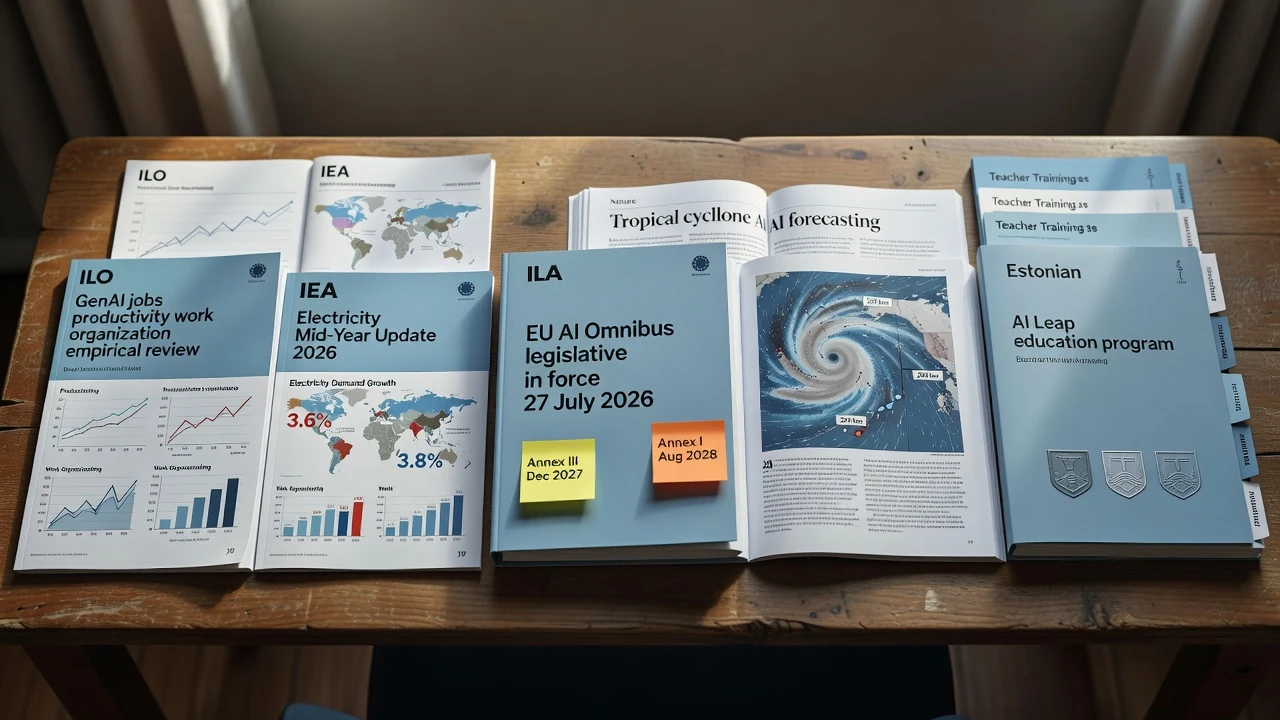
Today’s ledger follows the ILO’s empirical review of GenAI on jobs and productivity, IEA’s Electricity Mid-Year Update on accelerating global demand with data centres among the drivers, the EU AI Omnibus high-risk timeline shift plus a NIST AI data-center security draft, Nature’s WeatherNext Cyclones track-skill gains, and Estonia’s AI Leap expansion into vocational and lower-secondary teaching.
ILO review: GenAI productivity gains are real — large-scale displacement is still limited
What happened. The International Labour Organization published The impact of GenAI on jobs, productivity and work organization: a review of the empirical evidence by Ernst, Samaan, del Rio-Chanona, and Teutloff. The synthesis draws on experiments, firm-level data, platform studies, and representative worker and firm surveys from Australia, Denmark, Germany, Korea, Kuwait, the United Kingdom and the United States. Locked claims: productivity gains are real but often unverified and uneven; large-scale job displacement remains limited; worker-reported time savings of a few per cent of working hours have not yet translated into higher measured output, earnings, or employment. Main risks named: growing inequalities, erosion of opportunities for younger workers, and reshaping of work organization — coordination, worker autonomy, and job quality.
What to watch. The missing measured print is not a mass-layoff line — it is time savings that still have not moved output, earnings, or employment, with youth and job quality named as the risk channels. Keep this literature/survey synthesis separate from Richmond Fed EB 26-27’s U.S. job-finding split, Atlanta Fed WP 2026-4’s executive survey, Brookings Metro’s adaptive-capacity residual, Census CES adoption packages, NY Fed firm-use shares, and any 2026 layoff census.
Read the ILO GenAI empirical review →
IEA Mid-Year Update: global electricity demand +3.6% in 2026 and +3.8% in 2027
What happened. IEA’s news release on the Electricity Mid-Year Update 2026 forecasts global electricity demand growth of 3.6% in 2026 and 3.8% in 2027, up from 3% in 2025. Global consumption is projected at 30,700 terawatt-hours in 2027 versus 28,600 terawatt-hours in 2025. Drivers named together: industry, appliances, cooling, electric vehicles, and data centres. Renewables are on track to become the world’s largest electricity source in 2026, overtaking coal after near-parity in 2025; renewable generation >8% in 2026; share 33% (2025) → 37% (2027). Solar PV output adds about 600 TWh in 2026. Power-sector CO2: about +1% in 2026, then flattening in 2027.
What to watch. The mid-year path accelerates global load with data centres as one named driver among several — a different product from yesterday’s U.S. national sales-record monthly and from decade-ahead data-centre TWh maps. Keep it separate from IEA Electricity 2026 Demand’s U.S. data-centre growth-share card, EIA September STEO’s U.S. record generation monthly, Gartner’s global DC power path, and campus megawatt announcements.
Read the IEA Mid-Year Update news release →
EU AI Omnibus in force: Annex III high-risk duties move to 2 December 2027
What happened. The European Commission’s Digital Strategy page confirms the AI Omnibus entered into force on 27 July 2026 (proposed 19 November 2025). Locked timeline changes: high-risk AI systems in Annex III apply from 2 December 2027; high-risk AI embedded in physical products (Annex I — machinery, toys, lifts, etc.) from 2 August 2028. Other locked items: SME simplifications extended to small mid-cap companies (SMCs); expanded sandboxes plus an EU-level sandbox; simplified AI-literacy duty; a ban on nudification apps; and AI Office extended oversight of certain GPAI systems embedded in large online platforms and search engines. Companion U.S. draft in the same window: NIST CSRC opened comments on draft SP 800-239, AI Data Center Security Analysis, through 25 September 2026.
What to watch. High-risk AI Act duties are not on the Article 50 transparency clock — Omnibus moved the Annex III and product-embedded dates later while adding an EU sandbox track and a nudification ban. Keep this separate from live Article 50 chatbot/mark/deepfake duties, the GPAI Code’s Articles 53/55, UK MHRA staged-authorisation advice, and NIST AI 300-1 documentation comments due 16 September.
Read the Commission AI Omnibus news page →
Nature: WeatherNext Cyclones cuts 5-day track error to 230 km versus ENS at 370 km
What happened. Alet et al. published Operational tropical cyclone forecasting with AI in Nature (DOI 10.1038/s41586-026-10953-2), introducing WeatherNext Cyclones (WN-C), a probabilistic ensemble co-trained on ECMWF atmospheric analysis and IBTrACS cyclone best tracks. At the 5-day horizon in test years 2023–2024, WN-C ensemble-mean track error is 230 km versus ECMWF ENS 370 km (140 km better) and GenCast 335 km (105 km better). ENS exceeds the 230 km error beyond about 3.75 days, so WN-C gives just over 30 h more warning at that accuracy. Historical burden locked on the page (not an AI result): past 50 years, tropical cyclones caused more than 700,000 deaths and US$1.4 trillion in economic losses.
What to watch. AI weather systems are now printing multi-hour to multi-day lead-time gains on cyclone track and intensity — a hazards-benefit print separate from clinical-AI trial scores. Lead-time advantage still has to pass through operational warning systems before it becomes a mortality print.
Read the Nature WeatherNext Cyclones paper →
Estonia’s AI Leap expands: ~18,000 vocational students and up to ~13,000 lower-secondary teachers
What happened. Estonia’s AI Leap program announced expansion for the 2026/27 school year to all upper-secondary grades, lower-secondary teachers, and vocational upper-secondary teachers and students. Reach targets: about 18,000 vocational upper-secondary students and 2,100 teachers, plus support for as many as 13,000 lower-secondary teachers. First-year baseline: 154 upper-secondary schools; about 5,000 teachers and 20,000 students; end-of-year survey: more than 90% of participating teachers used AI at work; 63% redesigned teaching methods; average teacher-estimated time savings about two hours per week. Lower-secondary students will not receive ITI student-app licenses yet; grades 1–4 teachers do not get tool licenses initially while materials are developed.
What to watch. A whole-country classroom AI rollout is now scaling to vocational and lower-secondary teachers while deliberately withholding student app licenses from younger grades until age-appropriate evidence is clearer. Keep this national program expansion separate from UNESCO ICT Prize restamps, HEPI undergraduate packages, and NYC K–8 student AI bans.
Read the AI Leap expansion announcement →
Also in today’s ledger
• NIST SP 800-239 comments close 25 September — AI campus security draft, separate from AI 300-1 documentation comments due 16 September.
• IEA’s global mid-year path is not the same product as EIA’s U.S. sales-record monthly or decade-ahead DC TWh maps.
• Digital Learning Week ends 11 September (day 4) — calendar context only.
|