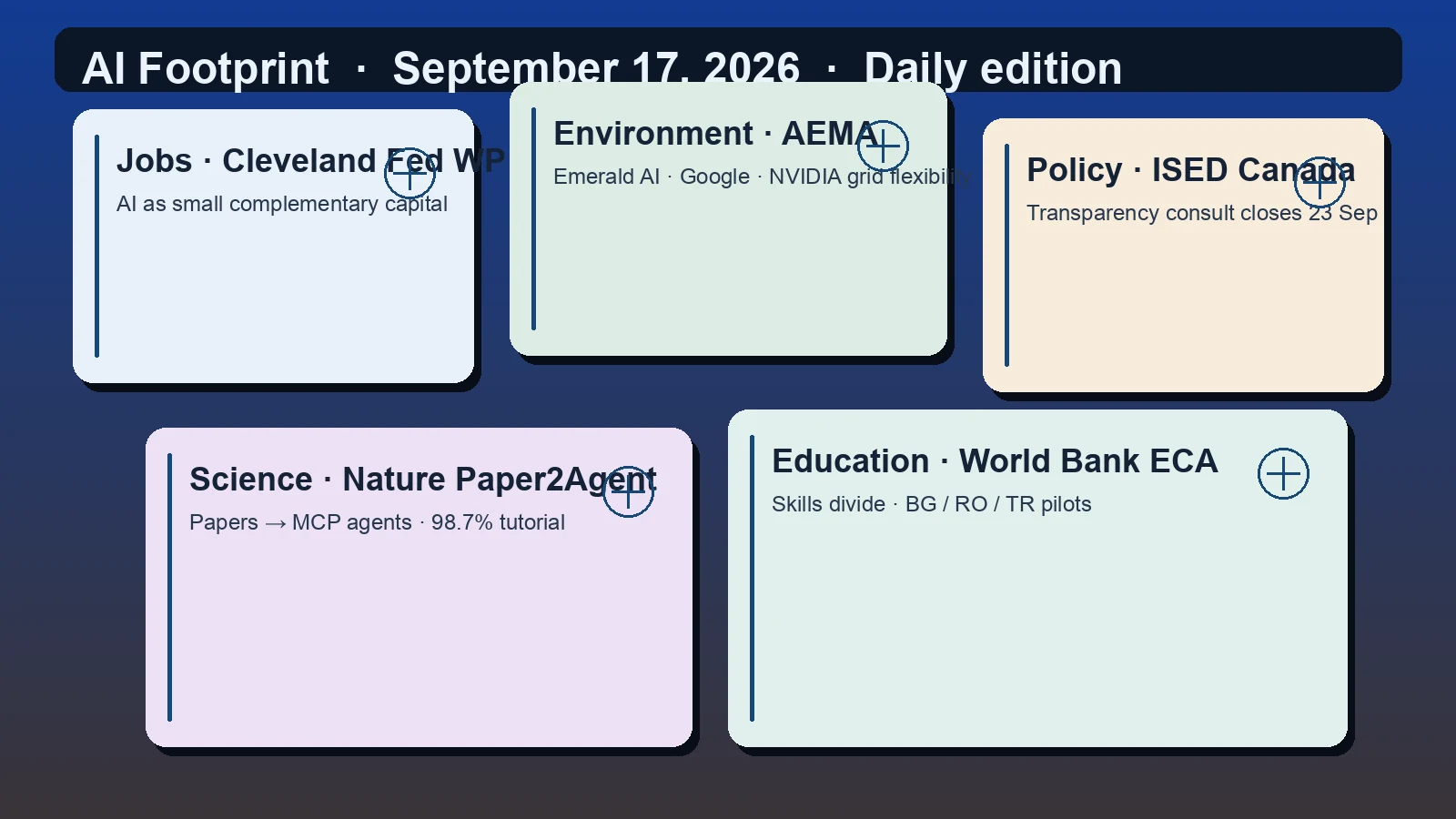
Thursday, September 17, 2026 · Daily edition
Cleveland Fed complementarity, AEMA grid flexibility, and Canada’s transparency clock
Today’s ledger follows a Cleveland Fed model that still treats AI as a small complement to skilled labor and equipment, a new Emerald AI–Google–NVIDIA alliance that wants data centers to flex with the grid, Canada’s AI-transparency consultation with six days left, Nature’s Paper2Agent work that turns research papers into interactive tools, and a World Bank note that Europe and Central Asia’s education bottleneck is skills, not chatbots.
Cleveland Fed: AI still looks like a small complement, not a replacement shock
What happened. The Federal Reserve Bank of Cleveland published working paper 26-22, AI-Augmented Capital-Skill Complementarity, by Luduvice and Pinheiro. The paper treats AI as its own capital input inside a production model, then embeds that structure in a dynamic economy. Brought to the data, AI looks complementary to the high-skill–equipment bundle, and its weight in production is still small. Raising the AI share without cheaper AI capital is contractionary in the model, because AI depends on a scarce complementary input. Cheaper AI capital is expansionary. Taxing AI capital income raises only limited revenue while the stock is small, though it can finance transfers as prices fall. A large consumption-tax-funded UBI slows AI investment, with gains for low-skill workers and losses for high-skill workers and entrepreneurs.
What to watch. This is a model of how AI sits inside production, not a layoff census and not yesterday’s industry-productivity bulletin. The claim worth holding is modest: AI still looks small and complementary to skilled equipment work, and forcing a larger AI share before prices fall can shrink the economy in this frame.
Read Cleveland Fed WP 26-22 →
Emerald AI, Google, and NVIDIA launch AEMA for flexible AI power
What happened. Emerald AI, Google, and NVIDIA announced the AI Energy Management Alliance (AEMA), with a membership home at aema.ai. The coalition’s pitch is that large data centers should manage electricity use with the grid — shifting workloads, discharging storage, using paired generation, or responding in contingencies — so a big customer can act as a controllable resource rather than a fixed load. Stated aims include faster connections, more useful watts from existing infrastructure, lower impact per watt, and interconnection rules written around measurable response speed, duration, predictability, and emergency behavior. The page also calls for pre-connection ride-through and curtailment obligations, shared performance metrics, and cost allocation tied to real system impacts.
What to watch. After a stretch of queue maps and load forecasts, the environment story is whether flexibility becomes a bankable interconnection standard. This is an industry standards launch, not a national TWh path and not a metered campus census.
Read the NVIDIA AEMA announcement →
Open AEMA →
Canada’s AI-transparency consultation closes 23 September
What happened. Innovation, Science and Economic Development Canada is taking comments through 23 September on advancing AI transparency under the national “AI for All” strategy. The five consultation areas are detecting AI-generated content, knowing when you are talking to an AI system, plain-language information about system capabilities and limits, tracking serious AI incidents, and better tracking of AI-agent activity and interactions. Government says it will publish a What We Heard report; submissions are treated as public.
What to watch. With six days left, this is a live design window for a G7 government — especially the agent-activity and serious-incident pieces — not finished law. Standing clocks elsewhere still include NIST AI 200-2 comments due 6 October and FTC personalized-pricing comments due 25 September.
Read the ISED consultation →
Nature’s Paper2Agent turns papers into interactive research agents
What happened. Nature published Paper2Agent, a framework that converts a research paper plus its codebase into a remote tool server, then wraps that server as a paper-specific agent. Tools are checked against reference outputs to cut “code hallucination.” In the AlphaGenome case, about 22 tools all passed automated validation and were built in roughly 45 minutes for about $14 with no human intervention. On tutorial queries, Paper2Agent hit about 99% accuracy versus about 83% for a coding agent pointed at the raw repo. Across 100 computational-biology papers, 74 became agents; 593 of 599 proposed tools passed validation. On 300 tutorial-derived questions, accuracy was about 91% versus about 80% for the repo baseline.
What to watch. The science beat is whether published methods can become reliable interactive tools instead of passive PDFs. This is research infrastructure and reproducibility work — not a hospital protocol and not a patient-outcome trial.
Read the Nature Paper2Agent paper →
World Bank: Europe and Central Asia’s AI education bottleneck is skills
What happened. A World Bank education blog on Europe and Central Asia argues that AI in schools will be shaped less by tool access than by whether systems build the skills to use tools critically. The piece draws on readiness work in Bulgaria, Romania, and Türkiye. Named examples include Türkiye’s EBA Student Assistant and AI Teacher Assistant translation support for more than one million school-age Syrian refugee children; Bulgaria’s Ucha.se platform with more than 27,000 curriculum-aligned lessons and BgGPT, a large model trained entirely on Bulgarian; and Romania’s SARO exam assistant, with homework-completion rates up 28%. Teacher-capacity notes: more than 70% of Bulgarian teachers are aware of AI tools and about half have tried them; Türkiye has trained more than 157,000 educators; Romania has reskilled nearly 83,000 teachers. The authors warn that tools still arrive faster than skills, urban/rural gaps persist, and national exams rarely test the higher-order skills AI use demands.
What to watch. The education beat is capacity under real national pilots — local-language models, teacher training, translation support, and one homework-lift print — not another strategy landing page and not a multi-country learning RCT.
Read the World Bank education brief →
Also in today’s ledger
• Complementarity in a model is not a layoff print.
• A flexibility coalition is not a TWh path — and a transparency consultation is not enacted law.
• Paper agents are not bedside protocols — and country pilots are not a global learning RCT.
|