Tuesday, September 1, 2026 · Daily edition
Census early-career hire squeeze, RAND site power screens, and a null lung-cancer pathway trial
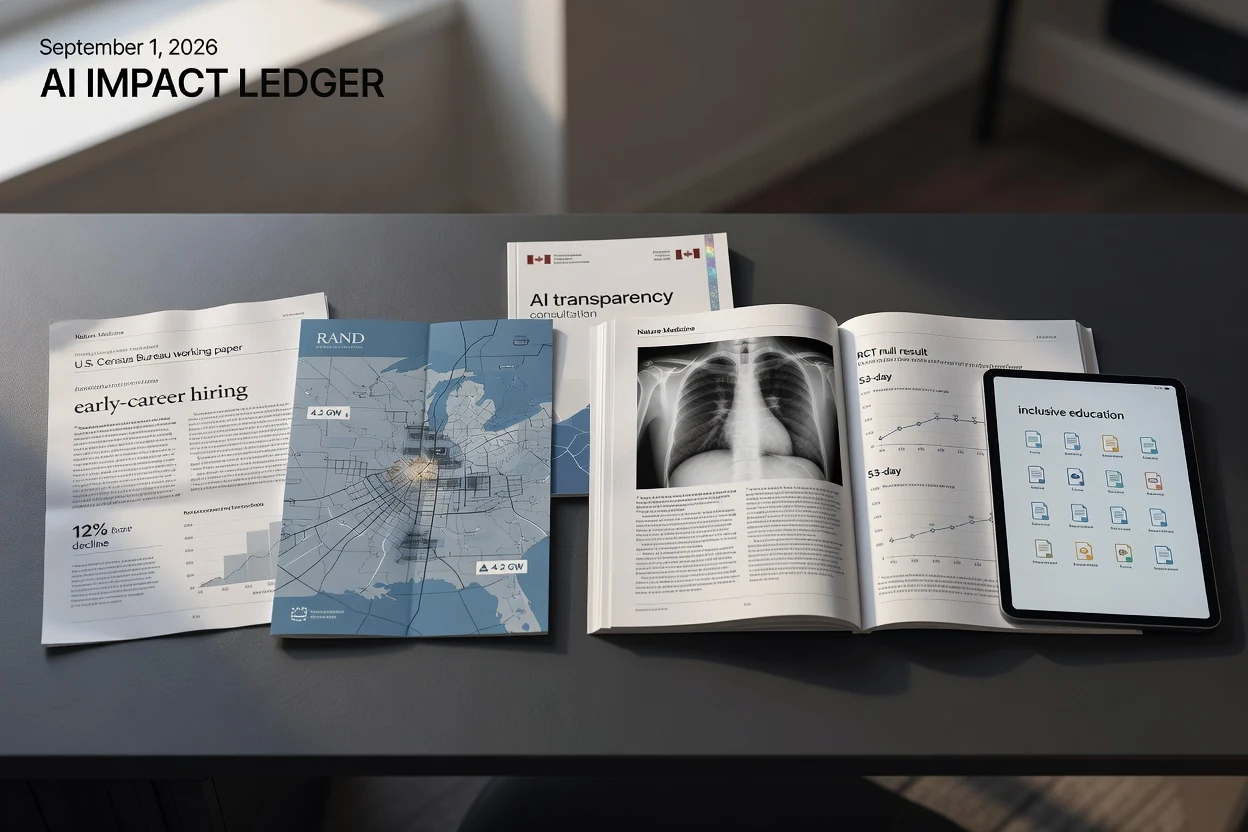
Today’s ledger shifts the instruments again. A U.S. Census Bureau working paper finds early-career employment fell 12% over 10 quarters in the most AI-exposed industry-state cells, with the hire channel as the main path. RAND screens 22 AI data-center sites for deliverable power by 2030 and puts Rockport, Indiana near a 4.2 GW upper bound among retired-plant options. Canada’s federal AI transparency consultation is open through 23 September, with agent activity and serious-incident tracking on the form. Nature Medicine’s LungIMPACT RCT reports a null pathway result for AI chest X-ray prioritization across five NHS trusts, and UNICEF accessible digital textbooks report nearly 2 million students reached on conversion infrastructure rather than exam gains.
Census QWI: early-career employment fell 12% in the most AI-exposed industry-state cells
What happened. U.S. Census Bureau working paper CES-WP-26-27 — Tucker, You’re (not) Hired: Artificial Intelligence and Early Career Hiring in the Quarterly Workforce Indicators (April 2026) — reports an immediate, sizable, persistent drop in early-career (ages 22–24) hires after ChatGPT in the most AI-exposed industry-state cells. Regression-adjusted employment of early-career workers in the most AI-exposed quintile of industry-state cells declined 12% over the 10 quarters after ChatGPT; less-exposed industries remained stable. The hire decline is the primary channel for later employment declines. The hiring rate largely recovered by early 2025 on a smaller employment base. Local projections attribute up to one quarter of the relative early-career employment gap through 2025q2 to monetary-policy shocks — not the rapid hire drop at the most AI-exposed firms versus others. This is Census QWI matched employer-employee evidence from the official abstract — not Stanford Canaries’ ADP occupation shortfall, not Ramp–Revelio firm headcount growth at intensive spenders, not BLS projection categories, and not OECD’s Capability Gap map.
What to watch. The early-career story is a hiring-channel squeeze in exposed industry-state cells, not a universal firm-headcount collapse. Keep instruments versioned: QWI cells are not ADP occupations and not per-employee AI spend. Firm expansion at heavy spenders and early-career hire freezes can coexist in different datasets.
Read the U.S. Census CES-WP-26-27 abstract →
RAND screens AI data-center sites by deliverable power — Rockport tops retired-plant options at ~4.2 GW
What happened. RAND’s research brief Assessing the Energy Potential of Artificial Intelligence Data Center Sites offers a five-part energy-suitability framework and applies it to 22 locations: 17 DOE-identified sites, two major private-sector sites, and three retired or retiring power-plant sites. Existing infrastructure — substations, transmission access, and previously developed industrial sites — is the hinge for power delivery by 2030. No site is ideal on every dimension; trade-offs run across power availability, infrastructure readiness, environmental risk, and governance. Among three retired/retiring plant cases, Rockport Power Plant in Indiana had the highest estimated potential at about 4.2 GW by 2030 — framed as a practical upper bound for grid-connected power at a single U.S. site on that timeline given how hard major new transmission is to build before 2030. This is a site-suitability / deliverable-capacity screen — not Ceres’ seven-state grid-water inventory, not PJM’s long-term peak path, not an IEA TWh demand path, and not EIA STEO near-term load growth.
What to watch. “How many TWh will AI need?” is the wrong only question. “Where can the grid actually deliver gigawatts by 2030?” decides which halls get built on the wire versus onsite generation. A strong power price without a deliverable interconnect is a stranded design.
Read the RAND AI data-center site energy brief →
Canada’s AI transparency consultation is live through 23 September — including agents and serious incidents
What happened. Innovation, Science and Economic Development Canada opened a public consultation on AI transparency on 23 July 2026; it closes 23 September 2026 — 22 days from this edition. Five named design areas: detecting and identifying AI-generated content; knowing when you are interacting with an AI system; consistent information on development, capabilities, and limitations; tracking serious incidents; and tracking activity and interactions of AI agents. The consultation sits inside the federal AI for All strategy launched 4 June 2026. An earlier October 2025 strategy consultation drew more than 11,300 responses plus 32 reports from a 28-member task force. This is a federal transparency-design consultation — not California’s live CAITA latent-mark and detection-tool duties, not live EU Article 50 chatbot/deepfake labelling, and not NIST AI 300-1 documentation templates.
What to watch. While CAITA and Article 50 already run as operative clocks, Ottawa is still taking comment on how transparency should work — including agent activity and incident tracking that many U.S. state media-provenance laws never reach. Comment windows are where those duties get written, or watered down, before anyone can enforce them.
Read the Government of Canada AI transparency consultation notice →
LungIMPACT: AI chest-X-ray prioritization did not speed CT or lung-cancer diagnosis
What happened. The Nature Medicine LungIMPACT RCT tested AI-based chest X-ray prioritization in the lung-cancer diagnostic pathway across five NHS Trusts (CXRs 17 July 2023–31 December 2024; follow-up to 5 June 2025). After cleaning: 93,326 CXRs from 86,945 patients; 45,987 (49.3%) in AI-prioritization sessions. Algorithm: qXR v4.0 (Qure.ai), class IIb CE-certified, 29 finding classes, applied to both arms at acquisition so reporters saw AI-marked images in both arms; intervention days added worklist notification for suspected-abnormal cases. Among 13,347 patients with a valid CT, median time CXR→CT was 53 days in both arms (ratio of geometric means 0.97, 95% CI 0.93–1.02, P=0.31). Among 558 lung-cancer diagnoses, median time to diagnosis was 44 vs 46 days (ratio 0.98, 95% CI 0.83–1.16, P=0.84). Report turnaround shortened 47 h → 34.1 h, still with no significant primary pathway differences. Authors conclude prioritization adds complexity and cost and is not required to accelerate the pathway. This is a null pathway service-delivery RCT — not a foundation-model accuracy win and not a diagnostic-accuracy claim.
What to watch. Faster report queues are not the same as faster cancer pathways. A large multi-trust null result is the honest counterpart to foundation-model accuracy headlines. Procurement should demand pathway endpoints, not only turnaround dashboards.
Read the Nature Medicine LungIMPACT RCT →
UNICEF accessible digital textbooks reached nearly 2 million students — conversion reach, not exam gains
What happened. UNESCO’s SDG4 knowledge hub republishes a UNICEF Accessible Digital Textbooks (ADT) good-practice submission: open-source AI-enabled conversion of curriculum materials into accessible HTML/ePub with text-to-speech, image descriptions, easy-read, and sign-language video. From November 2024 to July 2025, 1,975,329 students used ADTs across six Latin America and Caribbean countries and two South Asia countries; 84,818 teachers were trained; more than 100 textbooks were converted. The UNICEF–OpenAI pipeline is claimed to cut time, human resources, and costs by up to 90% versus traditional production; about USD 3 million was raised for Latin America and the Caribbean, 2021–2025. UNESCO / SDG4 HSC do not endorse the submission. This is accessible-materials reach and production evidence — not UNESCO Digital Learning Week ministers, not AI4IA’s 28 September conference counts, and not a multi-country learning-outcomes RCT.
What to watch. Inclusive conversion at scale is a different education beat from chatbot homework polish or ministerial AI literacy weeks. Reach is not learning gain — and non-endorsed hub republication is not a UN evaluation.
Read the UNESCO SDG4 accessible digital textbooks hub note →
|