Sunday, September 20, 2026 · Daily edition
CAISO’s large-load tariff clock, Philly Fed’s own-job split, and Europe’s AI marking code
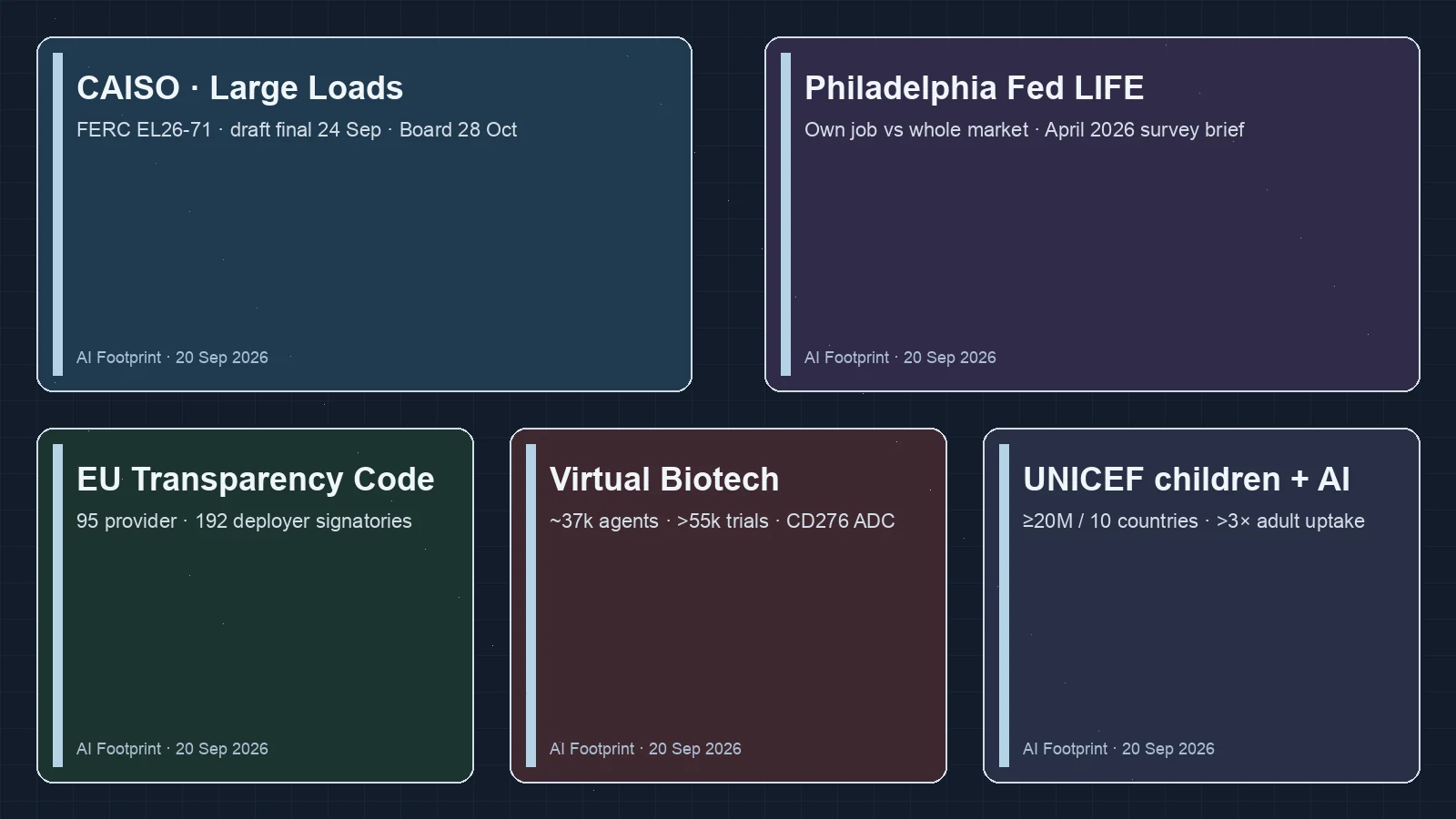
Today’s ledger follows California’s grid operator as it turns a FERC show-cause into tariff language for data centers and other giant loads, a Philadelphia Fed survey where workers shrug at AI damage to their own job while still saying the whole market is changing, Europe’s voluntary code for marking AI-generated content, a multi-agent “Virtual Biotech” system that mined tens of thousands of trials, and UNICEF’s snapshot of children adopting AI more than three times faster than adults.
CAISO’s large-load clock: draft final proposal and draft tariff language due 24 September
What happened. The California Independent System Operator’s Large Loads stakeholder initiative is the West Coast answer to how data centers, advanced manufacturing, and other giant energy users connect to the transmission system. A June 2026 FERC order to show cause (EL26-71) told CAISO and other regional grid operators to test whether existing tariffs, interconnection processes, transmission services, and cost allocation still treat these loads fairly — with aims to keep the system reliable, stop cost shifts onto other customers, and keep impacts transparent. The process is in proposal development and launched 27 February 2026. Near-term calendar on the page: straw-proposal comments were due 2 September; 24 September is the draft final proposal and draft tariff language; a hybrid meeting on the draft final is set for 1 October; comments on the draft final plus draft tariff are due 15 October; a draft-tariff meeting is 19 October; and the Board of Governors meets 28 October 2026. This is a stakeholder tariff-response clock, not a delivered megawatt or terawatt-hour census.
What to watch. After ride-through design, queue audits, and 2025 growth-rate prints, the power story is how one major ISO turns a FERC show-cause into real tariff language — who pays, how big loads interconnect, and what transparency looks like. It is process design, not another long-run electricity path.
Read the CAISO Large Loads initiative →
Philadelphia Fed: workers reject AI damage to their own job — and still say the market is changing
What happened. The Federal Reserve Bank of Philadelphia’s Consumer Finance Institute published Tom Akana’s brief It’s You, Not Me – Survey Data on AI’s Impact on Employees, drawing on the LIFE Survey. Across most demographic groups, employed respondents are very likely to disagree that AI is directly affecting their own jobs or career opportunities — and very likely to agree that AI is affecting the job market as a whole. The page frames mixed effects on employees and on the market. It does not publish a layoff census, vacancy headcount, or a full table of percents in the HTML used here. This is an employee-perception brief from a Reserve Bank consumer-finance survey, not FOMC policy and not a task-cluster wage model.
What to watch. After task-transformation models and household fear surveys, the jobs beat is the own-job versus whole-market split: people can believe the market is changing without believing their own role is already hit. Perception asymmetry is not a pink-slip count.
Read the Philadelphia Fed LIFE brief →
EU transparency code: 95 provider and 192 deployer signatories for marking AI content
What happened. The European Commission reports strong backing for the Code of Practice on Transparency of AI-generated Content — a voluntary instrument drafted by independent experts and judged adequate by the Commission and the AI Board. It helps providers and deployers of generative AI systems mark and label AI-generated content under the AI Act. It complements, and does not replace, the Act or the Commission’s Article 50 guidelines. Section 1 covers providers: machine-readable marking and detection of AI-generated or manipulated audio, image, video, and text. Section 2 covers deployers: labelling deepfakes and AI-generated or manipulated text on matters of public interest, unless human review plus editorial responsibility applies; EU icons are offered as an option. By end of July 2026, about 190 organisations had signed ahead of marking obligations on 2 August 2026; about half of those early signatories were small and recent companies. The live list used for this edition shows 95 Section 1 signatories and 192 Section 2 signatories, including Aleph Alpha, Anthropic, Cohere, Google, Meta, Microsoft, Mistral, OpenAI, and others. Two task forces are set to launch in September 2026 on best practices and implementation feedback. The code remains open for signature.
What to watch. The policy beat is industry uptake of marking and labelling practice while Article 50 duties run. A voluntary code is help beside the law — not a substitute for the legal obligation itself.
Read the Commission news page →
Read the Code of Practice policy page →
Nature on Virtual Biotech: tens of thousands of AI agents mine trials — and propose a lung-cancer ADC still unvalidated in the lab
What happened. Nature news recapped Zou, Zhang, and colleagues’ Science paper on “Virtual Biotech,” a multi-agent system for drug discovery. The system can run as many as about 37,000 agents — with one account of a chief scientific officer assigning 37,075 agents, each tackling a single later-stage trial. Agents analysed published results of more than 55,000 clinical trials. A CSO agent directs “employees” across divisions such as target identification and clinical-trial design; versions of Claude were used as the underlying model in the study, with the claim that other advanced models, including open-source ones, could substitute. From the agents’ search of gene-activity data, drugs targeting proteins active in specific cell types were nearly 50 percent likelier to reach market than other drugs. Directed to investigate CD276 as a lung-cancer target, the system confirmed the candidate on previously collected data and proposed a CD276-recognizing antibody tethered to an anticancer drug — an antibody-drug conjugate. External reviewers, with the authors, called it a promising avenue. The Nature page is explicit that the approach is not vetted in real-world drug discovery: predictions were not validated through experiments, let alone clinical trials.
What to watch. After clinical risk tools and evidence-standard debates, the science beat is agent-swarm literature mining for discovery hypotheses. An in-silico proposal is not a lab result and not a patient trial.
Read the Nature recap →
UNICEF: at least 20 million children across 10 countries have used AI — more than three times faster than adults
What happened. UNICEF’s press release reports analysis from 10 countries estimating that at least 20 million children have used AI, with many outpacing adults by adopting it at rates more than three times faster. More than 2 million children — about 1 in 10 in the sample frame — said they turn to AI for advice on things that worry them. An estimated 13 million said they use it to support learning and homework. Risk is already live: in the 10 countries, a third of children reported concerns about AI used to scam or trick others or spread misinformation; a quarter feared images or videos manipulated into sexually explicit deepfakes. UNICEF frames a generation growing up inside a “global experiment,” and says most AI governance does not prioritise children. The education beat is children’s actual use and protection gaps — not another adult skills campaign.
What to watch. Scale of child uptake is already running ahead of adult norms and of child-centred governance. The stakes are advice, homework, scams, and deepfakes — not registrant headcounts for intro courses.
Read the UNICEF release →
Also in today’s ledger
• A tariff clock is not a terawatt-hour path — and own-job disagreement is not a separations census.
• A voluntary marking code is not Article 50 itself.
• An agent swarm is not a clinical trial — and child uptake is not an adult intro course.
|