
AI in Schools Newsletter: Petition Success, VSB Ignorant of Research
Welcome to the first edition of the PACES Vancouver Newsletter!
If you're receiving this, it means that you were one of the 300 people who signed our petition to the Vancouver School Board.
This monthly newsletter will round up the previous month's local AI and schools information and be the start of a community for like-minded parents and guardians.
In this Issue
- Petition Success and VSB Responses
- VSB Seemingly Ignorant of Research on Effects of AI
- Still No Justification for AI Usage from VSB
- What Next
- Upcoming Events
- Recent Articles
- Book Recommendation
- How You Can Help
Petition Success and VSB Responses
Our petition to the Vancouver School Board hit 300 signatures this week and is still growing! Thank you to everyone who signed and shared it with others.
Thanks to the clear level of interest in the local community, VSB responded to (most) of our questions. Here are their responses:
1. We ask that VSB clarify its plans regarding the use of Generative AI tools in classrooms
From a discussion with VSB District Principal Zhi Su and other statements made by Christina Walker on CBC, we can say with some confidence that:
- Microsoft Copilot 13+ will be made available to all VSB school students that are 13 years or older at some time in the spring.
- The version of Microsoft Copilot 13+ provided by Vancouver School Board will not be usable by children under 13 at school.
- However, that does not mean that students under 13 will not be using AI in classes. Which tools are and aren't used in the classroom is a decision for teachers and schools. Already we have heard reports Many parents have reported children under 13 being given assignments to use generative AI.
This final point is key. VSB sees its role as providing technology to schools, but that schools and teachers are the ones ultimately responsible for using it.
2. We ask that VSB require schools to ask parents/guardians for consent before children use Generative AI in the classroom, and allow parents to opt-out.
VSB Response:
- VSB District Principal Zhi Su made it clear that he saw the issue of consent as not VSB's responsibility, and that consent should be discussed with school administrators and individual teachers.
- Zhi Su: "from our standpoint, we just create the opportunities for our students, the whole system, and then we provide resources for our teachers"
3. We ask that if VSB recommends a class on AI Literacy, that it is not run by a for-profit AI company like Microsoft, SchoolAI, that has a vested interest in AI.
We did not get the chance to ask this question directly yet, but we feel that the answers to previous questions, and VSB's statements in CBC and others are more important to pursue at this time.
VSB Seemingly Ignorant of Research on Effects of AI
There have been two very worrying developments in the last month, with regards to VSB's knowledge of research on the effects of AI on learning.
First, in a CBC interview, VSB's Digital Literacy Mentor Christina Walker was asked "Have you noticed a decline in students when they’re using AI, whether it’s those critical thinking skills, whether their grades are going down? Is there any metric for that?”
She responded:
"I wouldn’t say that there’s a metric. There isn’t really a metric just yet, other than, of course, having conversations and of course, as teachers, we are working in the classrooms, we are seeing what’s happening there."
Christina Walker - Vancouver School Board Digital Literacy Mentor
This is of course completely inaccurate. There are a host of metrics that are used in scientific research to evaluate the effects of AI on learning. A small number of the scientific papers that have been published in the last 2 years are listed on our Why be cautious of AI? page.
Second, in our phone call with VSB District Principal for Learning and Information, we pointed out that there are many research papers online that show the negative effects of AI on student learning.
His response was:
"the interesting thing about research is, if you go looking for it, you'll find it, you know, depending on what you are looking for"
Zhi Su - Vancouver School Board District Principal
It seems that Zhi Su views scientific peer-reviewed research as no different from articles published on the web. When asked for links to research that VSB had used when deciding to put AI in classrooms, he pointed to the University of British Columbia web page on Guidelines for Generative AI. The guidelines are not peer-reviewed scientific research and do not discuss the merits of AI in classrooms.
These two examples seem to show a lack of understanding of the scientific research that is consistently proving that AI at-best has no effect on learning outcomes, or at-worst is a detriment to it.
Still No Justification for AI Usage from VSB
To our knowledge, VSB has still not presented any evidence for why they are putting AI into classrooms. This is something that the BC Ministry of Education and Child Care's guidelines recommend that school boards do.
In the British Columbia Ministry of Education and Child Care's "Considerations for Using AI Tools in K-12 Schools" document, they recommend that school boards check "Evidence-based effectiveness":
Seek AI tools with a proven track record of effectiveness backed by research or case studies demonstrating that they deepen learning for students.
As yet we have not seen any examples of research or case studies that were used by the Vancouver School Board when choosing Microsoft Copilot or AI in general as a tool to put in classrooms.
Unfortunately in the most recent CBC interview, the VSB representative was not asked why AI is being put into classrooms. With the amount of hype surrounding AI in the news, it seems to be (incorrectly) assumed that AI is inevitable.
What Next
VSB comments have made it clear that they are not willing to pull out of any commitments to Microsoft to put Copilot into classrooms. However whether it is used in classrooms is still a choice for teachers and administrators.
For this reason, we are suggesting a shift in focus from VSB to schools and the provincial Ministry of Education and Child Care.
We urge parents and guardians to talk to teachers and administrators about the negative ways that AI affects learning. Make it clear to them that even if Copilot is available in class, you do not consent to your child using it.
The curriculum that is being used by schools is designed by the Ministry of Education and Child Care. If the curriculum requires that students think for themselves and use vetted sources, then Copilot cannot be used in classrooms.
Upcoming Events
AI and Climate Change - A People's Consultation - Saturday, February 28, 2026 - 1:30pm
In October last year, the federal government held a very short "consultation" where it asked how AI affected people's lives. The consultation was criticized by many as being too short and too biased in favour of AI.
A local climate change group, For Our Kids Vancouver, are hosting a session of the People's Consultation on AI, which aims to be a more democratic and thoughtful counter-point to the government's consultation last year.
If you are interested in AI in schools, it will be a great place to meet like-minded people, talk about the ways in which AI affects education, and what we can do about it. We will be attending and hope to see you there!
- Where: Kitsilano Vancouver Public Library
- When: Saturday, February 28, 2026 at 1:30-4:30
Recent Articles
- Students Are Skipping the Hardest Part of Growing Up by Clay Shirky
- Resisting AI Mania in Schools by Anne Lutz Fernandez
- Pedagogy of the Inevitable by José Antonio Bowen
- Learning is complex, messy, emotional: AI can’t replicate that by Caitríona Leahy, Norah Campbell, Clare Kelly
the biggest loss is not the institutional one, it is the loss of learning as a slow, difficult, humbling, rewarding confrontation with the shared limitations and potential of both ourselves and the world we inhabit. It is the loss of what it means to be human.
Learning is complex, messy, emotional: AI can’t replicate that by Caitríona Leahy, Norah Campbell, Clare Kelly
Book Recommendations
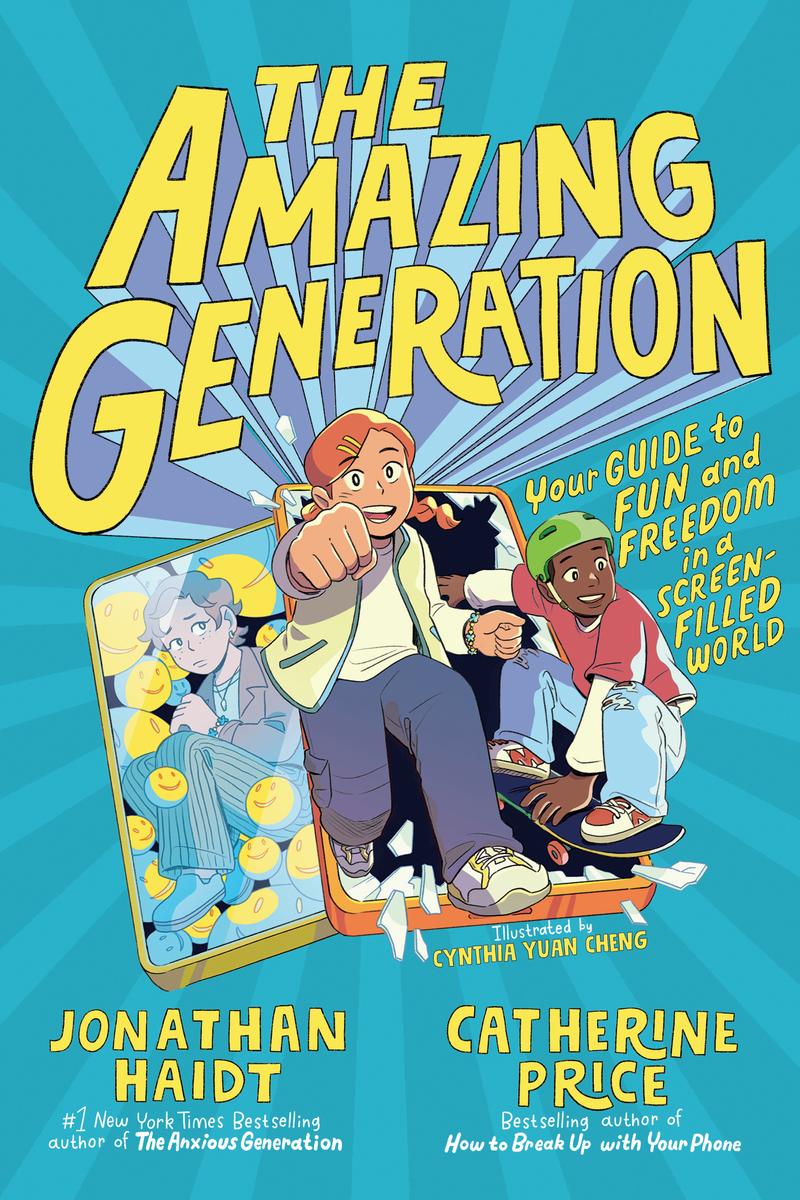
The Amazing Generation, is a mix of fictional comic book and pop-sci insights into the way that tech companies exploit addictive behaviour with apps and smart phones. One of the authors, Jonathan Haidt, previously wrote The Anxious Generation Jonathan Haidt.
While it is aimed 8-16 year olds, everyone can learn from its explanations of how apps are designed to keep people engaged and addicted.
How you can help
- If you are a parent with a child in a VSB school, please send any examples of AI usage being mentioned or assigned as part of school work to [email protected]
- If you have time and would like to volunteer, we need help with creating posters and copy-editing text. You can contact us at [email protected]
- If you are a teacher or educator and would like to talk to us anonymously, you can do so through Signal by messaging @aicaution.42
If you have any feedback on this newsletter, feel free to contact us.
Thanks for reading!


