|
|
ECOSYSTEM
MAJOR
2026-09-28
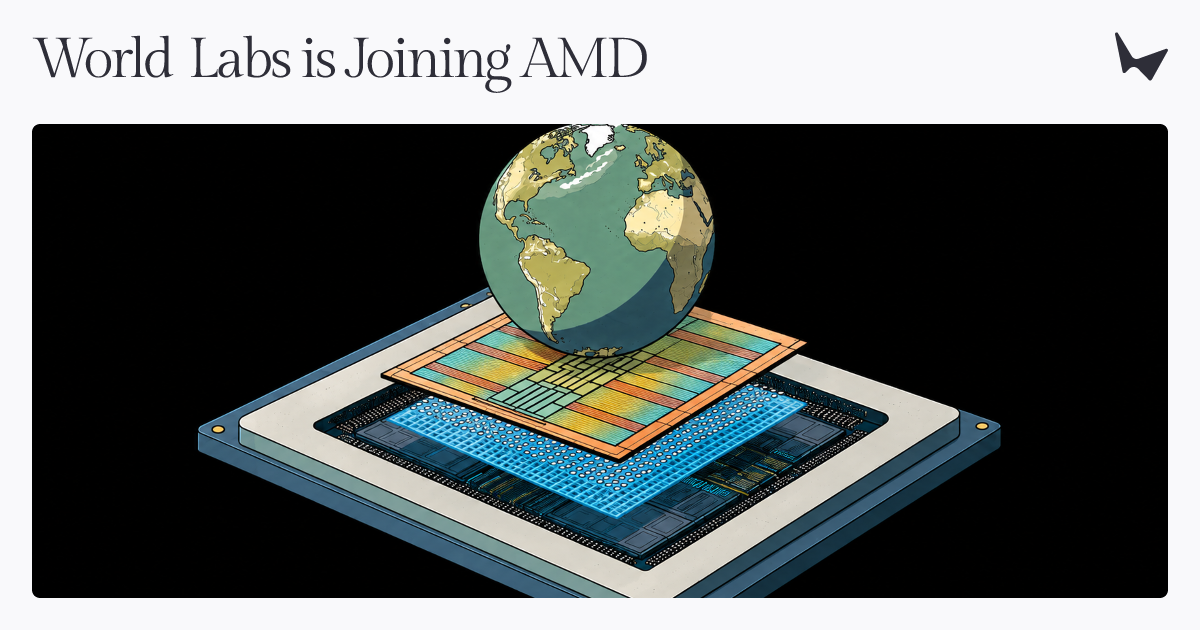
AMD to buy World Labs for $8.2B — Fei-Fei Li becomes AMD's chief scientist
A chipmaker buys a world-model lab so frontier model research shapes its hardware roadmap.
What is it?
AMD signed a definitive agreement on 28 September 2026 to acquire World Labs for about $8.2 billion in stock. World Labs builds spatial-intelligence models that generate and simulate interactive 3D environments; its founder, Fei-Fei Li, joins AMD as executive vice president and chief scientist.
How does it work?
The World Labs team continues model research inside AMD, directly shaping how AMD designs AI chips and systems. The two companies already partnered on training and inference optimisation on AMD GPUs.
Why does it matter?
Chipmakers are now buying model labs, not just selling to them. The deal helps AMD compete with Nvidia's Cosmos world models, and both describe the goal as an end-to-end open AI ecosystem from hardware to open models.
Who is it for?
Developers using world models, robotics and simulation teams watching AMD's hardware and software roadmap.
|
|
|
|
SECURITY
MAJOR
2026-09-28
NVIDIA Open Agent Safety Platform — a hardware watchdog for AI agents
Agent safety rules move off the machine the agent runs on and into a separate chip it cannot reach.
What is it?
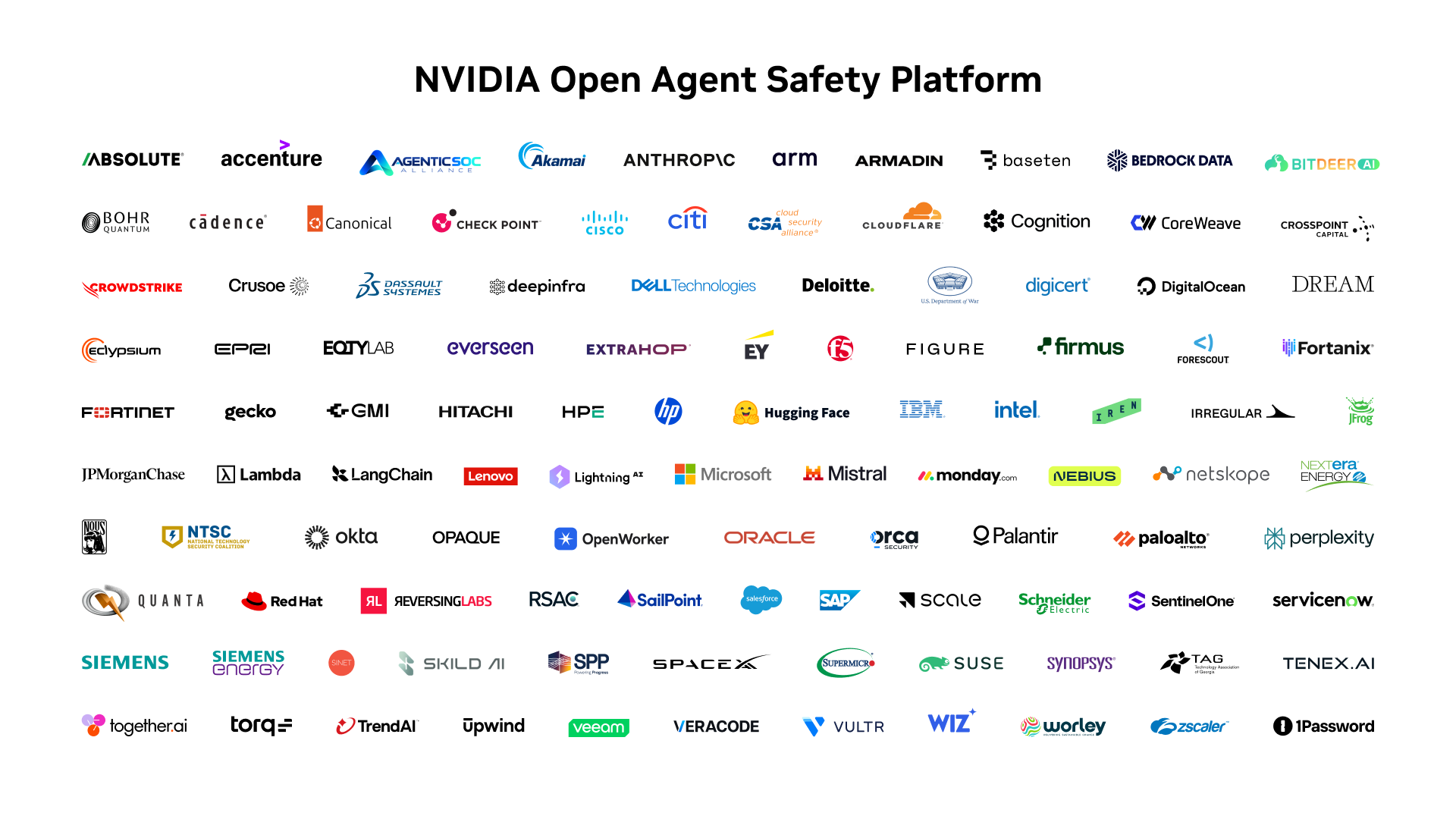
The Open Agent Safety Platform guards autonomous AI agents at two layers: OpenShell (Apache-2.0), an open-source runtime on the host CPU, and NVIDIA Sentry, a watchdog running on a BlueField-4 DPU that is physically separate from the machine the agent runs on.
How does it work?
OpenShell converts operator instructions into per-agent policies covering files, networks, tools and credentials, enforced with kernel-level isolation. Sentry sits on the node's only path to the model and quarantines any agent that breaks its boundary in milliseconds.
Why does it matter?
A software sandbox can be attacked from inside; this design puts the final check on hardware the agent cannot see or reach. More than 100 organizations back the platform — including Anthropic, Microsoft, Cisco and Hugging Face — though TechCrunch notes OpenAI is absent from the list.
Who is it for?
Platform and security teams deploying autonomous agents in production who need enforceable, auditable limits.
|
|

|
|
TOOL
MAJOR
2026-09-28
Manus 2.0 and Cue — agents with their own email, phone and wallet
Manus rebuilds its agent on a new harness and launches Cue, where each agent gets an email, a phone number and a wallet.
What is it?
Manus 2.0 is a rebuilt general-purpose AI agent running on the new Cascade harness, launched alongside Cue — a standalone app where each personal agent gets its own email address, phone number and wallet so it can message, pay within a set budget and take calls.
How does it work?
Cascade starts each project light and adds specialised capabilities only when a task needs them. In Manus's own tests it used 23.2% fewer tokens, finished tasks 28.2% faster and cost 32% less than the previous system.
Why does it matter?
Giving an agent a real identity lets it deal with people and services directly instead of only operating inside a chat window. For existing Manus users, the Cascade results also mean meaningfully cheaper and faster runs.
Who is it for?
People who hand everyday tasks and business workflows to AI agents and want an agent that can act independently in the world.
|
|

|
|
TOOL
MAJOR
2026-09-28
Claude Code 2.1.284 — Sonnet 5.5 becomes the default Sonnet with 1M context
The terminal agent switches to Anthropic's new Sonnet on the day it ships and starts showing costs in dollars.
What is it?
Claude Code 2.1.284 makes Claude Sonnet 5.5 the default Sonnet model with a 1M-token context window, and shows spending in US dollars in /usage and the status line — for example "$271.40 / $500.00 spent this month".
How does it work?
A new /mcp reconnect all command retries every failed MCP server at once; damaged response streams are retried instead of shown as raw errors; telemetry can now be exported to Google Cloud over OTLP.
Why does it matter?
Sonnet users get the newer, cheaper model ($2/$10 per 1M input/output tokens) without changing any setting. Dollar amounts in the status line also make plan limits far easier to read than raw token counts.
Who is it for?
Claude Code users on any plan, and team admins managing monthly spend limits.
|
|

|
|
MODEL
MAJOR
2026-09-28
Jeff — Jev-compatible 0.8B decision models trained on one home GPU
Three tiny open models that pick between options you describe in plain words, in about 22 milliseconds.
What is it?
Jeff is a family of three zero-shot decision models — a 0.8B and 2B Qwen3.5 fine-tune plus a Gemma 4 E2B variant — that accept the same request format as TypeSafe's Jev and return a calibrated probability per option. Weights are Apache 2.0; the project is independent of TypeSafe.
How does it work?
One forward pass reads a trained answer over option letters; a single fitted temperature calibrates the output probabilities. Training ran on one RTX PRO 6000 GPU — the 0.8B in about 2 hours — and the models run on NVIDIA, CPU, or Apple Silicon via MLX.
Why does it matter?
Routing and intent calls can run locally in 22–60 ms instead of costing a full API call each time. The 2B scores 83.1% across five benchmarks — matching Jev's published 83.0% — and a task-specific fine-tune takes under half an hour on one GPU.
Who is it for?
Backend and agent engineers who need fast, local, zero-shot classification without sending every decision to an API.
|
|

|
|
TOOL
NOTABLE
2026-09-29
Codex CLI 0.159.0 — steer the agent mid-response with instant interrupt
Codex CLI's new release lets you redirect the agent without waiting for it to finish.
What is it?
Codex CLI 0.159.0 adds an opt-in instant_interrupt setting that lets new input steer the agent while the model is still answering or running a long code-mode call. New sessions also open on a compact welcome screen with consistent headers and occasional tips.
How does it work?
The Mermaid renderer now handles more flowchart edges, labels and node groups. On safety, .aws directories are protected by default under writable roots. Windows users lose the stray console windows that MCP servers and piped commands used to open.
Why does it matter?
Stopping an agent heading the wrong way normally means waiting for the turn to finish or cancelling it entirely; steering mid-response saves both time and tokens. The release also removes automatic follow-up prompt suggestions.
Who is it for?
Developers using the Codex agent in the terminal, especially those running long code-mode tasks where course-correction mid-run matters.
|
|

|
|
ARTICLE
NOTABLE
2026-09-28
Cal Newport — it's time for Congress to investigate the AI labs
Cal Newport says lawmakers should stop letting a few AI companies set the terms of the AI debate.
What is it?
In 'It's Time to Investigate the AI Labs', Cal Newport argues that OpenAI and Anthropic have exhibited erratic behavior — from claims about agent power to public employee debates about extinction odds — and calls on Congress to open a public fact-finding mission.
How does it work?
Newport proposes three specific lines of inquiry: isolate the systems actually causing concern, examine internal safety procedures, and scrutinize how 'apocalyptic futurist ideologies' shape decisions at the frontier labs.
Why does it matter?
Newport criticizes Dario Amodei's 'We Must Pace the Frontier' letter and Sam Altman's endorsement of it, and argues the public should stop letting a small number of private companies control how society feels about AI. The essay reached 449 points on Hacker News.
Who is it for?
Anyone following AI safety, AI policy, and the growing debate over how frontier labs govern themselves.
|
|
|
All releases at ai-tldr.dev
Simple explanations • No jargon • Updated daily
|
|