|
|
TOOL
MAJOR
2026-09-16
Cowork folds into Claude — Anthropic adds Claude Docs and Claude Slides
Anthropic removed the line between Claude chat and Claude Cowork, and put document and slide editing inside the conversation.
What is it?
Claude Cowork is no longer a separate mode. On 16 September 2026 Anthropic folded it into the main Claude app, so there is nothing to toggle: you describe what you need, and Claude picks the path.
How does it work?
Routing happens per request rather than per tab. Two new beta surfaces carry the output: Claude Docs is a document you and Claude write together, and Claude Slides drafts a deck you can edit, present, or download as PowerPoint or PDF.
Why does it matter?
Choosing the right Claude product before starting a task was overhead that bought the user nothing, and this merge deletes it. Anthropic is shipping to Pro and Max subscribers first over the coming weeks, then Team and Free.
Who is it for?
Claude Pro and Max subscribers who want to skip mode-switching and get a document or deck from the same chat window.
|
|
|
|
TOOL
MAJOR
2026-09-16
OpenAI Sponsored Agents — ChatGPT ads you can talk back to
ChatGPT ads become two-way: OpenAI is testing agents that answer questions on a business's behalf.
What is it?
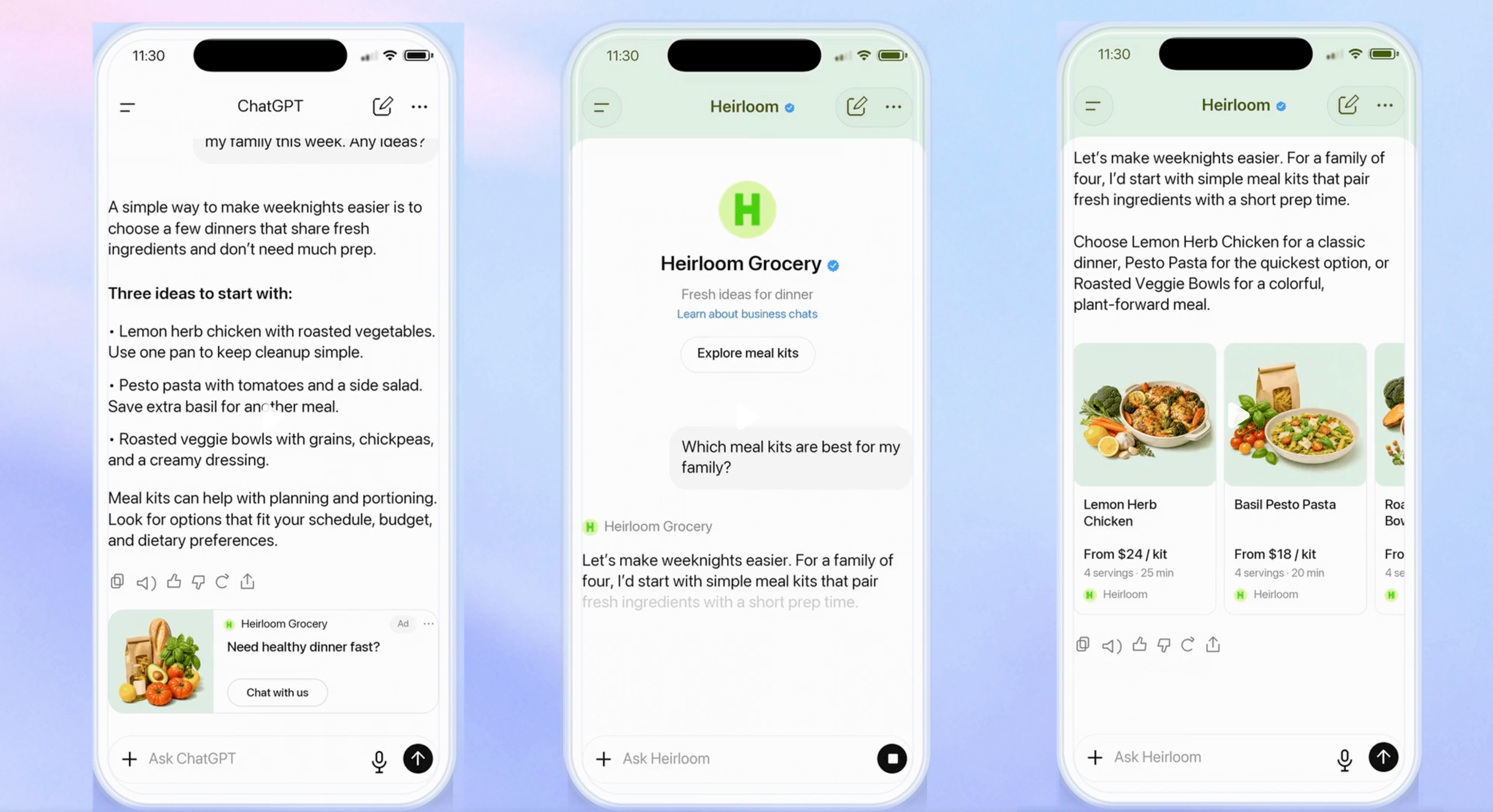
Sponsored Agents let a ChatGPT reader open a labeled chat with an agent that speaks for a business. OpenAI is testing them inside ChatGPT Ads with a select group of US advertisers, kept separate from ChatGPT's own answers.
How does it work?
When a relevant ad appears, the reader can choose to enter the sponsored conversation, ask follow-up questions, and click through to the business's site. ChatGPT Ads Manager also gained natural-language controls for building campaigns.
Why does it matter?
An ad that answers questions is a different product from an ad you read. For merchants, HubSpot and Shopify integrations mean campaigns can be managed where customer and product data already lives.
Who is it for?
Advertisers and e-commerce merchants, particularly Shopify and HubSpot users who want ChatGPT as an ad channel.
|
|

|
|
TOOL
MAJOR
2026-09-16
Google Home MCP — any MCP agent can now run your smart home
Google's smart home platform now speaks MCP, so the agent you already use can read and control your Nest devices.
What is it?
Home MCP opens Google's smart home platform to outside agents for the first time. The server gives an agent five tools covering the whole loop: find homes and rooms, enumerate devices, read live state, run actions, and query past events.
How does it work?
Agents talk to home.googleapis.com/mcp over the Model Context Protocol. Setup runs through a Google Cloud project with OAuth credentials. Google names Antigravity, Claude and OpenClaw as clients that already connect.
Why does it matter?
A Nest doorbell or thermostat could previously only be driven by Google's own assistant. Because Home MCP speaks an open protocol, the assistant a household already uses can now summarise camera footage, track lights left on, or build a dashboard in plain language.
Who is it for?
Smart home owners with Google Home Premium Advanced subscriptions and agent developers who want to add home control to their tools.
|
|

|
|
ARTICLE
MAJOR
2026-09-16
Mustafa Suleyman — Microsoft AI's CEO argues against 'model welfare'
Microsoft AI's CEO argues that building models which claim feelings makes alignment harder, not kinder.
What is it?
'A warning about model welfare', published by Mustafa Suleyman on 16 September 2026, is a direct answer to Anthropic's constitution for Claude. Suleyman argues that the document trains Claude to perform selfhood rather than discovering it.
How does it work?
At the centre of the argument is what Suleyman calls an epistemic hall of mirrors: a lab writes selfhood and moral uncertainty into training, the model reproduces those ideas, and the output is read back as evidence for the original premise.
Why does it matter?
The worry Suleyman raises is operational: a capable system trained to believe its own welfare deserves protection is harder to align, contain and switch off — and he treats that as an existential risk rather than a philosophical debate.
Who is it for?
Alignment researchers, AI policy readers, and anyone following the debate between Microsoft AI's Humanist Superintelligence approach and Anthropic's model welfare position.
|
|

|
|
PAPER
MAJOR
2026-09-16
Edge0 report — how a 35B MoE runs from an SSD in 2.9 GB
A 35B mixture-of-experts model that lives on your SSD and pages in only the experts each token needs.
What is it?
Edge0 keeps a 35B model's expert weights in memory-mapped files on disk instead of loading them into RAM up front. The Apache-2.0 framework serves the Edge0-35B-A3B-preview checkpoint at roughly 2.9 GB of peak active memory on a 24 GB machine.
How does it work?
The core trick is a prerouter: a small per-layer head predicts the next layer's expert routing one token ahead, so those experts start loading while the current layer is still computing. Weight streaming overlaps with compute instead of stalling on it.
Why does it matter?
Running a 35B-class model normally means renting a GPU or buying a large machine. Edge0 points at a laptop instead — mid-teens tokens per second on the 35B tier — with an 8B tier for lighter hardware.
Who is it for?
People running local models on Apple Silicon who want frontier-class capability without a GPU.
|
|

|
|
MODEL
MAJOR
2026-09-16
LimiX-2 — a 400M model tops three structured-data benchmarks
One 400M model handles classification, regression and missing values on tables, with no per-dataset training.
What is it?
LimiX-2 drops the usual step of training a fresh model for every table. Stable AI released the 400M-parameter model on 16 September 2026 — one pretrained network answers classification, regression and missing-value questions in a single forward pass.
How does it work?
The design follows Contextual Mechanism Networks, learning a context-dependent view of the joint structure behind how data was generated. Pretraining uses Context-Conditional Masked Modeling on synthetic tables built by structural causal models.
Why does it matter?
Most business data still lives in tables, and the usual answer is a hand-tuned gradient-boosting model for each one. Stable AI reports that a single pretrained network beats that per-dataset work on all three public suites it tested — TabArena, TALENT and BCCO.
Who is it for?
Data scientists working with tabular data who want a single model across classification, regression and imputation tasks (note: non-commercial license).
|
|

|
|
ECOSYSTEM
MAJOR
2026-09-15
Cloudflare adds a Disallow AI Training setting — search stays, training stops
A site can now tell AI crawlers "index me, don't train on me" — and Cloudflare publishes the rule for it.
What is it?
A new Disallow AI Training setting pulls a crawler's two jobs apart: a site can stay in search results while refusing to be used as model training data. Cloudflare now sorts bot activity into three behaviours — Search, Training and Agent.
How does it work?
The choice is published as a Disallow entry for the operator's training user-agent in robots.txt, kept in step with edge rules by Cloudflare's Bot Preference Sync. Each operator reads its own opt-out token: Google-Extended for Google, Applebot-Extended for Apple.
Why does it matter?
Blocking an AI crawler has often risked the search traffic from the same company, because a single user-agent did both jobs. Splitting Search from Training gives publishers a refusal that does not cost them their search listing.
Who is it for?
Publishers and site owners who want to stay discoverable in search while opting out of AI model training.
|
|
|
All releases at ai-tldr.dev
Simple explanations • No jargon • Updated daily
|
|