|
|
MODEL
MAJOR
2026-09-04
MAI-Image-2.6 — Microsoft's image model lands at No. 2 on Arena
Microsoft's newest image model ranks second on Arena and ships with a faster, cheaper Flash variant.
What is it?
MAI-Image-2.6 adds multi-image reference editing, web grounding and dynamic aspect ratios, reaching up to 1.5K resolution. A Flash variant, MAI-Image-2.6-Flash, targets latency-sensitive production workloads at less than half the price.
How does it work?
Web grounding pulls current web context into generated images; multi-image reference lets you keep style and subject consistent across outputs. Flash is the same family tuned for 2.8× faster throughput than GPT-Image-2-Medium.
Why does it matter?
Arena and Artificial Analysis both rank the model second for text-to-image, with a +79 Elo gain over MAI-Image-2.5 overall and +91 Elo on text rendering — still the weak spot for most image models.
Who is it for?
Design and marketing teams, image API developers.
|
|

|
|
TOOL
MAJOR
2026-09-05
SGLang v0.5.19 — beam search arrives, plus 786 merged pull requests
SGLang's September release adds beam search, nine more models, and an AMD attention kernel that fills idle compute units.
What is it?
Beam search is the headline in SGLang v0.5.19 — pass beam_width in a request and get the n best sequences back instead of one sample. The release carries 786 pull requests from 214 contributors.
How does it work?
The unified radix tree becomes the mandatory prefix cache, and a new Lean attention kernel on AMD fills idle compute units during long decode batches. Layer normalization is split per tensor-parallel rank to cut prefill work.
Why does it matter?
On MI355X, disaggregated GLM-5.2 decode drops from 23 ms to 8 ms per output token. Hopper teams gain ~12% output throughput on DeepSeek-V4-Flash through FP8 activation quantization.
Who is it for?
Inference and platform teams.
|
|

|
|
BENCHMARK
MAJOR
2026-09-04
GPT-6 Astra on robot arms — 95% on a block task, Claude Fable 5.1 got 40%
An independent benchmark put three frontier models in charge of the same robot arms and counted what they actually picked up.
What is it?
Robocurve ran GPT-6 Astra, Claude Fable 5.1 and Claude Fable 5 over 20 trials each on two robot-arm tasks, counting what they actually picked up. Astra finished 19 of 20 block-in-bowl runs; Fable 5.1 managed 8.
How does it work?
Each turn the model sees three camera views plus arm state, replies with absolute end-effector poses, and the arm moves. Both Astra and Fable 5.1 finished only 2 of 20 on the harder puzzle task requiring sub-millimetre precision.
Why does it matter?
Astra was faster ($0.94/run vs $2.12) and more accurate on the easy task, but the precision task shows every general-purpose model still misses nine times out of ten — a long way from dependable manipulation.
Who is it for?
Robotics engineers and evaluation researchers.
|
|

|
|
TOOL
MAJOR
2026-09-04
llama.cpp v0.4.0 — Qwen3.8-Flash-Next support and lazy tensor loading
The local LLM runtime picks up two new model architectures and learns to read weights from disk on demand.
What is it?
A new --lazy-mode flag in llama.cpp v0.4.0 reads model weights from disk only when needed, skipping the full upfront load. Four new architectures ship alongside it: Qwen3.8-Flash-Next, Nemotron-3-Puzzle-75B-A9B, DSpark, and nanbeige4.2-3B.
How does it work?
Beneath the flag, ggml 0.23.0 adds sparse flash attention for DeepSeek-V4 and the new qwen4exp architecture, Apple RDMA as an RPC transport, and a RAM-capped quantizer that streams rows in slabs.
Why does it matter?
Capping peak memory during load and quantization lowers the hardware bar for large models, and Qwen3.8-Flash-Next support means the open 125B mixture-of-experts model can now run locally soon after its release.
Who is it for?
Local LLM users and inference engineers.
|
|

|
|
TOOL
MAJOR
2026-09-03
LangChain 1.4.0 — a built-in MCP adapter for agent tools
LangChain agents can reach Model Context Protocol servers through a first-party adapter.
What is it?
The new langchain.mcp namespace in LangChain 1.4.0 ships an MCPAdapter class that connects an agent to any Model Context Protocol server and returns its tools as ordinary LangChain tools. The namespace ships in beta.
How does it work?
Point MCPAdapter at an HTTP URL, file path, transport object or in-process FastMCP instance and it infers the right connection type. await adapter.list_tools() returns discovered tools ready to pass to create_agent.
Why does it matter?
Connecting an MCP server to a Python agent now takes a few lines of first-party code rather than custom glue — a team's existing MCP servers can plug straight into a LangChain agent.
Who is it for?
Python developers building LLM agents.
|
|
|
|
TUTORIAL
NOTABLE
2026-09-05
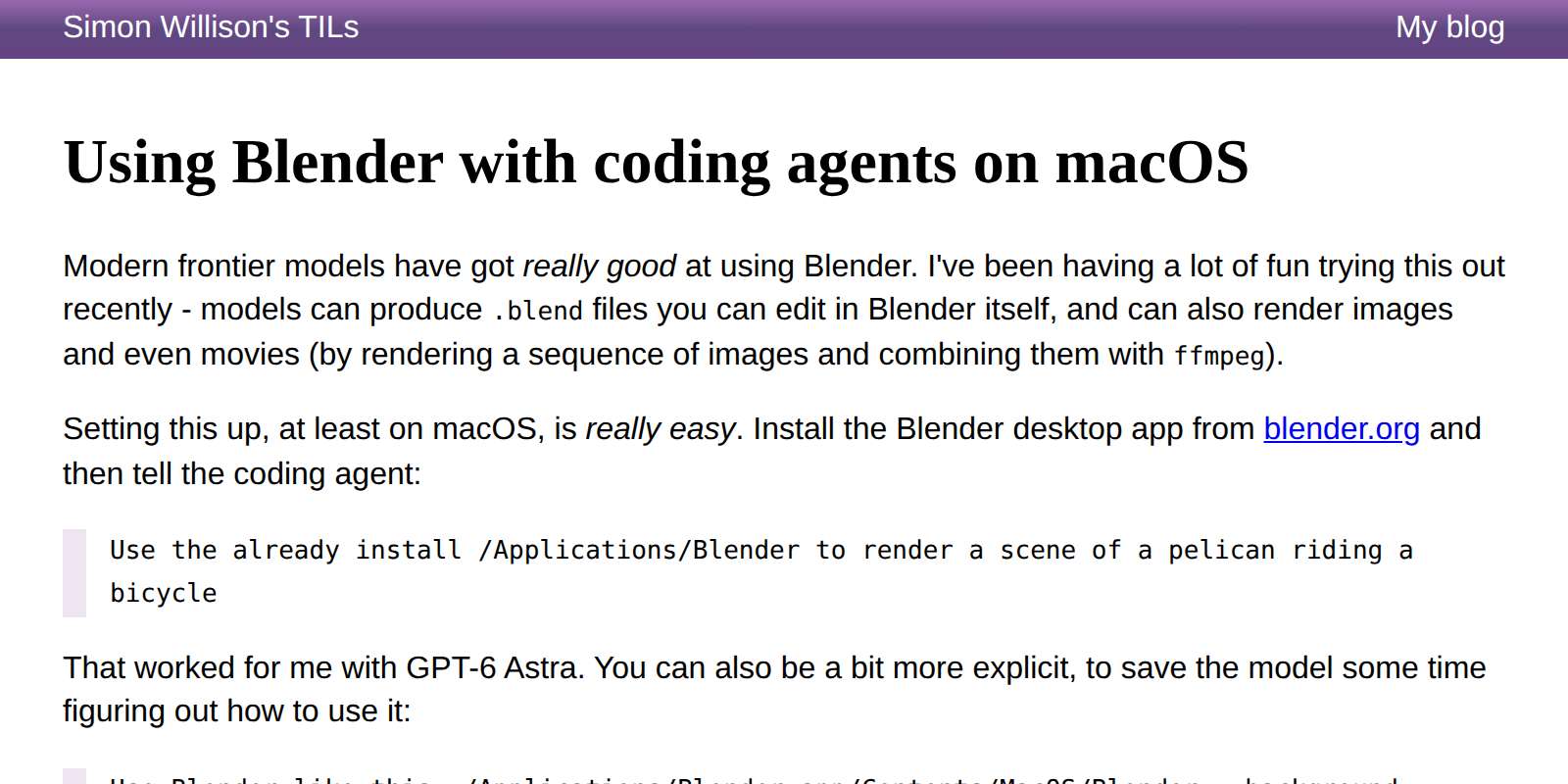
Simon Willison — driving Blender from a coding agent on macOS
Install Blender, tell a coding agent where it lives, and it writes the Python that builds and renders the scene.
What is it?
Simon Willison lets a GPT-6 Astra coding agent control a local Blender install on macOS with a single instruction: build a scene of a pelican riding a bicycle. Three rounds evolved the render from plain to a sunset coastal scene with flowers and a sailboat.
How does it work?
Each round the agent writes a Python scene file, runs Blender headless with --background --python, inspects the render output, then revises. Movies come from rendering a frame sequence and joining it with ffmpeg.
Why does it matter?
The workflow ends with a reusable Markdown "Blender Local" skill, so future prompts skip rediscovering the commands. The scene scripts, .blend outputs and full agent transcript are all in a public GitHub repo.
Who is it for?
Developers experimenting with agent-driven 3D.
|
|

|
|
VIDEO
NOTABLE
2026-09-05
Wes Roth — 'OpenAI just crossed a THRESHOLD' on 12.5 hours of Astra
Wes Roth spends an episode leaving GPT-6 Astra agents running for hours at a time and says the model now feels like AGI to him.
What is it?
Wes Roth puts GPT-6 Astra on a single 12.5-hour 3D world project through Blender and Unreal Engine, then has it play RimWorld, order groceries and edit video — with what he calls an entire AI team running overnight across several computers.
How does it work?
The asset pipeline starts in GPT Image, moves concept art into Blender, and finishes in Unreal Engine. Roth runs agents overnight, resumes after usage quotas reset, and converts each run's lessons into reusable skills.
Why does it matter?
Long unattended runs reveal where a computer-use model holds up over hours rather than minutes — the part of agent capability that short benchmarks can't capture. Roth's "feels like AGI" is his personal read from hands-on use, not a measured result.
Who is it for?
Developers running long agent sessions.
|
|
|
All releases at ai-tldr.dev
Simple explanations • No jargon • Updated daily
|
|