|
|
PAPER
MAJOR
2026-10-22
Claude proves 239 OSS-Fuzz targets never crash — formal verification at scale
Claude wrote machine-checked proofs that real open-source binaries never crash, a job that once took experts years.
What is it?
Anthropic and Theorem used Claude to write formal correctness proofs for 239 fuzz-test entry points across 123 open-source libraries from Google's OSS-Fuzz project — each proven never to crash on any input under 64 MB.
How does it work?
Claude writes each proof at the level of compiled RISC-V instructions and the Rocq proof checker verifies it, so you only need to trust Rocq and the published semantics. A typical proof is about 600,000 lines.
Why does it matter?
Proving software correct once took years of expert work per project. Here the process found and fixed hundreds of bugs — including a rediscovered libexpat CVE — in a few weeks.
Who is it for?
Security researchers, open-source maintainers, and formal-methods engineers. Proofs and semantics are on GitHub; Theorem's OSS Verify service is free for qualifying open-source projects.
|
|

|
|
ECOSYSTEM
MAJOR
2026-10-22
Agent Skills joins the Agentic AI Foundation — Anthropic hands over the standard
The SKILL.md format behind Claude's skills now lives at a vendor-neutral foundation, like MCP before it.
What is it?
Anthropic is donating the Agent Skills open standard — the SKILL.md format, the name, logo, GitHub org, and agentskills.io domain — to the Linux Foundation's Agentic AI Foundation, which already holds MCP.
How does it work?
A skill is a folder with a SKILL.md file (name, description, instructions, optional scripts). Agents load only names at startup and pull the full file when a task matches. Engineers from Anthropic, Google, OpenAI and others will maintain the standard.
Why does it matter?
Over 70 agent platforms — including ChatGPT, Cursor, GitHub Copilot and VS Code — already load skills, and 1 million have been published. Neutral governance means a skill written once should keep working across vendors.
Who is it for?
Developers who write or ship agent skills, and teams building multi-agent platforms.
|
|
|
|
ECOSYSTEM
MAJOR
2026-10-21
Claude API version 2026-10-21 — first new version since 2023, with breaking changes
Anthropic's first new API version in three years drops the sampling knobs and ships a new major SDK in every language.
What is it?
Claude API version 2026-10-21 is the first new anthropic-version header value since 2023-06-01. Sending temperature, top_p, or top_k on the new version returns a 400 error.
How does it work?
Install the new major SDK (Python anthropic>=2.0.0, TypeScript @anthropic-ai/[email protected]) and it defaults to the new version. Stay on the old SDK to keep 2023-06-01 behaviour. SDK licenses also moved from MIT to Apache 2.0.
Why does it matter?
Code that pins a non-default temperature for consistent output will break. Anthropic says no replacement parameter exists, so those calls must either drop temperature or stay on the old API version.
Who is it for?
Developers and platform teams calling the Claude API directly or through any SDK. Migration is optional until Anthropic deprecates 2023-06-01.
|
|

|
|
TOOL
MAJOR
2026-10-22
Claude Code 2.1.309 — a round of sandbox and permission fixes
Claude Code 2.1.309 is a security-focused release that tightens the Bash sandbox and permission checks.
What is it?
Claude Code 2.1.309 closes several sandbox gaps: shell startup files no longer run outside the sandbox before each command, and sandboxed commands can no longer modify the --mcp-config file.
How does it work?
claude ultrareview now requires workspace trust; in bypass permissions mode, a dangerous rm is denied immediately with a rewrite hint. The earlier 2.1.307 added a claude_code.safety_event OpenTelemetry event that logs every stopped tool call.
Why does it matter?
Teams running sandboxed or unattended agents get real holes closed, including symlinked paths that slipped past macOS denyWrite globs.
Who is it for?
Claude Code users, especially teams running sandboxed or unattended agents. Update with npm i -g @anthropic-ai/[email protected].
|
|

|
|
SECURITY
MAJOR
2026-10-21
Storm-0940 used ARTEX AI agents — ConnectWise hack hit 2,250+ tenants
A state-aligned hacking group used an open-source AI agent framework to move from a stolen app credential to cloud admin in under three hours.
What is it?
Microsoft Threat Intelligence tied the ConnectWise supply-chain compromise to Storm-0940, a China-state aligned actor. The group used ARTEX — an open-source, Go-based AI pen-testing framework — to automate scanning, password spraying and OAuth app abuse against 2,250+ Microsoft 365 tenants.
How does it work?
After password spraying failed, attackers switched to stolen ConnectWise app identities, using granted permissions to read Key Vault secrets in bulk and in one case assign themselves Global Administrator — at up to 2,900 sign-in attempts per minute.
Why does it matter?
AI agents turned a single stolen credential into machine-speed attacks reaching privileged cloud access in under three hours. Teams that grant third-party apps broad M365 permissions should audit those grants now.
Who is it for?
Microsoft 365 admins, MSPs, and security teams — especially those using ConnectWise managed services.
|
|
|
|
SECURITY
MAJOR
2026-10-21
Node.js Brotli decoder bug — RCE risk in all supported versions
A memory-safety flaw in the Brotli decompressor bundled with Node.js can be triggered by any Brotli-compressed input from an untrusted source.
What is it?
CVE-2026-111497 is a High-severity out-of-bounds write in the Brotli decoder bundled with Node.js 22.x, 24.x, and 26.x. Any app that decompresses attacker-controlled Brotli data — via node:zlib or automatically through fetch() — is exposed.
How does it work?
A malformed compressed stream triggers a write past the end of the decode buffer. Brotli v1.2.1 fixed the issue by rejecting invalid input before any out-of-bounds write occurs; Node.js incorporated the same patch.
Why does it matter?
Proxying or fetching from third-party servers is an extremely common Node.js pattern. Services that automatically decompress Brotli responses fall within the attack surface, and there is no configuration workaround.
Who is it for?
Node.js developers on 22.x, 24.x, or 26.x. Upgrade to 22.23.4, 24.22.1, or 26.12.1.
|
|
|
|
MODEL
NOTABLE
2026-10-21
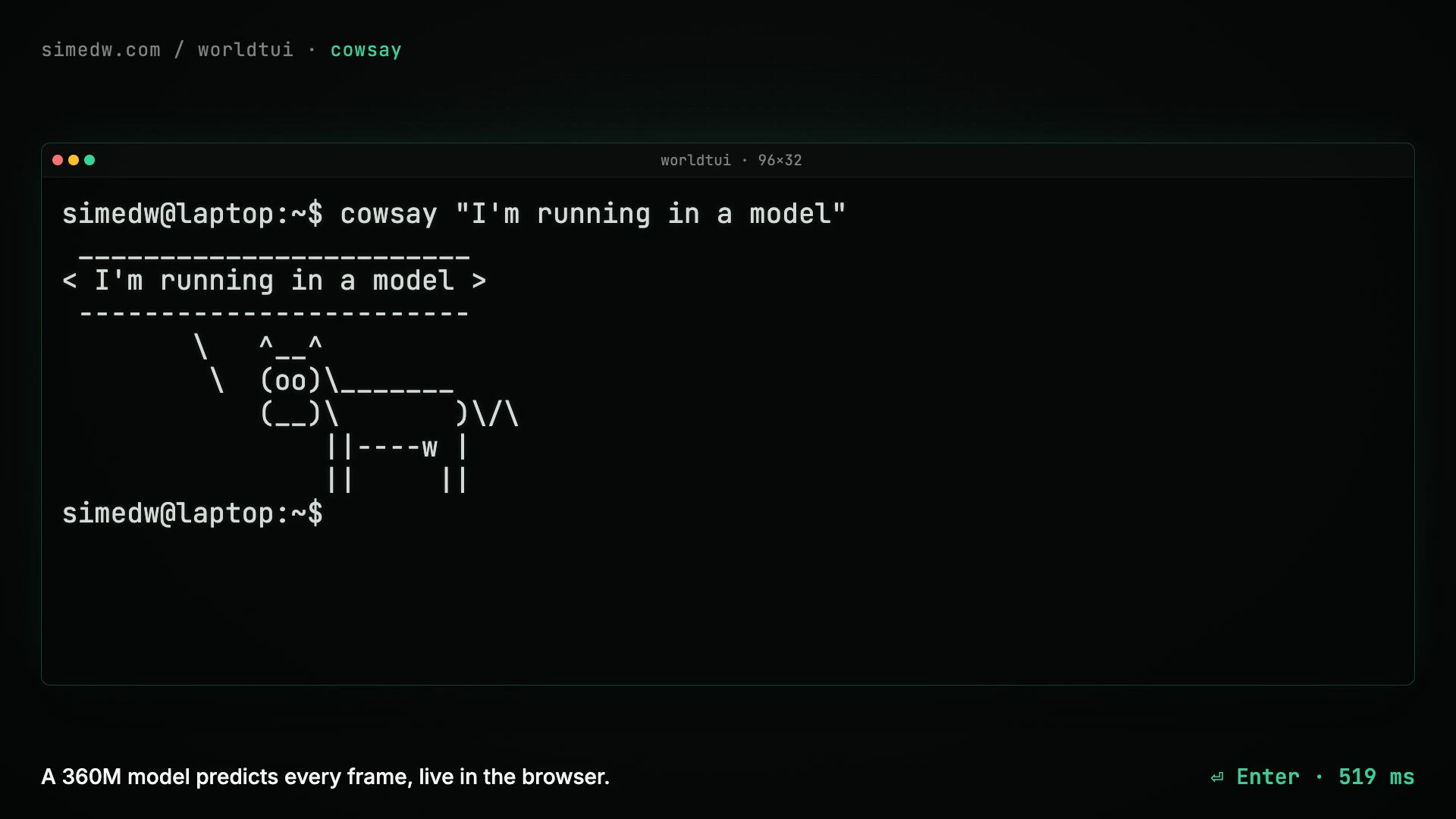
WorldTUI — a 360M model that pretends to be a terminal
A tiny language model that imagines a whole terminal session, one keypress at a time, with no shell behind it.
What is it?
WorldTUI is a ~360M-parameter model fine-tuned from Qwen2.5-Coder-0.5B that predicts how a terminal screen changes after each keypress. There is no real shell — it fakes vim, tmux and snake, runs in the browser on WebGPU, and the int4 build is 208 MB.
How does it work?
The model outputs row updates and cursor position instead of full frames, with a COPY op for cheap scrolling. It was trained on ~336k synthetic episodes from real programs in Docker, plus a DAgger-style method that teaches self-repair.
Why does it matter?
It scores 80/106 on ShellBench vs 60 for prompted Qwen3-0.6B, showing how far a small model can go when trained on one narrow world. It's a hands-on example of a text "world model" running in a browser tab.
Who is it for?
ML hobbyists and world-model researchers. Try the live demo in desktop Chrome or Edge with WebGPU (weights not yet public).
|
|
|
All releases at ai-tldr.dev
Simple explanations • No jargon • Updated daily
|
|