
|
|
SECURITY
MAJOR
2026-11-12
Daybreak Red Team and Defense Factory — OpenAI's agents test and patch apps
OpenAI's Daybreak platform adds an agent pen-tester for web apps and an agent pipeline that fixes code flaws.
What is it?
Two new OpenAI security products announced on November 12, 2026. Red Team, in early access, tests web applications for vulnerabilities, and Defense Factory finds, validates and fixes flaws across an organization's codebases.
How does it work?
Red Team's agents use an app's source code and context to test attack paths and retest patches. Defense Factory's agents, built on OpenAI's cyber models including GPT-6 Cyber, write the patches and open a merge-ready pull request with a test.
Why does it matter?
Security teams drown in scanner alerts that may or may not be real. These products aim to confirm which issues are exploitable and prepare tested fixes, while a human still approves every change.
Who is it for?
Application security and vulnerability management teams.
|
|

|
|
TOOL
MAJOR
2026-11-12
Self-hosted Claude Managed Agents — run the whole agent service in-house
Claude Managed Agents can now run entirely inside a company's own network, with the model provider of its choice.
What is it?
The whole Managed Agents service — API, agent loop and storage for agents and sessions — can move onto a customer's own cloud account or data center. Until now only the tool sandboxes could be self-hosted. It's in private beta via an Anthropic account team.
How does it work?
A server, a PostgreSQL 16+ database and sandbox workers run in your environment, with the same API as the hosted service. Model calls go to the Claude API by default, or to Amazon Bedrock, Google Cloud, Microsoft Foundry or your own gateway.
Why does it matter?
Teams running unattended agents on internal systems often can't let session history or credentials leave their environment. They no longer have to build the platform themselves, though they take on securing the server and installing each release.
Who is it for?
Enterprise platform and security teams running agents on internal systems.
|
|

|
|
TOOL
MAJOR
2026-11-12
Claude Meetings — Claude joins video calls as a participant
Claude sits in your video call, answers questions and builds docs and whiteboards while you talk.
What is it?
Claude Meetings lets Claude join a Google Meet call as a visible participant. Teammates ask it questions aloud or in chat, and when the call ends it leaves notes and action items.
How does it work?
Claude follows the conversation, answers in writing by default and builds docs and whiteboards live. Each meeting gets its own page in claude.ai, and Claude asks before using someone's connected tools.
Why does it matter?
Teams get notes and a first draft of the work without a separate note-taking bot. Admins stay in control: outside guests are off by default and Claude leaves if an outsider joins.
Who is it for?
Team and Enterprise admins and teams (beta).
|
|

|
|
MODEL
MAJOR
2026-11-12
Edge0-145B — an open 145B MoE model that runs on one consumer GPU
Edge0 open-sources a 145B coding and agent model that fits a single consumer GPU.
What is it?
Edge0-145B is a 145-billion-parameter open-weight model built to run on one computer instead of a data center. It launched on 12 November 2026 alongside a smaller Edge0-120B and an app for running it.
How does it work?
It's a Mixture-of-Experts model: only 10 routed experts plus 1 shared expert work on each token, so about 10B parameters are active. Experts can sit on the GPU, in system RAM or be swapped in as needed.
Why does it matter?
Edge0's own tests put it ahead of Qwen3.8-Flash-Next and DeepSeek-V4-Flash on Terminal-Bench 2.1 (86.5) at 29 GB measured peak memory. These are the maker's numbers, not independent results.
Who is it for?
Developers who want a strong coding model running locally.
|
|
|
|
ECOSYSTEM
NOTABLE
2026-11-12
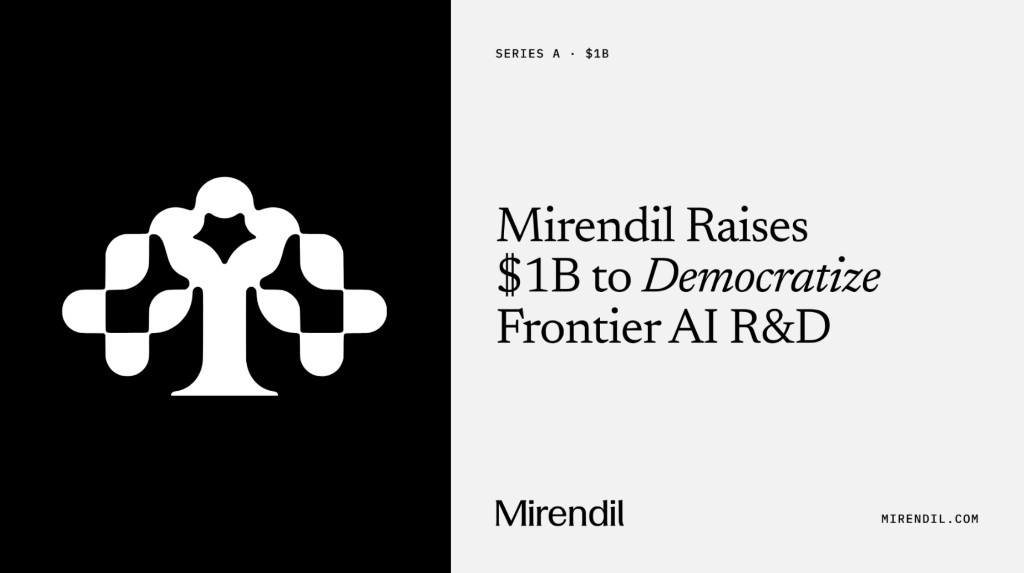
Mirendil raises $1B Series A — ex-Anthropic lab building AI R&D agents
Mirendil raises $1B to put frontier AI research tools within reach of more scientists and engineers.
What is it?
Mirendil announced a $1B Series A on 12 November 2026, led by Kleiner Perkins and Clearlake Capital. The lab was started by former Anthropic researchers and raised a $200M seed earlier this year.
How does it work?
Its Lor environment, now in private beta, runs hundreds of agents that write code and run experiments for days at a time. The company says one researcher with agents pretrained its Mirendil-Base coding model in 3.5 months on under $10M of compute.
Why does it matter?
A $1B round for AI that does AI research is a big bet that model development can move from large labs to small teams. If Lor leaves private beta, it would be one of the first commercial agent environments built for running ML experiments end to end.
Who is it for?
ML researchers and teams following AI-for-AI-research tools.
|
|

|
|
TOOL
NOTABLE
2026-11-13
OpenCode 2.3.0 — subagents run in the background by default
OpenCode 2.3.0 makes subagents non-blocking and trims the transcript down to a quiet activity row.
What is it?
Background subagents are now the default: a subagent call returns at once, runs on its own and reports back when idle. You can start several in parallel without leaving the parent session.
How does it work?
The TUI now defaults to low verbosity and folds tool calls and thoughts into one collapsible activity row. Experimental flags add MCP events and background handling of timed-out shell commands.
Why does it matter?
Long agent sessions get easier to follow and to parallelise. Plugin and SDK authors gain MCP event subscriptions and cooperative cancellation through ToolContext.signal.
Who is it for?
Developers using or extending OpenCode.
|
|
|
|
TOOL
NOTABLE
2026-11-12
Brave Search API — AI agents can now pay per request with x402
Brave Search API lets an AI agent pay for each search with a stablecoin, with no account or API key.
What is it?
Brave Search API now supports the x402 protocol, so developers and agents can query Brave's index and pay per request without a plan, account or key. The signed payment replaces the API key as the credential.
How does it work?
An unpaid request returns HTTP 402 with the price. The agent signs a USDC payment on Base and retries, and Brave verifies it, runs the search and returns a receipt.
Why does it matter?
An agent can buy search on its own with a funded wallet, at $0.005 per request. Nobody has to sign up, store a key or pick a monthly plan first.
Who is it for?
Agent builders who want keyless, pay-as-you-go web search.
|
|
|
All releases at ai-tldr.dev
Simple explanations • No jargon • Updated daily
|
|