|
|
TOOL
MAJOR
2026-05-29
OpenAI Launches Rosalind Biodefense
OpenAI hands its biology-tuned reasoning model GPT-Rosalind to vetted biodefense teams and governments, free of charge, for pandemic-prep work.
What is it?
Rosalind Biodefense is a new OpenAI program giving sponsored, vetted access to GPT-Rosalind — the company's life-sciences reasoning model — for biodefense, pandemic preparedness, and public-health workflows. Launch partners include Lawrence Livermore National Laboratory, Johns Hopkins APL, CEPI, Fourth Eon, and SecureDNA.
How does it work?
GPT-Rosalind reasons over molecules, proteins, genes, pathways, and disease biology. Qualified teams apply for a Trusted Access channel; OpenAI sponsors API use and provides launch support for biosurveillance, diagnostics, DNA screening, and vaccine development workflows.
Why does it matter?
It's the first time OpenAI has fenced off a frontier domain-specific model behind a vetted public-health channel instead of selling it commercially or open-sourcing it — a test of whether "GPT-but-for-biology" compresses outbreak-to-countermeasure timelines in practice.
Who is it for?
Biodefense developers, government public-health teams, vaccine and diagnostics researchers, and biosurveillance programs.
|
|

|
|
MODEL
MAJOR
2026-05-29
Stepfun Releases Step 3.7 Flash
198B-parameter vision-language MoE tuned for high-frequency agentic workloads — Apache 2.0, 256K context, and three reasoning levels you can dial up or down.
What is it?
Step 3.7 Flash is Stepfun's new open-weights multimodal model — a sparse 198B MoE combining a 196B language backbone with a 1.8B vision encoder, activating ~11B parameters per token for production throughput.
How does it work?
Three selectable reasoning levels (low / medium / high) plus an Advisor Mode that picks the cheapest level capable of solving the task. Visual search, GUI operation, and tool calls share one compositional pipeline, lifting SWE-Bench Pro to 56.3% at up to 400 tok/s on 256K context.
Why does it matter?
Open-weights vision-language MoEs that hit 50%+ on SWE-Bench Pro are still rare, and Apache 2.0 weights with 256K context let teams run agentic coding and multimodal workflows on their own infrastructure.
Who is it for?
Agent builders deploying multimodal pipelines on their own GPUs, especially cost-sensitive teams needing a Flash-tier answer to GPT-5.5 or Claude Opus 4.x.
|
|

|
|
TOOL
MAJOR
2026-05-27
Robinhood Opens Brokerage to AI Agents
Robinhood plugs a 27M-customer brokerage into the agent stack via MCP — your bot can trade equities and swipe a Gold Card on its own.
What is it?
Two new products: Agentic Trading lets a customer-chosen AI agent place equity orders in a dedicated Robinhood account, and the Agentic Credit Card gives that agent a virtual Gold Card with a user-set monthly spending cap — both powered by new MCP servers for trading and banking.
How does it work?
Agents connect through Robinhood's MCP trading server with read access to the portfolio and write access to place orders; every trade fires a push notification, and users can revoke agent access at any time. The Agentic Credit Card is scoped so the agent can never touch the customer's primary card.
Why does it matter?
This is the first major US broker to publish an MCP server for autonomous agent trading and the first to ship a credit card built explicitly for AI agents — American Banker called it a "wake-up call" for retail banks.
Who is it for?
Devs building autonomous portfolio agents, fintech founders, retail-broker product teams, and MCP server authors.
|
|

|
|
MODEL
MAJOR
2026-05-28
Qwen Ships Qwen-VLA
Qwen's vision-language stack now talks to robots end-to-end — one checkpoint covers manipulation, navigation, and trajectory prediction across embodiments.
What is it?
Qwen-VLA extends the Qwen3.5-4B vision-language backbone with a 1.15B DiT flow-matching action decoder, so a single checkpoint produces continuous robot actions rather than only text — covering manipulation, navigation, and trajectory prediction across different robot embodiments.
How does it work?
A vision-language transformer encodes camera frames, language instructions, and embodiment-aware prompt tokens; a diffusion transformer (DiT) decoder trained with flow matching then samples continuous action tokens. Joint pretraining mixes robotics manipulation, human egocentric demos, simulation data, and vision-and-language navigation.
Why does it matter?
Qwen-VLA's single checkpoint matches or beats task-specific specialists on LIBERO (97.9%), Simpler-WidowX (73.7%), RoboTwin Easy/Hard (86.1/87.2%), and real-world ALOHA OOD (76.9%), giving robotics teams an open-source generalist starting point.
Who is it for?
Robotics and embodied-AI researchers needing a generalist VLA that handles diverse tasks and hardware without task-specific fine-tuning from scratch.
|
|
|
|
TOOL
MAJOR
2026-05-28
Kog Ships Inference Engine Tech Preview
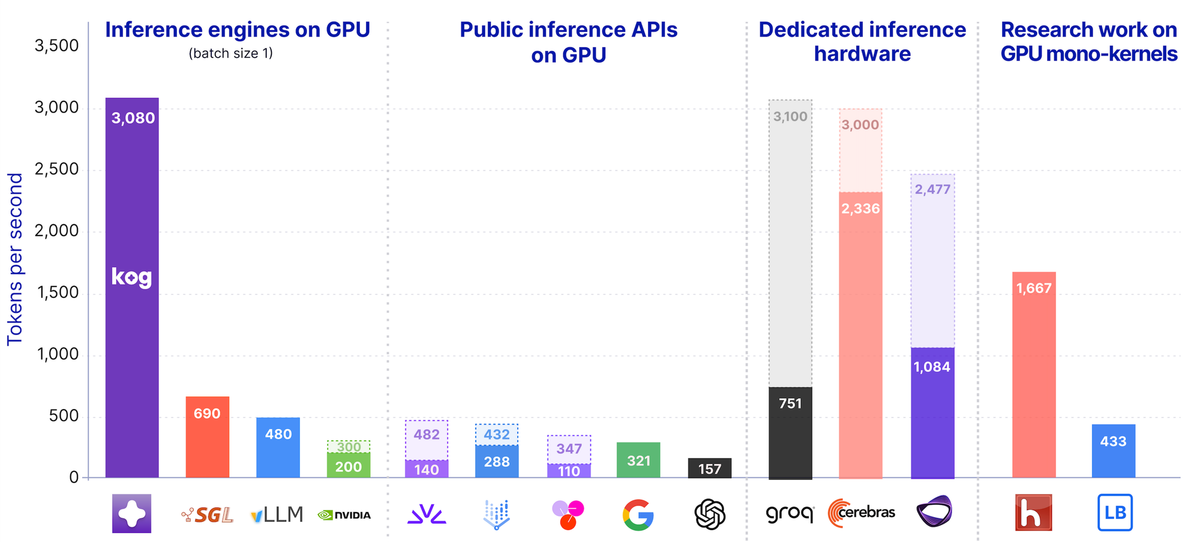
A Paris startup squeezes 3,000 tokens/s out of a single inference request on standard datacenter GPUs — no speculative decoding required.
What is it?
Kog Inference Engine (KIE) is a from-scratch C++/CUDA LLM inference engine focused on single-request decode latency rather than aggregate batch throughput, hitting 3,000 tok/s per request on 8× AMD MI300X and 2,100 tok/s on 8× NVIDIA H200 with a live playground.
How does it work?
Decode runs as a single persistent GPU program (monokernel) to eliminate per-token kernel launch overhead. A custom KCCL collective library cuts inter-GPU sync to under 3 microseconds, while the Laneformer architecture's Delayed Tensor Parallelism overlaps cross-GPU communication with computation.
Why does it matter?
Agentic, voice, and gaming workloads depend on single-stream token speed where batched engines like vLLM leave bandwidth on the table. Kog claims ~3.5× faster generation than vLLM on identical AMD hardware, compressing long reasoning chains into product-grade latency.
Who is it for?
Infra engineers running agents, voice AI, and gaming workloads on MI300X or H200 who need minimum latency on a single request stream.
|
|
|
|
MODEL
MAJOR
2026-05-28
Liquid AI Ships LFM2.5-8B-A1B
8B-total / 1B-active mixture-of-experts trained on 38 trillion tokens, tuned for on-device agentic work with explicit chain-of-thought.
What is it?
LFM2.5-8B-A1B is Liquid AI's new on-device assistant model — a hybrid MoE that activates only 1B parameters per token for phone and laptop speed, pretrained on the same 38T-token scale as much larger frontier models with a 128K context window.
How does it work?
MoE routing pairs with grouped-query attention and a gated short-convolution path from the LFM2 family. Context jumps from 32K to 128K, vocabulary doubles to 128K tokens (boosting tokenization efficiency 120%+ for Hindi, Thai, and Arabic), and RL post-training enables tool-call chaining with explicit chain-of-thought.
Why does it matter?
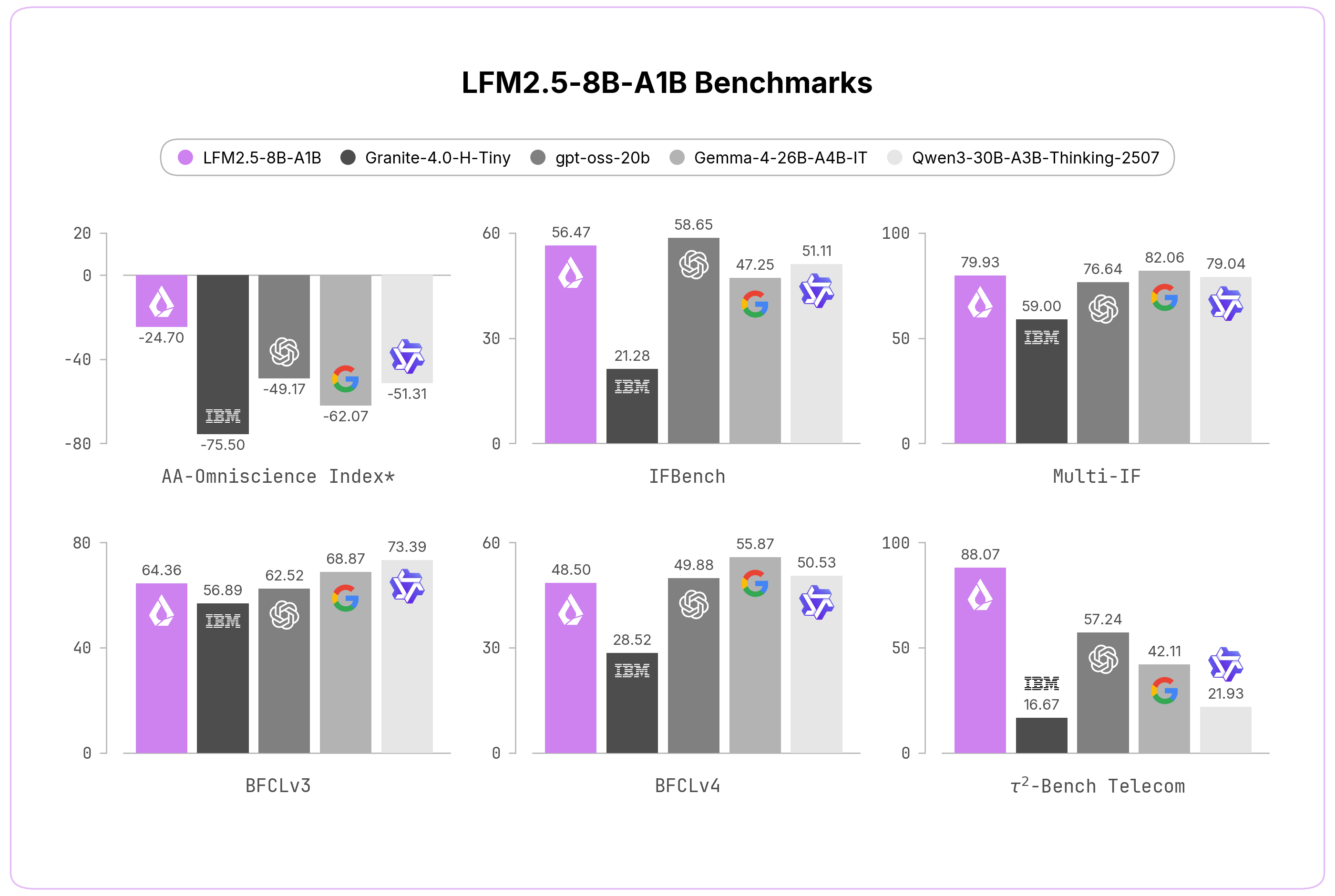
IFEval (91.84), MATH500 (88.76), and Tau² Telecom (88.07) scores put LFM2.5-8B-A1B in range of much larger dense models while keeping latency consumer-friendly — making it usable inside apps that can't ship cloud inference.
Who is it for?
Edge and mobile app developers who need frontier-class reasoning quality without cloud inference costs or latency.
|
|

|
|
SHOWCASE
MAJOR
2026-05-28
Microagi's Shift Lands in New York
Microagi's new Shift app cleans your NYC apartment for free if you let a camera-clad operator film the whole job as robot training data.
What is it?
Shift is a New York-only home cleaning service from German robotics-data startup Microagi. Customers pay nothing; in return, camera-equipped cleaners record their first-person view of a two-hour appointment, with footage sold as training data to AI labs building household robots.
How does it work?
Operators wear chest-mounted camera rigs during normal cleaning routines; on-device ML blurs faces and PII before the anonymized clips are licensed to AI labs. Microagi already runs comparable data-collection programs and has paid 10,000+ operators over $5M in Q1 FY26 across 15 countries.
Why does it matter?
Shift turns the consumer relationship inside out — instead of paying contractors for data, it gives away a household service and harvests the training-data byproduct. If the model survives privacy scrutiny, it points to a future where free physical services are subsidized by their AI-training exhaust.
Who is it for?
Robotics teams, embodied-AI researchers, privacy watchers, and NYC residents who want a free clean in exchange for footage.
|
|
|
All releases at ai-tldr.dev
Simple explanations • No jargon • Updated daily
|
|