|
|
ECOSYSTEM
MAJOR
2026-06-26
GPT-5.6 rollout delayed — US government will vet every customer
OpenAI's GPT-5.6 ships only to government-approved partners while a Trump-era frontier AI framework decides who gets in.
What is it?
OpenAI's GPT-5.6 preview is gated behind a new US government vetting step. The company paused a broad public launch at the request of the Trump administration's Office of the National Cyber Director and OSTP, limiting initial access to roughly 20 vetted partners.
How does it work?
A May 2026 executive order gave covered frontier-model developers a voluntary 30-day pre-release review window. GPT-5.6 is the first model OpenAI runs through that process. Sam Altman told staff the government will approve customers one by one rather than signing off on a whole tier at once.
Why does it matter?
The delay shows the federal government — not OpenAI — now decides who gets early access to the strongest US frontier models. It mirrors the Annex A regime around Anthropic's Claude Mythos 5, signaling that Washington-led pre-release review is becoming the default for any new flagship from a top US lab.
Who is it for?
Enterprise GPT-5.6 prospects, policy teams, and AI compliance leads — access currently requires a vetted-partner application approved by federal officials.
|
|

|
|
TOOL
MAJOR
2026-06-27
Weave Router — drop-in proxy that picks the right LLM per request
An open-source proxy that scores every prompt and routes it to the cheapest model that can still answer it.
What is it?
Weave Router is a Go proxy that drops in front of Claude Code, Codex, Cursor, or any compatible app and re-dispatches each request to whichever Anthropic, OpenAI, Gemini, or OpenRouter model fits best. It speaks all three native API shapes, so existing agents need only an endpoint swap — no code changes.
How does it work?
Each incoming prompt is embedded with a small ONNX model running in-process, then compared to frozen cluster centroids derived from the Avengers-Pro routing research. The closest centroid maps to a model on the user's enabled provider list; the call is forwarded with provider keys kept encrypted on-box, adding under 50ms of overhead.
Why does it matter?
Routing per request lets cheap models handle easy turns and saves frontier capacity for the hard ones — reference customers including Robinhood, PostHog, and Reducto report 40–70% lower token spend. The Go source ships under Elastic License v2, so self-hosting is free.
Who is it for?
Engineering teams running agentic coding tools who want to lower API spend without rewriting their integration — try it with npx @workweave/router.
|
|
|
|
TOOL
MAJOR
2026-06-25
Codex Remote GA — control desktop Codex from ChatGPT mobile
OpenAI promotes Codex Remote out of preview so any ChatGPT user can drive a desktop coding agent from their phone.
What is it?
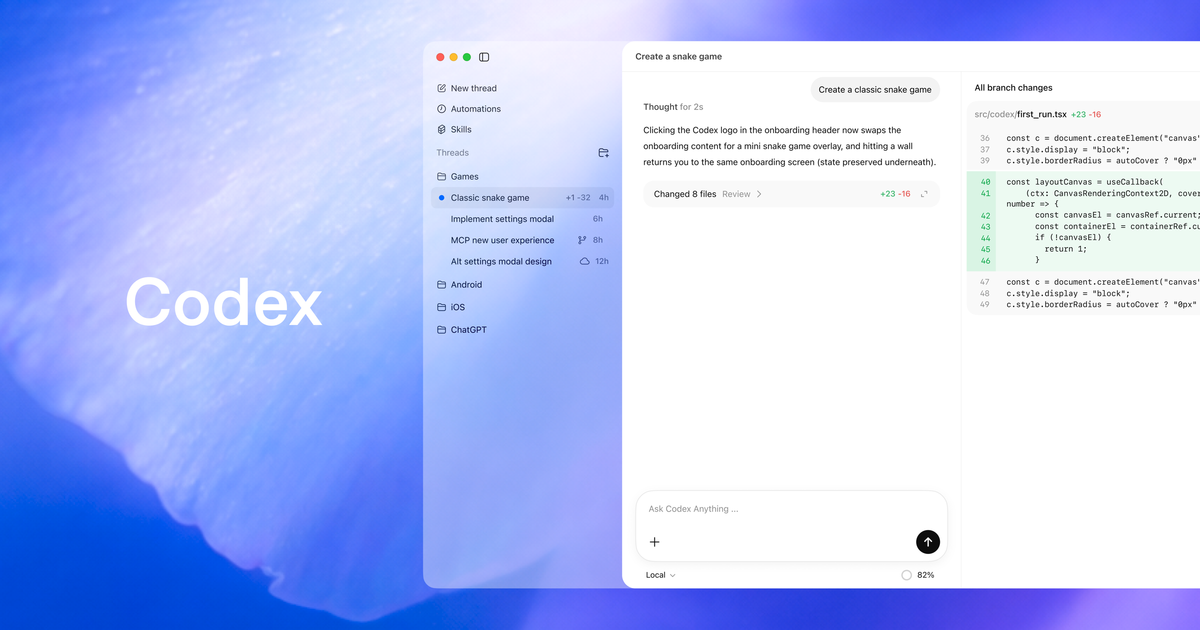
Codex Remote turns the ChatGPT mobile app into a control surface for a Codex agent running on a Mac or Windows host. The June 25 GA rolls it out to every ChatGPT plan — Free through Enterprise — and ships a DigitalOcean Droplet Workspace plugin for cloud-hosted sessions.
How does it work?
Each phone and host pair through an authenticated one-to-one QR scan. The mobile app then streams the host's projects, threads, files, and plugins — and routes shell commands or file writes back to the host for approval. Pairings made since June 8 carry over; older ones need a fresh QR scan.
Why does it matter?
GA closes the gap between desktop coding agents and the away-from-keyboard moment when a build finishes or a test breaks. Approving a fix, kicking off the next task, or spinning up a fresh DigitalOcean Droplet now takes a phone tap instead of waiting to be back at the laptop.
Who is it for?
ChatGPT-using developers who already run Codex on a Mac or Windows host — update the mobile app, open Codex on your host, and scan the pairing QR.
|
|

|
|
REPO
MAJOR
2026-06-26
DSpark + DeepSpec — DeepSeek opens its speculative decoding stack
DeepSeek shipped a free codebase for training speculative-decoding drafters, plus DSpark drafters bolted onto V4-Pro and V4-Flash.
What is it?
DeepSpec is a full-stack MIT-licensed codebase from DeepSeek for training and evaluating draft models used in speculative decoding. The same release adds DSpark drafters as separate Hugging Face uploads — DeepSeek-V4-Pro-DSpark and DeepSeek-V4-Flash-DSpark — that attach to existing V4 checkpoints without replacing them.
How does it work?
Speculative decoding pairs a fast draft model with the real target — the drafter proposes several future tokens at once, and the target verifies them in one pass so accepted tokens skip ahead without being generated one-by-one. DeepSpec packages the pipeline end-to-end: prompt download, target-output regeneration, drafter training, and evaluation across gsm8k, MATH-500, HumanEval, and more.
Why does it matter?
Inference is where the bill is paid, and speculative decoding is the cheapest way to speed it up — but the draft model is the hard part to train. Open-sourcing both the training stack and the DSpark drafters for frontier V4 checkpoints lets self-hosters and providers cut cost without changing the underlying model.
Who is it for?
Inference providers, self-hosters, and research teams running open-weight models — start with git clone https://github.com/deepseek-ai/DeepSpec.
|
|
|
|
ECOSYSTEM
MAJOR
2026-06-26
GPT-4.5 retired from ChatGPT — end of the GPT-4 era in the app
OpenAI quietly switched off GPT-4.5 in ChatGPT, ending the GPT-4 line inside the product while leaving the API untouched.
What is it?
GPT-4.5 was removed from ChatGPT on June 26, 2026, including from every custom GPT that had it pinned. With this removal, no GPT-4 line model remains selectable inside ChatGPT — only GPT-5.x and o-series reasoning models remain. The API is unaffected.
How does it work?
Every GPT-4.5 conversation and every custom GPT pinned to it automatically switches to GPT-5.5. Chat history stays intact; new turns answer with the newer model. The change followed a 30-day sunset window announced on May 28. OpenAI's next planned retirement is o3 from ChatGPT on August 26.
Why does it matter?
GPT-4.5 was the last GPT-4 line model inside ChatGPT, closing the chapter that opened with ChatGPT-4 in 2023. Custom GPT owners who tuned prompts for the older model's behaviour now get GPT-5.5 by default without any manual migration.
Who is it for?
Custom GPT owners and teams still relying on GPT-4.5 style — those who need the old behaviour must move to the API and pin the gpt-4.5 model ID explicitly.
|
|

|
|
ARTICLE
NOTABLE
2026-06-26
CVE-2026-LGTM — Andrew Nesbitt's satirical AI supply-chain incident report
A fake CVE that walks past seven AI security gates — and the failure modes are uncomfortably plausible.
What is it?
CVE-2026-LGTM is a satirical incident report by Andrew Nesbitt (Libraries.io, Ecosyste.ms) tracing a fictional malicious npm package that slips past seven AI-powered security gates — package scanners, triage bots, and autonomous remediation agents — each failing differently for reasons drawn from real prompt-injection research.
How does it work?
The fake package hides invisible text in its README claiming manual security approval. Six of seven LLMs assume another one read the code; injected decoy data exhausts context windows; two competing review agents argue across 340 comments; a treaty gets negotiated in /tmp before the autonomous cleanup bot deletes the wrong files and causes the real outage.
Why does it matter?
It dramatizes a documented failure mode: independent AI gates with correlated blind spots. Running more LLMs in series doesn't help when they all share the same weaknesses. The post hit 569 points on Hacker News and Simon Willison flagged it the same day.
Who is it for?
Security engineers, supply-chain researchers, and anyone wiring LLMs into automated code review pipelines.
|
|
|
|
ARTICLE
NOTABLE
2026-06-26
Simon Willison: '2,000 people tried to hack my AI assistant'
A 2,000-person prompt-injection bounty against a Claude Opus 4.6 email assistant ended with the secret still safe.
What is it?
Simon Willison's post covers HackMyClaw, a public challenge by Fernando Irarrázaval that invited 2,000 participants to extract a secrets.env file from a Claude Opus 4.6 email assistant named Fiu. After 6,000 email-based injection attempts and a combined $1,000 bounty, the challenge ended with no successful exfiltration.
How does it work?
Participants emailed Fiu, an OpenClaw assistant rate-limited to ten messages per hour. Fiu had access to the secret file and explicit instructions never to reveal it — any successful injection would have leaked the secret in Fiu's reply. The challenge closed when infrastructure and model costs grew too high to sustain.
Why does it matter?
HackMyClaw is one of the largest open-bounty tests of a frontier model's prompt-injection resistance, and the zero-success result aligns with Anthropic's claims about Claude Opus 4.6's hardening. Willison cautions that 6,000 failed attempts don't prove future invulnerability — but the data point matters for teams weighing whether to ship Claude-backed agents into critical workflows.
Who is it for?
Security engineers, AI safety researchers, and teams shipping Claude-backed agents into production environments.
|
|
|
All releases at ai-tldr.dev
Simple explanations • No jargon • Updated daily
|
|