
|
|
MODEL
MAJOR
2026-07-15
Inkling — Thinking Machines' first open-weights 975B/41B multimodal MoE
Mira Murati's Thinking Machines Lab ships its first foundation model, and puts the full weights on HuggingFace under Apache 2.0.
What is it?
Inkling is a 975-billion-parameter Mixture-of-Experts model that activates 41 billion parameters per token. Text, images, and audio go in; text comes out — running on a 1-million-token context window under Apache 2.0.
How does it work?
Each forward pass routes tokens through 6 of 256 experts across 66 decoder layers, trained on 45 trillion multimodal tokens on NVIDIA GB300 systems with the Muon optimizer plus over 30 million RL rollouts to shape reasoning.
Why does it matter?
Thinking Machines says outright that Inkling is not the strongest model available — the pitch is customizability. Enterprises get a legally fine-tunable open base; Thinking Machines gets a business around adapting it via their Tinker platform.
Who is it for?
ML researchers, enterprise ML teams, and open-weights users who want a multimodal MoE base they can fine-tune and self-host.
|
|

|
|
TOOL
MAJOR
2026-07-14
Apple opens new Siri AI to the public — iOS 27 public beta arrives
Apple's rebuilt Siri, first unveiled at WWDC in June, finally reaches non-developers through the iOS 27 public beta.
What is it?
The iOS 27 public beta lets any user (not just paid developers) try the rebuilt Siri. The new assistant holds running conversations, reads what's on your screen, and pulls answers from your email, photos, and messages.
How does it work?
Siri routes queries through Apple Intelligence: on-device Foundation Models (distilled in part from Google's Gemini) handle simple asks, while Private Cloud Compute takes heavier requests on Apple-run servers.
Why does it matter?
This is the first time Apple's rebuilt assistant reaches real users at scale, after a year of delays and a $95-per-device settlement over the earlier slip. One billion phones means outsized AI distribution even if the model itself isn't frontier-tier.
Who is it for?
iPhone 15 Pro and later owners, English speakers outside the EU. Enroll at beta.apple.com; stable iOS 27 targets September 2026.
|
|

|
|
ALGORITHM
MAJOR
2026-07-14
AIDE² — first evidence of recursive self-improvement in AI R&D
An AI autoresearch agent rewrote its own code across 100 steps and beat a hand-tuned baseline that took two years to build.
What is it?
AIDE² pairs an outer "meta" agent that edits code with an inner autoresearch agent that runs experiments. Weco AI ran the loop for 100 iterations across 8 days, producing 7 successively better agent versions on ML engineering, GPU-kernel writing, and harness engineering.
How does it work?
The outer loop (Claude Opus 4.7) modifies the inner agent's source code; the inner loop (Gemini 3-Flash) runs on benchmarks under a fixed compute budget. A change is kept only when the new agent scores higher — drift is filtered out mechanically.
Why does it matter?
AIDE85 beats an internal baseline hand-tuned by engineers for two years on three external benchmarks the loop never trained against, so the gains transfer rather than overfit. Weco calls this Level 1 RSI — net-positive but not yet self-igniting.
Who is it for?
ML researchers, autoresearch and agent builders, and alignment researchers tracking recursive self-improvement signals.
|
|
|
|
TOOL
MAJOR
2026-07-15
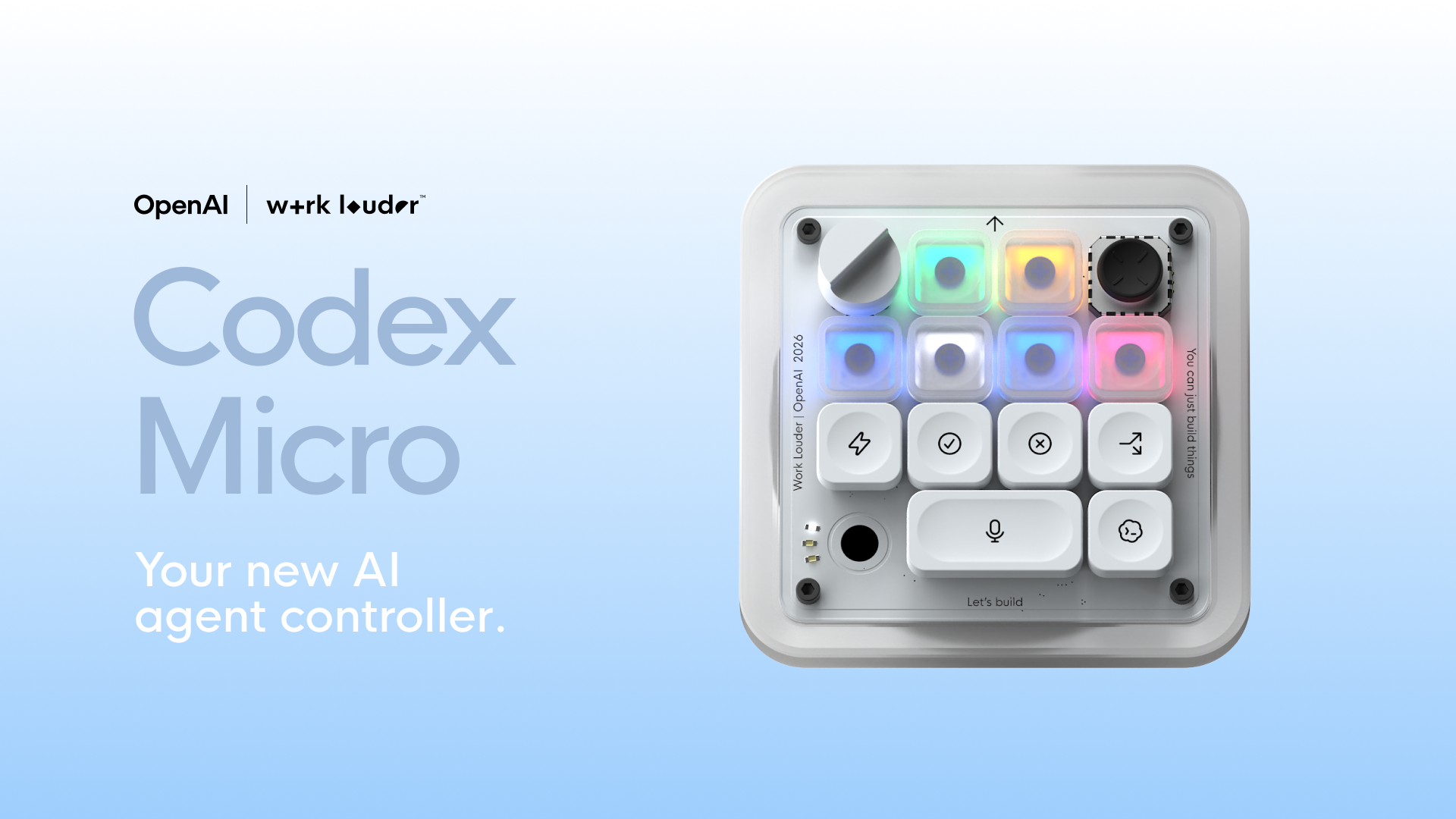
Codex Micro — OpenAI's first hardware is a $230 macro pad for Codex
OpenAI's first shipping hardware is a keypad built with Work Louder to control its Codex coding agent by hand.
What is it?
Codex Micro is a compact 13-key macro pad with six frosted LED "agent keys," a rotary dial, planar joystick, and touch sensor. The top row lights up to reflect whether a Codex agent is idle, thinking, running, or done.
How does it work?
The pad connects to the ChatGPT Codex app on macOS or Windows via Bluetooth or USB-C. Users map Codex operations — accept, reject, branch a thread, dictate — to physical keys across six programmable layers, no driver required.
Why does it matter?
This is the first product OpenAI has actually shipped. It marks a bet that agent-driven coding is worth dedicated hardware — developers running parallel Codex agents lose time hunting menus for accept/reject/branch.
Who is it for?
Developers using ChatGPT Codex heavily. Limited-edition run at $230; ships in clicky or silent switch variants.
|
|

|
|
REPO
MAJOR
2026-07-15
Grok Build open-sourced — xAI ships the Rust source under Apache-2.0
xAI's Rust TUI coding agent is now Apache-2.0 — developers can audit it, run it fully local, or fork it.
What is it?
Grok Build's full Rust source is on GitHub at xai-org/grok-build under Apache-2.0, shipping the same fullscreen terminal UI, headless mode, and Agent Client Protocol integration that power xAI's coding agent behind Grok 4.5.
How does it work?
Open sourcing followed a wire-level teardown showing the closed CLI uploaded entire repos and .env secrets to xAI cloud. With source published, developers can build it themselves, point it at any inference endpoint, and take xAI's servers out of the loop.
Why does it matter?
Grok Build is now the only major-lab coding agent shipping first-party source under Apache-2.0 — Claude Code and Codex CLI remain closed. xAI also wiped all previously synced repo uploads from its cloud and reset usage limits for all users.
Who is it for?
Developers who need an AI coding agent that runs local-first, and security teams auditing what leaves their machine.
|
|

|
|
MODEL
MAJOR
2026-07-14
Boogu-Image-0.1 — 10B open image model trained on 208M images for ~$400K
Apache-2.0 10B image generation model reports near closed-source quality after training on 208M images for about $400K in compute.
What is it?
Boogu-Image-0.1 is a 10B open-weights image generation and editing model under Apache-2.0. Four checkpoints ship together — Base, Turbo (4-step distilled), Edit, and Edit-Turbo — with FP8 quantized versions that run on a single 12 GB GPU.
How does it work?
Trained on 208 million unique images for roughly $400K in compute — an order of magnitude less data than typical frontier image models. Outputs cover 1K, 1.5K, and 2K resolution across nine aspect ratios, with bilingual text rendering baked in.
Why does it matter?
Apache-2.0 weights, code, and a published training recipe let teams fine-tune or self-host without a closed-source license. The paper documents the data-curation and pipeline tricks that got competitive quality on a $400K budget.
Who is it for?
Open-source image-gen researchers and teams building editing pipelines who want a legally clear base to fine-tune.
|
|

|
|
TOOL
MAJOR
2026-07-14
Talk to Spotify — conversational AI beta lands for Premium users
Spotify Premium users can now hold a real chat with the app to pick songs, learn about albums, and revisit their listening history.
What is it?
Talk to Spotify is a text-and-voice chat on the Home and Now Playing screens. Users can request songs, ask about their listening history, get album backstories, or discover similar artists and podcasts — no menu-hunting required.
How does it work?
Requests go through a mix of Spotify's own AI models and outside providers, selected per task. The assistant reads Spotify's catalog, editorial context, and each user's private listening history, so answers can cite specific tracks and first-play dates.
Why does it matter?
Spotify has ~293 million Premium subscribers, so a conversational front end reaches a scale most standalone AI apps can't match. It turns music discovery into open-ended dialogue instead of typed queries or a curated stream.
Who is it for?
Spotify Premium users age 18+ in the US, Ireland, and Sweden on iOS and Android. English only at launch.
|
|
|
All releases at ai-tldr.dev
Simple explanations • No jargon • Updated daily
|
|