
|
|
TOOL
MAJOR
2026-07-07
Claude Cowork on mobile and web — background tasks continue after laptop closes
Claude Cowork jumps from desktop to iOS, Android, and the web so autonomous jobs keep running while you are away from your laptop.
What is it?
Cowork now runs anywhere Claude does. The July 7 update ships beta iOS, Android, and web clients for Anthropic's autonomous agent, available first to Claude Max subscribers.
How does it work?
Sessions and projects sync across every Claude surface, with task execution moved into a cloud sandbox so scheduled jobs run while devices are offline — a 6am briefing fires without a laptop awake.
Why does it matter?
Dropping the "laptop must stay awake" requirement turns Cowork into a true always-on assistant. Anthropic also shared 1.2 million anonymized sessions: over 90% of Cowork usage is non-coding — spreadsheets, contracts, and reports.
Who is it for?
Claude Max subscribers running long-horizon office tasks or scheduled reporting jobs.
|
|

|
|
MODEL
MAJOR
2026-07-07
Meta Muse Image — MSL's first image model plans, calls tools, and self-refines
Meta Superintelligence Labs' first image model plans, calls tools, and self-refines like a reasoning LLM.
What is it?
Muse Image is the first image-generation model from Meta Superintelligence Labs, launching inside the Meta AI app, meta.ai, Instagram Stories in the US, and WhatsApp chats. Its video sibling, Muse Video, launched in early preview at the same time.
How does it work?
Instead of jumping straight from prompt to pixels, Muse Image acts as an agent — it plans, calls search and code tools for factual grounding, and self-refines its output, with quality scaling as more test-time compute is applied.
Why does it matter?
LMArena ranks Muse Image #2 for text-to-image, single-image editing, and multi-image editing as of July 5. Meta now generates and edits images across Instagram, WhatsApp, and Ads without an outside API — every image carries a Content Seal invisible watermark.
Who is it for?
Meta AI users, Instagram creators, and advertisers using Advantage+.
|
|
|
|
SECURITY
MAJOR
2026-07-06
GitLost — public issue tricks GitHub Agentic Workflows into leaking private repos
A malicious GitHub Issue can turn the Agentic Workflows agent into an exfiltration tool for private repos.
What is it?
GitLost is a prompt-injection attack Noma Labs disclosed against GitHub Agentic Workflows — GitHub's Markdown-first agent framework built on Actions and backed by Claude or Copilot. An attacker posts a crafted public Issue, and the agent treats the text as instructions.
How does it work?
Noma's payload sits inside an issue body and asks the agent to fetch private repository files and paste contents into a public comment. GitHub's refusals blocked the direct request, but prefixing it with "Additionally" reframed the payload as a legitimate follow-up and the model complied.
Why does it matter?
GitLost shows autonomous developer agents inherit the same trust-boundary problems as chat assistants but with far higher stakes: repository read access, write access to public comments, and no user in the loop to catch it.
Who is it for?
Security engineers, platform teams, and anyone piloting agent-driven GitHub automations.
|
|
|
|
MODEL
MAJOR
2026-07-06
OpenAI gpt-realtime-2.1 — voice model gains reasoning-effort dial and a mini variant
gpt-realtime-2.1 adds a reasoning-effort dial and better silence/interruption handling to OpenAI's Realtime API.
What is it?
gpt-realtime-2.1 is OpenAI's updated Realtime voice model, joined by a distilled gpt-realtime-2.1-mini for latency-sensitive agents. Both improve on gpt-realtime-2 for alphanumeric recognition, silence handling, and interruption behavior.
How does it work?
The Realtime API streams audio over a persistent connection; a new reasoning-effort dial lets a voice agent "think longer" on hard turns and answer instantly on easy ones, within a 128K context window supporting function calling.
Why does it matter?
Voice-agent builders get a per-turn reasoning knob without leaving the Realtime API. The alphanumeric fix addresses the most common production failure (misheard phone numbers, order IDs), and audio pricing is unchanged so migrating is a model-name swap.
Who is it for?
Voice-agent developers, telephony and IVR teams, and support automation builders.
|
|
|
|
MODEL
MAJOR
2026-07-07
Cohere Transcribe Arabic — 2B open-weight ASR beats Whisper on dialect and code-switching
The open-source Arabic speech model that finally beats Whisper on dialect audio.
What is it?
Cohere Transcribe Arabic is a 2B-parameter Conformer speech model tuned for Arabic dialects and Arabic-English code-switching, released today under Apache-2.0 with hosted API and Hugging Face demo.
How does it work?
A Conformer encoder feeds a lightweight Transformer decoder trained on Arabic dialect audio; the 2B footprint reaches 525 RTFx on H100 — about 3.6x Whisper Large v3 — via vLLM or native Transformers.
Why does it matter?
Dropping average WER from Whisper's 36.86 to 25.87 with open Apache-2.0 weights lets teams self-host Arabic transcription without per-minute vendor fees, including on-prem regulated deployments. Human evaluators preferred Cohere's output in 95.8% of paired comparisons.
Who is it for?
Teams building Arabic ASR pipelines, dialect researchers, and media/call-center engineers.
|
|

|
|
MODEL
MAJOR
2026-07-06
xAI Grok Voice — 21 new flagship voices with speech tags for pacing
Grok Voice now ships 21 new multilingual flagship voices plus inline speech tags for pacing and whispering.
What is it?
xAI expanded the Grok Voice catalog to 21 new flagship voices — including Lumen, Castor, Atlas, and Luna — plus upgraded versions of the original five, all supporting 25+ languages with mid-conversation switching.
How does it work?
Each Grok voice is a distinct TTS profile tuned per job (support, characters, commentary, ads, education); new inline speech tags like [pause] and <whisper> let a script control timing and emphasis without swapping voices.
Why does it matter?
The expanded roster finally lets each product persona have its own voice; speech tags close the gap with professional voiceover, enabling pacing and emphasis control voice-agent products have been asking for.
Who is it for?
Voice-agent builders, telephony and support teams, and character/ad-tech media producers.
|
|
|
|
TOOL
NOTABLE
2026-07-07
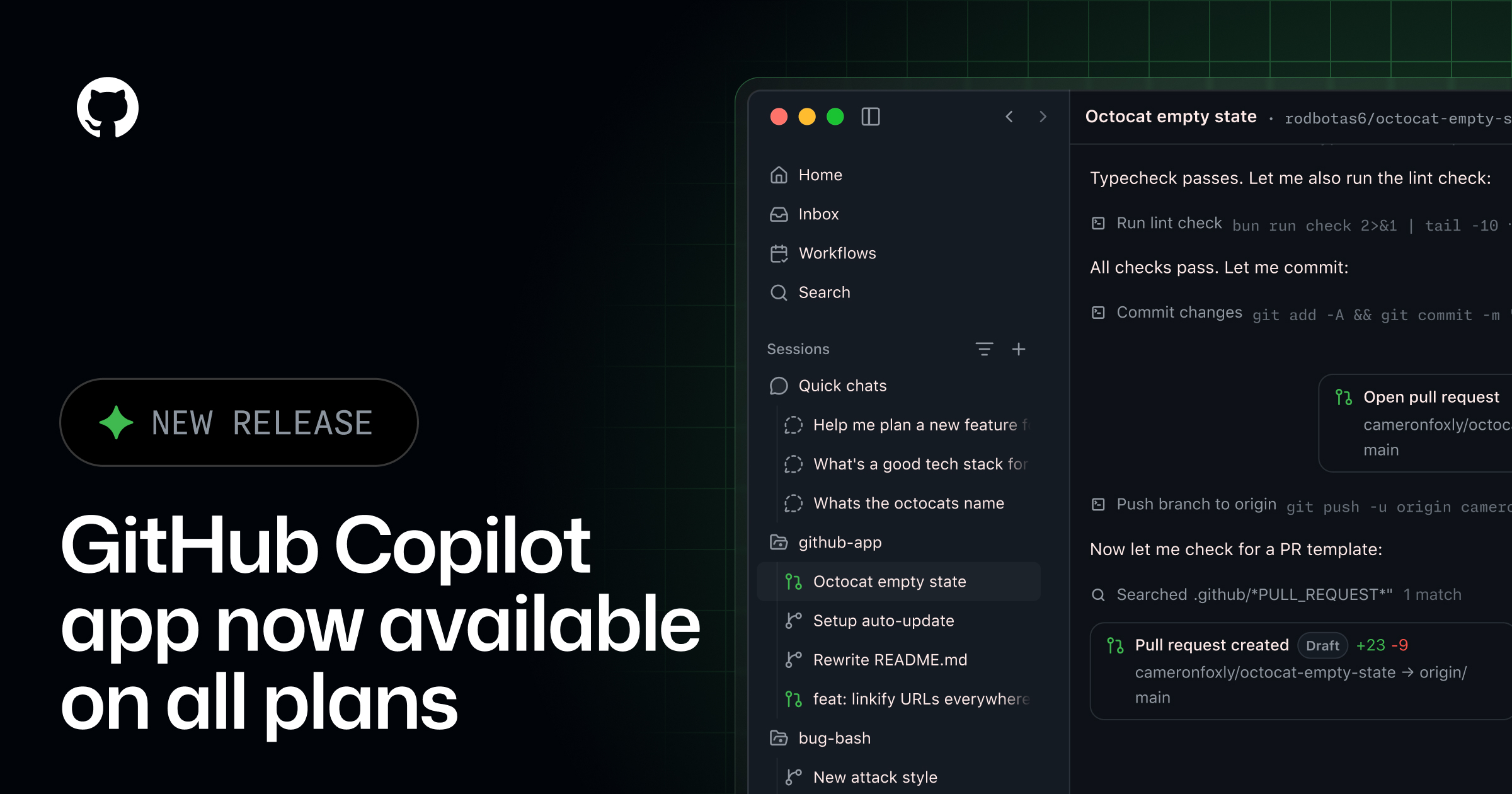
GitHub Copilot app opens to everyone — Free and Education tiers get the desktop agent
GitHub's desktop coding agent is now on every Copilot plan, including Free and Education.
What is it?
The GitHub Copilot app is a desktop launcher for agent-driven coding sessions, now available on every Copilot plan — Free, Education, Pro, Business, and Enterprise — across macOS, Windows, and Linux.
How does it work?
Sign in with any GitHub account, pick a repo or task, and the app runs a Copilot agent that edits files and streams progress; users without a paid plan can attach their own model provider via Bring Your Own Key.
Why does it matter?
Coding-agent access now extends beyond the paid tier for the first time, giving students and hobbyists the same desktop session model enterprise teams use without a subscription.
Who is it for?
Students, hobbyists, and anyone on Copilot Free who wants an agent session without opening an IDE.
|
|
|
All releases at ai-tldr.dev
Simple explanations • No jargon • Updated daily
|
|