|
|
MODEL
MAJOR
2026-08-11
AMIE (Video) — Google's medical AI matches doctors in live video consults
Google's AMIE now runs synchronous video consultations and guides patients through a virtual physical exam.
What is it?
AMIE (Video) adds a live audio-visual channel to Google's medical AI research system, so it can hold a real-time video consultation instead of a text chat. The system watches the patient, picks up non-verbal cues, and asks the patient to move a limb or angle the camera so it can see the sign for itself.
How does it work?
Three agents run asynchronously behind the video call — a Talker that keeps conversation flowing at low latency, a Planner that refines the clinical reasoning and differential diagnosis, and a Perception agent that scans the audio and video stream for clinically relevant cues. The stack is built on Gemini and Project Astra.
Why does it matter?
Across 300 live consultations, blinded clinical evaluators rated AMIE on par with 30 board-certified primary care physicians on diagnosis and management, and scored it higher at eliciting physical signs on camera. For clinical AI teams, it sets a concrete benchmark for what a multi-agent audio-visual consultation can reach.
Who is it for?
Clinical AI researchers and digital health teams building or evaluating AI-powered telehealth systems.
|
|
|
|
TOOL
MAJOR
2026-08-11
Grok Bot — xAI's always-on agents get their own cloud computer
xAI's agents now hold their own cloud machine, log into your tools, and finish the job while you are away.
What is it?
Grok Bot gives each agent its own cloud computer and a login to the apps you already use. Released in public beta on August 11 on Mac, iOS, Windows and Linux, jobs keep running after you close the laptop and Bots return only when they need approval.
How does it work?
The agent drives real apps and websites through its own cloud machine, so a service needs no API or MCP server. You teach a workflow by doing it once; the Bot saves those steps as a routine and repeats them on its own, and multiple Bots can run in parallel, pass work between each other in group chats, and keep context from earlier tasks.
Why does it matter?
Most agent tools stop at whatever has an API. By signing in the way a person does, Grok Bot reaches the long tail of internal dashboards and web apps that never got one — precisely where repetitive knowledge work lives.
Who is it for?
Sales, ops and engineering teams with repetitive multi-app workflows. Access is bundled into SuperGrok Heavy, Cursor Ultra, and Cursor Teams Premium ($120/seat/month).
|
|

|
|
MODEL
MAJOR
2026-08-11
LTX-2.5 — open-weights video model makes a 10s clip in 6.8 seconds
An open-weights video model that renders connected multi-shot scenes faster than real time.
What is it?
LTX-2.5 is a 22B open-weights diffusion transformer that generates multi-shot scenes from a single prompt, keeping character, environment and lighting consistent across cuts. Weights are free for companies under $10M ARR under the LTX-2 Community License, and the model needs just 16GB of VRAM to run.
How does it work?
Diffusion Fidelity Rendering allocates compute to complex parts of a scene and skips it on simple ones. A new diffusion video decoder replaces the older VAE reconstruction step, cutting the measured visual-artifact score from 0.74 to 0.28 glitches per clip and recovering fine detail like text and faces in high-motion shots.
Why does it matter?
Video generation has mostly been a closed API business. Because LTX-2.5 ships its weights, a small studio can fine-tune the base checkpoint on its own footage and keep every frame on its own hardware — no vendor lock-in, no per-second bill.
Who is it for?
Video production teams, ComfyUI users, and robotics or physical-AI researchers who need to adapt the model to non-cinematic training data.
|
|
|
|
TOOL
MAJOR
2026-08-11
ChatGPT Desktop for Linux — OpenAI ships a preview with Codex built in
OpenAI's desktop app now runs on Linux, bringing ChatGPT, ChatGPT Work and the Codex coding workspace to Ubuntu, Debian and Fedora.
What is it?
Linux users can now install an official ChatGPT desktop app. OpenAI released it in public preview on August 11 as DEB and RPM packages for x64 and ARM64, tested on Ubuntu 24.04/26.04 LTS, Debian 13, and Fedora 43/44.
How does it work?
One window holds three products: ChatGPT for normal chat, ChatGPT Work for longer tasks, and the Codex workspace for coding. Installing the package also adds an OpenAI software repository, so updates arrive through the system package manager rather than a separate updater.
Why does it matter?
Linux was the last major desktop platform with no official ChatGPT client — OpenAI says it was the most-requested one. Developers can now point Codex at a local repository without uploading files anywhere, keeping everything on their own machine.
Who is it for?
Linux developers, especially those already using Ubuntu, Debian, or Fedora who want Codex without switching to the browser.
|
|

|
|
ECOSYSTEM
MAJOR
2026-08-11
Manus returns to independence — Meta-era user data gets deleted
Manus is leaving Meta's ownership, and the legal split means some user data is wiped on August 23 unless you export it first.
What is it?
Manus is returning to independent operations after Chinese regulators blocked Meta's December 2025 acquisition. The legal separation requires deleting user data created on or after December 29, 2025 to satisfy regulatory requirements in certain jurisdictions.
How does it work?
The deletion runs August 23–24 (Singapore Time) and affected users lose account access for those two days only. A backup tool at manus.im/backup lets users export their work before the 7:59 a.m. SGT cut-off on August 23; restored data can be uploaded back when accounts reopen on August 25.
Why does it matter?
Anyone who has built workflows on Manus since late December has a real deadline. Manus confirms the deletion is a compliance step, not a security incident — but the data is gone if you miss the August 23 cut-off.
Who is it for?
Teams running agent workflows on Manus who signed up or created data after December 29, 2025 — check your email for Manus's direct notification.
|
|
|
|
PAPER
NOTABLE
2026-08-10
BDH-CQ — a 150M model that reasons in latent space on ARC-AGI-1
Pathway's BDH-CQ solves ARC-AGI-1 puzzles by thinking in a recurrent latent state instead of writing out a chain of thought.
What is it?
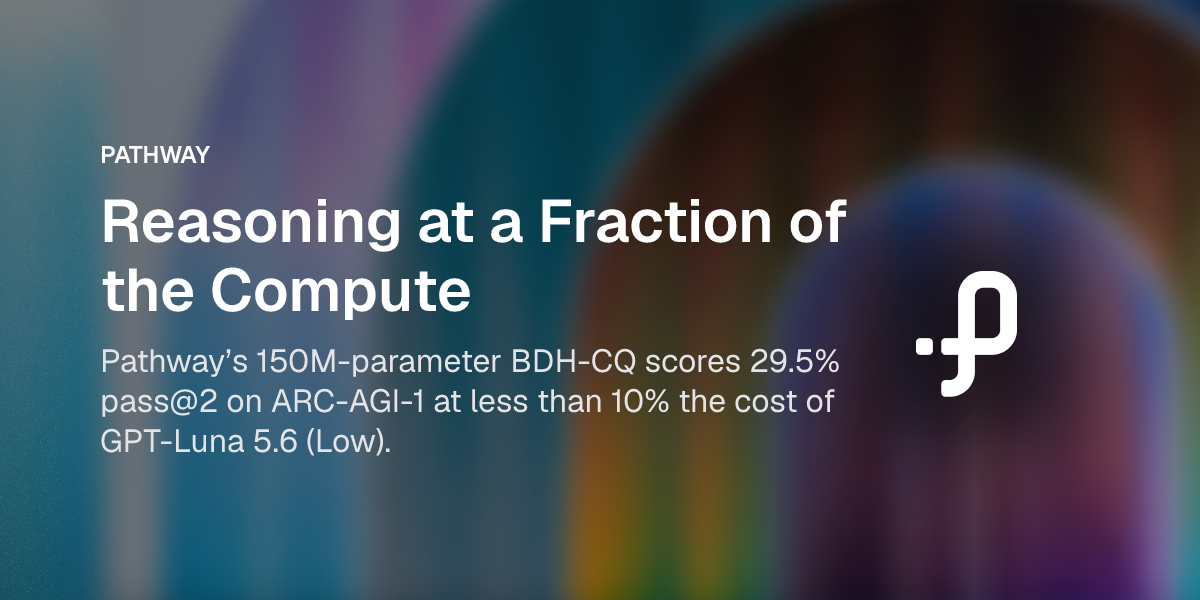
BDH-CQ is a 150M-parameter model from Pathway that scores 29.5% pass@2 on the public ARC-AGI-1 evaluation set at $0.00070 per task — roughly 57× cheaper than GPT-5.6 Luna on the same benchmark, which scores 34.2% at $0.040 per task.
How does it work?
Demonstrations at inference time update a recurrent memory one step at a time; the model then runs iterative steps inside a high-dimensional latent workspace and decodes an answer from the final state. No chain-of-thought text is written out — the reasoning stays entirely in latent space.
Why does it matter?
If latent reasoning holds up at larger scale, small models could take on puzzle-style reasoning that currently requires a frontier model and a long chain of thought. The run was reproduced independently by Łukasz Kaiser, a co-author of the original Transformer paper.
Who is it for?
ML researchers studying alternative reasoning architectures and teams benchmarking inference cost on ARC-AGI-style tasks.
|
|
|
|
ARTICLE
NOTABLE
2026-08-11
Annie Sexton — 'Compression is prediction, and LLMs are compressors'
A language model and a zip file are two faces of one idea: guess the next symbol well and you save bits.
What is it?
"Compression is prediction" is an August 11 post by Annie Sexton on the ngrok blog, written for engineers who use LLMs daily but have never seen the information-theory link spelled out. The central claim: data compression and language modeling solve the exact same problem.
How does it work?
Entropy coders shrink data by giving likely symbols short codes and unlikely ones long codes — the better your probability estimate, the smaller the output. An LLM does the identical thing: it produces a probability distribution over the next token, and training minimizes cross-entropy, the exact quantity a compressor is trying to lower.
Why does it matter?
Sexton's framing gives a plain answer to what a model is actually learning during pretraining — a probability model of text, scored by how few bits it would need to encode that text. The post reached the Hacker News front page with 419 points and 168 comments.
Who is it for?
Engineers who want the information theory behind LLM training explained without a textbook.
|
|
|
All releases at ai-tldr.dev
Simple explanations • No jargon • Updated daily
|
|