
[AI Skeptics] Techno-Negative, chapter 5 reflections
Hey, in about 3 hours, at 8pm ET, we're going to get together to talk about chapter 5 of Techno-Negative. I wanted to offer a couple of thoughts after reading it (and the additional reading, "Police Keep Losing Their Jobs for Using Flock Cameras to Stalk People" by Sophie Hurwitz for Mother Jones).
I was really fascinated by this chapter and intrigued by the phenomenon of "vandals [who] left neither statements of intent nor a written comprehensible demand or future visions" (page 96); it reminded me of counter-archival work and the difficulty in piecing together a series of events when documenting things like anti-carceral protest among prisoners in the United States prison system (for more on that, I would heartily recommend Tip of the Spear by Orisanmi Burton).
Dekeyser is doing something different than Burton did, so I won't dwell on that comparison, but I think an acute sense of the state's use of lanterns for surveillance being central to the (supposedly senseless) smashing of these lanterns - a desire to weakn the "visual hold" of the landscape, that Dekeyser talks about on page 100. Skimming this chapter last week I was thinking about Flock cameras, and about the DeFlock movement, and how supposedly senseless a lot of destruction of surveillance tech seems: you look at people burning down Waymo cars and people call it senseless violence until it emerges that [Waymo is sharing video footage with police][waymo cops]; you look at people breaking Ring cameras, and again it's described as senseless vandalism until you see a commercial turning your community into a panopticon (ostensibly to find a dog, but in reality to provide to police as a service); you see people cutting down Flock stations - very much the same literal silhouette as light posts in the 19th century - and it seems random and senseless... again, until you understand it through the lens of a visceral response to constant surveillance and a police state that's not just growing , but somehow growing more rapidly.
I've written about all this in some previous reflection or another, so I apologize if all of that's repetitive, and I'll digress, haha. But I am really interested in exploring what (I think, for me, anyway) feels like a novel tension about the literal destruction of a thing that symbolically represents progress and advancement - the destruction of literal enlightenment must have been an annoyed at people saying stupid shit like "Ah, you don't like these oil lanterns, but you apparently like fireworks; I am very intelligent."
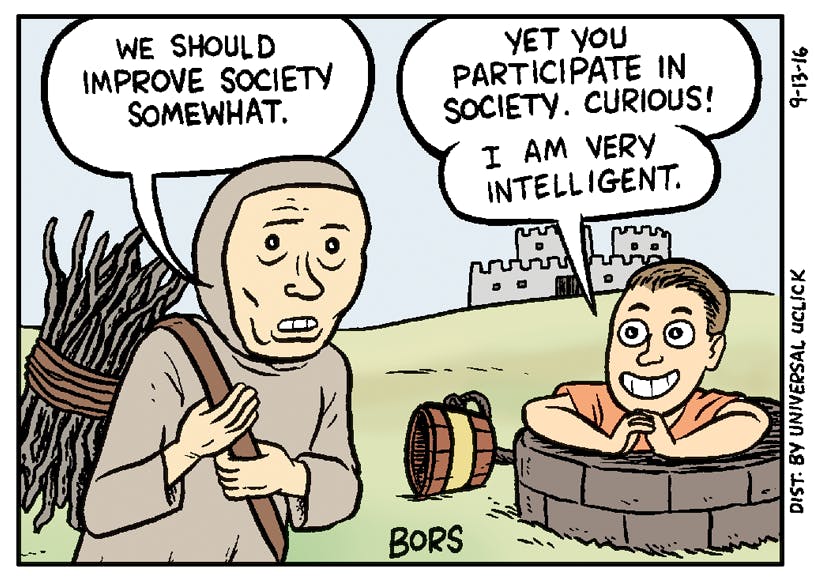
Here's the part that felt like it pulled back the curtain and clarified a ton of stuff for me, not just in the book but like... in online arguments (akin to the above comic panel):
The revolutionary smashers would unlikely have taken issues with the production of new urban spaces of reason or, more generally, with the path of enlightenment promised by reason, given how committed they were—to the point of putting their bodies on the line—to a rationalist mode of political organization distinct from divine and monarchic rule. They were not, then, enemies of Enlightenment reason.
Instead, I want to propose, they fought against the precise ways the state was translating these epistemological principles into epistemic tools of governance.
Was this theoretical and political clarity totally apparent to the people destroying lanterns? Maybe not (well, probably not, if Dekeyser is advancing a solution to this apparent dilemma that had persisted for the better part of a hundred years...). But I think in the same way that it's obnoxious when people say "Yet you used AI to unlock your phone" or "Yet you used a data center to make this post" (and the corresponding "I am very intelligent"), it's self-evident that refusal (and in this case smashing street lights) is not a rebuke of illumination; it's a rebuke of the arrangement of governmental infrastructure to reshape and govern the public. It may seem like lashing out at everything to take shots at authoritarianism, fascism, and capitalism. Indeed, there are targets everywhere! But I don't think we need to burden ourselves with other people being unable to make out the distinguishing characteristics of what we strategize to undermine, to make more expensive, or to stop outright.
I realize I went on a tangent that didn't really attend to the stuff at the end of the chapter - the idea of being transparent (to the state or to anyone), and to be known (policed). I would really, really like to hear how that all felt for people reading this chapter, because I'm also resonating strongly with that, but I want to hear what you all think about it.
When you're ready to join at 8p ET, you can click on this link or you can go here:
https://al2.in/ReadingGroupRoom
See you then.
(This email should be arriving a little earlier in the day than usual; I'm experimenting with giving people more time to read my reflections, vs running the risk that people will read the email and then go do other things and forget that we're doing our video chat. I'm trying sending this earlier because someone suggested it - if you have suggestions, please let me know!)