The Kosmos of Gorgias's Helen
The Kosmos of Gorgias’s Helen
Part III of Plato on “Therapy” & “Flattery”
Previous parts of the series:
The speech of Gorgias of Leontini called "Encomium of Helen" is an example of "epideictic" oratory. The adjective epideictic comes from the Greek verb ἐπιδείκνυμι (epideiknymi), which means to "display" or "exhibit"; specifically to give a display of one's own skill or art. The speech is supposed to display to potential student-customers the particular good or power which they can acquire through lessons with Gorgias. It is an advertisement of Gorgias's professional skill.
An "encomium" is a speech in praise of a person or thing. The root of the word is κῶμος (kōmos)—either a "band of revellers" or the solemn "procession" which celebrated a victor in Panhellenic games.
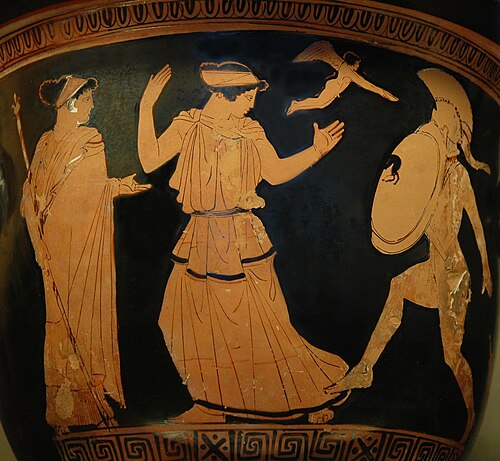
Helen of course is the famous beauty whose "face launched a thousand ships"—the wife of Menelaus, ancient King of Sparta. Her "adventure" to Troy with Prince Paris provoked the Trojan War. To an audience of Greeks, she is an odd choice as subject for a speech of praise. To get a feeling for the effect of the title on Gorgias's audience, imagine an American president delivering a 4th of July speech in praise of King George III.
Gorgias begins his encomium with a statement of general principles before coming to his particular topic:
"(1) What is becoming to a city is manpower, to a body beauty, to a soul wisdom, to an action virtue, to a speech truth, and the opposites of these are unbecoming. Man and woman and speech and deed and city and object should be honored with praise if praiseworthy and incur blame if unworthy, for it is an equal error and mistake to blame the praisable and to praise the blamable. (2) It is the duty of one and the same man both to speak the needful rightly and to refute the unrightfully spoken. Thus it is right to refute those who rebuke Helen, a woman about whom the testimony of inspired poets has become univocal and unanimous as has the ill omen of her name, which has become a reminder of misfortunes. For my part, by introducing some reasoning into my speech, I wish to free the accused of blame and, having reproved her detractors as prevaricators and proved the truth, to free her from their ignorance." (translation, adapted, via
(Greek text available here.)
The series of perfectly balanced phrases and stark antitheses (or "oppositions") is a hallmark of Gorgias's style. The first sentence, in Greek, begins and ends with words that mark a basic polarity that runs through all types of things. The words are κόσμος (kosmos), "what is becoming," and ἀκοσμία (akosmia), "unbecoming."
Kosmos is a word whose range and resonance no single English word can adequately convey. "Becoming" captures its aesthetic dimension but obscures another fundamental meaning: "good order," or "the order that produces or constitutes goodness." Kosmos is inseparable companion to the adjective καλός (kalos)—themselves unbreakably linked to the noun-adjective pair ἀρετή-ἀγαθός (aretē-agathos).
So intimately bound are kalos and agathos in Greek that the language turned the phrase καλὸς κἀγαθός (kalos kagathos, kalos and agathos) into the hybrid abstract noun καλοκαγαθία (kalokagathia)—which indicates something like the perfect embodiment of every physical, moral, and intellectual quality that makes a human being resplendently awesome/beautiful/good. "Awesome-beautiful-goodness" or "Good-beautiful-awesomeness" is the closest approximation in English.
Gorgias's speech thus begins, or at least appears to begin, with a resounding affirmation of the existence of beauty/goodness/good order, as found not only in material objects but also human institutions and individual persons and actions.
The Roman statesman and orator Cicero, in his famous treatise On Duties, gives a similar account of this quality of kosmos—beauty/order/goodness. In fact he identifies the ability to perceive this quality as the defining characteristic of human beings—as what distinguishes them from mere animals.
And it is no mean manifestation of Nature and Reason that man is the only animal that has a feeling for order, for propriety, for moderation in word and deed. And so no other animal has a sense of beauty, loveliness, harmony in the visible world; and Nature and Reason, extending the analogy of this from the world of sense to the world of spirit, find that beauty, consistency, order are far more to be maintained in thought and deed, and the same Nature and Reason are careful to do nothing in an improper or unmanly fashion, and in every thought and deed to do or think nothing capriciously.
It is from these elements that is forged and fashioned that moral goodness which is the subject of this inquiry—something that, even though it be not generally ennobled, is still worthy of all honour; and by its own nature, we correctly maintain, it merits praise, even though it be praised by none. (De Officiis 1.14; Walter Miller's translation, via; emphasis added)
The Latin word translated "moral goodness" is honestum. It corresponds exactly to the first word of Gorgias's speech, kosmos. Gorgias's speech thus purports to offer us (potentially corrective) insight into a particular instance of something which, by its own nature, even though praised by none, merits our praise.
This will be a principle of overriding importance as we continue this inquiry into Plato's thought on the opposite practices of therapeia and kolakeia—the principle that there is such a quality existing in real things as to make them really, truly praiseworthy; and which makes us, as beings uniquely capable of perceiving that quality, responsible for praising them.
Some miscellaneous praiseworthy items:
From Sara Hendren’s “catechesis by camera”: “The experiential divide between knowing a baby not yet born — even one kicking and present in your own body — and the one you hold in your arms and care for — it’s a gulf that begs for monumental metaphors. There’s an oceanic distance between the abstraction and its embodiment. Making room for a child isn’t fully thinkable-through with just your skull-shaped cognition. It’s in the habitus of your body. Becoming a parent is like swallowing a solar system: a reordered gravitational pull, a new series of orbits, with magnetism and polarities that sway all of life’s conditions. It is many things, but it is not a project.”
Alan Jacobs has a new website on the films of Terrence Malick. It is called Cosmos Malick. See this post, and this one, on the significance of Jacobs’s use of the word cosmos. From the latter: “So I would say that Cosmos Malick starts with these fundamental, governing apprehensions: that we are not alone, that we wake into a world — but that world offers ambiguous testimony to its own character. There is a war at the heart of nature; but if we look and listen with sufficient attention, we may discern also the way of grace. We may, we just may, be able, eventually, to “get round in front” and see the face of the world.” You can support Professor Jacobs’s work, which he generously publishes gratis, at his Buy Me a Coffee page.
My brother Jason writes a Substack called Take as Needed. I highly recommend taking his latest issue on a chance encounter with a surrealist walker at a London bar.