Plato on "Therapy" and "Flattery": Part II, Gorgias the Speaker
Gorgias the Speaker
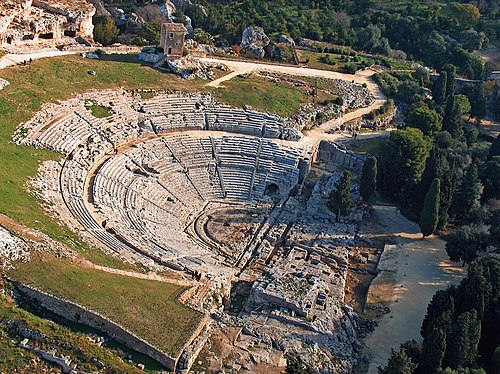
(Part I of this series is available here.)
ψυχὴ γὰρ εὔνους καὶ φρονοῦσα τοὔνδικον
κρείσσων σοφιστοῦ παντός ἐστιν εὑρετίς.

"A well-disposed mind, with righteous thoughts,
is a better inventor than any sophist."

— Sophocles, fragment 97 in Nauck (translation by Guthrie)
Gorgias, son of Charmantides, was born at Leontini in Sicily around 485 BC. He lived to be well over 100 years old.
Later authors describe a memorable visit Gorgias made to Athens in 427, when his native Leontini was under attack from Syracuse. The Leontines chose Gorgias to lead their embassy asking for Athenian help. Diodorus Siculus (fl. first century BC) describes the event:
The leader of the embassy was Gorgias the speaker, who in eloquence far surpassed all his contemporaries. He was the first man to devise rules of rhetoric and so far excelled all other men in the instruction offered by sophists that he received from his pupils a fee of one hundred minas. Now when Gorgias had arrived in Athens and been introduced to the people in assembly, he discoursed to them upon the subject of the alliance, and by the novelty of his speech he filled the Athenians, who are by nature clever and fond of dialectic, with wonder.… In the end he won the Athenians over to an alliance with the Leontines, and after having been admired in Athens for his rhetorical skill he made his return to Leontini. Bibliotheca Historica 12.53 (I slightly adapted the source's translation. Greek text available here.)
Gorgias the speaker—Γοργίας ὁ ῥήτωρ (Gorgias ho rhētōr)—is the phrase Diodorus uses to identify the famous Sicilian. The Greek word for "speaker"—rhētōr—is the source of our word rhetoric—the art of speaking, especially of speaking persuasively. To that phrase Diodorus adds the detail that Gorgias "in eloquence far surpassed all his contemporaries." A better translation of the Greek might be "who far surpassed all his colleagues by the awesome power of his speech"—by his deinotēs logou.
The stem of that word deinotēs—found also in the adjective deinos—comes from a verb that means "to fear"—δείδω (deidō). W. K. C. Guthrie explains the basic sense: "it stands for anything terrible or dreadful, as for instance in Homer weapons, the glare of a foe, the whirlpool Charybdis, thunder, lions. Of a goddess, it is coupled with 'reverend', and may have conveyed an idea more like 'the fear of the Lord'." (Guthrie, p. 32)
In another source, Plato's dialogue Meno, the eponymous speaker, a student of Gorgias, remarks that what impresses him most about his teacher is that he professes specifically to make his students deinoi legein—"awesome" or "terribly clever" at speaking (Meno 95c). Gorgias and his students possessed such powerful skill (deinotēs) in speaking as to make others fearful or at least put them in awe of their speech.
Gorgias was a professor, and purveyor, of an awesome, newly discovered technology.
Diodorus uses another important word to describe Gorgias's distinctive skill—the word σοφιστεία (sophisteia)—translated as "the instruction offered by sophists." What is a sophist?
Sophist, first of all, is no translation, but merely a calque, of the Greek word σοφιστής (sophistēs). It is a special kind of noun or name called, in Latin, a nomen agentis ("name of the doer")—the special name or title of a person who does a particular job or action.
Other examples of such "agent nouns" (nomina agentis) are ναύτης (nautēs, "sailor"), ποιητής (poiētēs, "maker" but also "poet"), and μαθητής (mathētēs, "learner" or "student" but also the New Testament word for "disciple"—from Latin discipulus); as well as the word ῥήτωρ (rhētōr) itself.
Sophistēs is formed from the noun sophia, which eventually came to mean "wisdom." But its earliest meaning was simply any kind of "skill" or “craft”—as, for example, in carpentry (see Iliad 15.412). Given its formation, the meaning of sophistēs should be something like skilled craftsman or artisan. But the meaning of both words—sophistēs and sophia—gradually expanded to indicate "wisdom" or "prudence" of a very general kind. And so the seven Sages of the ancient world were known as either sophoi (“wise men” or “the wise”) or sophistai (plural of sophistēs).
By the time Gorgias visited Athens, however, "Sophist" had taken on another more-specific sense. It was the title given (and sometimes accepted) to itinerant teachers who travelled the Greek world and offered instruction in various higher studies, for a substantial fee. (Diodorus claims that Gorgias received 100 minas.)
The oldest of such "Sophists" was Protagoras of Abdera, who is the chief interlocutor with Socrates in the dialogue that bears his name. In that dialogue, Socrates accompanies the young man named Hippocrates (not to be confused with the famous physician), who is eager to receive instruction from Protagoras. Socrates, however, is not sure what precisely the content and purpose of such instruction is. Hippocrates, when pressed, is likewise unable to say exactly what he hopes to gain from Protagoras’s lessons.
The great Sophist himself, however, has a ready answer. The particular lesson Hippocrates will receive is:
good judgement in his own affairs, how best to order his own home; and in the affairs of his city, how he may have most influence on public affairs both in speech and in action. (Plato, Protagoras 318e–319a)
To this Socrates responds, "Do I follow what you are saying? For you seem to me to speak of the art of citizenship and to be promising to produce good citizens." "That is precisely, Socrates, the very profession which I profess," answers Protagoras.
In the dialogue Protagoras, this exchange between the famous Sophist and Socrates opens up the question, central to all of Socrates’s and Plato’s thought, what is goodness or virtue? Protagoras’s profession, apparently, is the art of producing good people, or of making people good, by giving them instruction in virtue.
At least according to Plato, Protagoras is content to call his profession the art of citizenship—ἡ πολιτικὴ τέχνη (hē politikē technē). This is surely a claim worthy of careful consideration. Protagoras, the eldest of all Sophistai—a name which implies special expertise or general wisdom—makes a profession of educating good citizens. This goodness, moreover, involves or simply consists in the ability to influence others both in speech and in action. Is this a plausible description of the goal of education and the nature of human goodness? Is human goodness—being a good person—something that can be taught? Is virtue a particular kind of skill or craft? A form of technical expertise?
In the next chapter, we will take a close look at a specific example of Gorgias’s “sophistic” or rhetorical skill in action, to see how claims such as those of Protagoras were put into practice.
Sources & Further Reading
Billings, Joshua, and Christopher Moore, eds. The Cambridge Companion to the Sophists. Cambridge, United Kingdom: Cambridge University Press, 2023.
Guthrie, W. K. C. A History of Greek Philosophy. Volume Three. The Fifth-Century Enlightenment. Cambridge: Cambridge University Press, 1969.
Kerferd, G. B. The Sophistic Movement. Cambridge: Cambridge University Press, 1981.
McKirahan, Richard D. The Sophists. Abingdon, Oxon: Routledge, 2025.
Nails, Debra. The People of Plato: A Prosopography of Plato and Other Socratics. Indianapolis, IN: Hackett, 2002.
Plato. Gorgias. Edited by E. R. Dodds. Oxford: Clarendon Press, 1959.