Friends!
I have a draft of a thing that’s been sitting in a folder for several years. It’s unpublishable, unresearched, unfinished. But there’s something to it that makes me want to quit my job and run away up into the forests of northern California, renting a cabin somewhere along the way, in order to spend a whole year typing away at this thing and building a little shrine of a website around the idea.
I imagine this thing is part type specimen, part historical account and it would focus entirely on the life of a Milwaukee born 20th century type designer called Morris Fuller Benton.
The name is famous in typographic circles, but it’s one that I don’t think many designers have heard. And yet it’s a name that all of us should know and, I would argue, be in awe of. This is because of all the type designers that have ever lived, Morris Fuller Benton is quite probably the best of them.

🔠 Type Journal
The other day I stumbled upon Type Journal, a website “devoted to type design, visual culture and typography in the Russian-speaking world,” and this year they collected ten of their favorite Cyrillic typefaces, bundling them all up into a lovely little microsite:
After scanning the site for approximately 0.006 seconds I immediately fell head over heels for Casus Pro by Eugene Yukechev, a gorgeous serif that seems just as useful and beautiful at larger sizes as it is smaller ones. It sort of reminds me of a more reserved Eames as each letter appears refined and stately, punctual even. These lively characters look like they aren’t really down to party (they most certainly do not listen to EDM) but only because they’re all too busy being effortlessly reliable at work and at home:
🔠California as an Island
Friends!
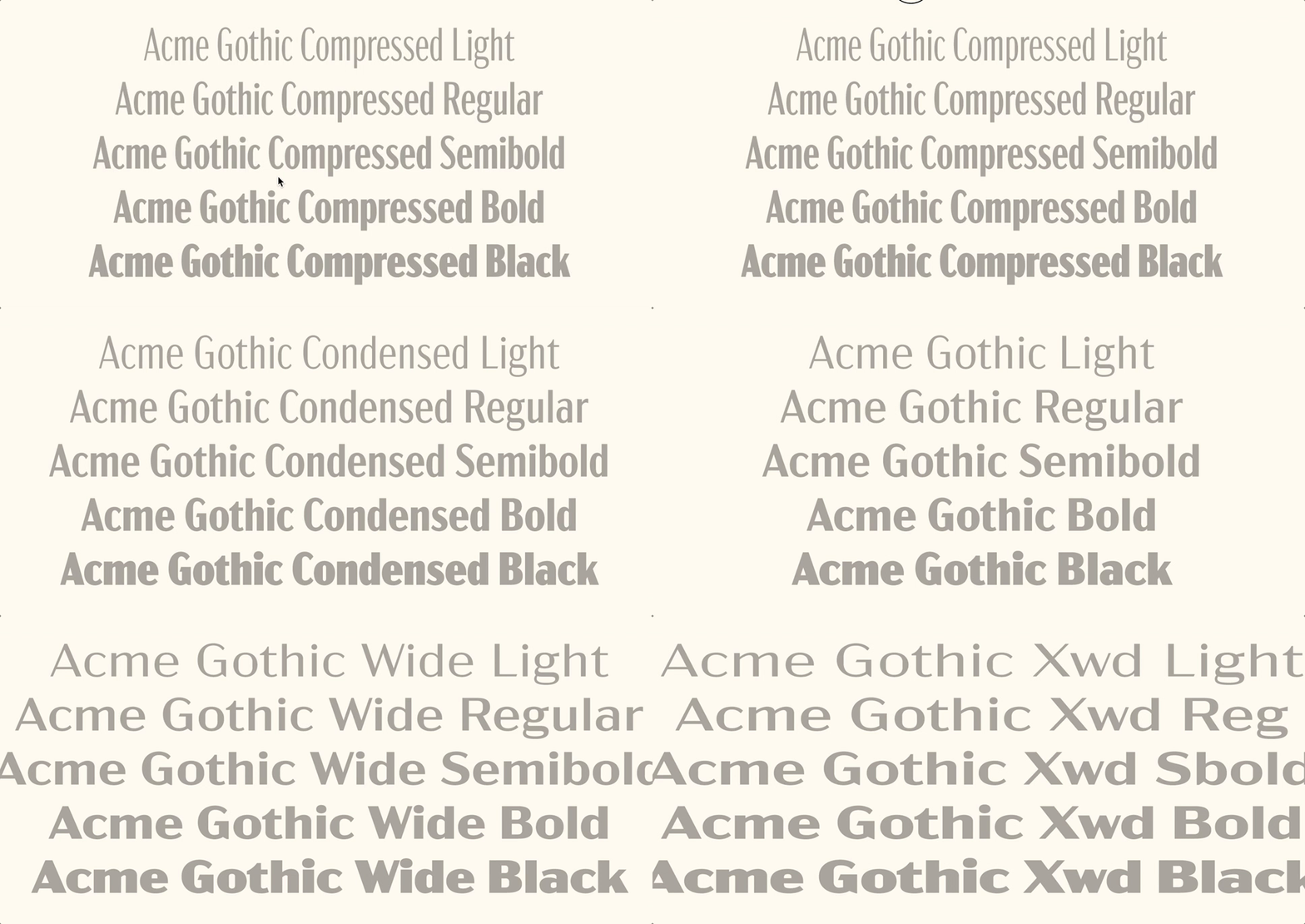
For a change of pace let’s talk about some real honest-to-goodness fonts, eh? One release that’s worth your attention and one I noticed that made me squeal with excitement was Acme Gothic, a new family my Mark Simonson that’s based on the lettering style that was pretty much everywhere in the U.S. in the early 20th century:
I can tell this is a lovely type family because of my big, dumb excitement about it. And generally speaking a lot of gothics look a little too mean and are trying too hard to be cool to be useful. Acme though doesn’t share the same quirks and since the family contains compressed, condensed, normal, wide and extrawide styles, it’s possible to cover a huge swath of design possibilities with ease.
🔠 Jack and the Magic Key
Friends!
It’s 2007: I’m sat in the kitchen watching a family friend and her four year old son talk to my mom. Over the course of a few minutes I notice how this kid, Jack, is starting to get bored; his eyes roll into the back of his head and all of his limbs begin to fidget independently of the host as if he’s possessed by the spirit of boredom itself.
In a flash my mom notices this before her friend does. Her eyes dart around the room, looking for something, anything, to entertain Jack with. Coming up short, my mom grabs the closest thing that was on the table: a key. I think it unlocked one of the older cabinets we had lying around back then so it was very nondescript and boring; it didn’t have any patterns on it, or engravings, and it certainly wasn’t imbued with ancient magic of any kind.
But my mom gets down to Jack’s level and hijacks his attention with the key. She twirls it between her fingers and Jack’s eyes expand to the size of saucers.
🔠 The Mark of Sincerity
Friends!
For the Atlantic, Julie Beck has written a lovely piece about the exclamation mark and how our use of it has changed in recent years:
Much like awesome once served a greater purpose, the exclamation point has been downgraded from a shout of alarm or intensity to a symbol that indicates politeness and friendliness. As Shipley and Schwalbe put it in their guide: “Exclamation points can instantly infuse electronic communication with human warmth.” And that’s what we use them for now.
“The single exclamation mark is being used not as an intensity marker, but as a sincerity marker,” says Gretchen McCulloch, a linguist who studies online communication. “If I end an email with ‘Thanks!,’ I’m not shouting or being particularly enthusiastic; I’m just trying to convey that I’m sincerely thankful, and I’m saying it with a bit of a social smile.”
This kind of communication isn’t only limited to messages with friends though, as I’ve started to notice how at work there’s something going on, too. Lowercase sentences, uncorrected spelling mistakes, the proliferation of emoji – all of it announces a new kind of enthusiasm and sincerity.
🔠 Reforma
Type pals!
If ever there was an award for the type foundry with the best italics then Pampatype would be amongst the front runners. It might come as no surprise then that when I stumbled over a piece they’d written about a new type family designed for Argentina’s Universidad Nacional de Córdoba called Reforma (which is simply beautiful in every which way) I was especially excited to see the italics:
🔠 The Secretary for Foreign Tongues
Friends!
I’m not sure if you have a favorite passage in the English language but I most certainly do, and it’s really the only parlor trick that I know. At a moment’s notice I can recite this bit of text and immediately become an unbearable 17th century Duke:
Thoughts, whither have ye led me, with what sweet
Compulsion thus transported to forget,
What hither brought us hate, not love, nor hope
Of Paradise for Hell, hope here to taste
Of pleasure, but all pleasure to destroy,
Save what is in destroying, other joy
To me is lost.
It’s a passage from Milton’s Paradise Lost where Lucifer describes how he gains pleasure only in breaking things and being a big, dumb jerk all the time. But he’s angry and doesn’t really want to be the devil and there’s something wildly interesting to me about that idea. Plus, the words just sound real good. Oh and try reading them aloud because that’s how Milton, once appointed as the Secretary for Foreign Tongues by the British Government (which is by far the coolest government position of all time if you ask me), dictated them due to his blindness. In other words his writing at this point was meant to be heard aloud, preferably as close as you can get to the seventeenth century; with a cozy fire and a sleeping dog.
🔠 Email is the Magic Key
Type pals!
Earlier this week I read an excellent post called How to Make a Book and it’s a collection of advice from writers and novelists about how to get started with a book of your own:
🔠 Potential Typography and the Oulipo
Chums! Pals! Life-long enemies with whom I shall only meet briefly before the painful end!
This week I picked up a copy of Many Subtle Channels, a book in which Daniel Levin Becker investigates the not-so-secret and almost-famous gathering known as the Oulipo. They’re a group of writers, poets, and mathematicians that are interested in two things: potential literature and constraints in writing. For example, one of the members of this illustrious group, Georges Perec, once wrote a novel without the letter “e”. That might sound daft but try and write a sentence without the letter “e” for a moment and you’ll find it’s much more difficult than it looks.
🔠 The National Geographic
Friends!
This week I’ve been obsessed with Foreday by the DSType Foundry and the reason why is quite extraordinary: I think it might be the first variable font where the options aren’t just font weight or the width of the characters. Instead, you can choose whether you have a sans or a serif typeface and change it on the fly.
Here, take a peek:
🔠 Honoring the Lexicographers
Dictionary friends!
On Tuesday I headed over to a book store in the Haight for the launch of Dictionary Stories, a peculiar little book by my pal Jez Burrows, and it just happens to be one of the most charming and joyous things I’ve ever read. In fact the book is overflowing with charm and I find myself thinking about it constantly.
Here’s the cover:
🔠 Hangul Fonts
Friends!
I’m a little worse for wear this weekend however I just wanted to write a brief note about a type specimen website published by Google that showcases a collection of Hangul fonts that they offer. It’s difficult to describe what’s going on because 1. it’s completely bananas and 2. it’s unlike any other specimen website I’ve seen before:
Hangul is the alphabet of Korea and this specimen site describes why developing webfonts for the language can get particularly complicated:
🔠 A Deadly Lowercase y
Type pals!
Last week Jason Pamental shared a link to Bona Nova which is a revival typeface of the serif persuasion and it’s designed by Mateusz Machalski. This specimen of Bona Nova is particularly lovely for so many reasons:
I love that Mateusz met the designer of the original Bona typeface, released in 1971 by Andrzej Heidrich, and the idea that the two of them sat down together with the student expanding and improving on Andrzej’s work from 40 years ago is simply lovely. I think it’s more often the case with revival typeface projects, such as a Baskerville or Caslon, that the type designer has only left over material from previous designers. Contacting the original designer is impossible because everyone has long since passed.
🔠 Typography is a Form of Kindness
Friends!
The Master Type and Media course at the Royal Academy of Art in the Hague is a masterclass in type design and the students there just released this lovely website in celebration of their work. It showcases all of the typefaces that they’ve been working on over the past twelve months and many of them are strikingly beautiful.
Take Henk by Martin Pyšný for example where things start off normal. We have a regular, italic and bold weight that share rounded serif characteristics like this: