#46 Spending $181 million on a painting
Unpacking the art world's $181M Pollock sale, tax loopholes, and potential money laundering.
Who in the world can spend $181 million USD on a painting?
Art history was just made at Christie’s in New York. Jackson Pollock’s "Number 7A, 1948" shattered records, selling for a whopping $181.2 million in less than seven minutes of bidding.
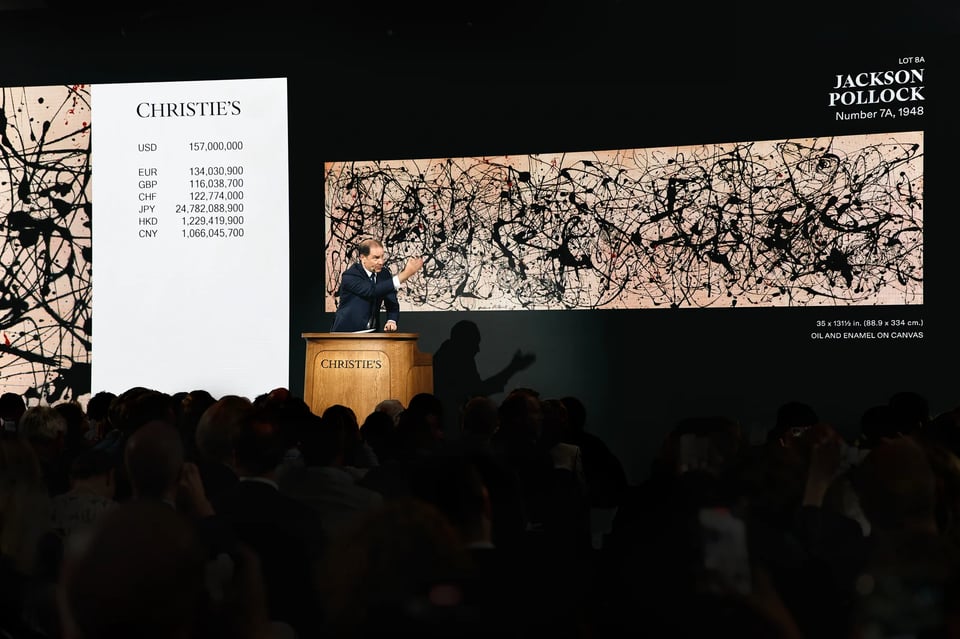
It begs the ultimate question: Who on earth has that kind of money, and why are the spending nearly $200 million on a painting?
Who?
While the phone bidder remains anon, the painting came from the estate of media tycoon S.I. Newhouse (Condé Nast). The buyers operating at this level belong to a tiny club of billionaires-like hedge-fund giants Ken Griffin and Steve Cohen-or sovereign states like Qatar, who routinely drop hundreds of millions to fill their state museums.
FAQ:
Is it a tax write-off?
Not directly. You can’t deduct a $181M luxury purchase from your tax bill. However, the ultra-wealthy use three legal strategies to protect their money:
The Freeport Loophole: Shipping the art straight to tax-free warehouses (like in Delaware or Geneva) allows buyers to legally skip state sales tax—saving about $16 million on this purchase alone.
The Cultured Donation: Collectors buy a piece, wait for its value to skyrocket, and donate it to a museum. They can then deduct the inflated fair-market value from their taxable income. (This is very common practice)
"Buy, Borrow, Die": Instead of selling art and paying a massive 28% Capital Gains Tax, billionaires use the $181M painting as collateral to take out low-interest bank loans. Because loan proceeds aren't taxable income, they get millions in tax-free cash to spend. (Also, very common)
Is it money laundering?
Probably not this specific auction, which happened under global scrutiny. But the wider art market? Absolutely.
Fine art has been a money launderer's paradise due to subjective pricing (art is worth whatever someone will pay), total anonymity via shell companies, and portability (it’s easy to roll up a multi-million-dollar canvas and fly it on a private jet).
A criminal can use dirty cash to buy art through a shell company, rotate it through international Freeports to tangle the paper trail, and eventually sell it at a legitimate auction house—walking away with a perfectly clean, official check.
Jackson Pollock’s "Number 7A, 1948"
If I had to put my money on it - my best guess is that this ends up in a Saudi gallery in the near future.
Onwards.

Add a comment: