
✨ on scarcity and abundance
2026-05-26
featuring Octavia Butler, Kohei Saito, Robin Wall Kimmerer, and more.
Dear friend—
The long-promised "abundance" essay has arrived. I started writing this more than a year ago, so some of it might feel weird and dated because of that, but hopefully the topic is ever-green :o) here she goes...
In February 2025, I read Octavia Butler’s Parable of the Sower, in which (light spoiler warning) a band of drug-addled arsons burn down the main character's walled neighborhood. Said main character, Lauren, flees with nothing but a pack of supplies into a world already writhing with collapse.
I read Parable the same year the book is set. While LA was burning in Lauren's world, LA was burning in mine. Wildfires swept through the city, leveling whole neighborhoods. Many people evacuated with nothing but the clothes on their backs.
I've been incredibly fortunate to have never have been in this position, but my childhood was haunted by the possibility of it.
As a kid, I would lay awake at night and imagine a variety of harrowing scenarios, unable to stop myself from digging deeper into each hypothetical, picking at them like scabs. What if a fire engulfed the house in the middle of the night? What if a flood submerged it to the first or second floor, and we couldn't escape? What would a comet strike or the end of the world feel like? I lined up my favorite stuffed animals--at the time, my most prized possessions--at the foot of my bed, for easy access in case of calamity.
As I got older, I eventually banished these night spirals with a healthy dose of compartmentalization. If a reminder of the thing is not directly in front of me, I can think and behave as though it doesn’t exist. Object im-permanence as coping mechanism.
This has been helpful in some ways (mental health, lol), but I worry that I have swung too far in the opposite direction. In Parable, Lauren’s neighborhood is destroyed because, among other reasons, no one could look slow-moving catastrophe and societal breakdown in the face.
The people in Lauren's community clung to the nostalgia for past security and empty hope for some external savior. As a result, no one prepared for the worst. Perhaps more importantly, no one acted to prevent it.
This book, besides opening with California wildfires in 2025, is eerily prescient. Many of the dynamics Octavia Butler captures--extreme wealth inequality, elites still scheming to jet to other planets while the rest of humanity suffers, privatization of absolutely everything, even a leader who promises to “Make America Great Again”--have already arrived in our current world.
But while I thought Parable of the Sower imparted important wisdom on what to do when shit hits the fan, I found myself wondering the whole time while reading, How do we avoid reaching this dire point in the first place?
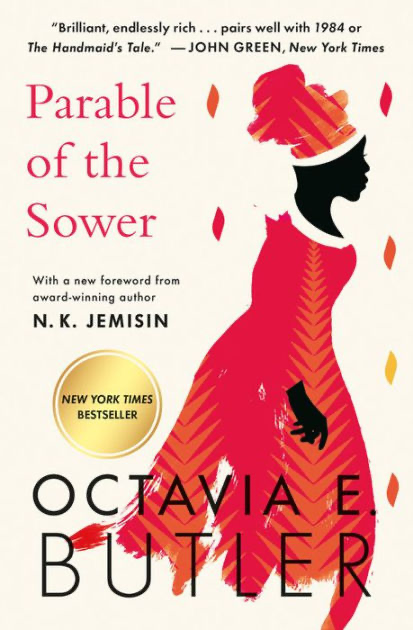
Lauren’s world is one of scarcity. There is no medical care or public services. Supermarkets are guarded by private security carrying machine guns. Cars and gas are rare, and most people travel on foot or by bike, their worldly possessions slung on their backs. It’s a world where any dumb or weak traveler could get knifed and robbed--or worse--in a blink.
Parable seems to emphasize the dangers of scarcity. How not having enough can turn people desperate and violent. It’s a version of humanity that I’m not sure I quite jive with--especially after seeing the love, resilience, steadfastness that remains strong in places like Gaza--but it’s one that I see reflected in the U.S. politics of today.
In the midst of economic crisis, it's all too easy for right-wing populists to turn people, who are often facing genuine hardship, against more marginalized groups. Naturalized citizens against newly arrived asylum-seekers. Working class white people against trans folks.
This is a vision of the world that won more than half of the voting electorate in 2024, as Trump promised lower grocery prices alongside mass deportations. This world is a dark and scary place of eat-or-be-eaten. It’s a zero-sum game where you can only get a leg up by pushing the people below you further into the dirt.
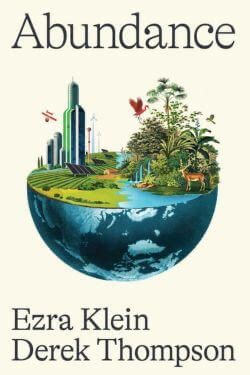
Recently, I’ve been reading many alternatives to this vision that center around abundance. To start, Ezra Klein and Derek Thompson’s new book, aptly named Abundance.
In the Klein and Thompson formulation, ensuring abundance for people is a lost art in liberal (i.e., left-leaning) politics. And the way we change that is by investing, innovating, and building. The future the authors imagine is one in which renewable energy, housing, new medical interventions, public transit--all the good stuff--are cheaper and abundant.
Accomplishing that, they argue, requires a hard look at the processes and regulations Democratic leaders have put into place that have made building more difficult and more expensive than ever. They point to cities like San Fransisco and New York City to make the case that procurement policies and regulations are contributing to cost of living crises in Blue states and cities.
Public input processes, for example, add years to approval timelines, adding costs onto projects. Moreover, these processes are often hijacked by well-to-do residents who have the resources and knowledge to fight any project that may lower the value of their houses. What was meant to be participatory democracy has been captured by wealthier interests.
They also critique what Klein calls “Everything Bagel Liberalism”--the phenomenon by which policymakers tack on so many requirements (e.g. union labor and labor from marginalized groups, environmental standards, participatory processes) that the projects become impossibly expensive or take so long that they don’t get done at all.
Ultimately, Klein and Thompson argue, these procedures and regulations stand in the way of the left’s goals, like affordable housing for all. As they write,
“... Does it make sense to be asking for special air filtration systems for developments near freeways when the alternative, for many of the would-be residents, is a tent beneath the freeway? To pose the question sounds callous. But to refuse to pose the question, given the need for more housing, is cruel.”
That, I think, is the crux of their critique of these processes and regulations: there has not been enough clear-eyed analysis of the trade-offs, no questioning of “Is this helping or hindering us in meeting our ultimate goal?”
We are in a time of ever-failing trust in institutions, including our government. Klein and Thompson are believers in government as an agent and engine of positive change, though they doubt its current capacity in various areas.
For them, the key to rebuilding this trust is to actually deliver--to say that we’re building lots of affordable housing and actually do it, to say that we’re building trains and bridges and parks and actually do it, etc. etc.
Further, they argue that a politics of abundance and a pattern of delivering is an essential counter to the rise of the far-right. Scarcity, they write, is a “handmaiden” of right-wing populism. It’s used as a bogeyman to close borders and reinforce hierarchies.
They cite one political scientist who concluded that climate policies drive those who bear the costs into the arms of right-wing strongmen who promise what people “have always wanted: the gift of abundant energy.” The alternative, therefore, is for liberals to give the people what they want--abundant energy--but by building more and more renewables.
With policies that help us build more, faster, better, we can deliver a good life for more people. Per Klein and Thompson, this is how we avoid the scarcity spiral--from the artificially constructed scarcity via policy to real scarcity in absolute terms--that will plunge us ever closer to the world Octavia Butler wrote about in Parable of the Sower.
✦
Before Abundance, I read Kohei Saito’s Slow Down: How Degrowth Communism Can Save The Earth, a completely different take on the answer to my question--How do we avoid reaching the dire state of society in Parable of the Sower in the first place?
Saito’s analysis would put the world of Parable in the hands of the intertwined crises of capitalism and climate change. These crises are the logical end to a world that has put profit before people and the planet. We now face climate-fueled disasters, extreme wealth inequality, and basic needs that are increasingly expensive and out of reach because of the havoc environmental degradation has wreaked.
Parable falls directly in one of the four different political projects Saito identifies as possibilities in a climate-changed world.
Barbarism: Anarchy, violence, societal breakdown, “eat or be eaten” in the face of climate disaster. (This is the world of Parable.)
Climate Maoism: An authoritarian state uses coercion, surveillance, and violence to force its citizens toward a greener future.
Climate Fascism: A strongman figure uses his power to continue accruing power and wealth to his allies while the world burns. (This feels like scenario the United States, with Trump at the helm, currently feels most on track to.)
And then there’s the model Saito advocates for, degrowth communism: a system of mutual aid, shared ownership of the commons, and participatory democracy that, together, slow capitalism’s ravages to the climate, environment, and humankind itself. Saito argues degrowth communism is the only viable alternative to these other three options.
Thompson and Klein have Words for degrowth; in some ways, these two books seem to be in direct conversation with each other. Abundance sees degrowth as its opposite; a model that falls squarely in the scarcity mindset they warn about. It's in the name, de-growth--how could we possibly get behind a vision of less?
But Saito would argue that, for one, Thompson and Klein's diagnosis is incorrect. Today’s scarcity is not largely caused by bad governance blocking innovation and deployment. Rather, the scarcity we face comes from capitalism itself. Scarcity is a key, defining feature of this system, because manufacturing artificial scarcity is key to making profit.
The laws of supply and demand may be familiar; the more supply of something, the lower demand for it, the lower the price. The less supply, the higher the demand, the higher the price. The latter, i.e. scarcity, is a major cog in the profit engine of capitalism.
While those who own the land or food or water make money off scarcity, the rest of us pay higher prices for the basic necessities of life. (This is a gross oversimplification of all the ways and reasons prices rise, but just giving a more concrete example to illustrate what i mean here!)
Moreover, this drive for profit creates its own scarcity, true scarcity; that is, the ruin of the natural processes and resources that we all depend on for survival. In essence, as Saito writes, “Quality of life is intentionally sacrificed in the name of driving up value."
To combat this, Saito sees degrowth communism as the only path to true abundance, in which everyone has everything they need on a thriving planet.
Crucially, Saito sees the abundance we experience in the Western world as a mirage. Like Klein and Thompson, he scorns the idea of increasingly cheap and abundant consumer products like TVs and smartphones as a measure of wellbeing. But he goes further by saying our very way of life in the West is dangerous because our abundance directly comes at the cost of people and environments elsewhere, causing extreme suffering and injustice as well as environmental collapse.
An oft-cited phenomenon--which I myself learned in grad school--is that developed countries become more environmentally friendly because they develop the technology to reduce pollution. It’s one that Klein and Thompson point to in advocating for eco-modernism (meaning lots of technology, in service of the a better, greener future).
But Saito argues that’s not the whole picture, as we export and obscure the harms of our lifestyle. For example, The United States has made incredible progress in cleaning up our air in recent decades. But that's less to do with "progress" than with the fact the polluting industries that support our lifestyles are now centered elsewhere, usually in the Global South.
This is what Markus Wissen and Ulrich Brand call “The Imperial Mode of Living”--comfort that relies on the suffering of others.
To me, this is one of the fundamental misses in Klein and Thompson's Abundance. They talk about tradeoffs, but only within a relatively small context. They don’t mention the tradeoffs baked into world trade and supply chains, in which Black and Brown people in the U.S. and abroad must suffer to support our lifestyles here.
The lithium poached from Native American lands and the cobalt mined by children in the Congo--both key metals for an electrified, clean energy future--underscore that under the status quo, even a green utopia in the U.S. would impose horrific costs for those we’ve long invisibilized and dehumanized. Technologies like renewable energy and high-speed rail will help us lower our impact, sure, but I have trouble believing, as Klein and Thompson seem to, that technological advances will save the planet.
In fact, Saito points out Jevons paradox, whereby increased efficiency leads to moreuse of the material or energy, leading to a net increase in that material or energy’s impact. For example, he notes that the growing popularity of larger, gas-guzzling SUVs have cancelled out what we gained from more fuel-efficient models.
Saito seems to speak directly to Klein and Thompson when he writes, “We should stop betting our future on the possibility that exponential growth in technological development will take care of things for us, exempting us from the need to modify our mode of living. Rather, we must change our mode of living so we can discover new forms of abundance.”
At the end of their book, Klein and Thompson argue that abundance and a "belief in plenitude" is a key feature of American identity through its history, and it must be a key feature of the politics of its future. But the examples they use to illustrate this history are telling. They quote a colonist in the 1600s and a British writer in the 1800s on the shocking abundance of natural resources found in "The New World."
Klein and Thompson fail to question--abundance for whom? They don't consider that the abundance that colonists and visitors were in awe of was only accessible through the genocide of peoples who both loved the land and understood how to nurture its abundance. Moreover, the two don't reckon with how this "belief in plenitude"--coupled with American exceptionalism and virulent racism--created a system of environmental and human subjugation that we are now paying for with a planet on fire.
✦
Notably, what degrowth proponents like Saito argue for is not a return to the harsh life of pre-capitalism, without the modern wonders of Penicillin or the internet or indoor plumbing, but rather a reconfiguration of society so that everyone’s basic needs are met (something capitalism has failed to do and in fact doesn't prioritize as a system) and the excesses of the wealthy (which are also destroying our planet, bringing more scarcity) are impossible.
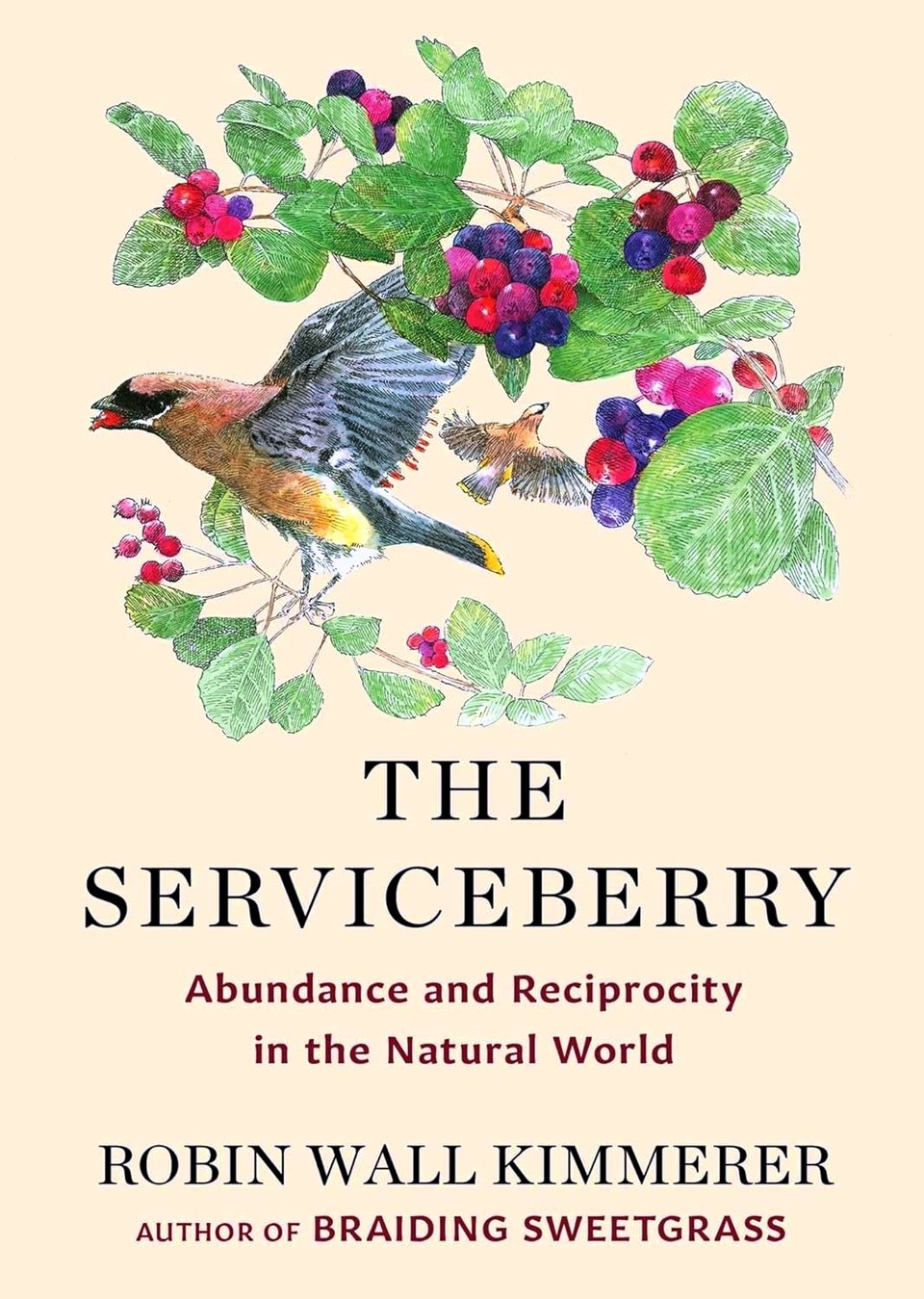
Before reading Saito, I read The Serviceberry, by Potawatami botanist Robin Wall Kimmerer. (Serviceberry includes a lot of the same ideas in Kimmerer's previous book, Braiding Sweetgrass, so I may refer to both here.)
One of the key themes in Kimmerer’s work is that we can find abundance through our way of being in the world, our way of seeing it. Even without the trappings of modern life, nature presents an abundance of gifts.
For example, berries on the bushes and fruit on trees offer themselves to us freely and in fact need us to eat them in order for them to spread and proliferate. Nature is full of relationships like this, where one species presents a gift to another--and the taking of that gift is in fact a gift in itself.
Crucially, Indigenous principles of the honorable harvest circumscribe how much and when we take. This culture of limitation, of taking only what you need and of respecting and nurturing the nature we take from (the river, the field, the fruiting trees), is key to preserving abundance for all.
In Kimmerer’s view, finding abundance happens both materially and mentally. Gratitude--expressed by enumerating our gifts, to start--creates a sense of abundance and satiety. It reminds us that we have everything we need.
When we pause and appreciate the wonders that we have, we can see the abundance inherent in that and stem the craving for more, more, more.1 And we can lean into generosity and gifting and relationships, instead of thinking we need to hoard everything and carefully guard it for some catastrophe in the future.
In many Indigenous cultures, Kimmerer notes, the idea of hoarding for times of scarcity doesn’t exist. Generosity and relationship is the name of the game; when you have surplus, you give to others with the knowledge that when you’re in need, others will give to you.
This is where true contentment and happiness lies--not in the rat race of the working world, or in consumerism or status or conveniences.
As Kate Soper points out in Post-Growth Living, economists and politicians are too quick to depict “human flourishing” as achieving a Western-style of affluence.2 Two cars, big house, white picket fence, etc. What they fail to acknowledge are “the inherently negative aspects of affluence and… the pleasures it is denying or removing.”
As Soper argues, rather than depict a slower, simpler lifestyle as a sacrifice we must make for a greater good (e.g. to avert climate disaster), degrowthers must emphasize what we stand to gain.
Car travel (and the car-dependent city planning) has poisoned our air and stolen the pleasures of nature and movement from us. Our consumption habits have obscured other, more fulfilling ways of finding novelty and shaping our identities. Constant grinding work in pursuit of material comfort has drained any chance of feeling fulfilled by that work.
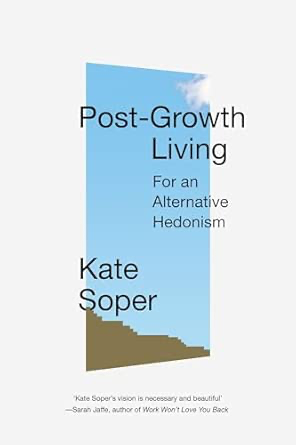
Soper has similar ideas to Saito about work, especially regarding craft. Both call for a return to more craft labor over the mass manufacturing that gives rise to most of the objects we use today.
Today, the manufacturing of objects is defined by isolating various parts into tasks and assigning each one to a person (or robot) to do ever and over and over again. In Ye Olde times, a craftsperson might design a chair, gather and chop the wood, carve the pieces, assemble it, and decorate.
Craftspeople have the skills to turn a dreamed thing into a reality with their own hands. This, Saito and Soper argue, puts the soul back into work; makes it more rewarding and less monotonous.
It’s much less efficient, sure, Saito writes, but this is a good thing. Less unnecessary chairs made for the express purpose of making someone richer; less deforestation for wood and resources put into marketing and transporting it.
But what do we gain from this kind of production? More care, more thought, more time for dreaming; chairs as beloved gifts to family, chairs as manifestations of imagination, chairs as pride of your own hands, etc. etc. That is its own kind of abundance, and probably one better for the soul.
✦
The work of Saito and others have me genuinely believing that to survive this world and be kinder to it, we will need to give up certain things.3 Personally, I think that I will have to give up some of the things and activities I’ve come to love to sustain the planet--if they’re not taken from me first. I don’t want to be taken by surprise like Lauren’s neighbors so that by the time the fires reach me, everything else has already collapsed.
U.S. consumption--of materials, of energy--is the major culprit for the Earth overshooting planetary boundaries. In other words, we are using and laying waste to so much of the Earth’s gifts that we are threatening the very processes that keep this whole operation--life on Earth--moving.
This is largely because of the ultra-wealthy but also the United States writ large. By one calculation, on average, someone amongst the richest 10% of people in India has just a quarter of the carbon footprint of someone amongst the poorest 50% in the United States.
To be clear, this is not to say that poor and working-class folks need to take responsibility for solving planetary collapse, but rather to illustrate the need to challenge and change, systemically, politically, fundamentally, how the powers-that-be order our lives in the U.S.
This order inundates us with cheap plastic that’s poisoning our earth, requires nearly everyone to have a car to get anywhere they need to, plans our towns and cities with endless sprawl, and feeds its population on carbon- and water-intensive foods that drain the soil of life. By design, even those who are struggling to make ends meet in the U.S. may still need to draw more from the Earth than she can give.
But there is an alternative. Writers like Saito and Soper and Kimmerer emphasize that while this alternative world will have less of some things, there will be so, so more of others.
In this world, I imagine there will be less online shopping but more community gardens and worker-owned independent businesses and book clubs and libraries. I imagine there will be less international travel but more beautiful public green spaces that anyone can enjoy; less time watching ~content~ and more time making and sharing art; less cars but more public transit; fewer blueberries in December but more delicious, healthy food for everyone.
It’s a world of less hyper-individualism, unnecessary material items, convenience, and security at the expense of others; but more of the delights of the natural world, of collective political power and joy, satiety and gratitude, generosity, relationships, love.
So, then, while Saito talks about the importance of “self-limitation,” building a more just and sustainable future is not only about denying ourselves things. As Soper would emphasize, it’s also about what we can embrace and build and spread and luxuriate in to bring this world more into being.
Thanks for reading, take care <3 <3
--mia xx
Kimmerer is writing against consumer culture here, not giving a prescription that also applies to those who don’t have their basic needs met! ↩
Tbh I don’t think she does this very well or compellingly, lmao. I wouldn’t really recommend this book except I think this idea is essential. ↩
The first person plural is once again doing some heavy living. Here I’m talking about middle-class folks in the U.S. And also, this whole essay is from the perspective of someone who has all her needs met and then some! So apologies if I word anything here insensitively, please lmk! ↩
Don't miss what's next. Subscribe to accidental light:
Add a comment: