Infographic of: Transaction Cost Economics
Management: Organization Theory
Transaction Cost Economics
Ronald Coase, Oliver E. Williamson (1937-1975)
Based on: Ronald H. Coase, The Nature of the Firm, Economica (1937); Oliver E. Williamson, Markets and Hierarchies: Analysis and Antitrust Implications (1975)
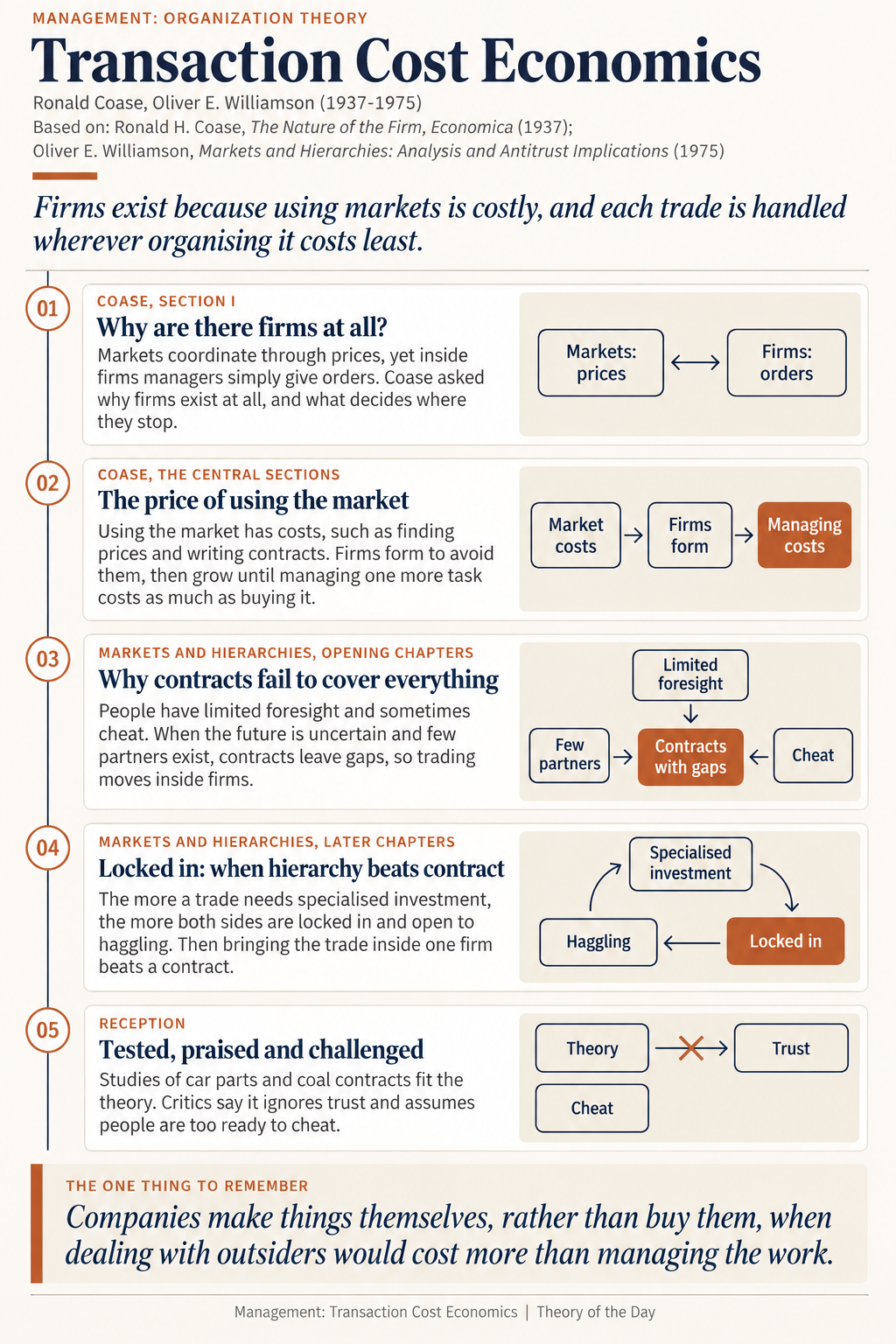
Firms exist because using markets is costly, and each trade is handled wherever organising it costs least.
In 1937 Ronald Coase, a young British economist, published The Nature of the Firm in the journal Economica. Economic theory of the time said that prices coordinate production, yet inside every firm managers direct staff by command. Coase asked a simple question: if markets work so well, why do firms exist, and what decides how big they are? Almost four decades later Oliver Williamson, an American economist, turned that question into a full theory in his book Markets and Hierarchies (1975).
Coase's article moves through six numbered sections. It begins by noting the puzzle, helped by Dennis Robertson's image of lumps of butter in a pail of buttermilk. It then argues that using the market has costs: finding the right price, bargaining, and writing a contract for each exchange. A firm lets an entrepreneur direct resources under one long employment contract, saving those costs. The later sections explain why firms do not grow without limit: as a firm gets larger, management makes more mistakes, so it expands only until organising one more task inside costs as much as buying it from outside.
Williamson's book moves from a general framework to applications. He asks what makes market exchange costly. The answer combines human factors and features of the situation. People have bounded rationality, a term from Herbert Simon meaning they cannot foresee or calculate everything. They are also sometimes opportunistic, meaning they pursue self-interest with guile. When the future is uncertain and few alternative partners exist, contracts cannot cover every case, and gaps invite exploitation.
The mechanism is therefore a comparison of costs. Each trade can be handled through the market or inside a hierarchy, a firm run by managers. Williamson stresses that trades needing investment valuable only to one partner lock both sides in once it is made, and so invite haggling. Later work gave this idea the name asset specificity. For such trades, bringing the activity inside one firm lowers cost. Drawing on Alfred Chandler's history of American business, Williamson also argued that the divisional form of large firms saves costs by separating strategy from daily operations.
Several people shaped the theory. Coase supplied the founding insight and the cost-comparison logic. Williamson supplied the behavioural assumptions, the focus on lock-in, and a research programme that could be tested. Coase later received the Nobel Prize in economics in 1991, and Williamson shared it in 2009 with Elinor Ostrom.
The theory has been tested widely. Monteverde and Teece found carmakers made specialised-engineering parts in-house more often, Masten found similar patterns in aerospace, and Joskow found long coal contracts where plants sat beside mines. Critics have pushed back. Mark Granovetter argued in 1985 that trust and social ties restrain cheating without hierarchy. Sumantra Ghoshal and Peter Moran said in 1996 that the theory's pessimism about people can harm management practice. Casadesus-Masanell and Spulber disputed a famous car-industry example, and Coase himself later questioned it. The theory still matters because it underlies debates on outsourcing, mergers and competition policy, where the question is always whether to make or to buy.
The work, part by part
1. Why are there firms at all?
Coase, Section I
In 1937 Ronald Coase, then a young economist, noticed a gap in standard theory. Economists said prices coordinate economic life, yet inside any firm a manager directs workers by command, not by price. Borrowing Dennis Robertson's image of lumps of butter in a pail of buttermilk, Coase asked why such lumps form, and what decides how big they are.
2. The price of using the market
Coase, the central sections
Coase argues that using the market has costs: finding the right price, bargaining, and writing a contract for every exchange. A firm saves these costs by letting an entrepreneur direct resources under one long employment contract. It grows until organising one more task internally costs as much as buying it from the market or another firm, because managers make more mistakes as the firm gets bigger.
3. Why contracts fail to cover everything
Markets and Hierarchies, opening chapters
Williamson's 1975 book Markets and Hierarchies explains why market costs vary. He builds on Herbert Simon's idea of bounded rationality (people cannot foresee or compute everything) and adds opportunism (pursuing self-interest with guile). When the future is uncertain and only a few partners exist, contracts cannot cover every case and partners may exploit the gaps, so internal organisation becomes attractive.
4. Locked in: when hierarchy beats contract
Markets and Hierarchies, later chapters
Williamson argues that trades differ in how much they tie partners together. If a trade needs investment worthwhile only for this partner, both sides are locked in once it is made, and can haggle or exploit each other. He concludes that such trades are safer inside one firm, and, following Alfred Chandler, that divisional structures run large firms efficiently.
5. Tested, praised and challenged
Reception
Later studies largely supported the logic: Monteverde and Teece found carmakers kept specialised parts in-house, and Joskow found long coal contracts where plants sat beside mines. Mark Granovetter countered in 1985 that trust and social ties, not hierarchy, restrain cheating. Sumantra Ghoshal and Peter Moran added in 1996 that its gloomy view of people can itself encourage distrust.
The argument in four steps
- Using markets is not free: finding partners, bargaining and writing contracts all cost money.
- Because people have limited foresight and sometimes cheat, contracts for complex, specialised trades stay incomplete.
- Where such trades lock partners together, haggling and hold-up become costly, so managers' orders do better than prices.
- So each trade is organised wherever its total cost is lowest, and that fixes the firm's boundary.
Who contributed what
- Ronald Coase (1937): In The Nature of the Firm, showed firms exist because using markets has costs, and set their size limit.
- Oliver E. Williamson (1975): In Markets and Hierarchies, explained why those costs arise: limited foresight, opportunism, few partners, and lock-in.
The evidence
- Monteverde and Teece's 1982 study found carmakers made specialised-engineering parts in-house more often.
- Joskow's 1987 study found coal contracts run longer where power plants sit beside one mine.
- Masten's 1984 study of aerospace parts found complex, specialised components were more often made in-house.
The criticisms
- Granovetter (1985) argued trust and social ties, not hierarchy, restrain cheating in markets.
- Ghoshal and Moran (1996) said its assumption of opportunism is gloomy and can harm practice.
- Casadesus-Masanell and Spulber (2000) disputed the Fisher Body case often cited as proof.
Compared with rival views
- Unlike standard price theory, it explains where a firm ends instead of treating the firm as a black box.
- Unlike power-based views such as Stephen Marglin's, it explains hierarchy by cost saving, not control of workers.
Why it matters today
Used in outsourcing decisions: firms weigh contracting costs and lock-in risks when choosing whether to make parts or services in-house.
Further reading
- Peter G. Klein and Michael E. Sykuta (eds.), The Elgar Companion to Transaction Cost Economics (2010)
- Aric Rindfleisch and Jan B. Heide, Transaction Cost Analysis: Past, Present, and Future Applications (1997)
- Oliver E. Williamson and Scott E. Masten (eds.), The Economics of Transaction Costs (1999)