Infographic of: Theory of the Public Sphere
Politics: Political Philosophy
Theory of the Public Sphere
Jürgen Habermas (1962)
Based on: Jürgen Habermas, The Structural Transformation of the Public Sphere: An Inquiry into a Category of Bourgeois Society (1962)
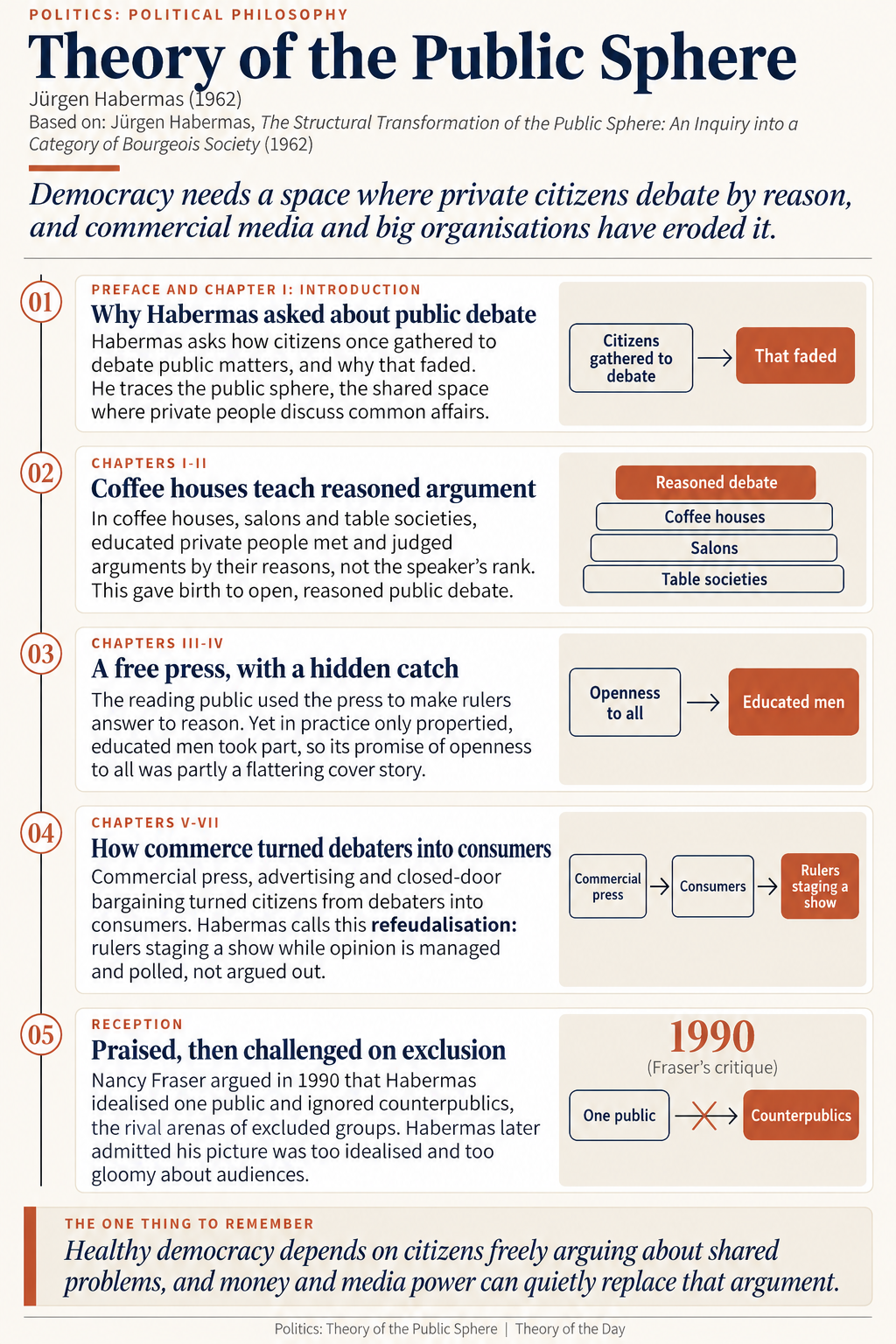
Democracy needs a space where private citizens debate by reason, and commercial media and big organisations have eroded it.
Jürgen Habermas wrote The Structural Transformation of the Public Sphere as a young scholar in West Germany, finishing it as a university thesis at Marburg under Wolfgang Abendroth and publishing it in 1962. Having worked with Theodor Adorno in Frankfurt, he wanted to understand how democracy could rest on citizens' own judgement after the Nazi period and in an age of mass media. His question was historical: how did private people come to debate politics openly, and why did that debate seem to fade? The English translation of 1989 brought the book a worldwide readership.
The book has a preface and seven chapters. The introduction defines the public sphere as the space between private life and the state where people form opinion by discussion. It contrasts this with the medieval lord who simply displayed his status before an audience, which Habermas calls representative publicness. The next chapters describe coffee houses, salons and table societies, where educated people met as equals, and show how reading novels and journals trained them to argue. The debating public then moves from literature to politics, using the press to demand that rulers justify laws by reason. The chapter on idea and ideology sets the ideal of openness to all against the reality that property and education restricted membership. The later chapters trace how the sphere changed in the nineteenth and twentieth centuries, and the final chapter examines the concept of public opinion.
The mechanism is a shift in who fills the public sphere and why. In the eighteenth century a newly independent middle class, with a family life that encouraged reading, supplied citizens who judged arguments by reasons and not rank. Their critical opinion limited state power. Then the state began to manage the economy and welfare while private organisations took on public power, so that society and state merged. The press became a business that sold advertising, and public relations let organisations stage their image. Citizens became consumers of culture and spectators of politics. Habermas calls the result refeudalisation, because publicity once again means display for an audience rather than critical scrutiny by one.
Habermas is the sole originator, but later scholars reshaped the idea. Nancy Fraser argued in 1990 that excluded groups formed their own counterpublics (rival arenas of debate), so a single public never existed. Geoff Eley and others in Craig Calhoun's 1992 collection pressed historical points about exclusion and conflict. Habermas answered in his own contribution to that volume and in Between Facts and Norms (1992), where he treats the public sphere as a network of communication feeding law-making and is less gloomy about audiences.
His historical evidence is drawn from English, French and German sources, including London coffee houses and journals such as the Spectator. Dena Goodman's study of the Enlightenment salons confirms that sociable debate flourished but shows women shaped it, which complicates his picture. Yochai Benkler's work on networked media suggests that new technology can reopen participation. Critics say he idealised an exclusive middle-class public and underplayed conflict, as Fraser and Eley argue. Others, citing audience research such as Katz and Lazarsfeld's, say ordinary audiences are less passive than he implied. Habermas himself accepted that his account was too gloomy about audiences.
The book still matters because it gives a vocabulary for asking whether media, money and platforms support or undermine democratic debate. Journalists, lawyers and political theorists use the public sphere to discuss fake news, echo chambers and press freedom. Its central lesson is that democracy depends on a space where reasons, not status or wealth, decide what counts.
The work, part by part
1. Why Habermas asked about public debate
Preface and Chapter I: Introduction
Habermas wrote this as a young scholar in post-war West Germany, completing it as a university thesis before it appeared in 1962. He asks how ordinary citizens once came together to argue about public matters, and why that seems to have faded. He traces the public sphere (the shared space where private people debate common affairs) from its rise to its decline.
2. Coffee houses teach reasoned argument
Chapters I-II
Habermas first contrasts the medieval lord, who displayed his status before onlookers (representative publicness), with the later middle-class (bourgeois) public sphere. In the late seventeenth and eighteenth centuries, coffee houses in England, salons in France and table societies in Germany let educated private people meet. There, reading novels and journals, they judged arguments by their reasons rather than by the rank of the speaker.
3. A free press, with a hidden catch
Chapters III-IV
Habermas shows the debating public turning from literature to politics, using the press to hold rulers to account. Its ideal was that laws should come from reasoned argument, open in principle to all. But he argues this was also ideology (a flattering story hiding real interests), because in practice only property-owning, educated men took part, while women, workers and the poor were left out.
4. How commerce turned debaters into consumers
Chapters V-VII
In the twentieth century, Habermas argues, state and society grew entangled and organised interests bargained behind closed doors. The commercial mass press, advertising and public relations turned citizens from debaters into consumers of entertainment, and he calls this refeudalisation (rulers staging a show for an audience). Public opinion, he says, is now managed and polled rather than formed by argument.
5. Praised, then challenged on exclusion
Reception
The English translation of 1989 made the book a foundation of media studies and democratic theory. Nancy Fraser argued in 1990 that Habermas idealised a single public and overlooked counterpublics (rival arenas formed by women, workers and other excluded groups). Habermas later conceded that his picture was too idealised and too gloomy about audiences, and he reworked the idea in Between Facts and Norms (1992).
The argument in four steps
- In the eighteenth century, educated private people began meeting in cafes and reading journals to debate shared concerns.
- Their reasoned debate created public opinion, which rulers had to answer to, shifting authority from status to argument.
- Later, commerce, mass media and bargaining between big organisations turned active citizens into passive consumers.
- So public opinion is now managed rather than formed through argument, and democracy needs the public sphere renewed.
Who contributed what
- Jürgen Habermas (1962): The Structural Transformation of the Public Sphere traced the rise and decline of the bourgeois public sphere.
- Nancy Fraser (1990): In 'Rethinking the Public Sphere', argued for multiple competing counterpublics instead of one bourgeois public.
- Geoff Eley (1992): In 'Nations, Publics, and Political Cultures', showed the public sphere was shaped by exclusion and conflict, not consensus.
The evidence
- Habermas's 1962 study of London coffee houses and the Spectator showed argument overriding rank.
- Dena Goodman's The Republic of Letters (1994) showed women hosting and shaping French Enlightenment salons.
- Benkler's The Wealth of Networks (2006) argued the internet opens a networked public sphere.
The criticisms
- Nancy Fraser: it idealises one bourgeois public and ignores women's and workers' counterpublics.
- Geoff Eley: it overstates a past golden age and understates conflict and exclusion.
- Audience research, like Katz and Lazarsfeld's, finds audiences less passive than Habermas implies.
Compared with rival views
- Unlike Arendt's public realm of action, it is a historical institution built on reasoned talk.
- Unlike Adorno and Horkheimer's gloomy culture-industry thesis, it sees the critical public as revivable.
Why it matters today
Debates over whether social media platforms help or harm democratic discussion routinely use Habermas's public sphere as their yardstick.
Further reading
- Craig Calhoun (ed.), Habermas and the Public Sphere (1992)
- Nancy Fraser, Rethinking the Public Sphere: A Contribution to the Critique of Actually Existing Democracy (1990)
- William Outhwaite, Habermas: A Critical Introduction (1994)