Infographic of: The Power of Now
Positivity: Classic Positive Thinking
The Power of Now
Eckhart Tolle (1997)
Based on: Eckhart Tolle, The Power of Now: A Guide to Spiritual Enlightenment (1997)
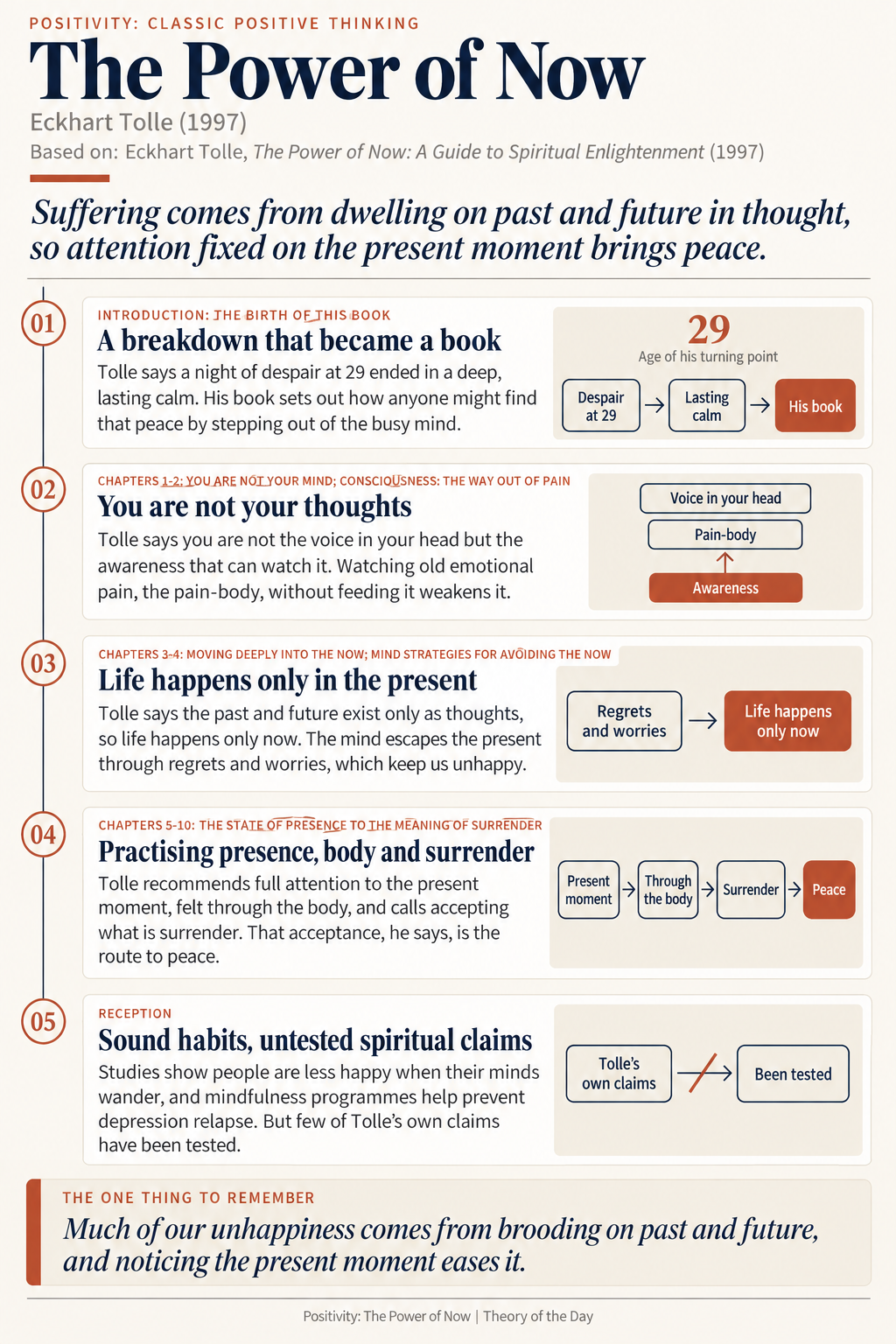
Suffering comes from dwelling on past and future in thought, so attention fixed on the present moment brings peace.
Eckhart Tolle's The Power of Now was first published in Canada in 1997 and reached a worldwide readership after a US edition in 1999. It grew from Tolle's own account of a crisis. He says that at 29, after years of anxiety and depression, he woke one night unable to live with himself, and that the thought split his mind in two: if he could not live with himself, who was the self he could not live with? The next morning, he says, he felt a deep calm. The book asks how people can end the suffering they create through their own thinking.
The book is a short introduction followed by ten chapters, mostly in question-and-answer form. Chapter 1, You Are Not Your Mind, argues that the constant stream of thought is not the self, and that the real you is the awareness that can watch it. Chapter 2, Consciousness: The Way Out of Pain, introduces the pain-body, a store of old emotional pain that Tolle says feeds on negative thinking. Chapters 3 and 4 move into the Now, the present moment, and describe the mind's strategies for avoiding it, such as dwelling on regrets or waiting for a better future. Chapters 5 to 7 turn to practice: the state of presence, the inner body (the felt aliveness inside the body), and what Tolle calls portals into the Unmanifested, such as stillness. Chapter 8 applies the ideas to relationships, Chapter 9 says peace lies beyond happiness and unhappiness, and Chapter 10 concerns surrender, meaning acceptance of what the moment contains.
The mechanism is a shift of attention. Tolle holds that identifying with thought creates a false self, the ego, which lives in what he calls psychological time: it is always replaying the past or chasing the future. That produces anxiety, regret and conflict. When a person notices thoughts and emotions without joining in, and rests attention in the body and the present moment, the ego's grip loosens and the pain-body loses its fuel. Practical tasks still need clock time, he says, but they can be done without inner turmoil.
Tolle presents himself as a spiritual teacher rather than a researcher, and he draws freely on Buddhist, Christian and other traditions. The scientific work that overlaps with his themes came from others. Jon Kabat-Zinn built mindfulness-based stress reduction in the late 1970s and reported results from a pain clinic in 1982. Zindel Segal, Mark Williams and John Teasdale developed mindfulness-based cognitive therapy for depression, described in their 2002 book. Matthew Killingsworth and Daniel Gilbert showed in 2010 how often minds wander and how that relates to mood.
The evidence supports parts of the picture but not the whole. Killingsworth and Gilbert's phone survey found people were less happy when their minds wandered. Teasdale and colleagues found in 2000 that mindfulness-based therapy reduced relapse in people with repeated depression. Kabat-Zinn's early pain-clinic study had no control group. None of this tests Tolle's own claims about the pain-body or enlightenment, which rest on his testimony. Nicholas Van Dam and colleagues warned in 2018 that mindfulness research is often hyped, and Lindahl and colleagues documented distress among some meditators in 2017.
The book still matters because its central advice, to notice your thoughts rather than obey them and to attend to what is happening now, matches techniques with good research support. It brought that idea to a very large readership, and the mindfulness courses used to prevent depression relapse teach a related skill. It is best read as a spiritual guide with a useful practical core, not as a scientific theory.
The work, part by part
1. A breakdown that became a book
Introduction: The Birth of This Book
Eckhart Tolle begins with his own story. At 29, after years of anxiety and depression, he woke one night unable to bear living with himself, and says he then awoke to a deep, lasting calm. The book, set out as questions and answers, offers his account of how anyone might reach that peace.
2. You are not your thoughts
Chapters 1-2: You Are Not Your Mind; Consciousness: The Way Out of Pain
In the first chapters Tolle argues that most people are trapped by the constant stream of thought in their heads, which he calls the mind, and mistake it for who they are. Behind it, he says, is awareness, which can simply watch thoughts without being them. He also describes the pain-body, an old store of emotional pain that feeds on negative thinking, and says watching it with awareness weakens it.
3. Life happens only in the present
Chapters 3-4: Moving Deeply Into the Now; Mind Strategies for Avoiding the Now
Tolle claims that past and future exist only as thoughts, and that real life is only ever the present moment, the Now. He says the mind avoids the Now by dwelling on regrets, hopes and worries, which he calls psychological time, as opposed to the clock time needed for practical tasks. Chapter 4 lists such strategies, including waiting for a better future, and argues they keep people unhappy.
4. Practising presence, body and surrender
Chapters 5-10: The State of Presence to The Meaning of Surrender
The later chapters turn to practice. Tolle urges presence, meaning full attention to the moment, and feeling the inner body, the sense of aliveness inside the body, as a way into it. He says gaps in thought, relationships treated as chances to be present rather than fixes for emptiness, and surrender, which means accepting what the moment already holds instead of fighting it, can all bring peace.
5. Sound habits, untested spiritual claims
Reception
Research on mind-wandering by Matthew Killingsworth and Daniel Gilbert (2010) found people are less happy when their thoughts stray from what they are doing, and mindfulness-based programmes help prevent depression relapse. Yet few of Tolle's own claims, such as the pain-body or enlightenment, have been directly tested. Nicholas Van Dam and colleagues (2018) also warned that mindfulness benefits are often overstated.
The argument in four steps
- Most people identify with the constant stream of thoughts in their heads and take it to be themselves.
- That thinking dwells on past regrets and future worries, which exist only in the mind, never in reality.
- Pain grows when thought replays the past; attention to the body and the moment starves it.
- Therefore peace comes from noticing thoughts without obeying them and accepting the present moment as it is.
Who contributed what
- Eckhart Tolle (1997): The Power of Now set out presence, the pain-body and surrender as a path to peace.
- Zindel Segal (2002): With Williams and Teasdale, built mindfulness-based cognitive therapy, shown to cut depression relapse.
- Matthew Killingsworth (2010): With Daniel Gilbert, a phone survey showed wandering minds go with lower happiness.
The evidence
- Killingsworth and Gilbert's 2010 phone study found wandering minds went with lower happiness.
- Teasdale and colleagues' 2000 trial found mindfulness-based therapy cut relapse in people with repeated depression.
- Kabat-Zinn's 1982 uncontrolled pain-clinic study reported patients' pain and mood improved after mindfulness training.
The criticisms
- Van Dam and colleagues (2018) say mindfulness benefits are overstated and poorly measured.
- Tolle's claims about enlightenment and the pain-body rest on personal testimony, not tests.
- Lindahl and colleagues (2017) documented distress and other adverse effects among some meditators.
Compared with rival views
- Unlike Peale's positive thinking, it asks you to watch thoughts, not replace them.
- Unlike the Law of Attraction, it seeks peace now, not future goals drawn by thought.
Why it matters today
Mindfulness courses used to prevent depression relapse teach present-moment attention, the practice Tolle's book brought to general readers.
Further reading
- Matthew A. Killingsworth and Daniel T. Gilbert, A Wandering Mind Is an Unhappy Mind (2010)
- Nicholas T. Van Dam and others, Mind the Hype: A Critical Evaluation and Prescriptive Agenda for Research on Mindfulness and Meditation (2018)
- Ronald Purser, McMindfulness: How Mindfulness Became the New Capitalist Spirituality (2019)