Infographic of: The Metropolis and Mental Life
Sociology: Classical Foundations
The Metropolis and Mental Life
Georg Simmel (1903)
Based on: Georg Simmel, The Metropolis and Mental Life (1903)
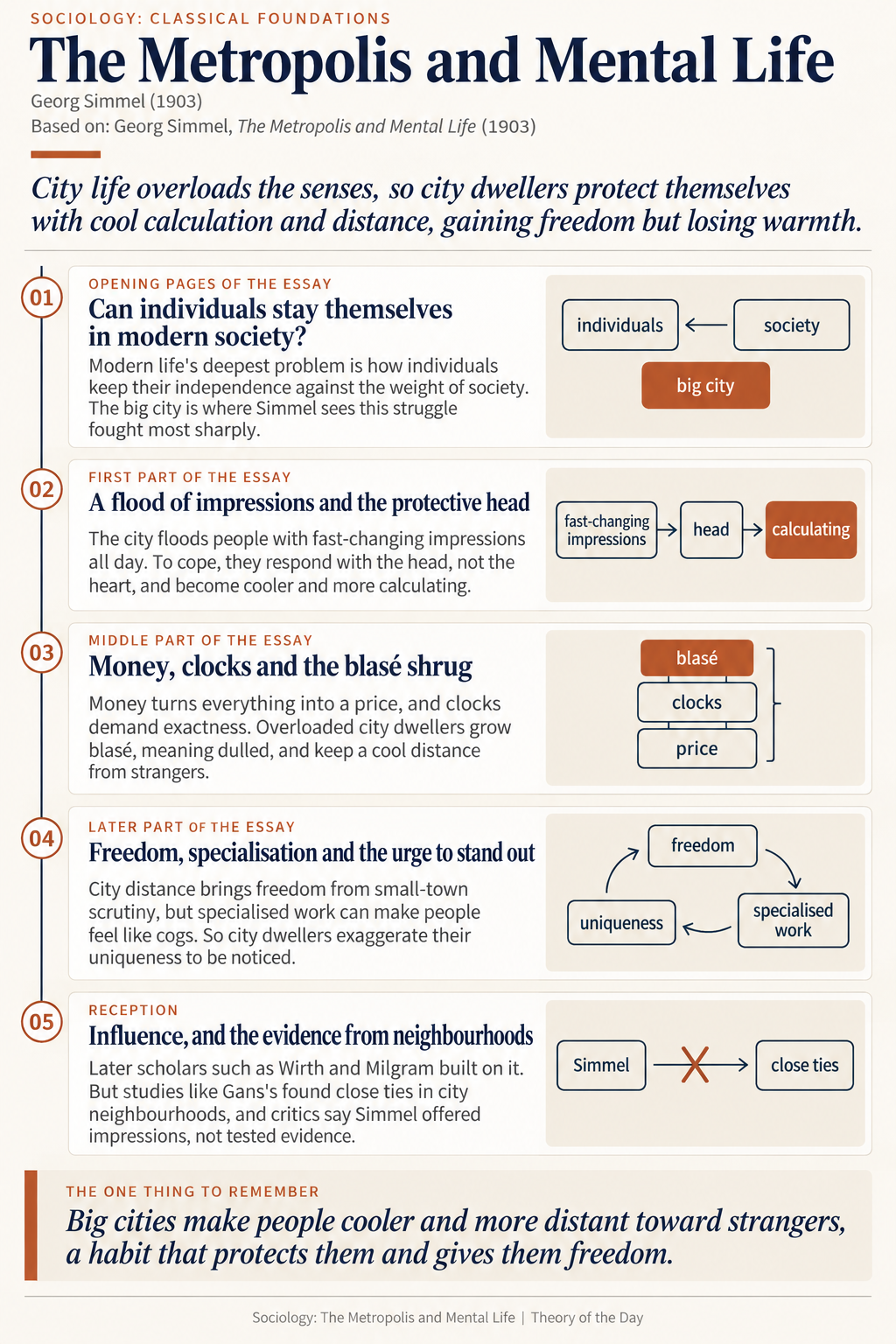
City life overloads the senses, so city dwellers protect themselves with cool calculation and distance, gaining freedom but losing warmth.
Georg Simmel, a Berlin philosopher and sociologist, wrote 'The Metropolis and Mental Life' in 1903 for a series of lectures on the city held in Dresden. In German it is 'Die Großstädte und das Geistesleben'. German cities were growing quickly, and many writers worried that crowded, commercial life was making people shallow. Simmel set out to ask a precise question: how does life in a big city change the inner life of the people who live there?
The essay has no numbered chapters, but it moves in clear stages. It opens by naming what Simmel sees as the deepest problem of modern life: how individuals keep their independence against the overwhelming weight of society, tradition and technique. He then describes the city's constant stream of changing impressions and what this does to the nerves. Next he links the calculating mind to the money economy, to clocks and to timetables. He goes on to the blasé attitude and to reserve, then to freedom, specialisation and the urge to stand out, and he ends by presenting the city as the arena where these struggles are fought.
Simmel's mechanism runs as a chain. Constant stimulation threatens to overwhelm the person, so city dwellers respond with the head rather than the heart, using intellect as a protective organ. This cool, calculating mind suits a money economy (a society where most things are bought and sold), which reduces things to prices and rewards exactness. Its side effects are the blasé attitude, a dulled indifference to differences between things, and reserve, a polite distance from strangers that can shade into mild aversion. That same distance frees people from the watchful, narrow community of the small town, but it can also leave them lonely. Because specialised work makes each person a small part of a huge machine, people try to stand out by exaggerating their individuality.
Simmel drew on his own earlier book, The Philosophy of Money (1900), which argued that money shapes how modern people think. Others carried the essay forward. Robert Park, who had heard Simmel lecture in Berlin, helped make these ideas central to the Chicago school of urban sociology. Louis Wirth's 1938 article 'Urbanism as a Way of Life' tied city size, density and variety to impersonal contacts. Stanley Milgram's 1970 article 'The Experience of Living in Cities' recast Simmel's point as a theory of information overload. Kurt Wolff's 1950 English translation made the essay widely available.
Some evidence fits Simmel's picture. Bornstein and Bornstein's 1976 study found that people walk faster in larger towns, and Levine and colleagues' 1994 study of 36 American cities found less helping in denser ones. Critics reply that the evidence is partial. Herbert Gans's 1962 study The Urban Villagers found close family and neighbourhood ties inside a big city. Claude Fischer argued that cities produce many lively subcultures, not simply isolation. Others note that Simmel offers vivid impressions rather than systematic data, so his claims are hard to test.
The essay still matters because it was one of the first to treat the city as a state of mind and not only a place. Researchers on urban mental health, designers of dense cities and writers on modern information overload all return to its questions about stimulation, indifference and freedom. It also shows a lasting lesson of classical sociology: our social surroundings shape how we feel and think, not just how we behave.
The work, part by part
1. Can individuals stay themselves in modern society?
Opening pages of the essay
Simmel wrote the essay in 1903 for a series of lectures on the city in Dresden. He opens by naming modern life's deepest problem, which is how individuals keep their independence against the weight of society and tradition. He sees the big city as the place where this struggle, running from the eighteenth century's call for freedom to the nineteenth's wish to be unique, is fought most sharply.
2. A flood of impressions and the protective head
First part of the essay
Simmel argues that the city bombards people with a constant stream of quickly changing impressions, which strains the nerves. Small-town life moves at a slower, steadier pace and runs more on habit and feeling. City dwellers therefore shield themselves by responding with the head rather than the heart, becoming cooler and more calculating.
3. Money, clocks and the blasé shrug
Middle part of the essay
Simmel links the calculating mind to the money economy, a society where most things are bought and sold, since money reduces everything to a price. City life also runs on clocks and timetables, which demand punctuality. Overloaded by stimulation, people become blasé (dulled and indifferent), and among strangers they keep a reserve, a cool distance that can shade into mild dislike.
4. Freedom, specialisation and the urge to stand out
Later part of the essay
Simmel argues that the city's distance brings real freedom, since people escape the watchful eyes and narrow rules of the small town. The large city also pushes specialisation, so each person is valued for a narrow task and can feel like a small cog in a huge machine. In response, people strive to be different, even exaggerating their own uniqueness, to be noticed.
5. Influence, and the evidence from neighbourhoods
Reception
Simmel's essay shaped urban sociology, and Louis Wirth's 1938 article on urbanism and Stanley Milgram's 1970 work on overload developed its themes. Evidence is mixed, however, since Herbert Gans's study of Boston's West End found close family and neighbourhood ties inside a big city. Critics also say Simmel offered vivid impressions rather than tested evidence.
The argument in four steps
- City life brings a constant flood of fast-changing impressions that strains the nerves.
- Dwellers shield themselves with cool intellect, which suits the money economy's prices, clocks and timetables.
- That protection breeds blasé indifference and reserve toward strangers, which also frees people from small-town control.
- So city life makes people more calculating, distant and free, yet driven to stand out.
Who contributed what
- Georg Simmel (1903): In 'The Metropolis and Mental Life', linked overstimulation, money, reserve and freedom to the city dweller's mind.
- Louis Wirth (1938): 'Urbanism as a Way of Life' tied city size, density and variety to impersonal contacts.
- Stanley Milgram (1970): 'The Experience of Living in Cities' recast Simmel's point as a theory of information overload.
The evidence
- Bornstein and Bornstein's 1976 Nature study found people walk faster in larger towns.
- Levine and colleagues' 1994 study of 36 US cities found less helping in denser ones.
- Milgram's 1970 article gathered studies showing city dwellers screen out stimuli and offer strangers less help.
The criticisms
- Herbert Gans's 1962 Urban Villagers found warm, close-knit ties in a big-city neighbourhood.
- Claude Fischer's subcultural theory says cities breed varied groups, not mere isolation.
- Simmel gives vivid impressions, not systematic data, so claims resist direct testing.
Compared with rival views
- Unlike Tönnies's community-versus-society scheme, it studies city minds and nerves, not just types of social bond.
- Unlike Durkheim's focus on social facts, it starts from the individual's inner experience of social life.
Why it matters today
Researchers on urban mental health cite it when studying whether city living raises stress, loneliness and indifference to strangers.
Further reading
- David Frisby, Sociological Impressionism: A Reassessment of Georg Simmel's Social Theory (1981)
- David Frisby, Georg Simmel (1984)
- Lewis A. Coser, Masters of Sociological Thought: Ideas in Historical and Social Context (1971)