Infographic of: The Magic of Thinking Big
Positivity: Classic Positive Thinking
The Magic of Thinking Big
David J. Schwartz (1959)
Based on: David J. Schwartz, The Magic of Thinking Big (1959)
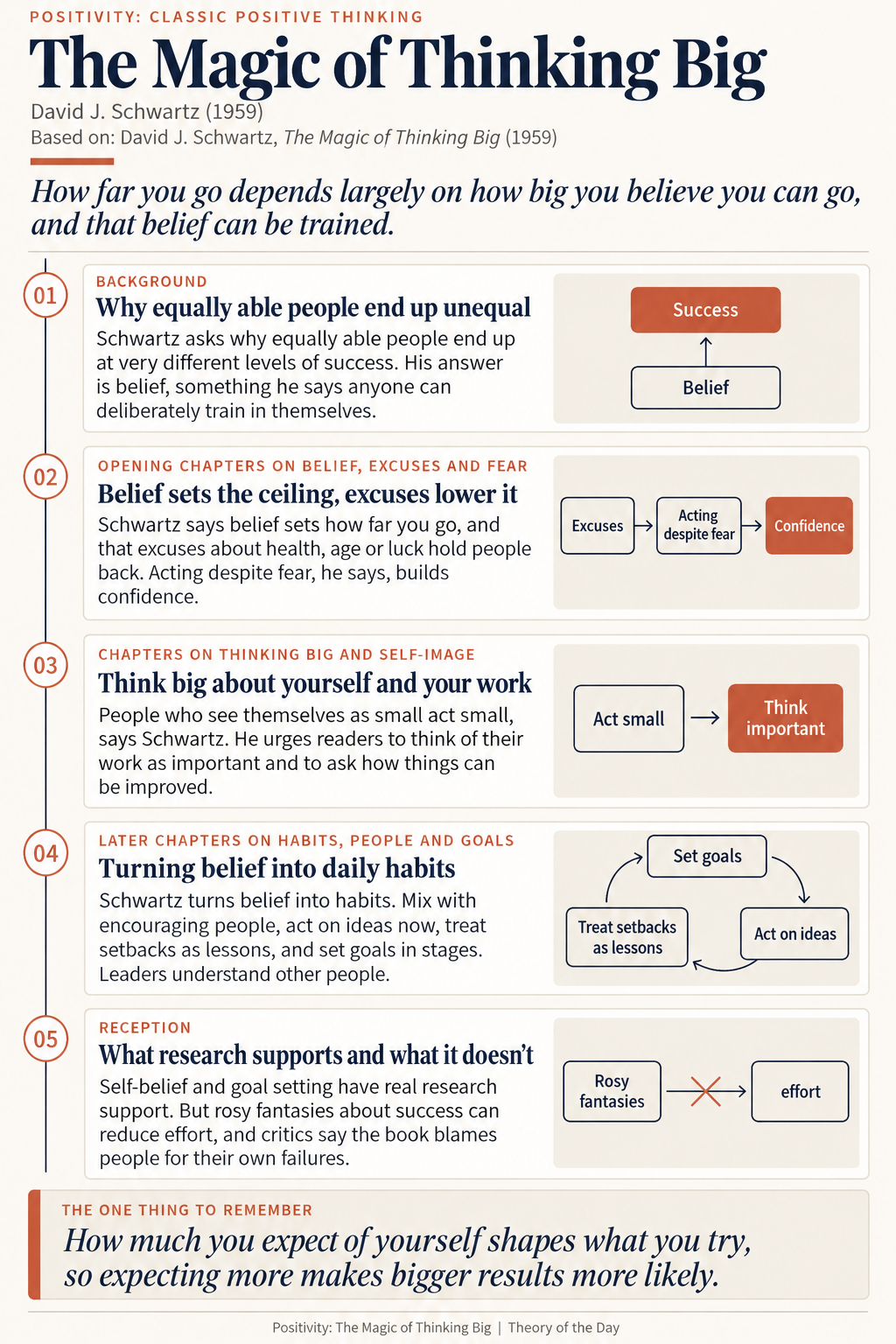
How far you go depends largely on how big you believe you can go, and that belief can be trained.
David J. Schwartz published The Magic of Thinking Big in 1959, when he was a marketing professor who also spoke to business audiences. It appeared in a prosperous America where sales jobs and corporate careers were growing, and where self-improvement books such as Norman Vincent Peale's were popular. Schwartz set out to answer a plain question: why do some people rise far higher than others who are just as able?
The book is a practical manual rather than an academic treatise. It opens with chapters on belief, arguing that the size of a person's success is tied to the size of their belief, and that belief means a real expectation, not wishful thinking. It then turns on excuses. Schwartz calls the habit of blaming health, age, intelligence or luck for not trying excusitis, and he treats it as the main thing holding people back. Next come chapters on building confidence and cutting fear, on thinking big and creatively, and on how self-image shapes behaviour.
The later chapters turn these ideas into habits. Schwartz tells readers to choose encouraging company, adopt positive attitudes, treat other people well, act on ideas at once, learn from defeat, set goals in stages, and think like a leader. Each chapter uses short stories of ordinary people and simple exercises.
The mechanism is straightforward. What you believe about yourself decides what you attempt. What you attempt decides what you achieve, and results then strengthen or weaken the belief. Schwartz says people can break into this loop by changing their thoughts and, above all, by acting, because action reduces fear and builds confidence. In his view, thinking big is a skill that anyone can practise.
Schwartz built on a tradition that includes Peale, but he left out Peale's religious emphasis and wrote for the workplace. Later researchers developed related ideas with real evidence. Albert Bandura's self-efficacy research, from 1977, showed that belief in one's own ability affects effort and persistence. Edwin Locke and Gary Latham's work showed that specific, demanding goals improve performance. Gabriele Oettingen added an important warning: positive fantasies about the future can lower effort, while pairing hopes with plans for obstacles works better.
So the evidence is mixed. Self-belief and goal setting have good support, but the book itself rests on anecdotes, not controlled studies. Barbara Ehrenreich and others argue that this style of advice blames individuals for failures with outside causes, such as low pay or discrimination. Oettingen's findings show that simply imagining success can backfire.
The book still matters because its core advice, to expect more of yourself, set goals and act despite fear, survives in modern coaching, sales training and self-help. Read with care, it is a useful prompt to challenge excuses, but it is not a guarantee of success.
The work, part by part
1. Why equally able people end up unequal
Background
David Schwartz wrote the book in 1959 as a marketing professor who also lectured to business audiences. He asks what separates people who rise from equally able people who stay put. His answer is that the difference lies less in brains or luck than in belief, which he treats as something a person can train.
2. Belief sets the ceiling, excuses lower it
Opening chapters on belief, excuses and fear
Schwartz opens by saying belief sets the ceiling on achievement, and that belief must be a real expectation, not wishing. He names excusitis, his word for the habit of blaming health, age, intelligence or luck for not trying. He then offers confidence-building habits, such as acting when afraid, since he says inaction feeds fear and action starves it.
3. Think big about yourself and your work
Chapters on thinking big and self-image
Schwartz argues that people judge themselves too small and so act small. He urges readers to see their own work as important, to drop the belief that a thing cannot be done, and to ask how it might be improved. He adds that others treat you as you carry yourself, so thinking well of yourself pays off.
4. Turning belief into daily habits
Later chapters on habits, people and goals
The middle and later chapters turn belief into habits. Schwartz advises readers to mix with encouraging people, to treat others with a positive attitude, and to act on ideas now rather than wait for perfect conditions. He treats setbacks as lessons, urges goals set in stages, and closes with leadership, which he links to understanding other people.
5. What research supports and what it doesn't
Reception
The book sold widely and stayed in print for decades. Some of its advice matches later research, such as Albert Bandura's work on self-belief and the goal-setting studies of Edwin Locke and Gary Latham. Critics such as Barbara Ehrenreich say it blames individuals, and Gabriele Oettingen found that rosy fantasies can sap effort and results.
The argument in four steps
- Success is limited less by ability than by how much people believe they can achieve.
- People who doubt themselves make excuses and act small, which keeps them small.
- Belief and confidence grow through habits: positive talk, encouraging company, goals and action.
- Therefore anyone who trains their thinking to expect more will achieve more.
Who contributed what
- David J. Schwartz (1959): In The Magic of Thinking Big, gave a secular, career-focused method for building belief, habits and goals.
- Albert Bandura (1977): Showed through self-efficacy research that belief in one's ability affects effort and persistence.
- Gabriele Oettingen (2002): With Mayer, found positive fantasies predicted weaker results, leading to plans that pair hopes with obstacles.
The evidence
- Bandura's 1977 self-efficacy paper showed belief in one's ability predicts effort and persistence.
- Locke and Latham's 2002 review showed specific, hard goals raise performance over vague ones.
- Oettingen and Mayer's 2002 studies showed positive fantasies about the future predicted worse results.
The criticisms
- Barbara Ehrenreich's Bright-Sided (2009) says it blames individuals for failures with outside causes.
- Oettingen's research suggests dreaming of success without planning for obstacles reduces effort.
- Support in the book is anecdote and seminar stories, not controlled studies.
Compared with rival views
- Unlike Peale's religious emphasis, it offers secular, business-minded habits and steps for careers.
- Unlike the Law of Attraction, it says action and habits, not thought alone, bring results.
Why it matters today
Goal-setting and self-efficacy ideas used in workplace coaching and sales training echo Schwartz's call to expect more of yourself.
Further reading
- Barbara Ehrenreich, Bright-Sided: How Positive Thinking Is Undermining America (2009)
- Gabriele Oettingen, Rethinking Positive Thinking: Inside the New Science of Motivation (2014)
- Albert Bandura, Self-Efficacy: The Exercise of Control (1997)