Infographic of: The Law of Effect
Psychology: Learning and Behaviourism
The Law of Effect
Edward Lee Thorndike (1898)
Based on: Edward L. Thorndike, Animal Intelligence: An Experimental Study of the Associative Processes in Animals, Psychological Review Monograph Supplements (1898); Edward L. Thorndike, Animal Intelligence: Experimental Studies (1911)
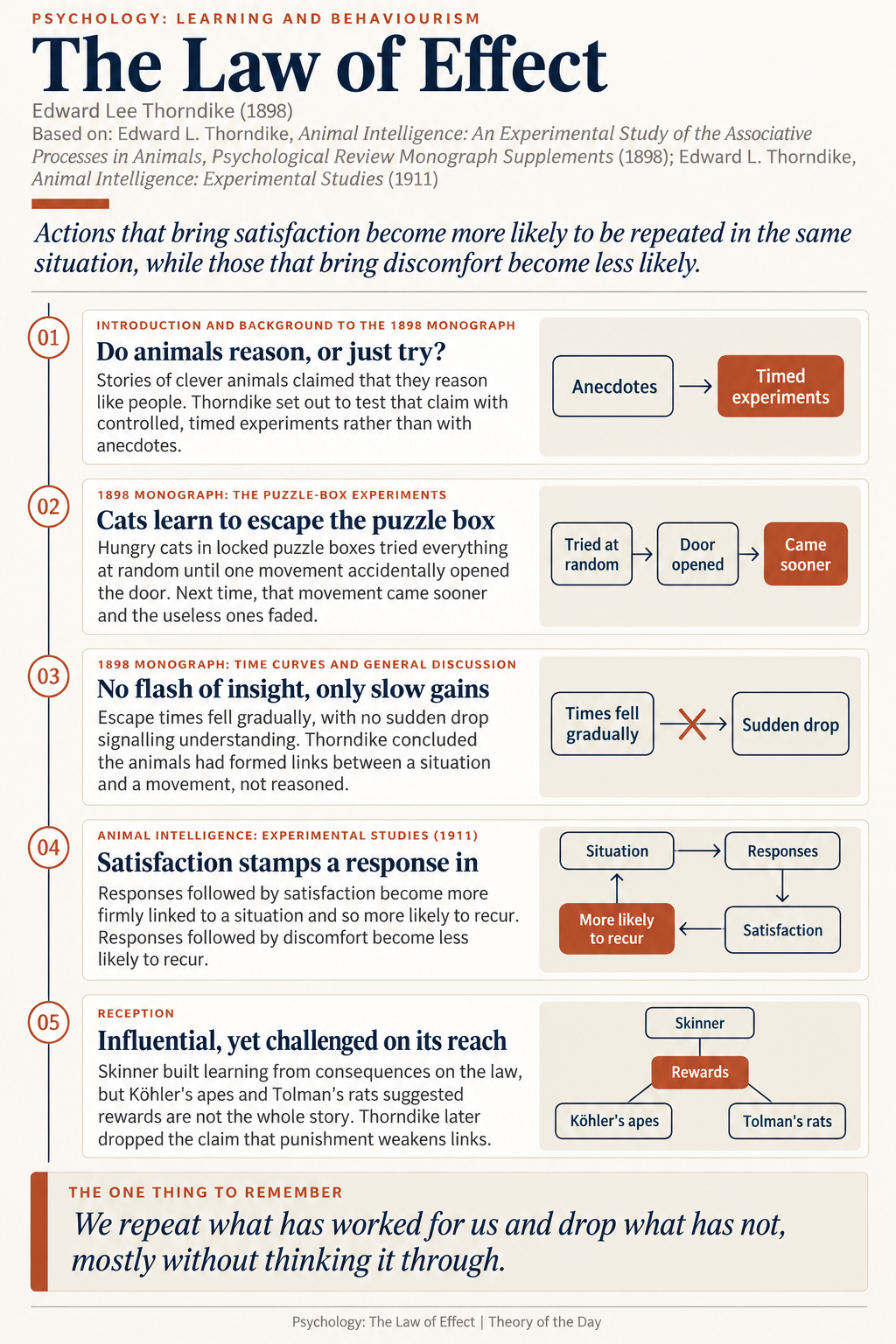
Actions that bring satisfaction become more likely to be repeated in the same situation, while those that bring discomfort become less likely.
Edward Thorndike wrote Animal Intelligence: An Experimental Study of the Associative Processes in Animals as his doctoral thesis at Columbia University, and it appeared in 1898 as a monograph in the Psychological Review series. He had begun experiments on chicks at Harvard, where William James supported him. At the time, popular books by writers such as George Romanes collected stories of dogs and cats that seemed to reason. Thorndike asked a plain question: do animals learn by understanding a problem, or by some simpler process that experiment can reveal?
The monograph is organised around experiments rather than chapters of abstract argument. Thorndike put hungry cats, and also dogs and chicks, into puzzle boxes, which were cages whose doors opened only if the animal pulled a loop, pressed a lever or turned a latch. Food sat outside in view. The animals clawed and struggled at random until a chance movement opened the door. Thorndike timed each escape over many trials and plotted the results as curves. The times fell slowly and unevenly, with no sudden drop that would mark understanding. He also found no clear sign that animals learned by watching others. His general discussion concluded that the animals had formed associations, meaning links between a situation and a movement.
The mechanism is selection by consequences. In the 1898 monograph Thorndike described pleasure as stamping in a link and discomfort as stamping it out. He later gave the principle its name, the law of effect, and stated it fully in his 1911 book Animal Intelligence: Experimental Studies, which reprinted the monograph. Of several responses made to the same situation, those followed by satisfaction become more firmly connected with it and so more likely to recur, while those followed by discomfort become less likely. He paired this with the law of exercise, which held that repetition alone strengthens a link.
Others reshaped the idea. B. F. Skinner, in The Behavior of Organisms (1938), turned it into operant conditioning, the study of how consequences change the rate of voluntary behaviour, and measured it in rats. Clark Hull, in Principles of Behavior (1943), recast reward as the reduction of a bodily need, or drive, within a formal system. Thorndike himself revised the law in the early 1930s. He concluded that reward strengthens links far more reliably than punishment weakens them, and he gave up the law of exercise.
The best-known evidence is Thorndike's own: the gradual fall in escape times. Skinner's rat experiments showed that lever pressing rises when followed by food, and James Olds and Peter Milner showed in 1954 that rats would work for direct brain stimulation. Critics have pushed back. Wolfgang Köhler's apes, described in 1917, seemed to solve problems suddenly by insight. Edward Tolman and Charles Honzik showed in 1930 that rats could learn a maze without reward, which Tolman called latent learning. Others charged circularity, since a satisfier seems to be identified only by what it strengthens. Paul Meehl answered in 1950 that a reward that works in one situation can be tested in others.
The law matters because it is one of the oldest clear statements that behaviour is shaped by its results. It underlies behaviour analysis, reinforcement-based animal training and classroom behaviour management. Its logic also runs through reinforcement learning in computer science, where programs improve by trial and reward. It marks, too, the shift in psychology from storytelling about animal minds to measurable experiments.
The work, part by part
1. Do animals reason, or just try?
Introduction and background to the 1898 monograph
Edward Thorndike wrote this monograph as his doctoral thesis at Columbia University, having begun his experiments with chicks at Harvard. Popular stories of clever dogs and cats, gathered by writers such as George Romanes, claimed that animals reason much as people do. Thorndike asks whether controlled, timed experiments, rather than anecdotes, can show what animals actually learn.
2. Cats learn to escape the puzzle box
1898 monograph: the puzzle-box experiments
Thorndike put hungry cats in puzzle boxes, cages whose door opened only when the animal pulled a loop, pressed a lever or turned a latch, with food visible outside. The cats clawed and struggled at random until, by accident, they hit the right device. Over repeated trials, useless movements dropped away and the successful one came sooner.
3. No flash of insight, only slow gains
1898 monograph: time curves and general discussion
Thorndike plotted how long each animal took on successive trials and found that the times fell gradually, with no sudden drop that would signal understanding. He concluded that the animals formed associations, meaning links between a situation and a movement, rather than reasoning about the box. This was an attack on the anecdotal view and a step toward explaining learning without appeal to ideas.
4. Satisfaction stamps a response in
Animal Intelligence: Experimental Studies (1911)
In his 1911 book, which reprinted the 1898 monograph, Thorndike stated the law in full. Of several responses made to one situation, those followed by satisfaction become more firmly linked to it and so more likely to recur, while those followed by discomfort become less likely. He placed it beside a second law, the law of exercise, which says that simple repetition strengthens a link.
5. Influential, yet challenged on its reach
Reception
Skinner's 1938 work built operant conditioning (learning from consequences) on the same idea, and later laboratories confirmed that rewards shape behaviour. Wolfgang Köhler's apes solving problems by sudden insight in 1917, and Edward Tolman's rats learning mazes without reward, challenged the law's claim to explain everything. Thorndike himself later dropped the claim that punishment weakens links.
The argument in four steps
- Animals placed in a problem situation try many movements, most of them useless.
- By chance, one movement brings a satisfying result such as escape and food.
- Satisfying results strengthen the link between that situation and that movement, while discomfort weakens it.
- So learning is gradual trial and error shaped by consequences, not sudden reasoning.
Who contributed what
- Edward Lee Thorndike (1898): Animal Intelligence monograph: puzzle-box experiments showed gradual trial-and-error learning and the link between situation and rewarded movement.
- B. F. Skinner (1938): The Behavior of Organisms: turned the law into operant conditioning, measuring response rates in rats.
- Clark L. Hull (1943): Principles of Behavior: recast reward as drive reduction inside a formal, mathematical system of learning.
The evidence
- Thorndike's 1898 puzzle-box cats cut their escape times gradually across trials, without sudden insight.
- Skinner's 1938 rat experiments showed lever-pressing rises when followed by food.
- Olds and Milner's 1954 rat study showed brain stimulation alone can reinforce behaviour.
The criticisms
- Köhler's 1917 apes solved problems suddenly by insight, not slow trial and error.
- Tolman and Honzik's 1930 rats learned mazes without reward, showing latent learning.
- Critics charge circularity: satisfiers are identified only by what they strengthen.
Compared with rival views
- Unlike Pavlov's classical conditioning, it concerns actions strengthened by their consequences, not reflexes triggered by signals.
- Unlike Romanes's anecdotal view, it explains animal learning by trial and error, not reasoning.
Why it matters today
Reinforcement-based animal training, such as clicker training for dogs, rewards wanted actions so that they recur.
Further reading
- Geraldine Joncich, The Sane Positivist: A Biography of Edward L. Thorndike (1968)
- Robert Boakes, From Darwin to Behaviourism: Psychology and the Minds of Animals (1984)
- Ernest R. Hilgard and Gordon H. Bower, Theories of Learning (1975)