Infographic of: The Four Agreements
Positivity: Classic Positive Thinking
The Four Agreements
Don Miguel Ruiz (1997)
Based on: Don Miguel Ruiz, The Four Agreements: A Practical Guide to Personal Freedom (1997)
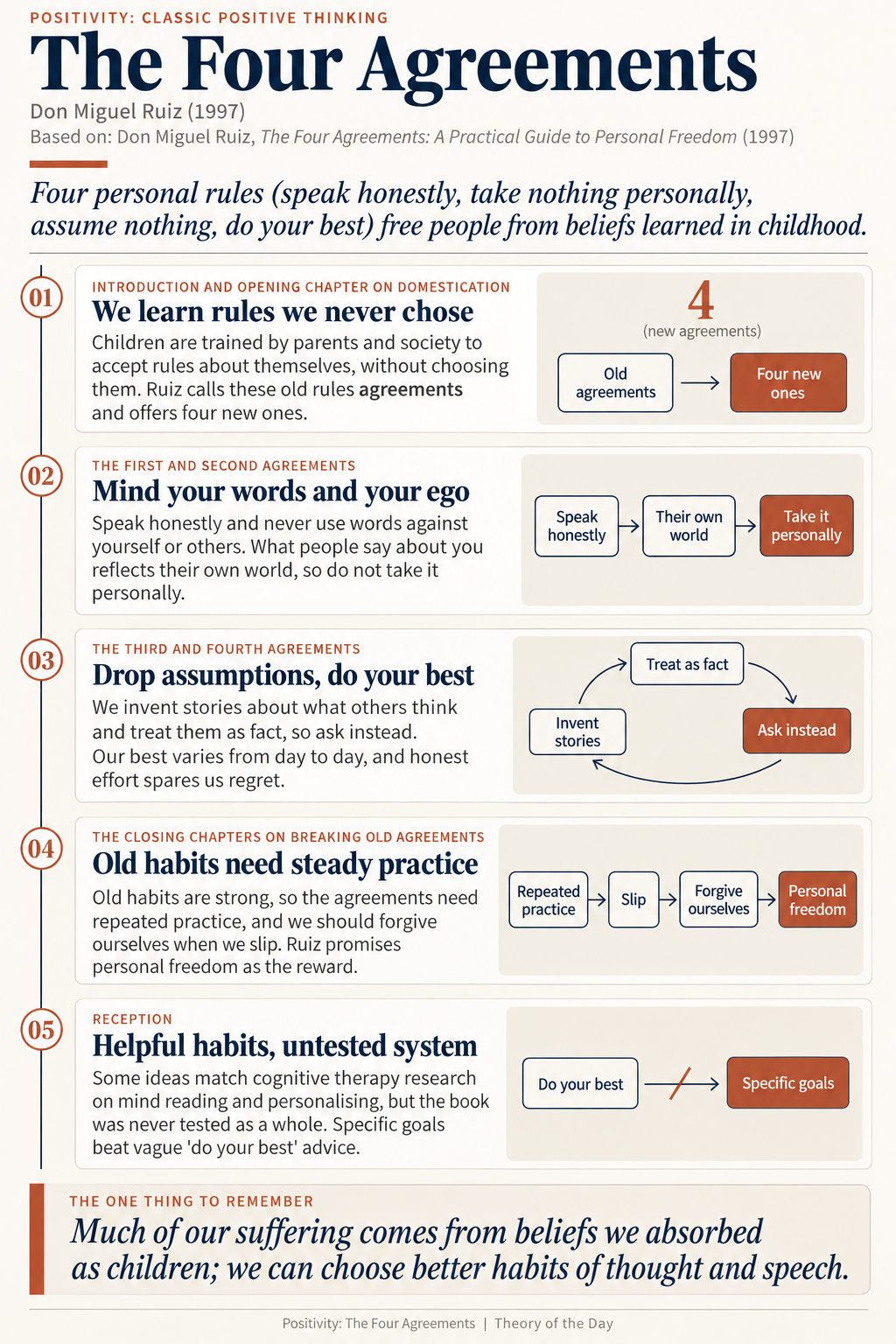
Four personal rules (speak honestly, take nothing personally, assume nothing, do your best) free people from beliefs learned in childhood.
Don Miguel Ruiz, a Mexican writer and teacher who trained as a surgeon, published The Four Agreements: A Practical Guide to Personal Freedom in 1997. It is a short, plainly written self-help book rather than an academic study. It sets out to answer a simple question: why do so many people feel unhappy and stuck, and what can they do about it? Ruiz's answer draws on what he presents as Toltec wisdom, a label of his own choosing.
The book begins with an introduction and an opening chapter on what Ruiz calls domestication. As children, he says, we are trained by parents, teachers and society, using rewards and punishments, to accept rules about who we are. He calls these rules agreements, and he calls the shared set of beliefs around us the dream of the planet. The next four chapters give one new agreement each: be impeccable (without fault) with your word; don't take anything personally; don't make assumptions; always do your best. Closing chapters deal with the practice of keeping them.
The mechanism is straightforward. Hidden beliefs shape what we say and how we react. Careless words hurt us and others. Taking comments personally makes us wounded by other people's opinions. Assumptions fill the gaps with invented stories that we treat as fact. Effort that swings from perfectionism to giving up leaves us full of self-judgement. Ruiz argues that choosing four new habits, and practising them while forgiving our slips, replaces the old agreements and brings a sense of freedom.
The theory has essentially one originator. Ruiz's later book The Fifth Agreement (2010), written with his son Don José Ruiz and Janet Mills, added the advice to be skeptical but learn to listen. Beyond that, the ideas have been absorbed into general self-help culture rather than developed by researchers.
There is no direct scientific test of the four agreements as a whole, but several parts overlap with research. Aaron Beck's cognitive therapy from the 1970s identified jumping to conclusions about others and personalising events as thinking errors tied to depression and anxiety. Gilovich, Medvec and Savitsky found in 2000 that people overestimate how much others notice them, and Keysar and Henly found in 2002 that speakers overestimate how well they are understood. Against this, Locke and Latham's goal-setting research shows that specific goals work better than vague instructions to do your best. Historians of Mesoamerica also do not recognise the Toltec framing as documented teaching, and critics add that the advice is general and hard to test.
The book still matters because it condenses useful habits of mind into four memorable rules. Many readers find them easy to remember and apply, and parts of the advice echo well-supported cognitive techniques. Read as practical advice rather than as a proven theory, it is a gentle prompt to question inherited beliefs, speak carefully and check assumptions.
The work, part by part
1. We learn rules we never chose
Introduction and opening chapter on domestication
Ruiz opens by saying that as children we are 'domesticated', meaning trained by parents and society through rewards and punishments to believe certain rules about ourselves. He calls these rules agreements and says we make them without choosing. Together they form what he calls the dream of the planet, a shared set of beliefs, and he offers four new agreements to replace the old ones. He describes these old beliefs as a kind of inner judge.
2. Mind your words and your ego
The first and second agreements
In the first agreement, be impeccable (without fault) with your word, Ruiz says words are powerful, so we should speak honestly and stop using them to gossip or to criticise ourselves. In the second, do not take anything personally, he argues that what others say reflects their own inner world, not yours. Together these two protect us from the poison of other people's opinions and our own.
3. Drop assumptions, do your best
The third and fourth agreements
The third agreement, don't make assumptions, says we invent stories about what others think and then treat them as fact, which breeds drama; Ruiz urges us to ask questions and say what we want. The fourth, always do your best, accepts that our best changes with health and mood, and says that trying honestly avoids self-judgement and regret.
4. Old habits need steady practice
The closing chapters on breaking old agreements
In the closing chapters Ruiz says the four agreements are hard to keep because old habits are strong, so we need to practise them repeatedly and forgive ourselves when we slip. He says that changing them step by step can produce what he calls personal freedom in daily life.
5. Helpful habits, untested system
Reception
The book became a long-running bestseller, though Ruiz never tested it as a scientific theory. Several of its ideas match research, for example Aaron Beck's cognitive therapy on mind reading and personalising, and studies of the spotlight effect. Critics note that the Toltec label is Ruiz's own framing, and that specific goals beat vague 'do your best' advice.
The argument in four steps
- Childhood training by family and society plants beliefs about ourselves that we never chose.
- These hidden beliefs make us suffer through gossip, hurt feelings and constant self-criticism.
- Four chosen agreements about words, offence, assumptions and effort can replace the old ones.
- So keeping these four agreements, with steady practice, frees us from needless suffering.
Who contributed what
- Don Miguel Ruiz (1997): The Four Agreements: framed four rules for personal freedom, built on 'domestication' and Toltec-style teaching.
- Don José Ruiz (2010): The Fifth Agreement, with Don Miguel Ruiz and Janet Mills, added 'be skeptical, but learn to listen'.
The evidence
- Beck's 1976 cognitive therapy work linked arbitrary inference and personalising to depression and anxiety.
- Gilovich, Medvec and Savitsky's 2000 spotlight studies showed people overestimate how much others notice them.
- Keysar and Henly's 2002 study showed speakers wrongly assume listeners understand them, supporting 'don't assume'.
The criticisms
- No controlled studies test the four agreements as a package.
- Locke and Latham's goal-setting research found specific goals beat 'do your best' instructions.
- Mesoamerican historians do not recognise it as documented Toltec teaching.
Compared with rival views
- Unlike Peale's positive thinking, it stresses dropping inherited beliefs rather than affirming success.
- Unlike cognitive therapy, it offers no tested clinical method, only four rules of thumb.
Why it matters today
Widely used in self-help groups and counselling-style workshops to teach ending assumptions and taking things personally.
Further reading
- Oliver Burkeman, The Antidote: Happiness for People Who Can't Stand Positive Thinking (2012)
- Barbara Ehrenreich, Bright-sided: How Positive Thinking Is Undermining America (2009)
- Judith S. Beck, Cognitive Therapy: Basics and Beyond (1995)