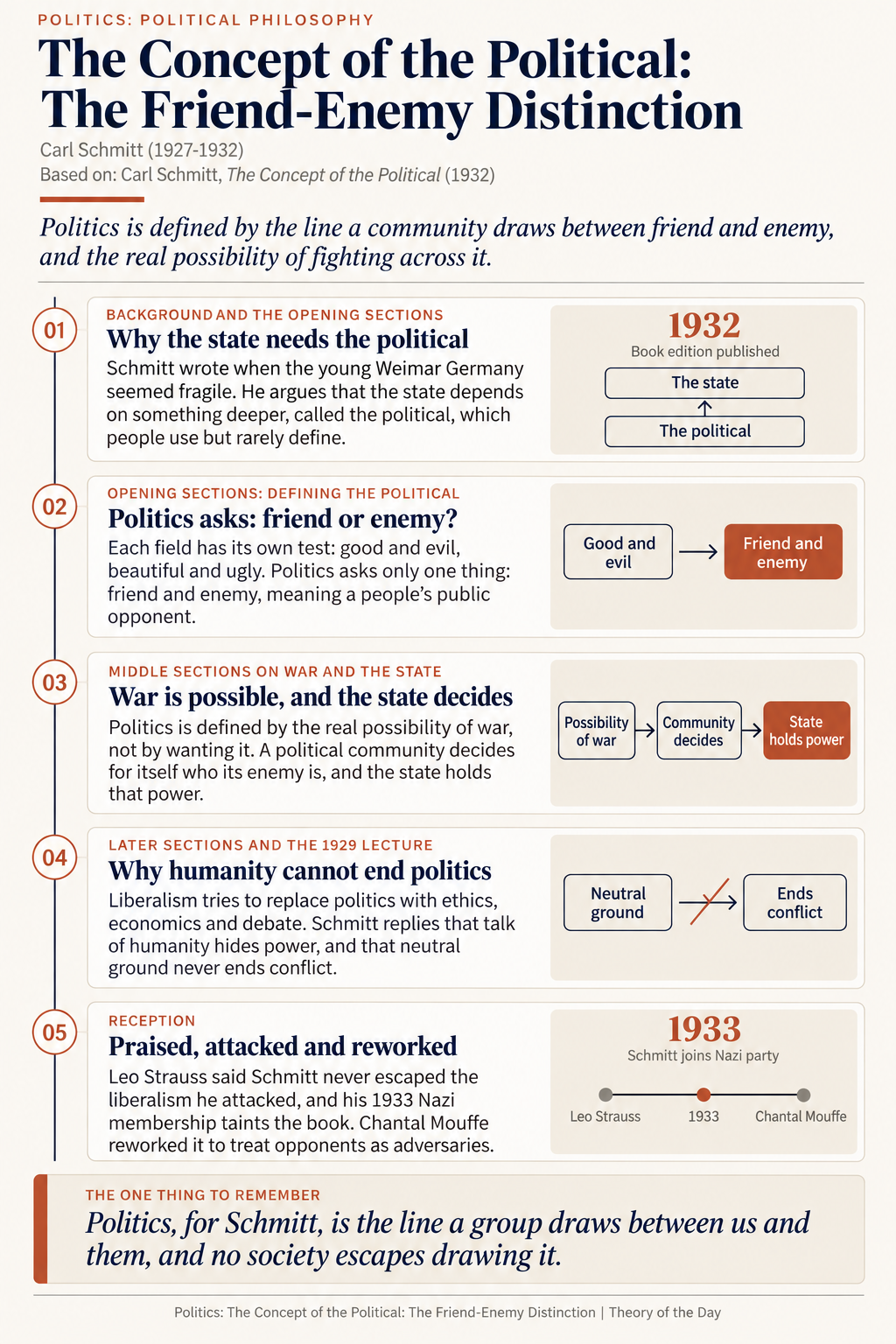
Infographic of: The Concept of the Political: The Friend-Enemy Distinction
Politics: Political Philosophy
The Concept of the Political: The Friend-Enemy Distinction
Carl Schmitt (1927-1932)
Based on: Carl Schmitt, The Concept of the Political (1932)
Politics is defined by the line a community draws between friend and enemy, and the real possibility of fighting across it.
Carl Schmitt, a German jurist, first published The Concept of the Political as an article in 1927 and expanded it into a short book in 1932. He wrote in the Weimar Republic, Germany's fragile democracy, where parties and private armies clashed openly and many doubted that parliamentary debate could hold the country together. His question was simple: what makes something political, as opposed to moral, economic or cultural? The usual answer, that politics is whatever the state does, struck him as circular, because the state itself needs explaining.
The book opens by saying that the idea of the state presupposes (depends on) the idea of the political. Schmitt then argues that every field of life has its own basic distinction: good and evil in morality, beautiful and ugly in art, profitable and unprofitable in economics. Politics, he says, has friend and enemy. The enemy is not a personal rival or someone we dislike. It is the public enemy, a group that stands against our own and is, in his words, existentially different and alien. He notes that the Christian command to love your enemies concerns private enemies, not political ones.
The middle sections move from this definition to war and the state. Schmitt says war is not the aim of politics, but the real possibility of war gives the friend-enemy distinction its meaning. He also rejects the British pluralists, who saw the state as one association among many, and argues that the state is the unit that decides who the enemy is. The later sections attack liberalism, which he says tries to dissolve politics into ethics, economics and discussion. He borrows Proudhon's warning that whoever speaks in the name of humanity wants to cheat. A related 1929 lecture traces how Europe's central concerns moved from theology to economics and technology, each time in search of neutral ground.
The mechanism is a matter of intensity. Schmitt does not treat politics as a separate area with its own subjects. Any issue, whether religious, economic or cultural, becomes political once it divides people so sharply that they group themselves as friends and enemies. At that point the community must decide, with no neutral rule to appeal to, who counts as the enemy. A people that gives up this decision does not escape politics. Someone else simply makes the decision for it.
Schmitt is the sole author, but others shaped how the idea has been read. Leo Strauss, in a 1932 review, argued that Schmitt's attack on liberalism still stayed inside a liberal frame. Schmitt joined the Nazi party in 1933 and altered the book in a later edition. Chantal Mouffe, in The Return of the Political (1993), accepted that conflict cannot be removed but turned the enemy into the adversary, an opponent respected within shared democratic rules.
The evidence is mixed because Schmitt offers a definition, not an experiment. Sherif's Robbers Cave study and Tajfel's minimal-group experiments show how readily groups form rival camps, which fits his picture. Critics, including Strauss and many liberals, say he overstates enmity and ignores law, cooperation and reasoned agreement. His Nazi ties make many readers wary. Even so, the book still matters because debates about populism, polarisation and us-versus-them politics keep returning to his question of who draws the line, and how.
The work, part by part
1. Why the state needs the political
Background and the opening sections
Schmitt wrote in Weimar Germany, a fragile young democracy where parties fought in the streets. He first published the essay in 1927 and expanded it into the 1932 book. His opening claim is that everyone talks about the state, yet the state presupposes (rests on) something more basic, the political, which nobody has properly defined.
2. Politics asks: friend or enemy?
Opening sections: defining the political
Schmitt says every field has its own basic test: good and evil in morality, beautiful and ugly in art, profit and loss in economics. For politics the test is friend and enemy. The enemy is the public enemy of a whole people, not a private rival, and is simply the stranger who is so different that conflict becomes possible.
3. War is possible, and the state decides
Middle sections on war and the state
Schmitt argues that the political is shown by the real possibility of war, meaning the chance that people will fight and kill for their group. He does not say war is good or wanted. He says a political community is one that can decide for itself who the enemy is and when to fight; in his view this power belongs to the state.
4. Why humanity cannot end politics
Later sections and the 1929 lecture
Schmitt turns on liberalism, which he says tries to replace politics with ethics, economics and debate. He borrows Proudhon's warning that those who speak for humanity usually hide a claim to power, since humanity has no enemy. In a related 1929 lecture, he traces Europe's shifts from theology to economics and technology, each an attempt to find neutral ground and end conflict.
5. Praised, attacked and reworked
Reception
Leo Strauss's 1932 review said Schmitt still stood inside the liberal world he attacked, since his defence of the political quietly rested on a moral choice. Critics also stress that Schmitt joined the Nazi party in 1933, which colours how his ideas are read. Chantal Mouffe, by contrast, borrowed his insight and argued democracy should treat opponents as adversaries, not enemies.
The argument in four steps
- Each area of life has its own basic test, such as good and evil or profit and loss.
- Politics has its own test: whether someone is a friend or a public enemy of the group.
- Because real fighting is always possible, a community must decide for itself who its enemy is.
- So the political cannot be abolished by ethics, economics or humanity; it only returns in new forms.
Who contributed what
- Carl Schmitt (1932): The Concept of the Political, expanding his 1927 article, set out the friend-enemy test of politics.
- Leo Strauss (1932): Notes on Carl Schmitt, The Concept of the Political: argued Schmitt remained inside liberal thinking.
- Chantal Mouffe (1993): The Return of the Political reworked Schmitt's enemy into the democratic adversary.
The evidence
- Sherif's 1954 Robbers Cave study showed boys' camp groups quickly turned rival and hostile under competition.
- Tajfel's 1971 minimal-group experiments showed even arbitrary labels make people favour their own group.
- Clausewitz's On War (1832) treated war as a continuation of politics, a link Schmitt builds on.
The criticisms
- Leo Strauss: Schmitt's defence of the political still rests on liberal moral assumptions.
- Jan-Werner Müller and others: Schmitt's Nazi ties and 1933 revisions taint the work.
- Liberal thinkers, Habermas among them, reject reducing politics to enmity; reasoned agreement matters too.
Compared with rival views
- Unlike liberalism from Locke to Rawls, it treats politics as group conflict, not agreement on rights.
- Unlike Aristotle's shared good life, it defines politics by enmity, not community of purpose.
Why it matters today
Chantal Mouffe's theory of agonistic democracy and left-populist strategy draws on Schmitt's friend-enemy distinction.
Further reading
- Heinrich Meier, Carl Schmitt and Leo Strauss: The Hidden Dialogue (1995)
- Chantal Mouffe (ed.), The Challenge of Carl Schmitt (1999)
- Jan-Werner Müller, A Dangerous Mind: Carl Schmitt in Post-War European Thought (2003)