Infographic of: Structural Marxism and Modes of Production
Anthropology: Foundations and Schools of Thought
Structural Marxism and Modes of Production
Louis Althusser, Emmanuel Terray and others (1965-1975)
Based on: Claude Meillassoux, Maidens, Meal and Money: Capitalism and the Domestic Community (1975); Louis Althusser and Étienne Balibar, Reading Capital (1965); Maurice Godelier, Perspectives in Marxist Anthropology (1973)
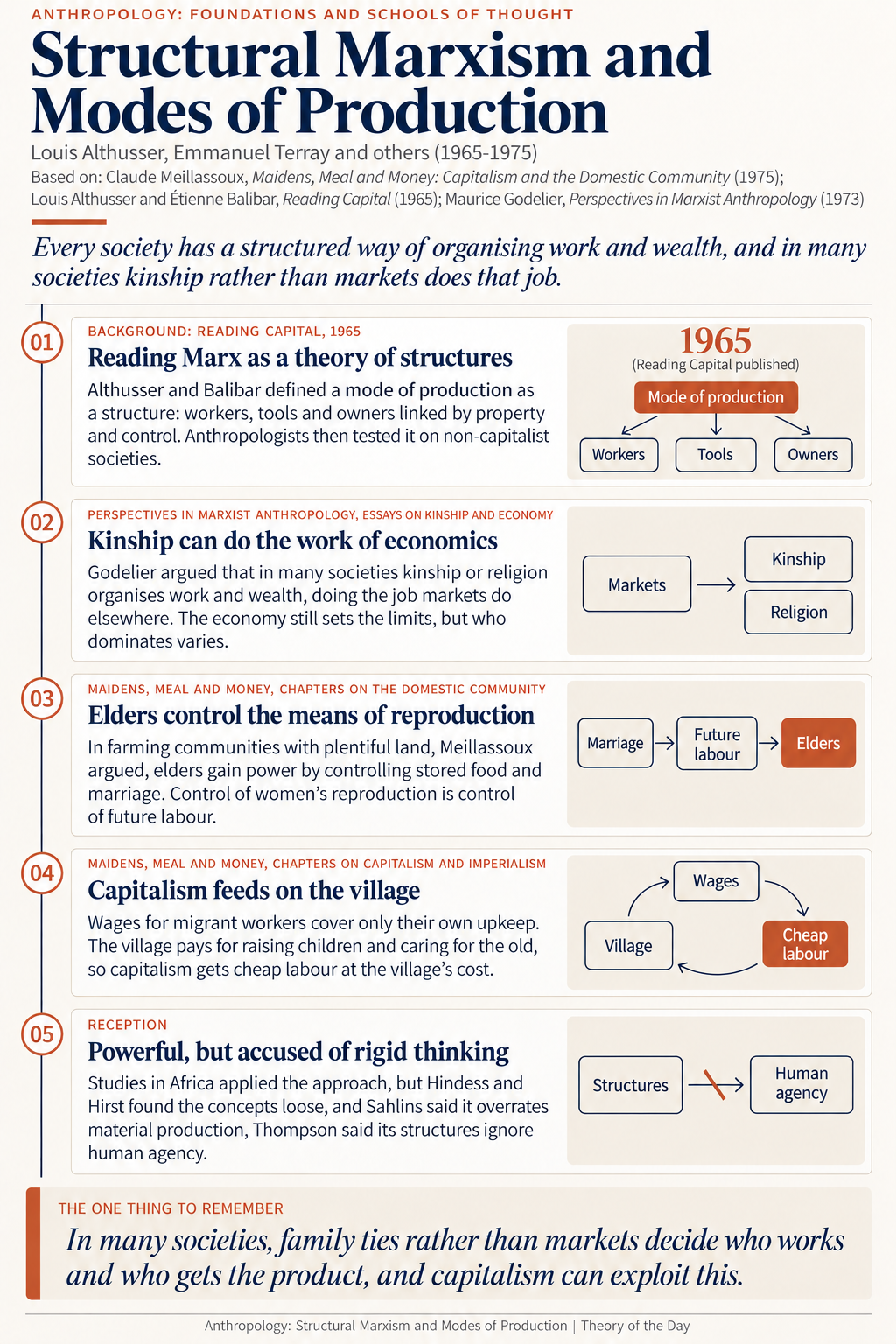
Every society has a structured way of organising work and wealth, and in many societies kinship rather than markets does that job.
Structural Marxism in anthropology grew up in Paris in the 1960s and 1970s. Louis Althusser and Étienne Balibar, in Reading Capital (1965), asked how to read Marx as a theorist of structures rather than of human nature. Anthropologists then asked whether the idea of a mode of production, a society's particular way of organising labour, tools and control of the product, could explain societies with no factories, wage labour or states. Claude Meillassoux's Maidens, Meal and Money (1975) is among the fullest answers for farming societies.
The argument is built in stages. Balibar's essay in Reading Capital defines a mode of production as a combination of elements: the direct workers, the means of production and the non-working owners, joined by relations of property and of control over the work process. Different combinations make different modes of production. Maurice Godelier, in the essays collected as Perspectives in Marxist Anthropology (1973), then argued that in many societies kinship, religion or politics works as the relations of production. Which institution dominates varies, though the economy still sets the limits. Meillassoux takes this further by studying one concrete type, the domestic community, a farming group that feeds itself from its own land.
The mechanism Meillassoux proposes turns on reproduction. Where land is plentiful, power does not come from owning land. It comes from controlling the people who work it, and so from controlling the marriage of women, who bear the next generation. Elders hold stored food and marriage payments, and by doing so they decide who can marry and who must remain a dependant. The community reproduces itself through this control. Capitalism then draws on it. Migrant workers are paid wages that cover only their own upkeep, while the village raises the children and cares for the old and the sick. Employers get cheap labour, and the village is slowly drained.
Other scholars shaped the theory in different ways. Althusser and Balibar supplied the structural vocabulary. Emmanuel Terray's Marxism and 'Primitive' Societies (1969) first tested it on African ethnography. Godelier showed that non-economic institutions can act as relations of production. Meillassoux added the focus on reproduction and on the exploitation of the village by capitalism. Pierre-Philippe Rey and Harold Wolpe developed the related idea that different modes of production can be linked together.
The evidence is mainly ethnographic. Meillassoux's earlier study of the Gouro of Ivory Coast showed elders controlling marriage and surplus. Rey's work in Congo-Brazzaville showed lineage elders' power being used by colonial capitalism, and Wolpe argued that South African reserves subsidised cheap migrant labour. Critics were sharp. Barry Hindess and Paul Hirst said the concept of mode of production was stretched too far. Marshall Sahlins argued that culture, not material production, shapes economic life. E. P. Thompson charged Althusserian structuralism with erasing human agency and history. Many also found the approach too fixed to handle change.
The approach still matters because it treats the household and the family as part of the economy. Arguments about migrant remittances, unpaid care work and low wages in global supply chains echo Meillassoux's point that employers can pay less than the full cost of keeping workers alive when someone else covers that cost.
The work, part by part
1. Reading Marx as a theory of structures
Background: Reading Capital, 1965
In the 1960s French Marxists wanted to read Marx as a scientist of structures, not a philosopher of human nature. Louis Althusser and Étienne Balibar, in Reading Capital (1965), defined a mode of production (a society's way of organising work and wealth) as a combination of workers, tools and non-working owners, linked by relations of property and control. Anthropologists then asked whether this fitted societies without factories or states.
2. Kinship can do the work of economics
Perspectives in Marxist Anthropology, essays on kinship and economy
Maurice Godelier argued that the economy is not always a separate sphere of factories and markets. In many societies kinship (family and descent ties), religion or politics itself works as the relations of production, organising who works and who gets the product. The economy still sets the limits in the end, but which institution dominates differs from society to society.
3. Elders control the means of reproduction
Maidens, Meal and Money, chapters on the domestic community
Claude Meillassoux, drawing on his earlier fieldwork among the Gouro of Ivory Coast, studied the domestic community (a farming group that feeds itself from its own land). He argued that land is plentiful there, so power comes not from owning land but from controlling people, above all the marriage of women, who bear the next generation of workers. Elders therefore control stored food and marriage payments.
4. Capitalism feeds on the village
Maidens, Meal and Money, chapters on capitalism and imperialism
Meillassoux then showed how capitalism uses the domestic community. Migrant workers earn wages that cover only their own upkeep, while the village raises children and cares for the old and sick. This lets employers pay less than the full cost of keeping workers alive, a form of exploitation Meillassoux linked to imperialism, and it slowly drains the village.
5. Powerful, but accused of rigid thinking
Reception
Emmanuel Terray and Pierre-Philippe Rey applied the approach to African societies, and Harold Wolpe made a similar argument for South Africa. Critics such as Barry Hindess and Paul Hirst said the concepts were loose, and Marshall Sahlins said Marxism overrates material production. E. P. Thompson attacked Althusser's structuralism for leaving out the choices of real people.
The argument in four steps
- A society's economy is a structure: workers, tools and non-working owners tied together by rules of property and control.
- In societies without markets, kinship, religion or politics can act as the rules that organise work and wealth.
- In farming communities with plentiful land, elders gain power by controlling marriage and so the next generation of workers.
- So capitalism can live off such communities, taking cheap labour while the village pays the cost of raising workers.
Who contributed what
- Louis Althusser (1965): With Balibar in Reading Capital, recast mode of production as a structure of linked elements and relations.
- Emmanuel Terray (1969): In Marxism and 'Primitive' Societies, tested Althusserian concepts on African ethnography.
- Maurice Godelier (1973): In Perspectives in Marxist Anthropology, showed kinship or religion can function as relations of production.
- Claude Meillassoux (1975): In Maidens, Meal and Money, analysed elders' control of reproduction and capitalism's exploitation of the village.
The evidence
- Meillassoux's 1964 study of the Gouro showed elders controlling marriage and food surplus in a farming society.
- Rey's 1971 study of Congo-Brazzaville showed lineage elders' power meeting and being used by colonial capitalism.
- Wolpe's 1972 article showed South African reserves subsidising cheap migrant labour for employers.
The criticisms
- Hindess and Hirst (1975) argued the concept of mode of production was loose and over-extended.
- Sahlins (1976) argued Marxism wrongly treats material production, not culture, as the base.
- E. P. Thompson (1978) argued Althusserian structures leave out human agency and history.
Compared with rival views
- Unlike Malinowski's functionalism, it explains societies by how work and surplus are organised, not by needs.
- Unlike Lévi-Strauss's structuralism, it treats economic relations, not mental codes, as the deepest structure.
Why it matters today
Debates about unpaid household and migrant labour subsidising low wages in global supply chains still draw on Meillassoux's idea of exploited reproduction.
Further reading
- Maurice Bloch, Marxism and Anthropology (1983)
- Aidan Foster-Carter, The Modes of Production Controversy (1978)
- David Seddon (ed.), Relations of Production: Marxist Approaches to Economic Anthropology (1978)