Infographic of: Social Contract Theory
Politics: Political Philosophy
Social Contract Theory
Thomas Hobbes, John Locke, Jean-Jacques Rousseau (1651-1762)
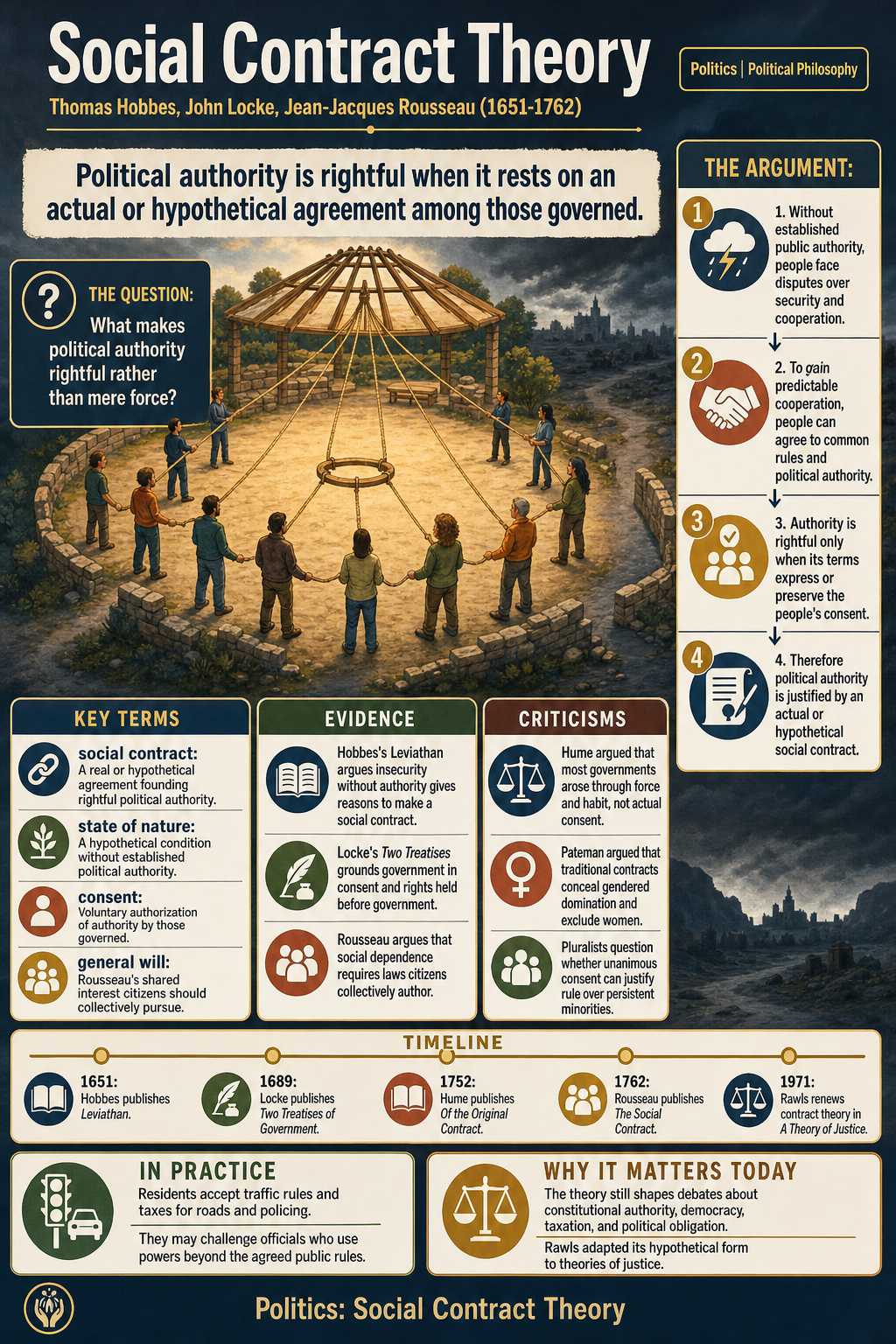
Political authority is rightful when it rests on an actual or hypothetical agreement among those governed.
Social contract theory is a family of arguments about the source and limits of political authority. It developed prominently in early modern Europe, when religious conflict, civil war, expanding states, and challenges to inherited monarchy made political obedience a pressing problem. Thomas Hobbes gave the first major modern formulation in Leviathan in 1651, during the English Civil War. John Locke developed a different account in the Two Treatises of Government, published in 1689, and Jean-Jacques Rousseau offered another influential version in The Social Contract of 1762. They did not propose one identical theory.
The central idea is that government is not rightful simply because rulers are powerful, traditional, or divinely appointed. Its authority must instead be connected to an agreement among those subject to it. The agreement may be historical, but it is more often hypothetical: it asks what terms free and reasonably situated people could accept. The state of nature is the imagined condition before settled government. Hobbes portrayed it as deeply insecure, giving individuals strong reasons to authorize a powerful ruler. Locke held that people already possess rights independently of government and may replace rulers who violate them. Rousseau argued that citizens should obey laws they make together, guided by the general will, or their shared public interest.
Social contract theory is primarily a form of moral and political reasoning, not an empirical theory confirmed by a single experiment. Hobbes's argument begins with the risks of conflict where no common authority can settle disputes. Locke points to the need for impartial law and protection of pre-political rights. Rousseau examines how social inequality and dependence can undermine freedom, then asks how collective self-rule might restore it. These arguments draw on observations about conflict, cooperation, law, and political dependence, but their conclusions depend on contested moral assumptions.
Important criticisms challenge both the history and the structure of contract reasoning. David Hume argued in his essay Of the Original Contract that actual governments usually emerged through conquest, inheritance, and habit rather than freely given consent. Later critics note that a merely hypothetical agreement can be difficult to distinguish from a philosopher's preferred principles. Feminist political theorist Carole Pateman argued that classic contract accounts often assumed male household authority and obscured women's exclusion. Critics also ask whether people born into an existing state can meaningfully consent, and whether majority decisions adequately respect minorities.
The tradition remains central because it supplies a powerful test for political power: could those governed reasonably regard its rules as their own? In the twentieth century, John Rawls revived the hypothetical-contract method in A Theory of Justice, using an imagined fair choice situation to identify principles of justice. Contemporary debates over democracy, constitutional limits, welfare, taxation, migration, and civil disobedience continue to ask questions shaped by the social contract tradition: who must be included, what may government demand, and when is obedience owed?
The argument in four steps
- Without established public authority, people face disputes over security and cooperation.
- To gain predictable cooperation, people can agree to common rules and political authority.
- Authority is rightful only when its terms express or preserve the people's consent.
- Therefore political authority is justified by an actual or hypothetical social contract.
Key terms
- social contract: A real or hypothetical agreement founding rightful political authority.
- state of nature: A hypothetical condition without established political authority.
- consent: Voluntary authorization of authority by those governed.
- general will: Rousseau's shared interest citizens should collectively pursue.
Further reading
- Thomas Hobbes, Leviathan (1651)
- Jean Hampton, Hobbes and the Social Contract Tradition (1986)
- Carole Pateman, The Sexual Contract (1988)