Infographic of: Practice Theory in Anthropology
Anthropology: Foundations and Schools of Thought
Practice Theory in Anthropology
Pierre Bourdieu, Anthony Giddens and others (1972-1984)
Based on: Sherry B. Ortner, Theory in Anthropology since the Sixties, Comparative Studies in Society and History (1984); Pierre Bourdieu, Outline of a Theory of Practice (1972)
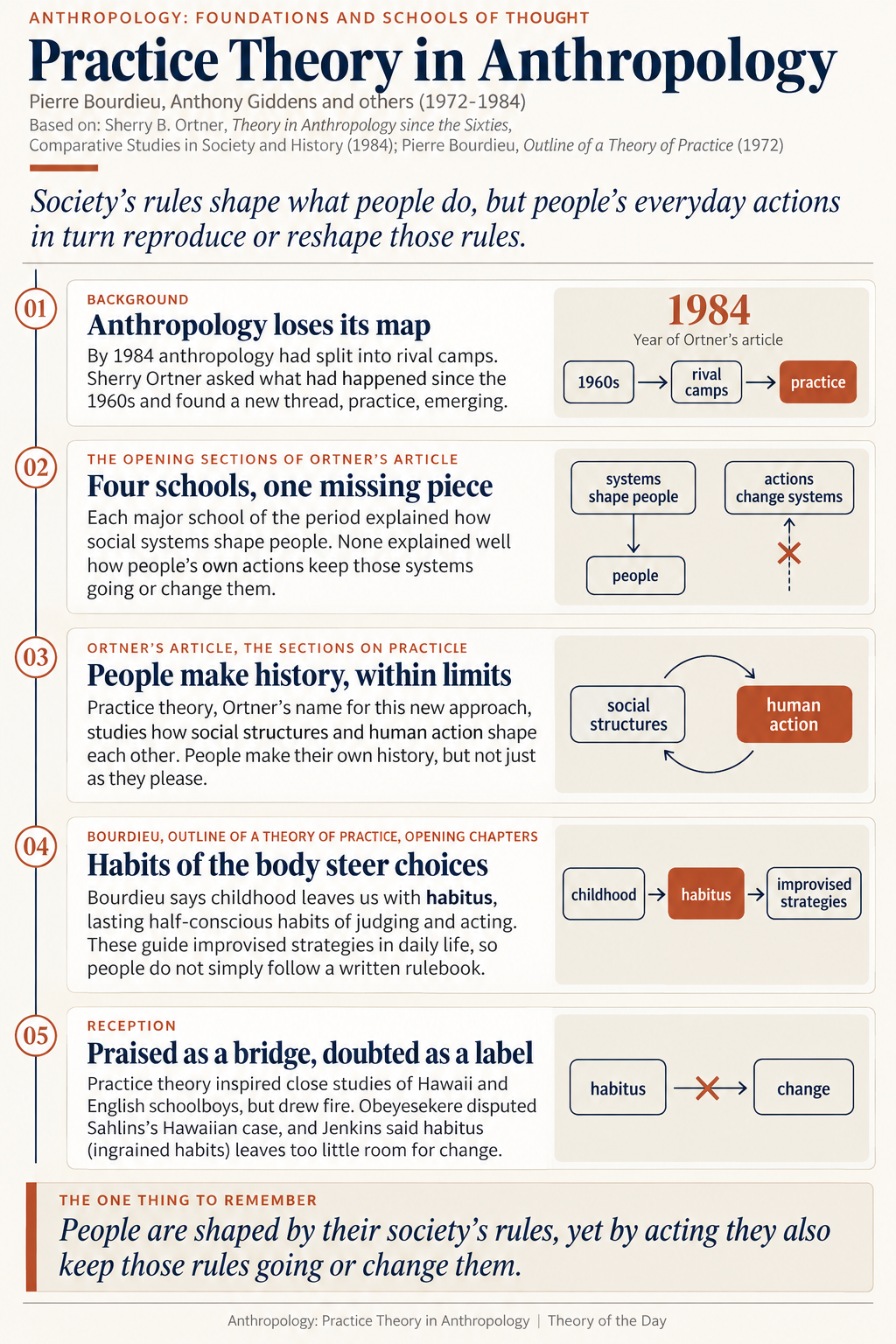
Society's rules shape what people do, but people's everyday actions in turn reproduce or reshape those rules.
In 1984 the American anthropologist Sherry Ortner published a long article in the journal Comparative Studies in Society and History called Theory in Anthropology since the Sixties. Anthropology had split into rival schools, and newcomers found it hard to see how they fitted together. Ortner asked a simple question: what has happened to the field since the 1960s, and what is it moving toward? Her answer was a name for a trend she saw emerging, practice theory.
The article first surveys the schools that grew up after the 1960s. These included symbolic anthropology (the study of shared meanings), cultural ecology (how environment shapes culture), structuralism (hidden mental patterns beneath culture) and Marxist approaches. Ortner shows that each explained, in its own way, how large systems shape what people think and do. She then argues that a newer body of work was turning the question around. It asked how people, acting in their own interests and with their own skills, produce, maintain or alter those systems.
The mechanism is a loop. Social and cultural structures give people their goals, habits and options. People then act, often unevenly and in competition, and their repeated actions either reproduce the structures or, under pressure from events, change them. Ortner borrows Karl Marx's remark that people make their own history, but not just as they please. Practice theory keeps both halves of that sentence.
Several thinkers built the theory. Pierre Bourdieu's Outline of a Theory of Practice, first published in French in 1972 and based on fieldwork among the Kabyle of Algeria, supplied the central tools. One is habitus, meaning lasting, half-conscious habits of feeling and judging absorbed in childhood. Another is strategy, meaning improvised moves rather than obedience to written rules. Anthony Giddens, in 1979, argued that structures are both the medium and the result of action. Marshall Sahlins, in 1981, showed through Hawaii how cultural categories are reshaped when events test them. Ortner herself did not originate these ideas but named the approach and mapped how it connected the older schools.
The evidence comes mainly from detailed case studies. Bourdieu showed that gift exchange among the Kabyle depended on timing and tact, since a delay before a return gift disguises calculation as generosity. Sahlins argued that Hawaiian myth shaped the response to Captain Cook and that the encounter then altered Hawaiian society. Paul Willis showed in 1977 that English working-class schoolboys, by resisting school, helped steer themselves into manual jobs. The criticisms are real. Gananath Obeyesekere disputed Sahlins's reading of the Hawaiian evidence. Richard Jenkins argued that habitus is too deterministic. Others say the practice label joins thinkers who differ widely.
The approach still matters because it offers a middle path between two extremes: the view that culture is a fixed script and the view that individuals are entirely free. Sociologists of education use habitus to explain why some students feel out of place at university. Anthropologists use practice thinking to study how rituals, politics and inequalities are renewed or challenged in everyday life. Ortner's article remains a clear guide to how the field reached that point.
The work, part by part
1. Anthropology loses its map
Background
By the early 1980s, anthropology had split into rival camps, each with its own heroes and vocabulary. Sherry Ortner wrote her 1984 article to ask what had happened to the field since the 1960s and where it was heading. She proposed that a new thread, which she called practice, was beginning to pull the scattered schools together.
2. Four schools, one missing piece
The opening sections of Ortner's article
Ortner surveys the schools that grew up after the 1960s. These include symbolic anthropology (the study of shared meanings), cultural ecology (how environment shapes culture), structuralism (hidden mental patterns) and Marxist approaches. Each, she says, explained how systems shape people, but none explained well how people's actions keep or change those systems.
3. People make history, within limits
Ortner's article, the sections on practice
Ortner argues that a newer approach, drawing on Pierre Bourdieu, Anthony Giddens and Marshall Sahlins, treats social life as made by people acting under constraint. She echoes Karl Marx's remark that people make their own history but not just as they please. Practice theory, as she defines it, studies how social structures and human action shape each other.
4. Habits of the body steer choices
Bourdieu, Outline of a Theory of Practice, opening chapters
Drawing on fieldwork among the Kabyle of Algeria, Bourdieu argues that people absorb their world as habitus, a set of lasting, half-conscious habits of feeling and judging acquired in childhood. These guide improvised strategies in daily life rather than obeying written rules. In gift exchange, for example, the delay before a return gift lets a calculated move pass as generosity.
5. Praised as a bridge, doubted as a label
Reception
Practice theory inspired detailed studies, including Marshall Sahlins's account of Hawaiian responses to Captain Cook and Paul Willis's study of how working-class schoolboys in England resist school and so end up in factory work. Gananath Obeyesekere disputed Sahlins's reading of the Hawaiian evidence. Richard Jenkins argued that Bourdieu's habitus leaves too little room for real change.
The argument in four steps
- Anthropology's main schools explained how culture and society constrain what people think and do.
- Yet people are not puppets: they act with goals, skills and rivalries inside those constraints.
- Their repeated actions either reproduce the system or, under pressure and events, gradually alter it.
- So structure and action must be studied together, because each continually makes the other.
Who contributed what
- Pierre Bourdieu (1972): Outline of a Theory of Practice: introduced habitus and strategy, replacing rule-following in Kabyle society.
- Anthony Giddens (1979): Central Problems in Social Theory: argued structures are both used and renewed through action.
- Marshall Sahlins (1981): Historical Metaphors and Mythical Realities: showed cultural categories reshaped by events, using Hawaii.
- Sherry Ortner (1984): Theory in Anthropology since the Sixties: named and mapped practice approach across the schools.
The evidence
- Bourdieu's Kabyle fieldwork (1972) showed gift exchange driven by timing and strategy, not fixed rules.
- Sahlins's 1981 Hawaii study showed Cook's reception shaped by Hawaiian myth, which events then altered.
- Willis's 1977 Learning to Labour showed schoolboys' resistance to school reproducing their class position.
The criticisms
- Obeyesekere (1992) denied Hawaiians saw Cook as a god, challenging Sahlins.
- Jenkins says Bourdieu's habitus is too deterministic, leaving little room for change.
- Some critics say the practice label joins thinkers who differ widely.
Compared with rival views
- Unlike Lévi-Strauss's structuralism, it treats rules as made and remade through action, not fixed mental codes.
- Unlike Geertz's interpretive anthropology, it adds power, interest and history to the study of meaning.
Why it matters today
Sociologists of education use habitus to explain why working-class students often feel out of place at university.
Further reading
- Sherry B. Ortner, Anthropology and Social Theory: Culture, Power, and the Acting Subject (2006)
- Richard Jenkins, Pierre Bourdieu (1992)
- William H. Sewell Jr., A Theory of Structure: Duality, Agency, and Transformation (1992)