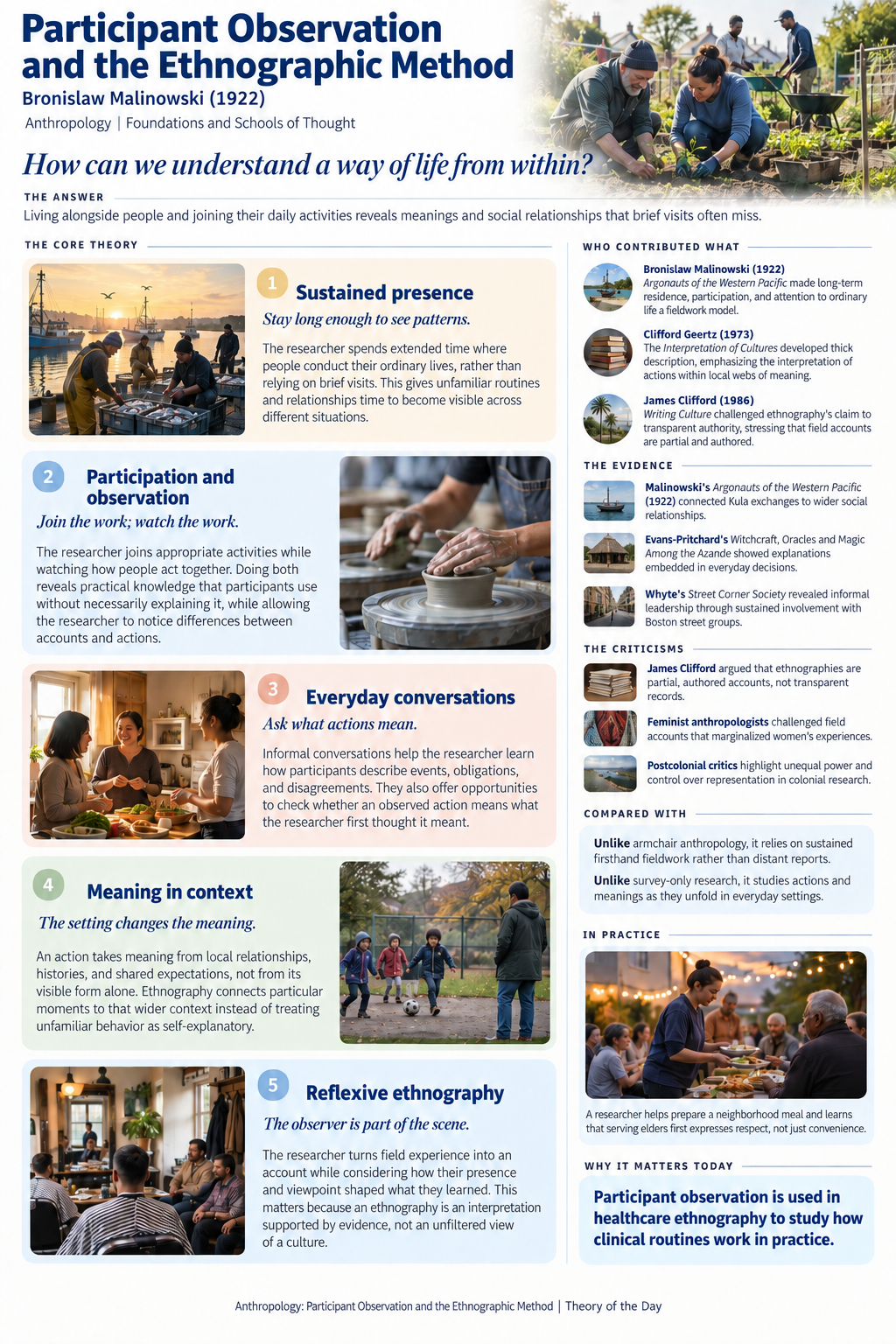
Infographic of: Participant Observation and the Ethnographic Method
Anthropology: Foundations and Schools of Thought
Participant Observation and the Ethnographic Method
Bronislaw Malinowski (1922)
Living alongside people and joining their daily activities reveals meanings and social relationships that brief visits often miss.
Participant observation became a defining practice of twentieth-century anthropology as scholars sought to understand social life through firsthand fieldwork rather than travelers’ reports or distant comparisons. It did not begin with one person: earlier anthropologists, including Franz Boas, conducted substantial field research. But Bronislaw Malinowski’s Argonauts of the Western Pacific (1922), based on work in the Trobriand Islands during the 1910s, gave long-term residence and close attention to ordinary life an influential methodological statement. His aim was to understand how institutions worked in the lives of the people involved.
The central approach is to spend extended time in a community, take part in suitable activities, observe interactions, and talk with people about what they do. Familiarity makes routines and relationships visible that a short visit could miss. Participation also brings practical questions into view: who does a task, when, with whom, and according to whose expectations? Researchers compare what they see with what participants tell them, then revise their interpretations as they encounter further people and situations. The result is an account grounded in context, not simply a catalogue of visible customs.
Malinowski made everyday conduct central to fieldwork, alongside people’s stated rules and explanations. Later scholars developed different aspects of ethnography rather than repeating his program. Clifford Geertz, especially in The Interpretation of Cultures (1973), argued for ‘thick description’: explaining an action requires attention to the meanings people give it within particular relationships and circumstances. James Clifford, in Writing Culture (1986), drew attention to another step in the process. The ethnographer selects, interprets, and writes the account; the finished text is not a transparent copy of social life.
Classic ethnographies show what prolonged fieldwork can uncover, although they do not prove that every interpretation is correct. In Argonauts, Malinowski described Kula exchange as part of an extensive network of relationships and obligations, not merely the movement of valuables. E. E. Evans-Pritchard’s Witchcraft, Oracles and Magic Among the Azande (1937) examined how explanations involving witchcraft and divination entered everyday decisions. William Foote Whyte’s Street Corner Society (1943) used sustained involvement in a Boston neighborhood to describe informal leadership and group relationships that would have been hard to infer from a brief visit.
The method has important limits. A researcher’s presence can affect events, access is uneven, and observation does not reveal everything people think or do. Feminist scholars questioned accounts that overlooked women’s experiences. Postcolonial critics examined how colonial power shaped fieldwork and who could speak for whom. Clifford and other critics challenged the idea that a single ethnographer could provide a complete, neutral account. Later practice has placed greater emphasis on reflexivity, research ethics, collaboration, and making the basis for interpretations clear.
Participant observation still matters because institutions and communities do not operate only according to their formal rules. In healthcare, for example, ethnographers can observe how staff and patients actually navigate a clinic’s routines while asking them what those routines mean. The method’s strength is the disciplined movement between participation, observation, conversation, and reconsideration. Its findings are strongest when researchers show how they reached an interpretation and recognize the limits of their own viewpoint.
The core theory
1. Sustained presence
The researcher spends extended time where people conduct their ordinary lives, rather than relying on brief visits. This gives unfamiliar routines and relationships time to become visible across different situations.
2. Participation and observation
The researcher joins appropriate activities while watching how people act together. Doing both reveals practical knowledge that participants use without necessarily explaining it, while allowing the researcher to notice differences between accounts and actions.
3. Everyday conversations
Informal conversations help the researcher learn how participants describe events, obligations, and disagreements. They also offer opportunities to check whether an observed action means what the researcher first thought it meant.
4. Meaning in context
An action takes meaning from local relationships, histories, and shared expectations, not from its visible form alone. Ethnography connects particular moments to that wider context instead of treating unfamiliar behavior as self-explanatory.
5. Reflexive ethnography
The researcher turns field experience into an account while considering how their presence and viewpoint shaped what they learned. This matters because an ethnography is an interpretation supported by evidence, not an unfiltered view of a culture.
The argument in four steps
- Outsiders often interpret unfamiliar behavior through assumptions drawn from their own lives.
- Daily participation reveals routines, relationships, and expectations that formal accounts leave out.
- Comparing what people say with what they do places particular actions in social context.
- So ethnography explains practices through the lived contexts that give them meaning.
How it works
- The researcher negotiates access and builds relationships through repeated presence in ordinary settings.
- Shared tasks and conversations expose misunderstandings, which the researcher checks against further encounters.
- Trust, ethical limits, and comparison across people and occasions shape which interpretations withstand scrutiny.
Who contributed what
- Bronislaw Malinowski (1922): Argonauts of the Western Pacific made long-term residence, participation, and attention to ordinary life a fieldwork model.
- Clifford Geertz (1973): The Interpretation of Cultures developed thick description, emphasizing the interpretation of actions within local webs of meaning.
- James Clifford (1986): Writing Culture challenged ethnography's claim to transparent authority, stressing that field accounts are partial and authored.
Compared with rival views
- Unlike armchair anthropology, it relies on sustained firsthand fieldwork rather than distant reports.
- Unlike survey-only research, it studies actions and meanings as they unfold in everyday settings.
Further reading
- Bronislaw Malinowski, Argonauts of the Western Pacific (1922)
- Clifford Geertz, The Interpretation of Cultures (1973)
- James Clifford and George E. Marcus, editors, Writing Culture: The Poetics and Politics of Ethnography (1986)