Infographic of: Neuromyths in Education
Education: Memory, Study and How Learning Sticks
Neuromyths in Education
Organisation for Economic Co-operation and Development, Sanne Dekker, Paul Howard-Jones (2002-2014)
Based on: Sanne Dekker, Neuromyths in Education: Prevalence and Predictors of Misconceptions among Teachers, Frontiers in Psychology (2012); Organisation for Economic Co-operation and Development, Understanding the Brain: Towards a New Learning Science (2002); Paul Howard-Jones, Neuroscience and Education: Myths and Messages, Nature Reviews Neuroscience (2014)
Many popular beliefs about the brain and learning are false, yet teachers widely hold them and base teaching on them.
By the late 1990s, brain science was exciting educators, publishers and governments. From 1999 the OECD, an organisation of mostly wealthy countries, ran a Brain and Learning project to see what neuroscience could offer schools. Its 2002 report, Understanding the Brain: Towards a New Learning Science, asked a practical question: which popular claims about the brain are backed by evidence, and which are not? It gave the errors a name, neuromyths, meaning false beliefs built on misread or overstated science.
The theory is built across three works. The OECD report surveyed what brain research could and could not say about learning, and flagged popular claims such as the idea that everything is settled in the first three years and the split between left-brain and right-brain people. In 2012 Sanne Dekker, Nikki Lee, Paul Howard-Jones and Jelle Jolles moved from warning to measurement. Their article in Frontiers in Psychology, with an introduction, methods, results and discussion, surveyed 242 teachers in the UK and the Netherlands on true and false statements. In 2014 Howard-Jones, writing in Nature Reviews Neuroscience, stepped back to explain where such myths come from.
The mechanism they describe is a chain. A real finding, say that some brain regions are more active in certain tasks, is simplified and stretched into a sweeping claim. Books, training courses and commercial programmes then turn it into a classroom method, and teachers who want to help pupils accept it readily. Because the claim sounds scientific, it is rarely questioned.
Each contributor added something different. The OECD supplied the label and the early list of suspect claims. Dekker's team supplied the first large comparison of belief across two countries. They found that teachers endorsed about half the myths, with more than nine in ten agreeing that pupils learn better in their preferred learning style. General knowledge about the brain did not shield them. Howard-Jones supplied the explanation of how myths arise and argued that neuroscientists and teachers need better dialogue.
Outside evidence supports the picture. Pashler and colleagues reviewed learning styles in 2008 and found no adequate evidence that matching teaching to a pupil's preferred style improves learning. John Bruer argued in 1997 that the first-three-years claim stretched findings about early brain development too far. Later surveys in other countries found similar beliefs, and Macdonald and colleagues found in 2017 that training reduced but did not eliminate them. Critics raise limits. Surveys measure what teachers believe, not what they do. The word myth can flatten claims that contain a grain of truth. Jeffrey Bowers has argued that neuroscience has little to add to teaching at all.
The idea still matters because it shapes teacher training. Many courses now use neuromyth checklists to challenge learning styles, left-brain and right-brain types and the ten percent claim. It also gives a general lesson: a brain-science label does not make an educational claim true, and teaching methods should still be tested in classrooms.
The work, part by part
1. A name for brain-science errors
Background: OECD, Understanding the Brain (2002)
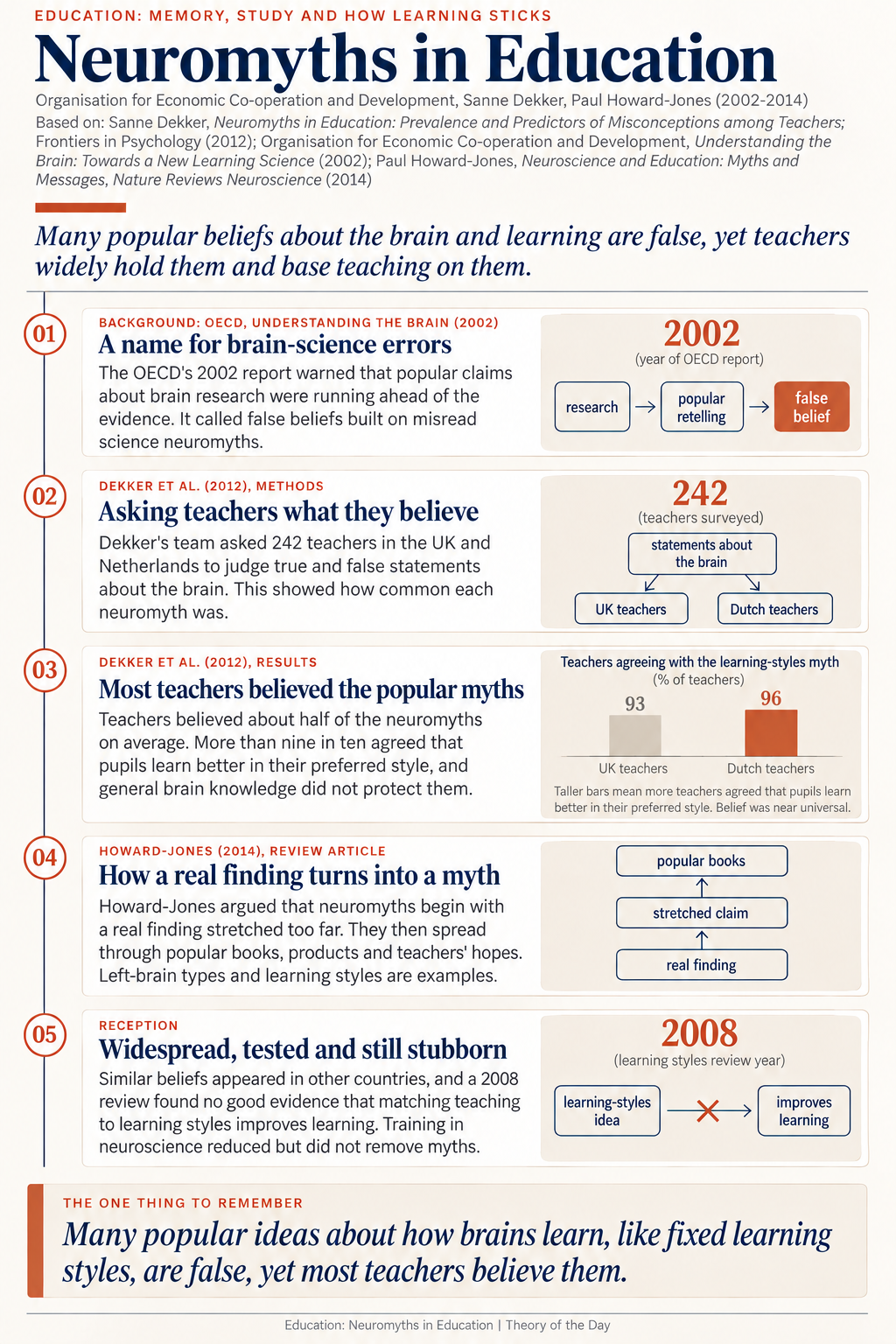
From 1999 the OECD, a club of mostly wealthy countries, ran a project linking brain research to teaching. Its 2002 report, Understanding the Brain: Towards a New Learning Science, warned that popular brain claims were outrunning the evidence. It labelled such claims neuromyths, meaning false beliefs built on misread science, such as the idea that learning is fixed in the first three years.
2. Asking teachers what they believe
Dekker et al. (2012), Methods
Sanne Dekker and colleagues, including Paul Howard-Jones, surveyed 242 primary and secondary teachers in the UK and the Netherlands. The questionnaire mixed true and false statements, some about the brain and some general. Teachers judged each statement as correct, incorrect or not known, so the study could measure how widespread each neuromyth was.
3. Most teachers believed the popular myths
Dekker et al. (2012), Results
Teachers endorsed on average about half of the neuromyths, 49 percent, especially those tied to commercial programmes. Over nine in ten in both countries agreed that pupils learn better when taught in their preferred style, such as visual, auditory or kinesthetic. Knowing more general facts about the brain did not shield teachers from these beliefs.
4. How a real finding turns into a myth
Howard-Jones (2014), review article
In 2014 Paul Howard-Jones traced how neuromyths arise in Neuroscience and Education: Myths and Messages. He argued that they usually start from a real finding that is stretched too far, then spread through popular books, commercial products and teachers' hopes. His examples include left-brain and right-brain types, learning styles and the claim that we use only ten percent of our brains.
5. Widespread, tested and still stubborn
Reception
Surveys in Spain and Latin America later found similar beliefs, and Pashler and colleagues in 2008 found no adequate evidence that matching teaching to learning styles helps. John Bruer argued in 1997 that the first-three-years claim overreads the science. Macdonald and colleagues found in 2017 that training in neuroscience reduced but did not remove such beliefs.
The argument in four steps
- Brain research is exciting, and schools want to use it to improve teaching.
- Findings get simplified and stretched, then sold in books and programmes as proven classroom methods.
- Surveys show teachers in several countries accept many of these claims, even when well informed otherwise.
- So neuromyths are common, and teaching should rest on tested evidence rather than appealing brain stories.
Who contributed what
- Organisation for Economic Co-operation and Development (2002): Understanding the Brain report popularised 'neuromyth' for education, flagging errors like the first-three-years and left-brain claims.
- Sanne Dekker (2012): Led the survey of 242 UK and Dutch teachers measuring how widely neuromyths are believed.
- Paul Howard-Jones (2014): Nature Reviews Neuroscience review explaining how neuromyths arise from stretched findings and how to counter them.
The evidence
- Dekker and colleagues' 2012 survey found 93% of UK teachers endorsed teaching to learning styles.
- Pashler and colleagues' 2008 review found no adequate evidence that matching instruction to learning styles helps.
- Bruer's 1997 essay argued early synapse findings did not show learning is fixed by age three.
The criticisms
- Bowers (2016) argues neuroscience adds little to classroom teaching beyond psychology.
- Critics note surveys measure belief, not what teachers actually do in classrooms.
- Labelling ideas 'myths' can hide partial truths, such as real early-years plasticity.
Compared with rival views
- Unlike popular 'brain-based learning' books, it tests brain-and-learning claims against controlled research evidence.
- Unlike the view that more neuroscience knowledge fixes errors, it shows knowledgeable teachers still hold myths.
Why it matters today
Teacher-training courses and surveys now use neuromyth checklists to challenge beliefs such as learning styles and left-brain, right-brain types.
Further reading
- Pedro De Bruyckere, Paul A. Kirschner and Casper D. Hulshof, Urban Myths about Learning and Education (2015)
- Kelly Macdonald, Laura Germine, Alida Anderson, Joanna Christodoulou and Lauren M. McGrath, Dispelling the Myth: Training in Education or Neuroscience Decreases but Does Not Eliminate Beliefs in Neuromyths (2017)
- Ana Torrijos-Muelas, Sara González-Villora and Ana Rosa Bodoque-Osma, The Persistence of Neuromyths in the Educational Settings: A Systematic Review (2021)