Infographic of: Interleaved Practice
Education: Memory, Study and How Learning Sticks
Interleaved Practice
Doug Rohrer, Nate Kornell, Kelli Taylor (2007)
Based on: Doug Rohrer and Kelli Taylor, The Shuffling of Mathematics Problems Improves Learning, Instructional Science (2007); Nate Kornell and Robert A. Bjork, Learning Concepts and Categories: Is Spacing the 'Enemy of Induction'?, Psychological Science (2008); Doug Rohrer, Robin F. Dedrick and Sandra Stershic, Interleaved Practice Improves Mathematics Learning, Journal of Educational Psychology (2015)
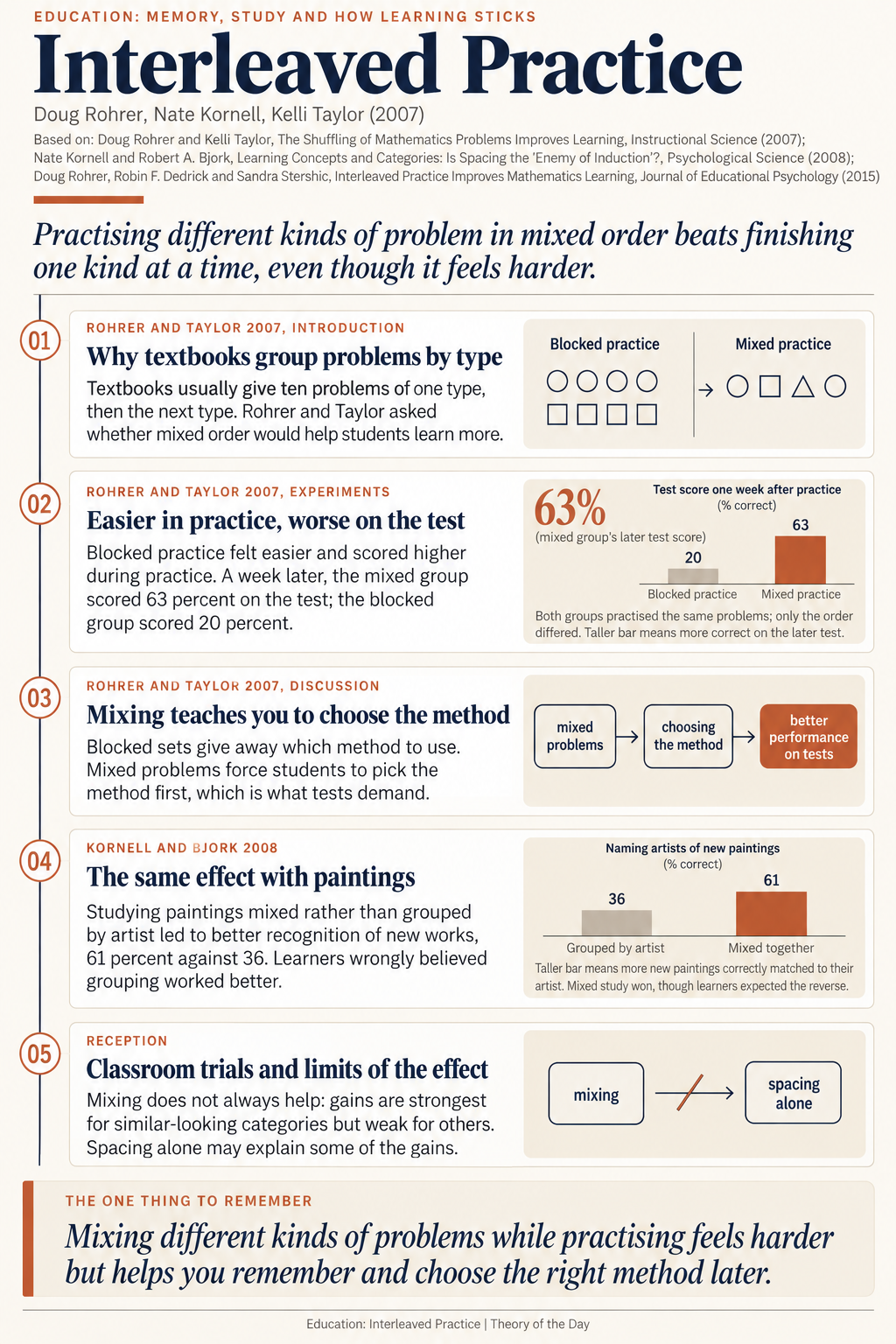
Practising different kinds of problem in mixed order beats finishing one kind at a time, even though it feels harder.
Most school maths books follow a familiar pattern: a lesson on one type of problem, followed by a block of practice on that type alone. Doug Rohrer and Kelli Taylor, cognitive psychologists at the University of South Florida, asked whether this habit is a good one. Their 2007 article in Instructional Science, 'The Shuffling of Mathematics Problems Improves Learning', set out to test whether shuffling problem types together during practice leads to better learning than grouping them.
The article opens by describing blocked practice and pointing to older research on varied practice in motor skills. It then reports experiments in which college students learned to calculate the volume of unusual solid shapes. Some students practised each shape in a block, while others practised the same problems in mixed order. The discussion explains why the result might hold and what it means for teaching.
The central finding is a reversal. During practice, blocked students did better, which makes blocking feel effective. On a test a week later, however, the mixed group scored 63 percent against 20 percent. Rohrer and Taylor suggest that blocking lets students skip a crucial step: deciding which method suits the problem in front of them. In mixed practice the previous problem gives no clue, so students must identify the type first, just as they must in a real exam. Mixing also spreads each type further apart in time, so spacing may contribute too.
Other researchers broadened the idea. Nate Kornell and Robert Bjork, in a 2008 Psychological Science paper, showed the effect when people learned the painting styles of twelve artists. Mixed study gave 61 percent correct on new paintings against 36 percent for grouped study, even though most learners thought grouping had helped more. Taylor and Rohrer's 2010 study extended the finding to young schoolchildren learning to solve prism problems. In 2015 Rohrer, Dedrick and Stershic ran an experiment in seventh-grade classrooms, where mixed assignments beat blocked ones.
The evidence is substantial but not unconditional. Brunmair and Richter's 2019 meta-analysis, a statistical pooling of many studies, found a moderate overall benefit, strongest for visual categories such as paintings and weak or absent for some other materials. Carvalho and Goldstone argued that mixing helps most when categories look alike, while blocking can work better when they are very different. Kang and Pashler suggested in 2012 that spacing, rather than mixing, may account for part of the gain. It is also hard to separate mixing from the extra effort it demands.
The idea still matters because it runs against intuition, and learners often choose the wrong strategy. It now informs how teachers design homework and revision sets, by returning to earlier topics instead of finishing each one for good. The practical lesson is that practice that feels slower and more error-prone can build the very skill of choosing the right method that later tests, and real life, require.
The work, part by part
1. Why textbooks group problems by type
Rohrer and Taylor 2007, introduction
Most textbooks group problems by type: ten of one kind, then ten of the next. Doug Rohrer and Kelli Taylor asked whether shuffling the types together would help students learn better. They called the shuffled approach interleaved practice and the usual approach blocked practice, and they tested it in mathematics, where blocking is the norm.
2. Easier in practice, worse on the test
Rohrer and Taylor 2007, experiments
Rohrer and Taylor taught college students to find the volume of four unfamiliar solid shapes, each needing its own formula. Some practised blocked, finishing one shape before the next, while others practised the same problems mixed. Blocked students did better during practice, but on a test a week later the mixed group scored 63 percent against 20 percent.
3. Mixing teaches you to choose the method
Rohrer and Taylor 2007, discussion
Rohrer and Taylor argue that blocked practice quietly removes a key step: deciding which method fits the problem. When every problem is alike, the one just solved tells you what to do. Mixed practice makes students identify the problem type first, as a real test does, and it also spreads each type further apart in time.
4. The same effect with paintings
Kornell and Bjork 2008
Nate Kornell and Robert Bjork showed that the effect reaches beyond mathematics. Students studied paintings by twelve artists, either grouped by artist or mixed together. When later asked to name the artist of new paintings by the same painters, mixed study gave 61 percent correct against 36 percent. Yet most students believed grouping had helped them more.
5. Classroom trials and limits of the effect
Reception
In 2015 Rohrer, Dedrick and Stershic found mixed review also helped seventh-graders in real maths classes. Later work qualified the claim, however. Brunmair and Richter's 2019 meta-analysis found benefits strongest for similar-looking categories like paintings but weak or absent for others, and Kang and Pashler argued in 2012 that spacing alone may explain some gains.
The argument in four steps
- Textbooks group problems by type, so the method for each problem is obvious from the one before.
- Blocked practice therefore feels smooth but never trains students to choose which method fits a problem.
- Mixed practice feels harder while studying, yet it forces that choice and spreads each type over time.
- So mixing problem types during practice produces better results on later tests than grouping them.
Who contributed what
- Doug Rohrer (2007): With Taylor, showed in Instructional Science that mixed maths practice beats blocked practice on a delayed test.
- Nate Kornell (2008): With Bjork, showed mixed study aids learning painting styles, and that learners misjudge it.
- Kelli Taylor (2010): With Rohrer, showed fourth-graders learning prism problems also gained from interleaved practice.
The evidence
- Rohrer and Taylor 2007: mixed maths practice scored 63% against 20% for blocked, a week later.
- Kornell and Bjork 2008: mixed study of paintings gave 61% correct on new works, against 36%.
- Rohrer, Dedrick and Stershic 2015: mixed review beat blocked review in seventh-grade maths classes.
The criticisms
- Brunmair and Richter 2019: benefit varies by material and is weak for some.
- Kang and Pashler 2012: spacing, not mixing, may explain part of the gain.
- Carvalho and Goldstone 2014: blocking can work better when categories look very different.
Compared with rival views
- Unlike blocked practice, it mixes problem types, so students must choose a method each time.
- Unlike plain spacing, it shuffles different kinds of material together, not just repeating one kind later.
Why it matters today
Maths teachers and revision guides now mix earlier topics into homework and review sets, instead of drilling one topic at a time.
Further reading
- Matthew Brunmair and Tobias Richter, Similarity Matters: A Meta-Analysis of Interleaved Learning and Its Moderators (2019)
- John Dunlosky, Katherine Rawson, Elizabeth Marsh, Mitchell Nathan and Daniel Willingham, Improving Students' Learning With Effective Learning Techniques (2013)
- Peter C. Brown, Henry L. Roediger III and Mark A. McDaniel, Make It Stick: The Science of Successful Learning (2014)