Infographic of: Hegemony and the War of Position
Politics: Political Philosophy
Hegemony and the War of Position
Antonio Gramsci (1929-1935)
Based on: Antonio Gramsci, Prison Notebooks (1948-1951)
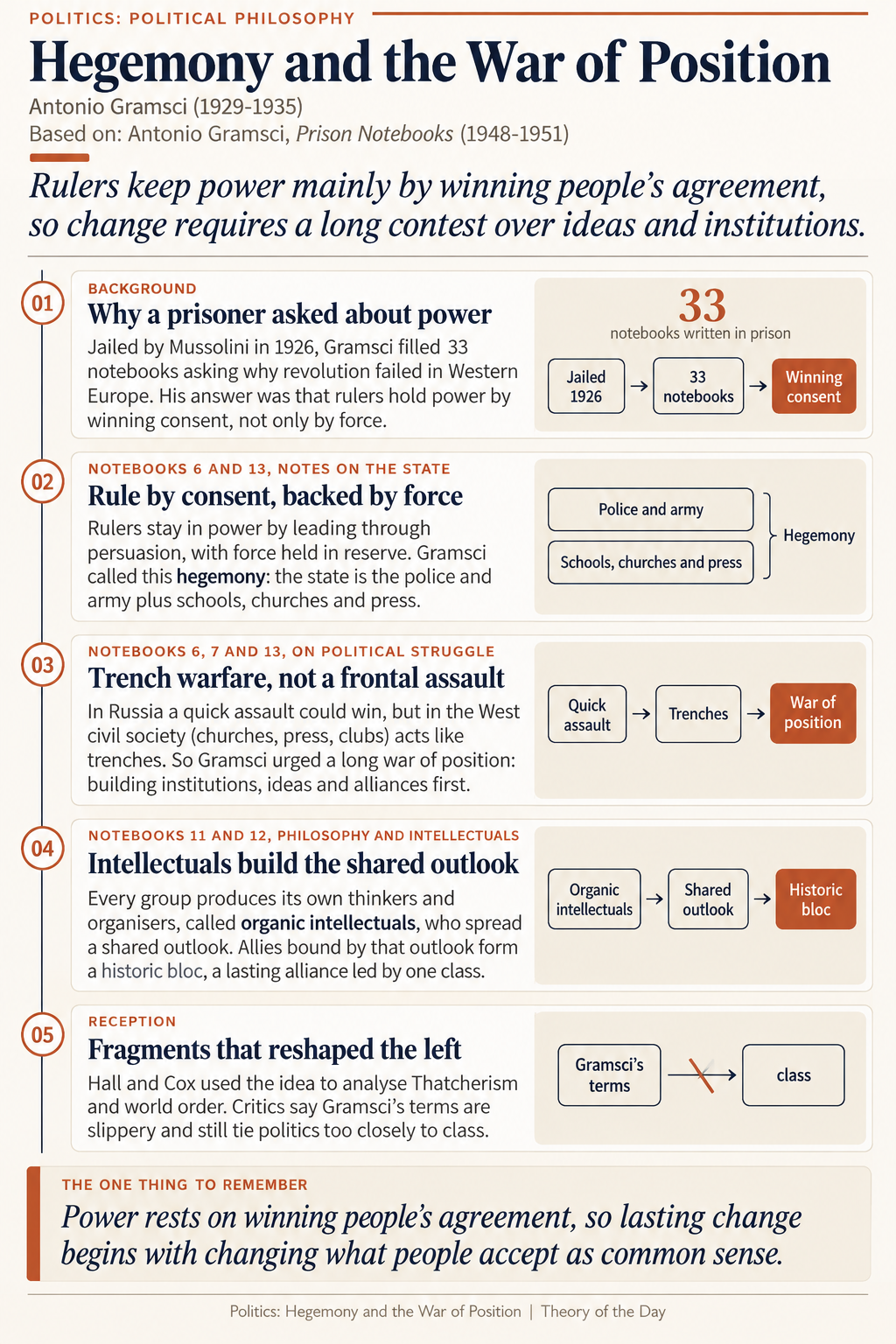
Rulers keep power mainly by winning people's agreement, so change requires a long contest over ideas and institutions.
Antonio Gramsci was a Sardinian-born journalist and a founder and leader of the Italian Communist Party. Mussolini's government arrested him in November 1926, although he was an elected deputy, and in 1928 he was sentenced to more than twenty years. Once allowed to write, he began the Prison Notebooks in February 1929 and kept going until ill health stopped him in 1935; he died in 1937. The question driving them was how ruling classes hold power without constant violence, and why a revolution that had triumphed in Russia in 1917 had failed in Western Europe while fascism won in Italy.
The Notebooks are not a book with chapters. They are 33 notebooks of fragmentary, often repeated notes, first published in thematic volumes in 1948-1951 and in a full critical edition by Valentino Gerratana in 1975. Because of prison censorship, Gramsci often wrote 'philosophy of praxis' for Marxism. The argument can be followed through three clusters: the notes on the state in Notebooks 6 and 13, the notes on political struggle in Notebooks 6, 7 and 13, and the notes on philosophy and intellectuals in Notebooks 11 and 12.
The mechanism runs through consent. Ruling groups spread their view of the world through schools, churches, newspapers and clubs until it feels like plain common sense, so that most people accept existing arrangements as natural. Gramsci called the resulting leadership hegemony, and described the state in the full sense as political society plus civil society: hegemony protected by the armour of coercion. Where this web is dense, as in the West, a war of manoeuvre, the quick frontal attack that worked in Russia, runs into trenches and fortresses. Challengers must wage a war of position. Organic intellectuals, thinkers and organisers who emerge from a rising group, build a rival outlook, turn the patchy common sense of ordinary people into a coherent critique, and assemble a historic bloc of allies before the state itself can be taken.
Gramsci did not work alone. He took the word hegemony from Russian Marxist debates, where it described the working class leading the peasants, a usage associated with Lenin. His sister-in-law Tatiana Schucht and the economist Piero Sraffa supplied books and helped save the notebooks, and Palmiro Togliatti oversaw their first publication. Later scholars carried the idea on. Stuart Hall used it to analyse Thatcherism, Robert Cox applied it to world order, and Ernesto Laclau and Chantal Mouffe rebuilt it in Hegemony and Socialist Strategy in 1985.
Evidence comes first from Gramsci's own notes on the Risorgimento (Notebook 19), where he argued that Italy's Moderates led allied groups by consent before taking power. Later studies applied the idea. Hall and colleagues' Policing the Crisis (1978) showed a mugging panic winning consent for harsher policing, and Michael Burawoy's Manufacturing Consent (1979) showed factory games drawing workers into agreement with their own exploitation. Critics object. Perry Anderson (1976) found that Gramsci's key terms shift in meaning, Laclau and Mouffe said he kept class as the necessary core, and Abercrombie, Hill and Turner (1980) doubted that dominant ideas win real consent from subordinate groups. The fragmentary, censored form of the notebooks also leaves much open to interpretation.
It still matters because it explains why power can be stable without constant force, and why change often begins in culture, schools and media before it reaches government. Scholars of international relations, media studies, education and labour politics still use hegemony. Gramsci's distinction between wars of manoeuvre and of position remains a common way of discussing slow political strategy.
The work, part by part
1. Why a prisoner asked about power
Background
Gramsci, leader of the Italian Communist Party, was jailed by Mussolini's regime in 1926 and sentenced in 1928 to over twenty years. From 1929 he filled 33 notebooks with fragmentary notes, asking why revolution had triumphed in Russia but failed in Western Europe, and why fascism had won in Italy. His answer, hidden from prison censors in careful wording, was that power rests on consent as well as force.
2. Rule by consent, backed by force
Notebooks 6 and 13, notes on the state
Gramsci used hegemony (leadership won by persuasion, so that people accept the rulers' view of the world as common sense) to explain stable power. He argued the state in the full sense combines political society, the police, courts and army, with civil society, the schools, churches, press and clubs. Rule is therefore consent protected by the armour of coercion, and ruling groups must lead before and while they command.
3. Trench warfare, not a frontal assault
Notebooks 6, 7 and 13, on political struggle
Gramsci borrowed military language to contrast two strategies. A war of manoeuvre (a swift frontal assault to seize the state) had worked in Russia, where he thought the state was everything and civil society weak. In the West, civil society (churches, press and clubs) was a system of trenches and fortresses, so socialists needed a long war of position, building alternative institutions, ideas and alliances before any seizure of power.
4. Intellectuals build the shared outlook
Notebooks 11 and 12, philosophy and intellectuals
A war of position is fought by intellectuals, which Gramsci defined broadly: every group produces organic intellectuals (thinkers, teachers, journalists and organisers who give it a shared outlook). He argued that ordinary people hold a patchy common sense, inherited from the past, which can be turned into a coherent critical outlook. Groups bound together by one such outlook form a historic bloc (a lasting alliance led by one class).
5. Fragments that reshaped the left
Reception
The notebooks were first published in thematic volumes in 1948-1951 under Palmiro Togliatti's direction, with a full critical edition by Valentino Gerratana in 1975. Stuart Hall applied hegemony to Thatcherism, and Robert Cox to world order. Perry Anderson (1976) charged that Gramsci's key terms shift in meaning, while Laclau and Mouffe (1985) rejected his view that class must anchor hegemony.
The argument in four steps
- Modern states rest on consent spread through schools, churches and newspapers, not only on police and army.
- Ruling groups win that consent by making their interests look like the common good.
- Where such consent is deep, a sudden assault on the state fails against society's defences.
- So challengers must wage a long war of position, winning minds and institutions before taking power.
Who contributed what
- Antonio Gramsci (1929-1935): Prison Notebooks: defined hegemony as consent protected by coercion and proposed war of position in the West.
- Stuart Hall (1979): The Great Moving Right Show: read Thatcherism as a hegemonic project winning popular consent.
- Ernesto Laclau and Chantal Mouffe (1985): Hegemony and Socialist Strategy rebuilt hegemony as contingent political articulation, dropping Gramsci's class core.
The evidence
- Gramsci's Notebook 19 (1934-35) showed Italy's Moderates leading allies before taking power.
- Hall et al.'s Policing the Crisis (1978) showed a mugging panic winning consent for harsher policing.
- Burawoy's Manufacturing Consent (1979) showed shop-floor games leading workers to consent to their own exploitation.
The criticisms
- Perry Anderson (1976) found hegemony and state used in shifting, inconsistent ways.
- Laclau and Mouffe (1985) said Gramsci still treats class as the necessary core.
- Abercrombie, Hill and Turner (1980) doubted that dominant ideas win real consent from subordinates.
Compared with rival views
- Unlike economic determinism, it gives ideas and institutions a causal role in keeping power.
- Unlike the Bolsheviks' 1917 seizure of the state, it favours a long struggle in civil society.
Why it matters today
International political economy scholars such as Robert Cox use hegemony to analyse how powerful states and elites sustain a world order through consent.
Further reading
- Perry Anderson, The Antinomies of Antonio Gramsci (1976)
- T. J. Jackson Lears, The Concept of Cultural Hegemony: Problems and Possibilities (1985)
- Kate Crehan, Gramsci, Culture and Anthropology (2002)