Infographic of: Formal Sociology: The Stranger, the Dyad and the Triad
Sociology: Classical Foundations
Formal Sociology: The Stranger, the Dyad and the Triad
Georg Simmel (1908)
Based on: Georg Simmel, Sociology: Inquiries into the Construction of Social Forms (1908)
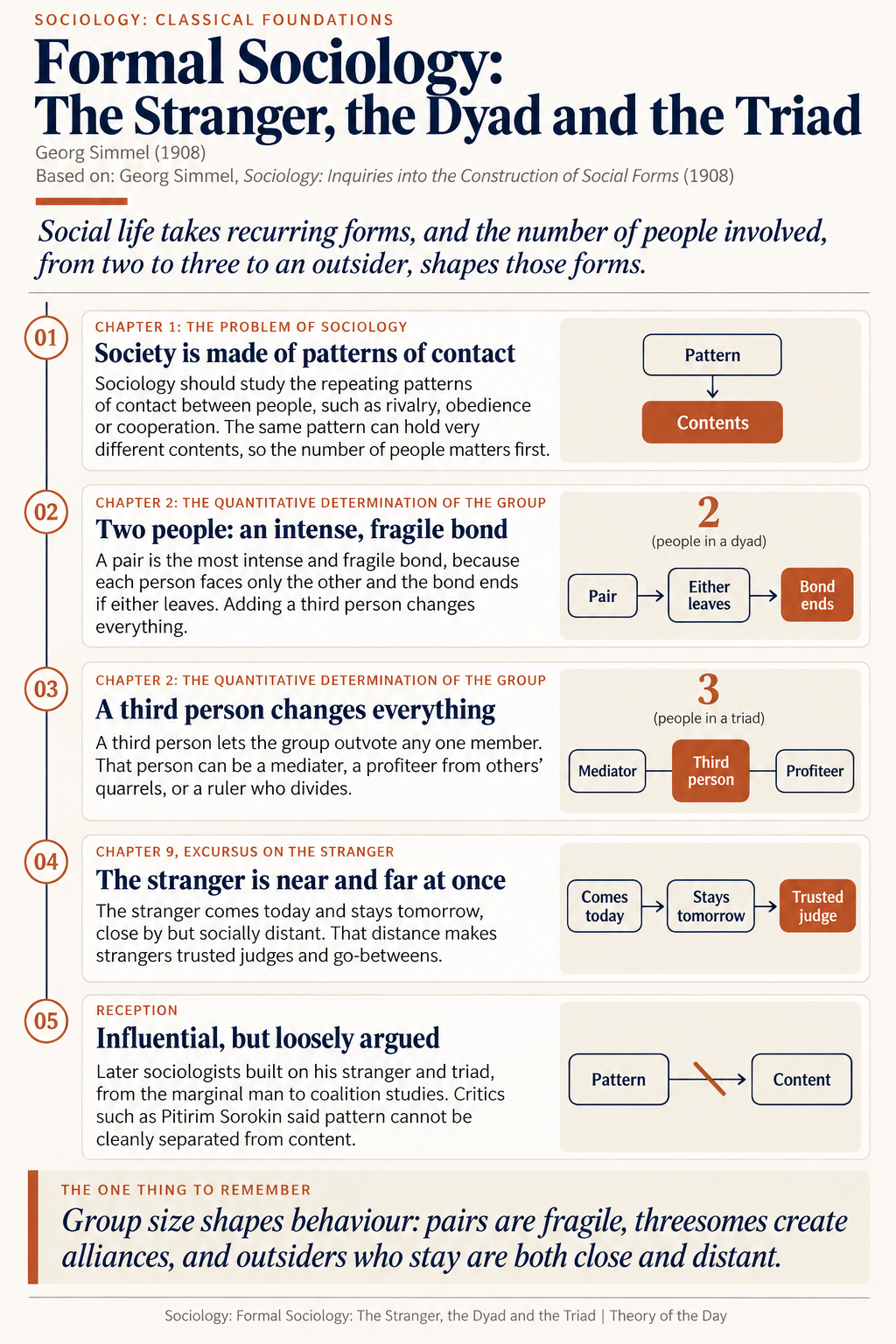
Social life takes recurring forms, and the number of people involved, from two to three to an outsider, shapes those forms.
Georg Simmel published Soziologie in Leipzig in 1908, when sociology was still fighting for a place in German universities. Simmel was himself something of an outsider, a brilliant Berlin lecturer who for years held no secure professorship. The book asks a basic question: if history, economics and psychology already study human life, what is left for a separate science of society?
His answer comes in the opening chapter, 'The Problem of Sociology'. Sociology, he says, should study forms of interaction, meaning the repeating patterns by which people deal with one another, such as rivalry, obedience, secrecy or cooperation. The same form can appear in a family, a business or a political party. The book then examines these forms one by one, in chapters on the size of groups, domination and submission, conflict, secrecy, overlapping social circles, the poor, and space.
The first mechanism is number. In Chapter 2, 'The Quantitative Determination of the Group', Simmel argues that adding or removing a single person changes the whole character of a relationship. A dyad, or pair, has no group standing above it, so each person feels the bond depends on them alone, and if one leaves, it ends. That makes pairs intense but fragile. A triad, a group of three, is different. It can outvote one member, and the third person can act as a mediator, as a tertius gaudens (the 'third who rejoices') who profits from the quarrel of the other two, or as a ruler who divides them.
The second mechanism is distance. In a short excursus within Chapter 9, on space, Simmel describes the stranger as the person who comes today and stays tomorrow. The stranger is near in space but far in social ties. That detachment makes the stranger objective and often trusted as a judge or go-between, while the group can also treat the stranger with suspicion.
Others carried the ideas further. Kurt Wolff's 1950 translation of selections brought Simmel to English-speaking readers. Robert Park's 1928 essay on the marginal man built on the stranger to study migrants. Alfred Schütz used the stranger in 1944 to analyse newcomers. Theodore Caplow and others studied coalitions in groups of three, and Ronald Burt's 1992 work on structural holes showed the advantages of those who bridge unconnected groups.
The evidence is a mixture of suggestive and illustrative. Experimental work on three-person groups, such as that of Mills in 1953, found pairs regularly joining against the third. Critics, however, have raised problems. Pitirim Sorokin argued that form cannot be separated from content. Many readers find the book more a series of brilliant essays than a tested system, resting on examples rather than data. Donald Levine showed that the 'stranger' has been interpreted in many different, sometimes conflicting, ways.
The work still matters because it gave sociology a way to think about structure at the smallest scale. Researchers on social networks, migration, mediation and workplace coalitions still use Simmel's pair, third party and stranger as starting points for asking how the shape of a group shapes the behaviour of those inside it.
The work, part by part
1. Society is made of patterns of contact
Chapter 1: The Problem of Sociology
Simmel asks what a separate science of society could study, given that history, economics and psychology already cover human life. His answer is that sociology studies forms of interaction (the repeating patterns by which people deal with one another), such as rivalry, obedience or cooperation. The same form can hold very different contents, so Simmel turns next to the simplest form of all, the number of people involved.
2. Two people: an intense, fragile bond
Chapter 2: The Quantitative Determination of the Group
Simmel argues that group size changes the nature of social life, and the smallest group is the dyad (a pair). In a pair each person faces only the other, so no one can hide behind a group, and if either leaves the relationship ends. This makes pairs intense and fragile, and it prepares the ground for his claim that adding a third person transforms everything.
3. A third person changes everything
Chapter 2: The Quantitative Determination of the Group
With three people, Simmel says, a group appears that can outvote any one member, so a structure now stands above individuals. He describes three roles for the third party: the mediator who settles disputes, the tertius gaudens (the 'third who rejoices') who profits from others' conflict, and the ruler who divides. A stranger, the next section shows, is a related kind of outsider.
4. The stranger is near and far at once
Chapter 9, Excursus on the Stranger
In a short excursus (a side essay), Simmel defines the stranger not as the wanderer who leaves tomorrow but as the person who comes today and stays tomorrow. Such a person is physically close yet socially distant, belonging to the group without sharing its roots. Because of that detachment, strangers are trusted as judges and go-betweens, and Simmel's historical example is the trader in European towns.
5. Influential, but loosely argued
Reception
Robert Park drew on the stranger for his 1928 idea of the marginal man, and Alfred Schütz used it in 1944 to study newcomers. Theodore Caplow's work on coalitions in threes and Ronald Burt's work on brokers between disconnected groups echo the triad. Critics such as Pitirim Sorokin argued that form cannot be separated from content, and others find Simmel's essays brilliant but unsystematic.
The argument in four steps
- Sociology should study recurring forms of contact between people, not the varied purposes that fill them.
- A pair is intense and fragile, because each person alone sustains the bond.
- A third person creates a group above individuals, with new roles such as mediator and profiteer.
- So the stranger, an outsider who stays, shows that closeness and distance coexist inside one group.
Who contributed what
- Georg Simmel (1908): In Soziologie, defined sociology as the study of interaction forms, analysing the dyad, the triad and the stranger.
- Robert E. Park (1928): Extended the stranger into the 'marginal man', a migrant living between two cultures.
- Alfred Schütz (1944): In 'The Stranger', analysed how newcomers meet a group's unspoken assumptions.
The evidence
- Mills's 1953 observations of three-person groups showed pairs regularly forming against the third member.
- Park's 1928 essay on migrants described the marginal man between two cultures, building on Simmel's stranger.
- Burt's 1992 Structural Holes showed managers bridging disconnected groups gain advantages, echoing the tertius gaudens.
The criticisms
- Pitirim Sorokin said form cannot be separated from content.
- Essayistic and unsystematic: claims rest on illustrations, not tested evidence.
- Donald Levine showed readers have taken the 'stranger' in conflicting ways.
Compared with rival views
- Unlike Durkheim's social facts, it studies interaction patterns between people, not society as an outside force.
- Unlike Comte's grand science of society, it claims one narrow subject: forms of association.
Why it matters today
Network analysts apply Simmel's tertius gaudens to brokers who bridge groups, as in Ronald Burt's studies of managers' careers.
Further reading
- David Frisby, Georg Simmel (1984)
- Donald N. Levine, Visions of the Sociological Tradition (1995)
- Theodore Caplow, Two Against One: Coalitions in Triads (1968)