Infographic of: Behaviourism
Psychology: Learning and Behaviourism
Behaviourism
John B. Watson (1913)
Based on: John B. Watson, Psychology as the Behaviorist Views It, Psychological Review (1913); John B. Watson and Rosalie Rayner, Conditioned Emotional Reactions, Journal of Experimental Psychology (1920)
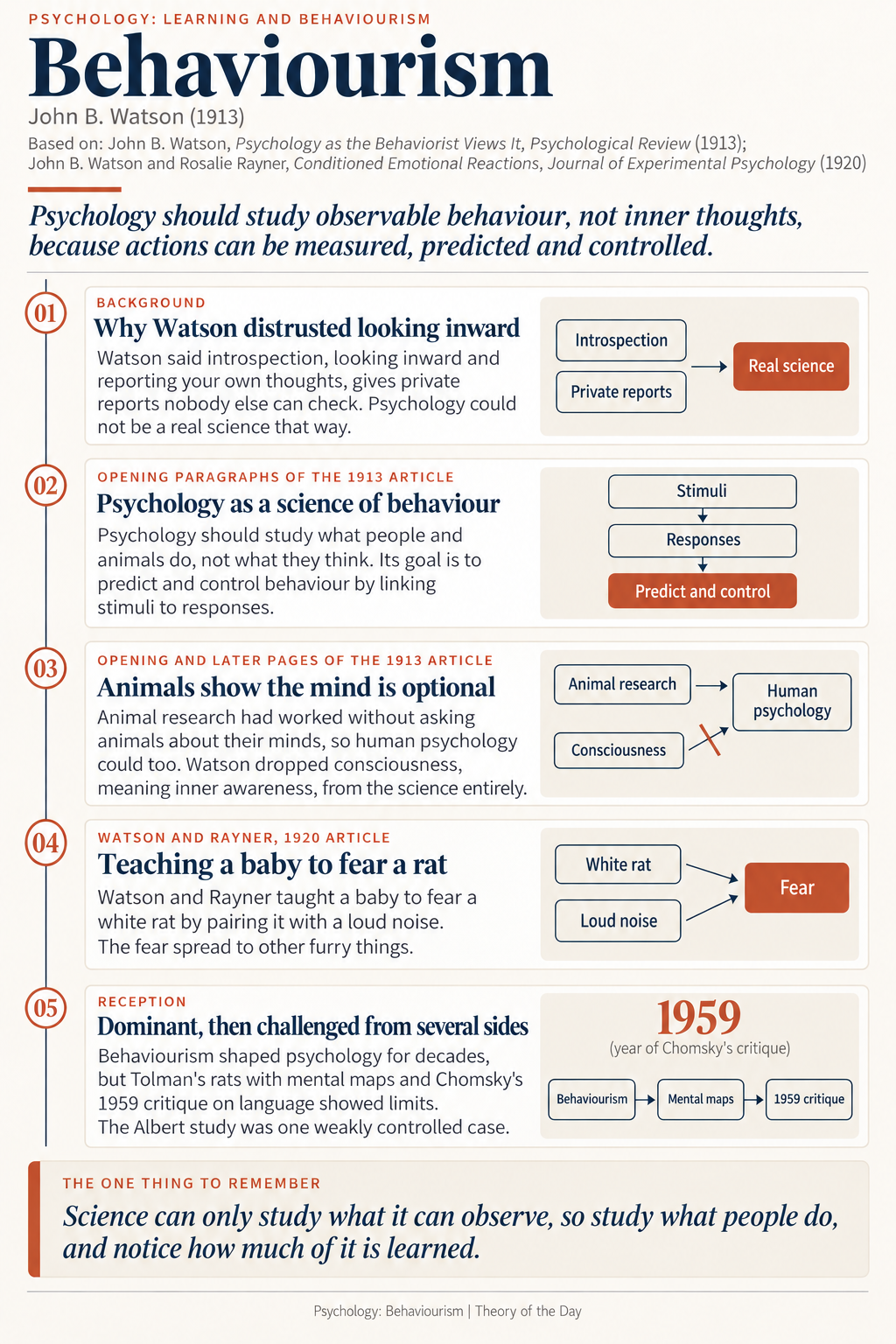
Psychology should study observable behaviour, not inner thoughts, because actions can be measured, predicted and controlled.
In 1913 John B. Watson, a psychologist at Johns Hopkins University, published "Psychology as the Behaviorist Views It" in Psychological Review. It grew out of lectures he had given at Columbia University. At the time most psychologists, following Wilhelm Wundt and Edward Titchener, defined their field as the study of conscious experience. They trained people to look inward and describe what they found, a method called introspection. Watson asked whether psychology could become a real natural science without relying on the mind.
The article is one continuous argument rather than a book of chapters. It opens by declaring that psychology, as the behaviourist sees it, is a purely objective branch of natural science whose goal is the prediction and control of behaviour. Watson then attacks introspection, pointing out that animal psychology had produced results without it. He adds that the behaviourist recognises no dividing line between humans and other animals. In the later pages he argues that topics such as sensation, attention and imagery can be studied through what a subject does, and that consciousness need not be mentioned. In 1920, in an article with Rosalie Rayner in the Journal of Experimental Psychology, he turned this programme into an experiment on one infant's emotions.
The mechanism is the link between a stimulus (something in the environment that acts on the body) and a response (what the body then does). Habits form when responses become attached to new stimuli. Watson drew on Ivan Pavlov's work on conditioned reflexes (reflexes learned through pairing) in dogs. In the Little Albert study, a baby was shown a white rat just before a loud, frightening clang. After several pairings Albert cried at the rat alone, and his fear spread to a rabbit and a fur coat. Watson took this as evidence that emotions are largely learned, not simply inborn.
Others built on Watson's base. Edward Thorndike's 1898 puzzle-box work on cats showed learning through success and failure, and Pavlov's research supplied the conditioning method. Mary Cover Jones in 1924 removed a young boy's fear of a rabbit by gradual exposure, an early step toward behaviour therapy. B. F. Skinner later developed radical behaviourism and, in 1938, the study of operant conditioning, where actions are shaped by their consequences. Edward Tolman, though also a behaviourist, allowed room for purposes and inner maps.
The evidence for behaviourism is that conditioning is real, measurable and useful, from animal laboratories to clinics. The criticisms are serious. Tolman's 1948 work on rats suggested internal mental maps. Noam Chomsky's 1959 review of Skinner's Verbal Behavior argued that learning by reward cannot explain how children acquire language. The Little Albert study rested on one baby, was loosely controlled, and Albert was never helped to lose his fear, which modern readers find ethically troubling.
Behaviourism still matters because its core demand, that psychological claims be tied to measurable evidence, became part of the discipline. Its methods live on in applied behaviour analysis for autistic children and in exposure therapy for phobias. Cognitive psychology rose partly as a reaction to it, yet it kept Watson's insistence on testable, observable results.
The work, part by part
1. Why Watson distrusted looking inward
Background
In 1913 Watson, then at Johns Hopkins University, argued that psychology had failed to become a real science. Its main method was introspection, in which people look inward and report their own thoughts and feelings. Watson said such private reports cannot be checked by anyone else, so they cannot produce reliable knowledge as experiments in physics do.
2. Psychology as a science of behaviour
Opening paragraphs of the 1913 article
Watson opens by declaring psychology a purely objective branch of natural science. Its goal, he says, is the prediction and control of behaviour, meaning what people and animals do. Observable stimuli (things in the environment that act on a body) and responses (what the body does) replace inner thoughts and feelings as the material to study.
3. Animals show the mind is optional
Opening and later pages of the 1913 article
Watson argues that the behaviourist sees no dividing line between humans and other animals. Animal researchers had already learned much without asking animals what they felt, and he wanted human psychology to work the same way. Consciousness (a person's inner awareness) is therefore not needed, and he proposed testing even sensation and attention through how subjects respond.
4. Teaching a baby to fear a rat
Watson and Rayner, 1920 article
In 1920 Watson and his graduate student Rosalie Rayner tested whether emotions are learned. They showed a baby known as Albert a white rat, then struck a steel bar loudly behind him; after several pairings he cried at the rat alone. His fear also spread to similar furry objects such as a rabbit and a fur coat.
5. Dominant, then challenged from several sides
Reception
Behaviourism dominated American psychology for decades, and Watson's method of objective measurement became standard. Critics replied that Edward Tolman's maze studies of the 1940s suggested rats form mental maps, and Noam Chomsky's 1959 review of B. F. Skinner argued that behaviourism cannot explain language. The Albert study is also criticised as a single, poorly controlled case, and Albert was never deconditioned.
The argument in four steps
- Introspection gives private reports that no other observer can check, so it cannot ground a science.
- Animal psychology already succeeds by measuring what creatures do, without asking about their minds.
- Human behaviour, including emotion, can be explained as responses learned from stimuli, as the Albert test showed.
- So psychology should drop consciousness and study behaviour, aiming to predict and control it.
Who contributed what
- John B. Watson (1913): Psychology as the Behaviorist Views It: defined psychology as objective study of behaviour, rejecting introspection and consciousness.
- B. F. Skinner (1938): The Behavior of Organisms: developed operant conditioning, where behaviour is shaped by its consequences.
The evidence
- Watson and Rayner's 1920 Little Albert study showed a baby learning fear of a rat.
- Thorndike's 1898 puzzle-box experiments showed cats gradually learning escape actions through trial and success.
- Mary Cover Jones's 1924 case of Peter showed a child's fear of rabbits removed by gradual exposure.
The criticisms
- Chomsky's 1959 review argued behaviourism cannot explain how children acquire language.
- Tolman's 1948 maze work suggested animals form inner mental maps.
- Later reviewers found the Little Albert study poorly controlled and ethically unacceptable.
Compared with rival views
- Unlike introspectionism (Wundt, Titchener), it studies only observable behaviour, not reported inner experience.
- Unlike cognitive psychology, it treats mental states as unnecessary for explaining what people do.
Why it matters today
Applied behaviour analysis uses reward and learning principles descended from behaviourism to teach skills to autistic children, and exposure therapy treats phobias the same way.
Further reading
- Kerry W. Buckley, Mechanical Man: John Broadus Watson and the Beginnings of Behaviorism (1989)
- Gerald E. Zuriff, Behaviorism: A Conceptual Reconstruction (1985)
- James T. Todd and Edward K. Morris (eds.), Modern Perspectives on John B. Watson and Classical Behaviorism (1994)