Closed Form logo

Closed Form

Archives
Subscribe

Closed Form

Archive

What if your professor was a hotel?

I’m not ashamed to admit that I am an enthusiastic reader of the London Review of Books. (It’s one of the last refuges of real, thoughtful long-form writing in our ablated Anglophone cultural world, man!) Today I want to offer you an extended meditation on the mode of associational thinking that seems to be so commonplace today. By way of very limited example, I’m going to use two reviews that appeared months apart in two separate issues of the LRB. Please consider that these examples are meant to be illustrative, not exhaustive, and I encourage you to think about examples of associational thinking in your own lives.* In the January 23, 2025 issue, Susan Pedersen reviewed Tehila Sasson’s The Solidarity Economy: Non-profits and the making of neoliberalism after empire; framing the prevalence of the “the making of” titling convention in this type of academic book, she writes: “A reader scanning bookshop shelves understands that such titles are just a way of saying that a particular person, place, process or thing is more important than you thought, and you’d best buy the book to learn about it. Whether the link can bear much causal weight is another question.” Almost exactly five months later, in the May 22, 2025 edition, David Runciman reviewed Quinn Slobodian’s Hayek’s Bastards: The neoliberal roots of the populist right. Runciman’s description of the book as “overdetermined and undertheorized” reminded me of Pedersen’s criticism of Sasson’s. Hayek’s Bastards, according to Runciman, “... suppl[ies] a litany of links from then to now,” which “isn’t the same as making sense of it all.” He continues: “This kind of history feels very much of its moment. It is perhaps a little too easy these days to track the connections across an endless array of online sources, following each idea into whichever murky chamber it might lead… everything connects if you look long and hard enough, which means that mere connection isn’t enough to sustain the argument.” 

The appearance of these two observations, in two temporally distant reviews in the same publication, suggests that I’m not alone in noticing the intellectual work that we’re all trying to make a gossamer of associations do. Everywhere I look, I seem to see a cobweb of superficial connections holding up a bowling ball like “the making of neoliberalism after empire.” This seems to account for the millennial-graying of nonfiction writing, a pronounced drift towards a minimalist economy of style, a mid-market baseline of concepts and ideas in play, and the primacy of bullet-point “argument” in five or six one-sentence paragraphs, gray carpet and gray paint now permeating our psychic as well as our interior spaces – something readers will understand. Readers who increasingly can’t read, or think, in any way except the associational headline-consumption fashion corresponding to the doomscroll. Of course I have wondered, as so many have, what exactly in the incentive structure of the Platform Economy encourages this bare associative style of reasoning. I’m sure I could find some sophisticated examples of the associative mode of reasoning looking into exactly this question – did you know that the predecessors of today’s computing technologies were made by weirdos and creeps receiving military money? But I think it’s more interesting, taking a page from Frederic Jameson, to consider the predominance of a mode of reasoning or a mode of intellectual discourse in terms of what it represents in processual/dialectical terms. Let me explain. 

Jameson called postmodernism (I’m condensing a fantastically dense 500-page tome into its subtitle here) “the cultural logic of late capitalism.” He focused, obviously, on cultural and aesthetic production; for him, what puts the late in late capitalism is the integration of aesthetic production into commodity production. The postmodern condition is characterized by the loss of the individual modern subject and, consequently, the “increasing unavailability of personal style.” The aesthetic mode thus engendered is pastiche, the imitation of various idiosyncratic or unique personal styles (Jameson goes on a delightful digression about the William Hurt vehicle Body Heat (1981) as a sort of Southern gothic art deco pastiche) but without any of the motivation, or humor, of parody. Pastiche is a symptom of our collective struggle, on the level of culture, to “fashion representations of our own current experience.” Might we identify a homologous process in the realm of knowledge production, academic work, or popular writing of an intellectual bent? Is there such a thing as the… shall we say the epistemological orientation of late capitalism? My tentative thesis here is that indeed we might, and indeed there is; that we might consider the deadening prevalence of associational (or “machine-readable”) reasoning to be the same sort of postmodern logic at work in the epistemological sphere. We struggle to fashion representations of the totality of our real world not just through art, but through the privileged tools and techniques of science, too. I would know! Our intellectual pronouncements represent a struggle with the same kind of frustrating impossibility of representation as, say, the Westin Bonaventure. 

It seems fairly certain that there has been a pronounced loss of the subject in knowledge production. Last year I lectured in a friend’s class, borrowing heavily from Kurt Danziger, about the double loss of the subject in psychological research: both as a researcher, and as a research object. The transition from the inquiry into phenomenological mental states of individual patients to the statistical analysis of aggregated study populations permitted the effacement of both the subjective inner experience of the individual and the supposedly subjective biases of the researchers. Quantitative research of the predominant type is statistical, and therefore associational – statistical analysis only allows for inference of association (correlation is not causation). Qualitative research doesn’t escape, though; even qualitative data have to be systematized in some way, and systematization, in rendering qualitatively different objects uniform enough to be comparable, is a cousin of mathematization. Consider, for example, the commonplace qualitative research activity of assigning and coding free-form survey responses to specific themes. In these studies, whether formally quantitative or qualitative, the associative relation between systematized units is the only bearer and arbiter of meaning, at the expense of richer and more narrative causal explanation.

#73
August 5, 2025
Read more

Where next, Columbus?

There’s a series on Public Books called “No Future” Lexicon, which the website explains was commissioned “to explore the question: can we reject the future?” The series caught my attention as I’m trying to meditate on the general theme of decline and decay for an inchoate writing assignment. One of the entries is about (“God Save The Queen” needle drop here) – punk! The entry on punk, by Annette Liebing and Matthew Worley, frames the question of rejecting the future vis-a-vis punk’s contradictions. Punk “envisaged both an end and a beginning.” It was “a reaction” that was, simultaneously, “something proactive.” The piece is ultimately a bit unsatisfying, like eating only one Ho-Ho in the package; it consists mostly of long quotations from a book about aging punks (called Punk, Ageing, and Time, though Being and Nothingness is catchier) that seems to be an ethnography of, well, aging punks, and how they’re reconciling their punk values of nonconformity and rejection with parenting and homeownership. (From Liebing and Worley’s piece: “To get older while tied to a punk identity is therefore complex.” You don’t say.) The authors conclude that “ultimately, No Future [the Sex Pistols song they use to frame the essay] doesn’t have to mean there is no future” and that “for their part, the anarchist band Crass always insisted that they saw Johnny Rotten’s use of that slogan not as an indictment but rather as a challenge.” Double-take. Crass?!

It may surprise you to know that I, of the laptop job and the STEM PhD, the neurotic obsession with housework and the fastidious habits of personal cleanliness, count myself among the biggest Crass-heads this side of the Atlantic. Where the Sex Pistols were the O-Town of punk bands, Crass were the feral crusties squatting in the forest. (Literally, members of Crass are the best-known residents of Dial House in Essex, certainly best-known to me as they’re the only residents I’ve ever heard of. There is a picture, living eternally online, featuring Penny Rimbaud naked and grinning upon a composting toilet out there.) It may not surprise you to know that my deep Crass fandom – legitimately, Penis Envy is in my top ten studio albums – has caught me endless ridicule and general shit from people within and without the “punk scene,” whatever that is. 

It’s easy to understand where the normie disdain comes from. Crass’s production is, uh, confrontational, even by punk’s anti-production production standards. The riffs have an atonal quality, the verbose and intensely didactic lyrics provide the only, and only occasional at that, anthemic potential of Crass’s songs, as in their arguably most famous song, “Do They Owe Us A Living?” (“‘Course they do, ‘course they do!”) Every song on The Feeding of the 5000 (“Do They Owe Us A Living?” is the second track) opens with a nearly-identical affected faux-martial drum pattern; every song has the same shrill, harsh guitar over Pete Wright’s rubbery bass. All this, plus extended meditations on “The System,” anarchist values, political subcultures in 1970s-1980s Britain, patriarchy, and imitations of Margaret Thatcher. They are, in a word, Political in a way that is easy to parody, ridicule, and dismiss.

#72
July 26, 2025
Read more

Give your orgones to women

The crisis of male loneliness is very much in the news right now, for good reason; masculinity is certainly, to say the least, In Crisis. This is worthy of serious attention, but not from me. I’m going to focus instead on something that I think is kind of overlooked right now – what’s going on, exactly, with normie women? Women are a core demographic of the MAHA woo-woo right, many of them having abandoned long careers as Democratic voters to become fruit snack crusaders, vaccine skeptics, and general social menaces. There was a piece last month that a lot of people sent me, knowing where my interests in this stuff lie: “How New Age Women Turned Right,” by Sarah Jones. I was expecting some kind of explanation of how New Age women “turned” right, but with all due respect, the piece didn’t really deliver on that or much of anything else. It’s not exactly a book review, but most of the content summarizes one book about one very infamous New Age lady: Burning Eye Sees All, by Leah Sottile, about the late (excuse me, ascended) Amy Carlson a.k.a. Mother God and her cult, Love Has Won. Most of the insights in the piece are sourced from Sottile’s book; the one that was particularly interesting to me was Sottile’s contention that mysticism has historically been an avenue for women to transcend (heh) their restricted social status. (Including the 1970s-1980s New Age movement – Sottile points out that during these decades, women were still blocked from more mainstream spiritual authority.) Jones writes of Carlson: “she wanted authority, and a version of motherhood on her own terms, and it consumed her.” I think this is mostly right, and while the piece doesn’t explore this satisfactorily, I am going to excavate it like a commercial crystal mine for further insights. 

Last month, around when the piece came out, I was also reading through most of Wilhelm Reich’s The Mass Psychology of Fascism. His ignominious later career notwithstanding, I was really impressed by it (it came out in 1933, for Christ’s sake!), and felt like it illuminates something crucial about the MAHA moment that other analyses continue to miss (our well of collective intellectual resource getting shallower, I fear, amid the contentization and podcastification of thinking). Reich carefully synthesizes social-economic and political data about Weimar and post-Weimar Germany to make inferences about the “average personality structure” of German people at the time, the average personality structure that, he contends, made them ready and even eager to receive the contradictory rhetoric, false promises, violent fantasies, and emotional appeals of fascism. Though Reich was a psychologist, the book is not principally “idealist.” A great deal of work is devoted to demonstrating how the average personality structure is contingent on what leftists like to call “material reality,” economic conditions of work and life, social conditions at the particular historical moment, distribution of life chances, prospects for fulfillment of basic and spiritual needs, and so on. Reich focuses on sex and sexuality (feels Freudian to me, idk), contending that the industrial organization of life creates sexual frustration, in fact exploits and diverts sexual energy to make people to things like work in factories for most of their waking hours and live in nuclear families. I think this can easily be generalized to what we might call life energy, creativity, spirit, or whatever, without losing Reich’s drift. Fascism, in Reich’s analysis, is an outgrowth of this diversion and exploitation; fascism as “organized mysticism,” as he calls it (mysticism of, for example, the family, the mother within the family) offers people a sort of substitute emotional release for all their pent up and frustrated aspirations and vital energy. 

In this way, the average personality structure acts like a lurking variable that serves to explain political outcomes that are otherwise contradictory at, for example, the level of balance-sheet material determination that we’re so comfortable talking in. Why do people vote against their own interests – poor people for rich people’s interests? Why do people “fall for” deceptive rhetoric and false promises? Because, according to Reich, the organized mysticism of fascist ideology offers a way to process the unbearable contradictions of social and sexual life that occur and are felt at the level of the individual psyche. German fascism affirmed, on an emotional and mystical level, the very “authoritarian family structure” (Reich’s term) that had been shredded by Weimar economic crisis. The particulars are, of course, different for us today, but I think the psychological aspect is similar. Social repression and exploitation and mystification/exaltation of the mother within an authoritarian family structure… where have I heard this before? 

The family structure in the US is under tremendous strain from economic conditions, social conditions, the commodification and brutalization of sexuality and emotional life, the bite of neoliberal social and welfare policy coming into millenial maturity, even women’s putative “liberation” with the freeing of markets – now you’re free to work a shift for your boss and then a shift, unpaid, for your husband and kids! Now you’re free to subjugate yourself to the market to survive! Is this not what Reich would call “sexual misery,” the frustration and wastage of women’s life force and ambitions on a population scale? But just you try to point this out, as Chappell Roan recently did when she mentioned on a podcast episode that the moms she knows are miserable. Those miserable moms will be the first to lash out at you; in addition to the bulk of unpaid social and private labor, women also, through social media, take on the work of mystifying themselves and their lives. (I just saw a TikTok video of a woman asking her husband to take their kids to a birthday party because she was tired, they both laughed as the husband hedged and said he didn’t know if he “had it in him.” Fucking embarrassing.)

#71
May 29, 2025
Read more

Sizzling with Drizzle, in this economy?

Long time, no talk. I’ll spare you the usual excuses and apologies and skip right to it. 

As I’m currently working with a friend on Something about data and datafication, I wanted to bang out a couple of quick thoughts here that aren’t totally germane to the main thrust of our thing. As an entry point, smooth as an ocean liner, I want to draw your attention to this amazing Financial Times Alphaville feature. This is not the “Lunch with the FT” feature where Roula Khalaf interviews the OpenAI CEO Sam Altman over pasta in his Napa home. Rather, this is the blog feature accompaniment to that piece, where someone named Bryce Elder (Bryce, if you’re reading this, I love you) reads Altman for absolute filth. To wit: Altman actually cooks with the “Drizzle” offering from the trendy Graza (gra-tha, if you’re insufferable like that, which I am) olive oil brand. You should never heat a finishing oil! The bottle Altman cooks with, Elder notes with appropriate outrage, is actually one of two open bottles in his kitchen. It’s perverse, unbelievably indulgent, like paneling the exterior of your Subaru beater in solid mahogany. Sam Altman also has an expensive espresso machine that functions poorly and is widely panned online, complete with an expensive and pointless add-on doohickey perched atop it. This doohickey is called, in all solemnity, a “puck sucker.” Altman wields a knife to prepare the lunch that vexes Elder to no end. It looks expensive, but it could be cheap; he wonders about where the center of gravity in the handle is – more towards the tip, as with a Japanese knife, or more towards the center, for the kinds of vegetable-chopping more common to European techniques? Impossible to say. The blade is curved, making it, I agree, a puzzling choice to use to chop garlic. (He made them pasta aglio e olio? Give me a fucking break!)

We care about Sam Altman because, as I said, he is the CEO of OpenAI. OpenAI is in, to put it mildly, trouble. Ed Zitron has called the company “a systemic risk to the tech industry” and it’s hard to see how he’s wrong. OpenAI is currently wrangling with Microsoft, its biggest corporate supporter, over the terms of a restructuring deal whose parameters I don’t quite understand but which I’m sure is certain to pointlessly burn even more money than the company has already wantonly torched. But I didn’t come here to eulogize the most money-losing company in the history of capitalism. I came here to talk about the basis of the AI, which is to say the tech industry, which is to say the stock market’s value, which is data. 

Back when I was most recently on Bluesky again (ugh), I got into an argument with somebody about how even the newest AI models don’t work – they are, in the words of Ed Zitron again, increasingly expensive and unsustainable “lossy bullshit.” (In machine learning jargon, “loss” is another word for “error.”) To support my original claim I maintained, correctly, that these models cannot really tell you what 2+2 is. My Bluesky interlocutor countered that the newer models are actually much improved over their older relatives, such that they can give answers to queries, queries like “what is 2 + 2,” to 99.999+% accuracy. Can I have a side of aglio e olio with that? You know what can give me the answer to “what is 2+2” with 100% accuracy, every time? A handheld calculator. And it doesn’t have to burn ten acres of rainforest to do it. “What is 2+2” is a simple question with a closed-form (shout out to me for the unexpectedly witty chosen name for my newsletter) arithmetic solution. If you perform the simple arithmetic operation known to initiates into the mathematical mysteries as “addition,” and perform it correctly, you will get the right answer, guaranteed. AI models like ChatGPT don’t work this way, though. An AI model answers a question like “what is 2+2” probabilistically, which means that it uses a bunch of unstructured data – let’s say, the text of every mathematics textbook it has pirated from JSTOR or wherever – to estimate the posterior probability distribution of the possible responses present in that training data set of mathematics textbooks (and whatever else, including the AI-generated slop that is beginning to creep over the face of the internet like kudzu – but this is a separate concern for now) to the question “what is 2+2.” To do this, it requires what we euphemistically call “computing power” – an awful lot of electricity and water. A very stupid and computationally intensive answer, one that is not even guaranteed to be right, to a very simple question. 

#70
May 12, 2025
Read more

I.G.Y.

This one is a bit of a meander (first as shower thought, then as free-write, and finally as free newsletter post, the great ouroboros of intellectual work in 2025) but I haven’t written anything for awhile and so I figured – what the hell, let’s lose some subscribers today. There are a few reasons I haven’t written anything for public consumption in a minute, though the private scribblings continue at their typically feverish pace, don’t you worry. For one, I have been working on an article for an actual publication which should be out soon; I’ll let you know when it is. Mostly, though, it’s a constellation of related reasons, spelling out “DESPAIR” in astrological glyphs. The state of the world is absolutely terrifying right now, and neither I nor anyone else has much of value to say about it; public-facing writing about it all feels, in its current iteration, broken as it has been by the perverse incentives of publishing, all rather bad-faith and inauthentic.

But here I go anyway, powered by the  jitters, palpitations, and false courage attendant to downing a couple of cold brew coffee smoothies. (These, my latest obsession, are further eroding my ability to produce any writing for anyone to read, since the embrace caffeine as my One Last Vice is fucking up my sleep quality.) I started piecing together the thoughts I’m going to attempt to tessellate today in the shower (where else), listening to my friend Tim’s excellent appearance on the Chapo Trap House podcast for an episode about Medicaid and the imminent attacks on it. Tim has two qualities, rarely co-present in the same person – an understanding of the arcana of health policy and an empathetic facility with human suffering – that I quite honestly envy.  It’s a good discussion of the problems with US health care and the sheer cruelty of it, and I agree tremendously with the parts of the discussion pointing out how much human potential is wasted so that rents can be extracted from the rationing of care. I also agree tremendously with the ominous sense that the particular structure of health care contributes to general, population-scale increases in sickness, in stress, in mental illness, and in continued fraying of social cohesion. I share Tim’s and the hosts’ foreboding about the violence that is built in to the health care system working its way out as more, lateral violence, as people lashing the fuck out at themselves and each other because they just can’t fucking take the bullshit anymore. 

All of this is absolutely convincing on its face. I do think there is another, underappreciated dimension to it, though. It’s easy to believe that this stuff is all just an adjunct to the singular profit motive programmed into US health care, and for a long time, that was a reasonably sufficient belief. I think we also need to be really, especially scared about the synthesis of this routinely evil stuff with the strand of techno-fascist accelerationism that now has the entire country in a chokehold. (For a great reading of the two apparently contradictory strains in the contemporary right wing, may I recommend Erik Davis’s newsletter.) That stuff, the Musk and Thiel stuff, the proliferation of lossy, expensive, destructive “AI tools” that are being shoved into every aspect of human existence, is predicated on a basic belief about the expendability and uselessness of human beings in general. In this sense, the squelching of human potential, the extreme inefficiencies in health care “markets,” the increases in social suffering and social volatility are not only convincing arguments for abandoning this system and creating a new one – they are, in the technofascist program, extremely intended outcomes. They want to create a world where we have nothing to live for, and where we’re tearing each other apart from the stress and difficulty of it all, because they’re betting that this will create the conditions to further consolidate their power. They’re not wrecking the government in spite of the suffering and chaos it will cause, but rather because of that; it’s their gamble – a dangerous one, but the one they’re making – that smashing the state and precipitating general societal breakdown creates opportunities for them. 

As the world turns to shit, life grinds on, and I’ve been reading a little bit of the structural Marxist Nicos Poulantzas on the state. Frustrated as I am by asinine mutual aid discourse as, for example, the public infrastructure that sustains my one-time profession is being imploded (look a few paragraphs ahead for the Great Gutting of the CDC Show), I have been thinking that it’s seriously time for the left – any left worth being a part of right now – to reengage the role of the state. Much as it’s understandable to want to retreat from it, the state does structure the contours of popular power and political possibility. I am not going to try to summarize the little bit of State, Power, Socialism that I’ve read, except to pluck out one little line in his section on what he calls “authoritarian statism.” Authoritarian statism involves, among many other things, the “establishment of an entire institutional structure serving to prevent a rise in popular struggles.” What is interesting to me at this moment is how much this institutional structure is constituted as a negative space, through the destruction and hollowing out of already-embattled institutions of so-called civil society. On what passes for the American left, long dominated by NGO philanthropy, we’re dealing with the fallout of a sudden and total shift in “cost-benefit” calculus for the stupid little nonprofits that sustain the actual work. Poulantzas continues: “Probably for the first time in the history of democratic States, the present form not only contains scattered elements of totalitarianism, but crystallizes their organic disposition in a permanent structure running parallel to the official State.”

#69
April 1, 2025
Read more

What I said at March for Science 2017

Lightly edited for clarity and relevance. The March for Science was organized here in Pittsburgh through the Pitt graduate student union organizing committee I was a member of, which explains a) why I spoke at it at all and b) the general bent of my remarks. (It’s also a bit more earnest than 2025-me feels super comfortable sharing, but whatever.) If I can get it together I am going to publish a more detailed critique of tomorrow’s action(s) tomorrow. In any case, enjoy.

*******************************************************

Today I want to use a common thing I hear when canvassing STEM grads as a starting point for a broader discussion about the moral responsibility of scientists. This goes something as follows: “well, I believe in what you all are doing, but I don’t want to pick a side, I just want to focus on my work.”

Kurt Vonnegut wrote a book called Cat’s Cradle that was published in 1963. In it, a brilliant but aloof scientist develops a technology called ice-nine, a seed crystal that freezes any water it comes into contact with. This fictional scientist, who developed the atom bomb and played cat’s cradle with a length of string as it was dropped on Hiroshima, developed ice-nine to help American soldiers avoid dealing with mud. His children sell the bits of ice-nine in their possession after his death and end up freezing all the water on earth, precipitating a global catastrophe and the extinction of all human life. That’s one example of divorcing your work from its context. Frankenstein is another. Frankenstein, as Vonnegut reminds us, is the name of the scientist.

#68
March 6, 2025
Read more

(Not) seeing like a state

The polycrisis grinds  along. It’s my least favorite time of year, less so even than the pit of winter. We love it when it’s 60 degrees one day and 30 the next, my sinuses love it, my mood loves it, the hypersensitized nerve endings in my brain, barely recovered from last week’s Airborne Toxic Event, absolutely fucking love it. The constant howling wind isn’t driving us to a kind of quaint sepia-toned 19th-century madness at all. One more thing to be grimly and stiffly borne, although eventually this transitional period will resolve definitively into spring. The polycrisis will also resolve, but those futures are less clear and more terrifying.

I want to try to touch on a few recent developments to make a few kind of crackpot points that may, nevertheless, resonate, as if struck with a wooden spoon. The first is the indefinite shuttering of the PRAMS (Pregnancy Risk Assessment Monitoring System).  I was, and remain (spiritually if not in practice) a perinatal epidemiologist, so this one is obviously near and dear to my heart. Quite obviously, this is Bad, another evil omen on a horizon crowded with them lately. Reading about this where most people get their news – privately-owned social media platforms – that’s probably all you’ve heard about it. It’s shut down inevitably. It’s Bad. And thus it gets sort of buffed out in the white noise of the polycrisis. 

The way the US state organizes data collection, especially around pregnancy, labor, and delivery, is suboptimal. I have written about this before. I don’t think shutting PRAMS down is good, but I also don’t think that the state of data for pregnancy/maternal mortality was good before Elon’s goons lit the fuse on a cartoon bundle of TNT under the entire administrative state. The way the US does it actually makes some important aspects of maternal mortality very hard to see; other aspects that are more visible are still rather imprecise. In the absence of a coherent national monitoring system, we have to rely on health care encounters, billable outcomes, and what can be inferred (often rather obliquely) from death certificates or pieced together from sub-national bodies like state maternal mortality review committees. ProPublica recently published a great article, essentially an epidemiologic analysis, linking Texas’s state abortion ban to a marked increase in the rate of pregnancy-associated septic infection. According to the substantial companion “methods” document, they were able to do this by purchasing seven years of hospital discharge data. (They did a good job, but the extensive methodology is necessary because this is not a straightforward, or obviously a free, thing to do. I am considering writing a long post going through this analysis so if you are interested in that, let me know.)

PRAMS is part of this ecosystem. It is a survey (not a population registry) of live births (so no pregnancies ending in miscarriage, termination, or stillbirth are included). PRAMS collects critical information – in these times, one has to make sure to adequately genuflect before the data collection systems that do exist – but it’s more akin to one piece of an old puzzle missing a handful of tabs and blanks. This has been, understandably, rather overlooked in the breathless reporting on the chaos of Trump’s first month in office. A Talking Points Memo article from February 22 reported that PRAMS had been completely shuttered, indefinitely, accepting no new data after January 31 of this year. (The PRAMS page on the CDC website says that data collection for 2025 will begin in April, so I’m not sure what to make of that.) There was no official announcement of this, but according to the sources cited for the article, the CDC is informally telling partner institutions that the entirety of PRAMS is undergoing a new IRB (Institutional Review Board) review. In a follow-up article, the reporter (Josh Marshall) speculates that this new IRB review may be because the PRAMS questionnaire is being modified to comply with Trump’s executive orders, meaning that questions about race and racism, socieconomic status, gender and sexual orientation, and so forth (much of which was part of the entire raison d’être of PRAMS in the first place) are being axed for future versions of the questionnaire. 

#67
March 3, 2025
Read more

Bird flu series #3

This will be another post about avian flu. I’m doing something I usually don’t do, which is working on this right after waking up. (Close your eyes and imagine the first sip of morning coffee hitting your blood-brain barrier.) (Considerable hours have now elapsed since the morning I wrote that.) I’ve been sitting on this too long, partially due to the general psychological block I’ve developed around writing and partially due to that block’s particular tendency to manifest as debilitating perfectionism. This ain’t a dissertation and considering the fucking slop people churn out daily I figure – it doesn’t have to be dissertation-quality. It just needs to be out there, because unfortunately, in today’s carnivorous world, when you’re not posting your take, someone else out there is. And theirs will be worse. 

 I have in the past heartily recommended Mike Davis’s 2005 book about avian flu, The Monster At Our Door. I still recommend it, it’s a great and highly informative read, and of course we all love Mike Davis, because he rocks. That being said, this post will be structured around a respectful critique of some aspects of the book. Not because I want to poke holes in his argument for the sake of it, and not because I think I’m so great or whatever, but because I feel like this is  an efficient way to communicate the extremely complicated content I want to impart. I’m essentially free-riding on the work Mike Davis already did to structure his book. There is one major axis along which I will critique The Monster At Our Door, which I started thinking about recently when I read an interview in The Sick Times with the great Colin Carlson. Colin cautioned against over-attributing the emergence of pandemics (or of novel pandemic-potential pathogens) to human agency. It’s important to remember (gentle reminder…) that the causal structure of something so complex is, well, complex. Humans are involved, of course, but not in straightforward ways that reduce to simple, more or less deterministic, Freakonomics-type beats. Humans are actors in a planetary ecosystem that we fundamentally do not and cannot control. As Colin says, “We all have this story in our heads of a remote community where people cut down forests and then mysteriously start getting sick.We get things wrong because of this narrative… A pandemic could just happen because we live on a biodiverse planet — we are constantly in contact with animals and pathogens.”

This is something that has bothered me about the Covid discourse for some time, and which I touched on in the first post of this series. This sort of causal over-attribution creates tidy narratives that drive engagement on online content platforms. That wouldn’t be as much of a problem if there were literally any sources of legitimate information left. Since there aren’t – as Colin points out – this tends to circumscribe better thinking about adaptation to and mitigation of pandemics that can, do, and will arise. Careful thinking about mitigation gets washed out in the white noise of outrage and anguish. This is what I meant in that first post that you can’t just back the truck up out of capitalism and be fine (contra the Bluesky guy who got insanely mad at me for saying that the United States of America, one country on the vast blue planet, having better “regulations” would likely not have been enough to stop H5N1 – this outbreak, which is not the first – cold). This attitude, and the attendant over-comparison of Covid and H5N1, is leading, among the internat chatterati at least, to a gloomy tone of dour inevitability about a possible H5N1 pandemic that I think is extremely fucked up. H5N1 is already a concrete, present issue that must be dealt with on a planetary scale; this present reality coexists alongside another truth, which is that the nightmare scenario most have in mind, H5N1 going human-to-human, is not inevitable. 

The really scary thing is that it is only partially under our control. And there are reasons to be freaked. It is a fucked up time in the US, to understate the problem, and we are not doing the kinds of flu responses that we should be. We’re not collecting the right kinds of data, studies are being suppressed, and so on. But there are farm workers in the country right now for whom H5N1 is not an abstract threat, and media studies professors on Bluesky who love to crow (eh?) about mutual aid could, in fact, be working on local organizing to get PPE to these workers instead of doomposting and engagement-mongering about it. I’ll list some things I think we can do, on an individual basis, to decrease the likelihood of a reassortment event, either at the end of this post or in a subsequent one if this post becomes too long (already looking like a possibility that it will be a separate post, after nearly 1000 words of throat-clearing here).

#66
February 21, 2025
Read more

RFK Jr. and MAHA hegemony

RFK Jr.’s fuckups, idiocies, and crimes have been amply documented by others and still, like a catastrophe unfolding in slowed-down trauma time, we’ve watched his confirmation grind obstinately to what has seemed to be its inevitable conclusion. This feels like one more defeat in a long, long streak of losing battles for “science.” Crying foul over the offensively stupid and harmful shit he’s said and done, chronicling the troubling resonances (with, for example, 19th century eugenic race science) in his own statements and in the priorities of the broader MAHA movement, have come to nothing. Calling Senators to voice objections has proven to be the weak tea it has always tasted like. And now, the lightworkers will have their day. In a grotesque parallel to the administrative takeover of the federal payments system by 22 year old groypers, RFK Jr. is (if I had to guess) going use his authority to use the federal government to arrange a broad patronage network for supplements hawkers, reiki practitioners, illiterate homesteaders, and 5G psychos. Grim. 

The framework that we’ve mostly been using to understand what has been happening here – the strange alignments that put Meister Brain Worm in charge of Medicare and Medicaid, for Christ’s sake – has been something like a “crisis of misinformation,” characterized in terms of a fragmentary information ecosystem and mounting distrust of experts through the Covid pandemic. A recent (and helpful, as far as it goes) post from popular Substack Your Local Epidemiologist says about as much. They recommend: 1) “Recogniz(ing) that top-down information doesn’t work anymore,” 2) “Meet[ing] people where they are,” and 3) “Tell[ing more stories.” I don’t necessarily disagree with any of this. I do, however, think that this analysis locates responsibility for the crisis with people we don’t understand – antivaxxers, TikTokers, lightworkers –  and specifically inside their heads, somewhere in their information-processing cortex, where it’s inaccessible to political analysis. As such, I think that while the tone is appropriately serious, the post actually underestimates what is really happening here, and thus the scale of the problem we are facing. What’s really happening here, in my view, is a seismic process in the struggle to construct hegemony. I am suggesting that MAHA, and RFK Jr. as its figurehead, signal a serious and ongoing rearrangement of the power stakes of science.

When I say the power stakes of science, I am not talking about the administrative relations and the legal rules that govern how science is carried out in the USA. (Of course, this is important, it’s just not what I’m talking about right now.) To bring in Bruno Latour (I’m so, so sorry), science is a social activity that fabricates reality itself. This does not, as vulgar “social constructionism” would suggest, mean that everything is a social construct and thereby somehow fake or not real. It is meant to be an accurate description of what science is, as a process and as an attempt to make human understanding of the world, separate from the abstract construction of Science as an arbiter of objective reality. Latour wrote a 2004 book whose English title is The Politics of Nature that treats exactly this topic. I’m not going to attempt a comprehensive summary of it here (in true Continental fashion, a concise or clear summary is all but impossible), but I am going to pick up on some key themes and ideas from it because I think they help to illustrate one way of thinking about what’s happening with MAHA.

Latour essentially uses Plato’s Cave (Lord), through a lengthy and painstaking procedure, to allegorize what he calls a “bicameral” relationship between science and society. One of the houses, science (or Science, as distinct from “the sciences” as people actually practice them), is the domicile of objects, objective reality or ontology if you’re nasty, and “facts,” which are real and bear some ultimate truth but are silent. The other is where dwell subjects, the social world, “politics,” social constructions, and the sense people make of things (epistemology) – these can speak, but their contact with ultimate reality is mediated and compromised by the meddlesome presence of messy human subjectivity. The figure of the scientist can pass between these houses, endowed with the special power to make objective reality legible to the subject-world. This is heady as fuck, I know. I’m not going to go down the rabbit hole of arguing for the “truth” of Latour’s metaphor or his assertions. I just want to lay out the basic template of his thinking to help us to get thinking this way.

#65
February 14, 2025
Read more

The bifurcation of the political, shitty version

Stuart Hall writes a lot about how Thatcherism is so successful because it manages to touch the real experience of people’s lives, and articulate something of that truth in a rightward direction, or maybe more precisely to articulate something of it as rightist ideology. Hall’s accounting of “authoritarian populism” feels especially, uh, relevant right now, but there’s something to this more tangible than the construction of historical categories. There is an emotive experience of everything that is “going on,” and that necessarily happens in a personal register. 

Or rather, maybe, there’s a weird double emotional register of events like what we’re living through right now. First, there’s the register of public performance. This is the register of the brave face, the sweeping statement, the performance of courage. It’s also the register of comparison and ranking. It’s where you have to rank your experience of your problem according to the miserly moral calculus of progressive discourse so often presented, dishonestly, as progressive values. I catch myself doing this all the time. I’ve caught myself doing it this week, in the middle of the abject panic about my future and my stability that is finally catching up to me. Of course my fear is nothing compared to the suffering of Gazans, or the terror inflicted on trans youth in our own country, and so on. I would never try to pretend that it is. However, it is there. It exists in the second register, the personal one, where catastrophe takes on a specific and personal shape. 

In my experience it is considered a progressive virtue to conduct our affective performances of politics entirely in the first register (the register of Posting). I do think this has drawbacks in and of itself, but I think it also has a secondary effect which is insidious and which few recognize. It ensures that personal catastrophes remain personal, never crossing the threshold into politicization. This is a particular problem for scientists, who struggle to politicize their experiences in the first place. (Don DeLillo in Libra: “The purpose of history is to crawl out of your own skin.”)

I think this helps to explain some of the intense ambivalence and psychic paralysis I’m feeling lately. I am terrified for my job (the threat of losing my job is very much experienced, by me, as personal catastrophe, in ways that I can’t/won’t go into) and at the same time I can’t believe that we’re really going to the fucking barricades for NIH indirects. But of course, we’re not going to the barricades at all, which furthers my indifference. Rather than a broad-spectrum assault on civil society, rather than an illegal attack that will fuck up thousands of people’s livelihoods, for no reason, at a single keystroke, scientists are articulating their opposition to this in terms of the particular merit of their own research. To put it bluntly: a lot of research is simply not good. Universities are not good. The system of funding is not good, it’s certainly not meritocratic, it’s a source of endless frustration and wasted time and administrative burden to everyone, it’s actually a principal reason I left academia (was this smart or dumb? I don’t know). 

#64
February 11, 2025
Read more

What is to be done? Scientific funding edition

I am not going to attempt a thorough overview of everything that has happened here. I’ll refer you to this post by Derek Lowe in Science for that. I’ll also engage with some of the content of the post in a more critical way in a little bit, but it’s a good overview of the basic timeline of what has happened and when with scientific funding and the freeze thereupon in the last two weeks or so. 

Today, I just wanted to quickly write this to address, in extreme brief, a practical aspect of what is going on. Specifically, I want to prepare you for the possibility that your primary point of political leverage, if you are a scientist or trainee affected by these actions, is not the content (or quality, or intrinsic value to humanity) of your research or research in general. Your primary point of political leverage is your role in the complex public-private interface of the university system. 

Lenin’s famous pamphlet What Is To Be Done? stresses (in extremely abbreviated and simplified terms here) the importance of a revolutionary vanguard in developing class consciousness among the laboring masses. While I’m not going to opine on the finer points or the operational virtues or drawbacks of the  vanguard/party formation, in Lenin’s time or our own, I will note that Lenin’s underlying thesis is correct, and has proven to be correct time after time after time: what we call “class consciousness” does not spontaneously arise from the harsh realities of class conflict. It has to be prepared, educated, and cultivated via thorough and ongoing study – not of abstruse points of Marxist theory, but of the concrete political and economic situation as it confronts us. (Gil Scott-Heron: the ‘revolution will not be televised’ because the first revolution is the one that takes place in your mind, when you suddenly understand how things really are). 

The funding freeze confronting scientists today is unprecedented in our lifetimes and highly disorganizing. What passes for leftist analysis of it is, as far as I have seen, mostly just creative catastrophizing, and ever more impassioned exhortations about the dire consequences to follow if research operations are more or less defunded. It’s not that I disagree with these exhortations, but they are further disorganizing and demobilizing. While understandable, they spring from a failure to understand the concrete political and economic reality of a scientific researcher or trainee in the US today, and the mistaken idea that there is some authority “out there” to be appealed to. 

#63
February 4, 2025
Read more

Bird flu series #2

I said in my previous post that we are going to start at the molecular level – and I really mean the most basic molecular level there is – and work our way up to the concept of reassortment today. Reassortment is in the news because another strain of avian influenza, H5N9, has just been detected on a duck farm in California. One possibility is that this H5N9 is the result of a “reassortment event,” which is a bad sign, although it doesn’t yet change the public health risk to humans (H5N1 and H5N9 are both avian flu viruses, which do not readily infect humans and can’t spread between humans). We will learn why this is and what all of this means by the end of this post.

But first, I’m going to start with some outdated high school-level biology. This is a paradigm called the “central dogma,” which was already crude and out of date by the time I learned it 20 years ago. I am mentioning it here for sheer pedagogical utility – I think it is the quickest way to bring everybody onto a level playing field with this stuff. So here we go. Living things are made of cells, and each cell contains genetic material. In humans, our genetic material is DNA. There is a similar molecule called RNA which makes up the genomes of some organisms, like influenza (is influenza “alive”? Sort of. We’ll see.). The central dogma that we were taught is that life functions occur via the twin processes of transcription and translation. The DNA encodes “instructions” in the form of codons or genes; this information is copied into so-called messenger or mRNA (transcription). Then the mRNA transcripts are “read” to assemble proteins and other macromolecules that do whatever the cell needs to do. As I’ve said, this is a hugely incomplete and simplified picture, but this is the basis for how we are going to understand what a virus does.

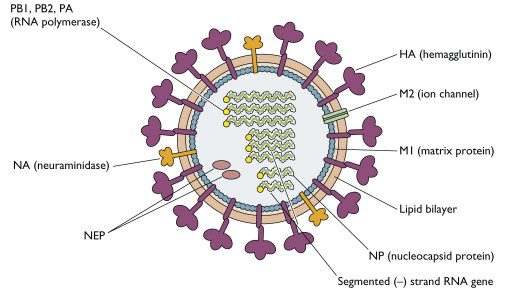
At the most abstract level, viruses work by getting into your cells and taking over (much popular science writing uses the term “hijacking”) this cellular machinery of transcription and translation; instead of making the macromolecules needed for whatever cellular function, though, the virus directs the machinery to just make more and more copies of itself. Those copies then bust out of the cell and find other host cells to infect, repeating the process over and over again. Viruses have genetic material, but little else – they are generally just some DNA or RNA wrapped up in a rudimentary membrane, as in this image:

Virology Blog/Vincent Racaniello
#62
January 28, 2025
Read more

Bird flu series #1

Some requisite housekeeping: I have been sick, depressed. Physically sick but also spiritually ailing, it has been bitterly pipe-freezing cold and the SAD is SAD-ing, as the youth would say. So I’m way behind where I would want to be in terms of writing, and most of the days lately I find I need to recalibrate my expectations way down to simply existing and getting done what must get done. This is all to say, I hope the micro-conditions of my daily existence improve soon, and I have good reason to think they will – the sun is out, I’m sitting in the library (not at home!), it might be warm enough to take a walk this week! 

Of course, the macro-conditions are absolutely rancid. I don’t want to rehash everything that has been going down at the federal level or pretend I know what it all means. But I am considering this the first in a series of posts about an issue of serious public import (avian flu) that takes the ignorance of the general American public as the object to be worked on directly rather than as an unfortunate constraint to be accommodated. Am I calling you, dear reader, ignorant? Not exactly. What I’m thinking is more like – our slop-world information environment is increasingly dominated by takes and preprocessed interpretation that presume increasing unfamiliarity with any kind of subject matter. I have noticed this even doing the small amount of “pitching” I’ve done in my life over the past few years: it seems increasingly the case that a successful pitch is one that is written to the level of the zero-information reader. I hope to do something different here – wild, I know – and use the medium of writing to convey information that any given reader may or may not have. 

Basically, I want to do this in the spirit of popular education as an end in itself, even if (especially if?) not a remunerative one. It’s hard to break out of the strictures imposed by the valorization imperative, especially in these lean, mean times. There’s just not any money floating around the economy to support any kind of independent work of any kind, and people no longer really have much wiggle room to do things for free. I am going to try. It’s not that I have the right answers, which I don’t. It’s that I have some stupid education that I paid for. I think there is shit going on in the world that you should know about, and I think that the more educated and informed the general public is, the better for us as a society. I’m under no illusions about how many people this newsletter reaches – it’s not many – but let a hundred flowers bloom and all that. 

I want to offer some context for how I am thinking about public health in terms of the evolving threat of avian flu. I feel like we’ve all well demonstrated how capitalism impacts public health. It’s kind of the whole thesis I and Nate have been working out on our respective newsletters over all this time: social murder, in all its various faces, is the expression of population health under conditions of capitalism. As Trump’s second term gets underway, I can already feel the popular discourse lurching in more of a “libbing the fuck out” direction, and thinking of capitalism in very moralizing terms. This is very good in terms of generating outrage, which drives subscriptions and engagement on the dominant platform model, but it is pedagogically empty and politically worse than useless. It’s demobilizing, which is just about the worst thing it could be.

#61
January 25, 2025
Read more

Airborne Toxic Inventory

I wanted to get something quick out because at least one person has asked me what is up with AQI (the EPA’s “air quality index”) and this is well within my wheelhouse. Progress on other posts and other projects is slow because I have a stupid life and a little bit of a stupid cold. (I feel fine, but it takes forever to make a million cups of black tea with orange and lemon, to keep refilling the hot water bottle, to keep myself stocked with clean spoons in a day.) So, thanks for bearing with me. Also, news of a ceasefire deal has just been announced; I haven’t posted about this because I am resolutely morally opposed to ambulance-chasing a fucking genocide for content, but I did want to at least register this. Fuck Joe Biden and free Palestine.

All air pollution is bad, but air pollution from the urban fires like those in LA recently is especially bad. This is because (duh) in these types of fires, it’s not just vegetation burning, but structures, and all the nasty building material they’re made of: paints, adhesives, asbestos in some cases, and every kind of plastic under the sun.

If you go on to websites like airnow.gov, you’ll see maps of the Air Quality Index. The Air Quality Index has five components: carbon monoxide, sulfur dioxide, nitrogen dioxide, ground-level ozone (colloquially known as “smog”), and fine particle pollution. The first four are gases at ambient temperature; the last is an umbrella term referring to the size of particulate matter that makes up the pollution. The two particulate pollution measures you’re likely to see are PM2.5 and PM10; “PM” stands for “particulate matter” and the number refers to particle size: PM2.5 is less than or equal to 2.5 microns in diameter (a micron, sometimes denoted µm, is a millionth of a meter or 1/10,000th of a centimeter) and PM10 is ≤ 10 microns in diameter. The size matters because smaller particles can penetrate into the tiny air sacs inside your lungs and really fuck up your lung function — smaller is worse. (A respirator like a KN95 or an N95 will protect you from particulate matter, but not from gaseous material.)

#60
January 15, 2025
Read more

Hearts of Space

This essay was supposed to be about loneliness, somehow. The texture of it, the quality of its light. This essay was supposed to connect the experience of loneliness to the moods and soundscapes of New Age music. The kind of abstract idea that would work as a poem, that sounds good as an essay, until you start to get into the actual writing of it. I’m not a poet, after all. I ordered a Vivian Gornick book, a collection of essays about being lonely and a woman, and then experienced a moment of panic because the book won’t arrive until later this week. I originally wrote “panick” in my notebook (anticipating “Gornick”), which I’m noting because I like it. Panick would be my Crowleyian religion. But really, it’s okay. What does a single woman in NYC (let alone in 2015 or whatever) have to tell me about loneliness? I’ve already lived that story, and found it a bit trite. NYC as Personage, Event, Catastrophe, Cultural Device intrudes, bullies. NYC as the fifth character in Sex and the City, the old one, the dying one, the ugly one, the one who’s rotting bottom-up and inside-out, starting from her reeking, decaying bowels, spraying sewer water on commuters. 

Is William Basinski’s Disintegration Loops perhaps the only piece of cybernetic 9/11 Art? By cybernetic I mean not representational (no exoticized terrorists or ticking time bombs or clash of civilization grand narratives here) and emerging from process – in this case, from the process of magnetic tape decaying.

#59
January 7, 2025
Read more

My Most Correct RFK Jr. Take

“When the going gets weird, the weird turn pro.” - Hunter S. Thompson, Fear and Loathing in Las Vegas, 1971

I’ve been pretty frustrated by the internet chatter this past week around RFK Jr. Right up top: we shouldn’t try to “work with” RFK Jr. The lib politicians who are saying this (like professional bozo John Fetterman, apparently) are as full of shit about this as they are about every other thing. What’s frustrating about the discourse, though, is that it leaves a critical implied question dangling unanswered. What are we going to do instead of “working” with RFK Jr.? Nobody who gets paid to have opinions about this sort of thing is getting paid to follow through on this. I want to suggest that “whatever it is we’ve been doing” is not good enough.

It’s a very uniquely 21st-century feeling, the heart-sinking that one gets watching a Voltron of loosely connected Takes cohere, via repetition and amplification, as Facts. Online, of course, where nobody has any power, not even close. Noncollaboration is a good start, a good first principle, a noble rhetorical stance, but let’s never forget that at the level of actual lived life for just about every single one of us, it’s the default option, requiring the least effort. We (posters on Bluesky, public health commentators, slingers of takes) don’t actually have any meaningful input into the confirmation process, let alone any way to meaningfully influence HHS policy from the top down. So what actually comes next? What should we actually be doing?

The below thread by Gregg Gonsalves (the GOAT) on the topic is, in my opinion, extremely illuminating. (I’m sorry this interface insists on embedding it rather than just letting me link.)

#58
January 3, 2025
Read more

Notes from above ground

What follows here is rather sketchy, not particularly thought-out or fleshed-out – I am still in Holiday Dysregulation Mode, getting my sleep schedule back in order, feeling juiced, trying to make sure to take walks, eat properly, fold my stupid laundry. In other words, not my best work, as real life is intruding in a particularly drab way, but hopefully interesting, and hey, this newsletter is free. 

Obviously, I’ve been doing more reading about the Unabomber over my short holiday break. In particular, I really enjoyed this from RH Lossin, published in The Nation in 2022. As a starting point for my line of speculation, it’s important to mention that Lossin runs through the familiar antecedents to the Manifesto: Jacques Ellul in particular, Marcuse’s One Dimensional Man, even hoary old Adorno and Horkheimer. The passage he plucks out of Marcuse is particularly interesting:

The technological universe… is the latest stage in the realization of a specific historical project—namely, the experience, transformation, and organization of nature as the mere stuff of domination.

Since my academic field is (was?) public health, this clearly puts me in mind of public health and statistics – high-modern technoscientific projects to dominate, exploit, subvert, and harness nature to serve the ends of Kaczynski’s System. Public health doesn’t understand itself this way (doesn’t understand itself at all, which engenders a lot of confusion in other quarters), but it is a part of this system of technological domination and rationality. In my estimation, this is a big part of why public health remains completely unable to answer to MAHA in its own idiom, or in any idiom that is intelligible to the general public on an experiential level. In fact, these concerns in their own idiom would mean, for public health, admitting something inadmissible and completely repressed, something essentially true that comes out in the Unabomber manifesto. Lossin: “we seem reluctant to fully acknowledge what Kaczynski proved: we cannot live beyond the reach of our technologies.” (Me: “some points were made.”)

#57
December 29, 2024
Read more

Bird flu

I wanted to write about something fun but with the flurry of news about H5N1 yesterday, it is with a heavy heart that I have decided more people would want and might benefit from some notes about the bird flu.

Here's the TL;DR: H5N1 is not spreading human-to-human at this time. This is subject to change, and I really hope it doesn't. If it does change, it will become apparent pretty quickly. (This is an epidemiology thing, you can deduce how something is spreading from its patterns of spread. They make you do endless exercises on this in public health grad school; my takeaway from that is, never eat the mayonnaise-based salad at the cookout. It’s always the mayonnaise-based salad.)

There are outbreaks in many herds of dairy cattle across the US, some of which have caused human infections; these human infections have generally been mild, not the terrifying level of severity we usually associate with bird flu. The strain of H5N1 circulating in cattle herds is clade 2.3.4.4b, genotype B3.13. Another strain of H5N1 (2.3.4.4b genotype D1.1) is circulating in wild bird populations. This strain, not the cattle strain, is the one responsible for two severe human cases (that I am aware of), a teenager in British Columbia who remains in the hospital and an adult in Louisiana whose hospitalization was reported on yesterday.

What do you, as a member of the general public who does not work with potentially infected animals, do to protect yourself against H5N1 at this point? Two things: 1) do not drink raw milk, and 2) avoid contact with wild birds, especially dead ones; avoid contact with birds in general.

#56
December 19, 2024
Read more

Feels So Good: Moral economy and ideology

I hadn’t planned to write anything but as always, the shower is Where The Thoughts Catch Up With You. This morning I was thinking about a few pieces of media related to the shooting that I have consumed lately. The first is this New York Times interview with three columnists; predictably, Dr. McMillan Cottom’s remarks are the worthwhile ones. She mentions the concept of moral economy, which I have written about here, taking inspiration from Nate’s (apparently) idiosyncratic reading of E.P. Thompson.

Though the term predates Thompson, we’re working with it as developed in Thompson’s 1971 essay, “The Moral Economy of the Crowd in the Eighteenth Century” (which I really ought to read, for how much mileage I get out of it). I’ll keep it short and sweet — Nate and I have been using it as a way of reading the moral valence around the economy, which is similar to but different from how Thompson used it (to describe the feudal economy based on common values of mutual obligation, rather than the capitalist economy based on abstract values of supply and demand and the like). Dr. McMillan Cottom is also using it in a similar sense as Nate and I: “markets have moral economies” and “our moral economy sucks.” Indeed!

I’ve also listened to a few podcasts about this that have been interesting. The most recent TrueAnon episode with Joshua Citarella (I'm sorry for no direct link but linking to SoundCloud is so annoying here, I'll figure it out later) is an interesting deep dive into Mangione’s background, online activity, and trajectory of radicalization. This Canadian critical theory podcast that I quite enjoy had an interesting discussion as well. Both of these, though, are sort of orthogonal to What’s Really Going On. The TrueAnon episode chronicles the particularly rancid and decidedly not left-wing intellectual environment of the techie “digital nomad” world that Mangione was immersed in, and PillPod tried to scan the event as strategic left-wing action (a failure in that read) or terrorism (perhaps a success in the Baudrillardian sense) and talked at length about ideology, mostly vis-a-vis the media.

But here’s the main thing, I think: on their own, each of chronic pain, dealing firsthand with American health care, and the Online of the past four years in particular are more than enough to disarrange anybody’s brain. The Online point bears emphasizing; McMillan Cottom and others (including me!) have written about the syncretic scramble of the privatized internet, where fringe right and spiritual left really do horseshoe together, oscillating in and out of weird phase space. One of those unlikely superpositions and amplifications happens in particular in the ideology of “tech,” whose creepy focus on self-optimization and human biology seems to take equally from the long and storied lineage of scientific racism and from the LSD-soaked countercultural left.

#55
December 17, 2024
Read more

The mechanized hum of another world

This has been the week where everyone is scrambling to come up with The Take about Luigi Mangione, alleged shooter of Brian Thompson. In the scramble, an interesting bit of trivia has been overlooked except as a joke among certain kinds of terminally online communities: Mangione’s Goodreads review of Industrial Society and its Future by Theodore John Kaczynski, a.k.a. the Unabomber manifesto. As a long time Manifesto-head, this obviously drew my interest in a more-than-extracurricular way. 

The basic overview of the Manifesto is essentially summed up in its opening line: “The Industrial Revolution and its consequences have been a disaster for the human race.” The arguments, which are not really all that outlandish (or all that original), are that the requirements of industrial society – technologically advanced society organized on a large scale such as we’re living in today – tend necessarily and, for Kaczynski, unacceptably, towards restriction of human freedom and autonomy, mostly (though not completely) via disruption of what Kaczynski terms the “power process.” (The power process is not all that important for the rest of this newsletter, so I’m not going to go into it further.) The terse manifesto (though not as terse as Mangione’s own) argues that the good parts of technological advancement are inseparable from the bad parts; that in the final analysis, there’s no way out but revolution (at best) or individual withdrawal and acts of disruptive violence intended to accelerate the painful demise of the system, which is obviously the route Kaczynski himself opted to take.

It’s hard to think of a technological apparatus that subverts human freedom and corrodes human dignity as efficiently as the US health care system. The exuberant, rattling anger that has bubbled over like boiling milk from a pot in all corners of US society, all ends of the ideological spectrum, and all walks of life following the shooting attest to how much this particular way of organizing advanced technical society degrades and dehumanizes people – and pisses them off.  Horror stories abound. So too does reporting on the bottomless evils of the health insurance industry. Everyone knows. In particular, the highly technified aspects of this industry have come under scrutiny in recent years, though as I will ultimately argue, that scrutiny (much like Kaczynski’s manifesto) is more than slightly misguided.

Just last year, United Health Group got in trouble for issuing so-called “algorithmic” denials of care in its Medicare Advantage programs (for last week’s post with more info on Medicare Advantage, see here). Here’s how Stat News summed up the lawsuit:

#54
December 16, 2024
Read more
  Newer archives Older archives  
Powered by Buttondown, the easiest way to start and grow your newsletter.