Night Traffic 26: The Return
Hello friends,
It’s been a while. Sorry about that. The last time I sent one of these emails was January 2024, and that was to say I was leaving Tinyletter (RIP) and setting up on Buttondown. But I never completed that process. Here I am now.
That last email contained a lot of grumbling about how hard I find self-promotion, social media, etcetera, and I feel that way even more acutely today, which is why I didn’t get around to resuming this newsletter for almost three years. But it did give me a non-social-media way of talking to people who might be interested, so here we are again. I hope you still are interested and thanks for your patience. I also hope everything works OK for you on the new system.
I think of myself as a very lazy, slow and unproductive artist, but looking over everything that’s happened since the last newsletter, it’s not so bad, even if some of it is old news now. As George Costanza said: "You know, if you take everything I've accomplished in my entire life and condense it down into one day, it looks decent.”
In 2025 I released my first collection of short stories, The Anechoic Chamber and Other Weird Tales, published by Salt. This includes nine stories, most of which have never been published before, and you can find out more about them below.
The title story of that collection, “The Anechoic Chamber”, is one of twenty stories in Salt’s Best British Short Stories 2026, which is on sale now.
In spring this year The Dead Man’s Empire, a sequel to the award-winning The Last Blade Priest, was published by Angry Robot. I think this book pulls off a variety of feats: it’s physically leaner than TLBP but in some ways richer and more expansive. Sadly all is not well at the publisher which rather took the wind out of my sails in promoting this when I should have done, but I will include a fuller update on what’s happening with this series in the next email.
The Last Blade Priest and The Dead Man’s Empire are now both available as audiobooks, read by the extremely talented Hannah Curtis. This is another thing that I should have promoted much more widely when it happened but idiotically didn’t because I hate success or something. Anyway they are available on a variety of platforms which you can find helpfully listed here: TLBP and TDME
On the non-fiction side I am now the regular architecture columnist for Apollo magazine, writing most recently on Peter Zumthor’s new buildings at Fondation Beyeler, the National Theatre at 50, and Gordon Cullen’s Townscape. Here’s a photo from Fondation Beyeler.
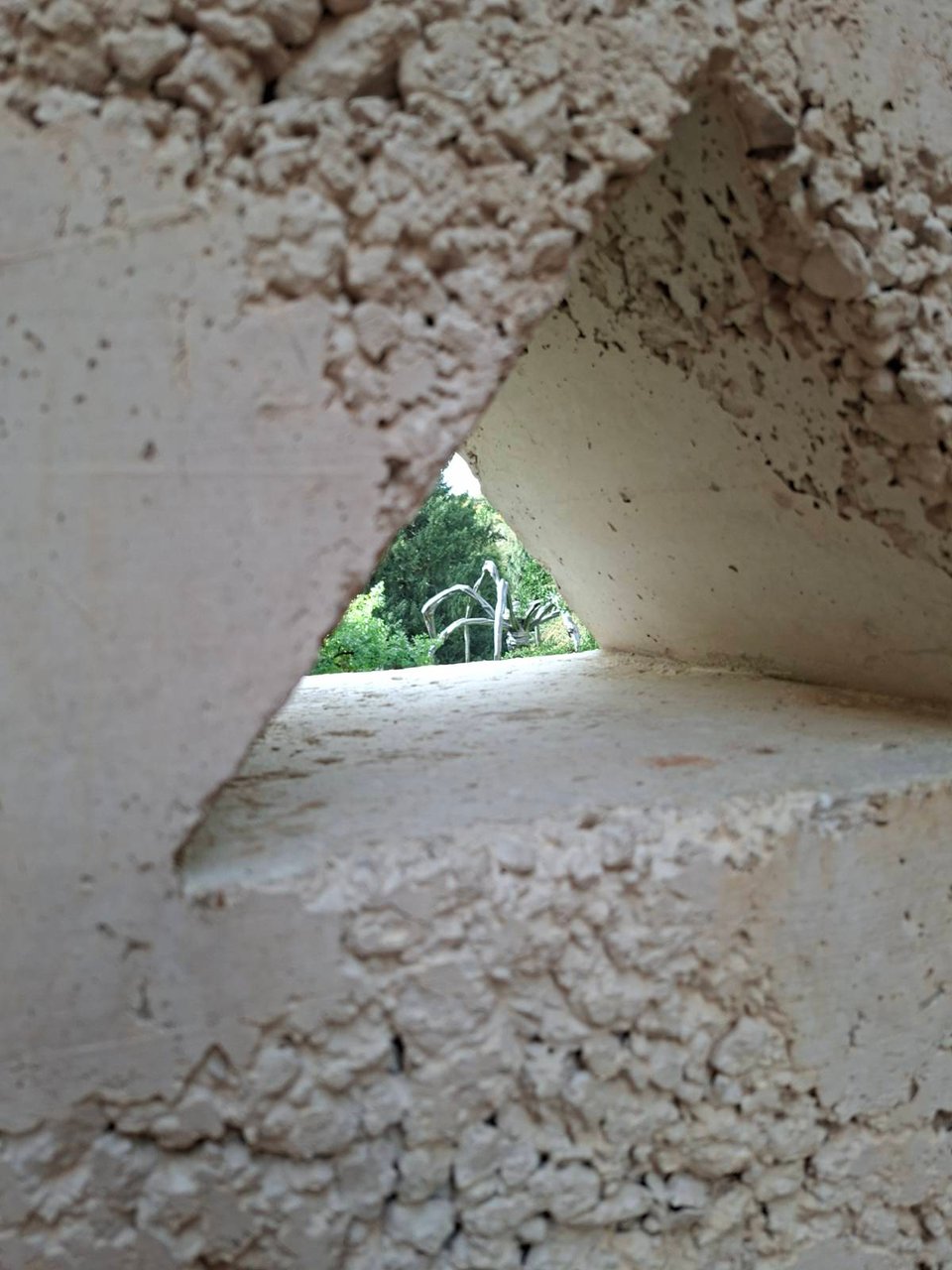
What’s next? A new literary novel is almost finished - there’ll be more to say about that soon I hope. A second collection of short stories is about half done. And I am working on volumes three and four of the fantasy series.
OK, on to the relatively fun stuff I promised - I wrote this around the time of the release of The Anechoic Chamber, intending to make it a newsletter. Kind of a DVD special features thing. Better late than never.
Liner notes for The Anechoic Chamber
“The Anechoic Chamber”
To my knowledge, this is the only weird tale set in an anechoic chamber. (In contrast, there are quite a few recording studio weird tales, such as the film Berberian Sound Studio.) I find this bizarre, as anechoic chambers – soundproofed rooms that have inner surfaces that do not produce echoes – are such acutely weird places, where silence becomes oppressive and terrifying. Like haunted houses, there are urban myths about anechoic chambers that offer prizes if you can last a certain amount of time without fleeing in terror. Unclaimed prizes, obviously. But what haunts the anechoic chamber is us. It’s so quiet in the chamber that you can hear your organs working. We are forced to listen to what is normally drowned out.
I also love the name “anechoic chamber”. Once you get your tongue round it, it’s the kind of phrase you repeat to yourself when you’re on your own. (Maybe that’s just me.) And the Angela Carter reference was irresistible, so it had to be the title story.
“Tesserae”
Most of these stories were conceived during the pandemic. At the time of the first lockdown, I had just finished writing The Last Blade Priest and I wanted to start a new novel, but I found I couldn’t. However, ideas for weird tales abounded, possibly owing to the weirdness of the times. This is one of two homages in the collection: I wanted to write a story in the MR James “doomed antiquarian” mould. But I can’t recall where the mosaic came from. Possibly it was related to the painted mummies of Fayum, mentioned in the story, which I’ve found fascinating for years. The end of Roman Britain is another preoccupation of mine. In my view (possibly thinking about it as a novelist), this story has the most satisfying plot in the collection – it’s tough to fit a fully formed plot into a short story and I am in awe of the writers who do it every time.
“The Meat Stream”
I mentioned that most of these stories were conceived during the pandemic. This is the only one actually set in a lockdown: a time of quiet horror and unacknowledged psychic damage, but also a time when the strangest things seemed possible. And it was a time of oddly intimate relationships with television. It was originally about steak – I was going to call it “Prime Steak”, a little streaming service joke. But Helen Graves of the wonderful barbecue magazine Pit asked if I wanted to write something for the kebabs issue, and I realised kebabs worked just as well, if not better, and were closer to the sort of mundane pleasure we were denied during lockdown. Nicholas Royle selected the story for Salt’s Best British Short Stories 2023, which ultimately led to this collection.
“A Private Square of Sky”
There’s only one “covid story” in this collection, above, but I think pandemic-related weirdness does appear in camouflaged form elsewhere. Hence: looking at the weird things your neighbours are doing on their balconies. It probably won’t surprise you to hear that I had a lot of ideas about architects and weird buildings, and in retrospect it’s a little surprising there aren’t more stories with that premise. Few architects have influenced me as much as Ivo Shandor. But architecture wasn’t the starting point of this story. It came from a line in a 2012 LRB essay: “Even when we find a comparatively familiar myth, the catasterism of the vanished tress of Berenice …” The what of the what of who? “Comparatively familiar”?? Obviously I had to look everything up. That combined with lingering preoccupations about apartment buildings, courtyards, balconies …
“Notes on London’s Housing Crisis”
This is the oldest story in the collection – it was first published in an Influx Press anthology called An Unreliable Guide to London (2016). I was studying London’s housing market for my Master’s degree, and thought it would be fun to write about a mirror-world “housing crisis” in which homes in London are overly abundant and inexpensive, and there’s far too much freedom and flexibility. The setting – an alternative London in which more of the utopian architectural dreams of the 1970s were realised – is a recurring obsession of mine. Maybe it’s steampunk in a different form (dieselpunk? Magnox-punk?) to imagine a Britain that didn’t squander its twentieth century technological advantage, and Londoners have Pyephones and indulge in Ceefax & chill. I actually wrote this story twice, in different ways, and thought about combining the two versions for this edition, but it involved more repetition than expansion. Nevertheless there’s a vast amount of “lore” for this story and some day I really want to return to the world that’s only glimpsed here.
“Moths”
A ghost story with no ghost. My father is an enthusiastic and talented semi-pro photographer, and routinely warns and apologises about the vast store of photographs he will leave behind. This story is not about him – Dad, really, it’s not! – but it is about that psychic problem. We take photos for emotional reasons, balanced against an imagined future moment of looking at photos. There’s an unpaid debt there. And it accumulates. I am also interested in the chemical magic of photo processing, including the glitches that can occur, and the origins of the technology, when long exposures meant living things were almost impossible to capture. I feel that this story doesn’t have the best ending, but it’s a story about irresolution so maybe that’s apt.
“Deeds”
This was written for an issue of the Architectural Review about “property”, but it had a convoluted backstory. Devotees will recall that my novel Plume (2019) is in part about psychogeography, gentrification, and the way that property industry recuperates and uses such countercultural impulses to sell its products. In short, “psychogeography” writers try to make the city gritty and real as a reaction against the commercialism of the property industry, but the property industry loves grittiness and coolness. (This drew on my Masters research.) The trap is inescapable and Oliver Pierce, the novelist in Plume, is driven mad by it. I should have seen what was coming. People in property love Plume, despite its incredibly unflattering portrayal of their industry. I ended up being invited into meetings like the one in this story, to help with “placemaking”. So I’ve written another story based on that unsettling experience. (The developer, Harbinger, is the one that appears in Plume, so it is in the same world.) I look forward to doing more lucrative consulting as a result, which will lead to more venomous portrayals of the property industry, which will lead to …
“A Report to the Imperial Customs Office”
The other conscious homage to the greats of the “weird tale” - this time, nodding to Lovecraft. The Doom That Came to Miedenthal. The set-up is at least as old as the Marie Celeste, and the setting is deliberately obscure in time and place. But the story had an oddly modern genesis. It was inspired by a computer game called Banished. In this game, you build an isolated medieval settlement. It’s punishingly difficult, and your little peasants are always getting wiped out by famine, epidemic, crop failure etc. The winters are long and hard. Oddly, the game keeps running after your last villager dies, so you can watch over your deserted settlement. I had lost the game, again, and everyone was dead. It was midwinter and no smoke rose from any of the little chimneys. But then a river boat appeared, a trader. He pulled up at the dock, in the snow, and waited, but no one came. Then he departed. The image of the boatmen arriving at the frozen, silent settlement came from that. And I suppose the concerns about epidemic and quarantine reflect the fact this was conceived during covid. But it’s not the plague that doomed Miedenthal.
“The Acknowledgements”
“People in publishing read the acknowledgements first.” My agent, Antony Topping, said this to me once, and it led to me thinking about the narrative potential of the Acknowledgements page. I love private libraries, obscure foundations, esoteric research institutes. Also I had a bruising experience of ghostwriting, a story which will have to be told another time. The writer here isn’t a ghostwriter, he’s a biographer … But …
+++
That’s all for this time - thanks for reading. See you in less than 33 months, I hope.
