I didn't do a stroke of work last week, because we were in Paris, being tourists. It was fantastic--and, I'm very relieved to say, not too hot. If you're anywhere near Paris before Aug. 30, I recommend the Hilma af Klint exhibition at the Grand Palais. It really is a grand palais, with massive walls that show off the large works (and the small ones). We also visited a few stationery stores (shocker!) and learned that, yes, it is possible to live on a steady diet of bread and bread products.
I found it very difficult to focus on reading--I didn't finish a single book while vacationing--though I am now well into A New World Begins: The History of the French Revolution, by Jeremy Popkin, which I'm enjoying. I thought I had a sense of what happened in the French revolution, and then we were in the Musée Carnavalet, which has a massive collection of revolution-related artifacts, and I realized I know rien de rien. (I sampled Simon Schama's Citizens, but the audiobook narrator had such a plummy English accent that I felt that he was single-handedly undermining the book's premise!)
This was my first break from working on the book in many months. I try to do something every day, mostly, I admit, because I'm afraid that if I slack for even a weekend, I'll revert to the lazy bum I was well into my 30s. Consequently, I was a bit nervous sitting down at my desk yesterday morning--but it was an excellent day, full of the thrill of detective work that is very addictive, even when you're fully conscious that you're dedicating days to tracking down something that will be at most a paragraph or two in the final book.
One of the things I've been trying to learn more about is the story of Rita Mae's first book, a collection of poems called The Hand That Cradles the Rock. It was published in 1971 by New York University Press. In her writing manual, Starting From Scratch, she says she was 22 when it came out--a bit of a math error, because she was 27, but that's still plenty impressive. The contents of the book was no challenge--I got my first copy in 1979 or thereabouts--but that was one of the two reprints. Lesbian-feminist publisher Diana Press reissued the book in 1974, in a nice edition with illustrations by Ginger Legato, and then Crossing Press published an edition in 1987, combined with Rita Mae's second book of poetry, Songs to a Handsome Woman.
However ... I came across an absolutely bonkers 1972 review of The Hand ... in a mainstream publication, which mentioned it was "first book of poetry to be published in America" by a feminist lesbian. The quotation marks were what got me. Where did that come from? Sinister Wisdom editor Julie Enszer pointed out "that must be from the NYU edition cover copy." The copies I had seen--at UVA and via the invaluable Internet Archive--didn't have a dust jacket. I did find the dust jacket on sites like eBay and AbeBooks that had copies of the NYU Press edition for sale, but they only showed the front, not the inside flaps, where I guessed the copy must've been.
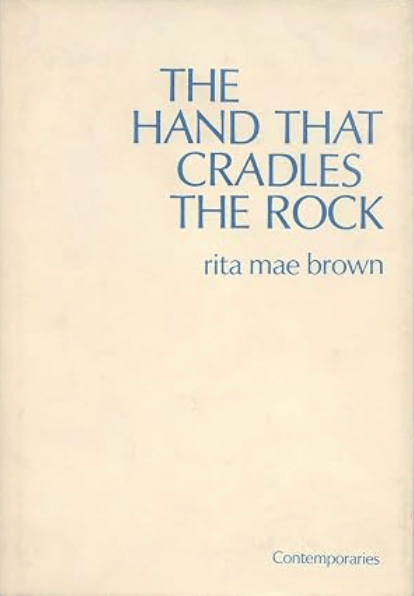
I did, however, notice that the word "Contemporaries" appeared at the bottom of the cover, so I searched the used-book sites for other books from the period with Contemporaries in the metadata. I found a few--n.h. pritchard's Eecchhooeess, and Jascha Kessler's After the Armies Have Passed. Other than noticing cool design language--title in caps, author name lower-case, blue for 1971 publications, red for 1970--I couldn't find much else. When I looked at the Library of Congress catalog, I could see that there was a "MARC data" field for "Contemporaries," but I couldn't figure out how to search for it. So, with my vacation coming up, I sent a note to the "ask a librarian" function of the LoC's site and tidied up my desk.
When I got back Friday night, I had an email from an LoC librarian, providing a list of eight books in the Contemporaries series, four from 1970 and four from 1971. When I searched for those titles, I saw that some of the 1970 publications had the words "Robert Hazel, editor" on the title page, so I searched for Robert Hazel ... and found myself in a deep, but totally fascinating rabbit hole. This was peak "spending a day on something that will be a sentence," but I couldn't help it. What a guy--for good and for very bad. He served in the Marines in World War II; worked at the University of Kentucky, where he taught Bobbie Ann Mason, Wendell Berry, and three other writers who made it into the Kentucky Writers Hall of Fame; before heading to NYU, where, I read, he mentored Charles Simic and Rita Mae Brown.
Having now consumed several obits of Hazel, not to mention many of the pieces in the Spring 2002 issue of Southern Quarterly that was pretty much devoted to him, I know that he was a writer's writer who wrote much-admired poetry and prose than no one seemed to care for, that he was an alcoholic, and that he regularly made moves on female students in so "gruesome" (to quote one of his friends) a way that it got him fired even from creative-writing departments in the 1960s and '70s. Oh, and as one of his friends noted, he grew up in the academic community of Bloomington, Indiana, but "projected himself as a country boy from the South."
I could go on, but I won't--well, except in the actual book--but I guess I should mention that I did find the inside-flap copy of the NYU Press edition of The Hand That Cradles the Rock, by buying the cheapest copy on AbeBooks, which was actually very reasonable for a first edition of Rita Mae's first book. It was worth the search! I also found an email address for one of the other Contemporaries series authors and heard back from her daughter, who promised to pass on my query to her 98-year-old mom!
READ ME: I donned my TV-critic cardigan for the first time in several years to review the new Big Bang Theory spin-off, Stuart Fails to Save the Universe for Slate. I was surprised how much I liked it--and how dynamic a show spawned by an incredibly static progenitor managed to be.
RECOMMENDATIONS: I wasn't sure what to expect from We Others, a collection of photos by Donna Gottschalk, with an essay by Hélène Giannecchini. It was shrink-wrapped in the store, and at £40, a bit of a risk. Well, let's just say, WELL WORTH IT! If you see a copy, buy it. The photographs--which cover a good span of Gottschalk's early life and work--are amazing, and the essay, in which Giannecchini narrates an afternoon spent with Gottschalk in Manhattan's Alphabet City, where she grew up, is really lovely. Now I'm even more excited for the Edinburgh International Book Festival session when Giannecchini will be with appearing with poet Joelle Taylor. (Shockingly, tickets are still available.)
You just read issue #75 of Where Are All the Emails?. You can also browse the full archives of this newsletter.