
St Peter's Crown Hill and other news (23 Jan 2026)
Demolition looms for the 1970 St Peter’s Catholic church in Crown Hill, Plymouth. Plus news of other C20 buildings in the west country.
It’s all churches this month, it seems.
I don’t go to the Crown Hill part of Plymouth often because it’s only on bus routes and my family were all over by the railway. Mostly I think of this northern suburb as where Derriford Hospital, a hulking grey block of a 1960s site, broods. But a reader got in touch to tell me that the Diocese of Plymouth has applied to demolish a 1970’s Catholic church, St Peter’s, there.
Apologies in advance if any links are faulty: I’m meant to be going into Storm Isobel to meet people for brunch, so I’ve not had time to triple-check.
St Peter’s Crown Hill (John Evans, 1970)
I’ll describe the church below, but I want to highlight first that any comments on the application need to be made by Thursday 5 February (less than two weeks’ away). Search for application 25/01687/FUL on Plymouth’s planning portal.
There’s no Heritage Assessment with the application, so I’ve pulled together these details from my knowledge of some sources. I suspect more information exists in sources I’ve not checked yet.1
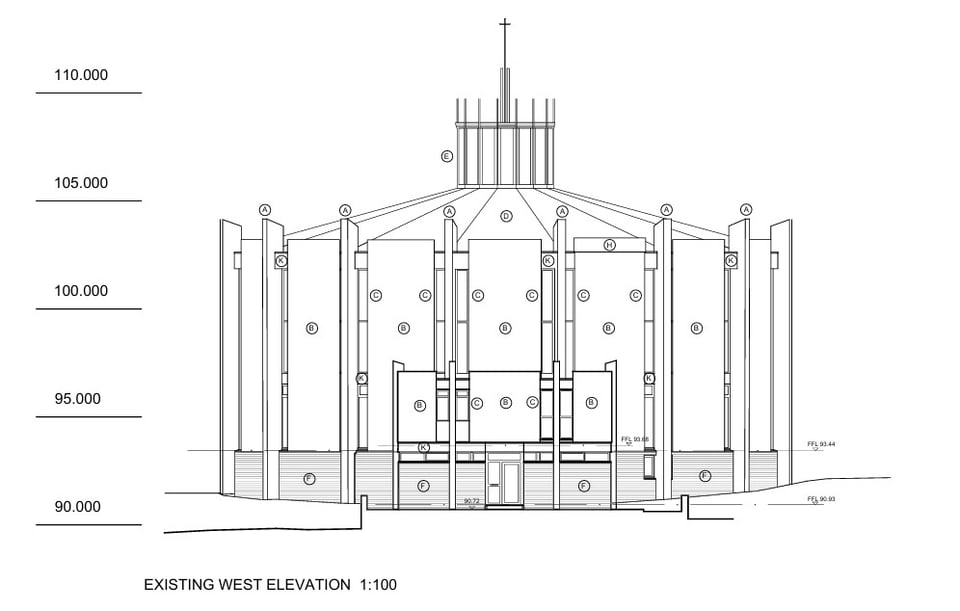
The Taking Stock survey of Roman Catholic churches describes St Peters Crown Hill as “a bold centrally planned and polygonal design of the post-Vatican II years, evidently inspired by Gibberd’s Liverpool Cathedral.”2 This is evident from its use of slim fin-like buttresses that rise up to form a crown above the roof and a monolithic main entrance.
A small RC church had been built in Crown Hill in the 1930s, to serve the Catholic families moving to the new council housing estates.3 By the 1960s, the congregation at St Peter’s had outgrown this building and the Diocese employed John Evans of Evans & Powell in Paignton to design a new building. (More about the ecclesiastical history is on the church’s own website.)
Drawing on Gibberd’s work, he designed a polygonal crown for, er, Crown Hill. The sixteen sides are loadbearing walls that meet a reinforced concrete perimeter tension beam. That ring carries the outward thrust of the hinged steel rafter roof. Inside, a single space soars up to the wood clad ceiling and huge lantern. The radial seating highlights the new principles of worship introduced by Vatican II.
The 1989 Pevsner for Devon lists it as “the most interesting of the post war RC churches” in Plymouth, describing it as a corona for the hilltop. It also notes that the church includes stained glass by Dom Charles Norris.4
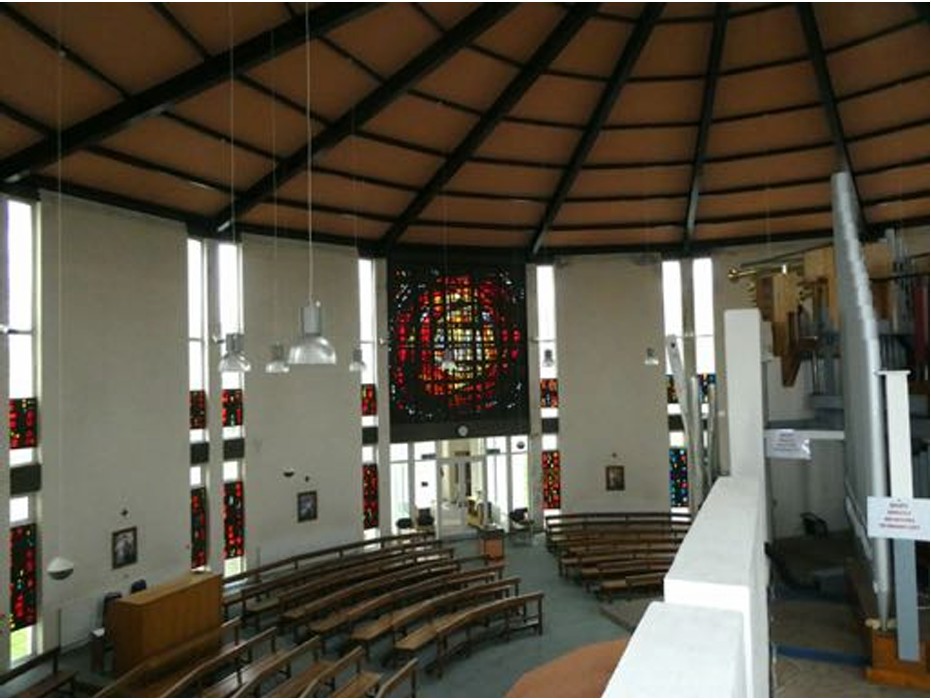
Dom Charles Norris was perhaps the leading British expert in dalle de verre. He’d studied art at the Royal Academy before joining the Benedictine order at Buckfast in Devon. By the 1960s, he had been trained by Pierre Fourmaintraux in how to design and create dalle de verre and his work is mentioned in the listings of several midcentury churches. St Peter’s Crown Hill is not listed. I’ve not been able to find a Historic Environment Record entry on it either.
The Architect’s Journal suggests St Peter’s Crown Hill was revamped by the Reverend Andrew Mottram and Emma Osmundsen of Ecclesiastical Property Solutions (EPS) in 2007. In 2008, Trevor Caley created a mosaic above the west door of St Peters Crown Hill. Caley had worked on mosaics for Transport for London, including working with Eduardo Paolozzi.5 Caley’s design included an inverted cross and other symbols associated with St Peter. I’ve not been able to find a photo of this work yet.
EPS had been registered at Companies House in 2004, and became dormant in August 2009.6 Its formation had been announced in 2003 when the plan was to set up “to help worshippers of all denominations to find an income from underused and deteriorating church buildings. While the churches will remain centres of worship, galleries, naves, side aisles and under-used chapels will become restaurants, galleries or shops.”7
Yet 18 years after the refurbishment of St Peter’s Crown Hill, the structural integrity of the building’s fabric is so decayed that the diocese has had to close it on safety grounds and is now looking to demolish it.
A 2025 structural engineer’s survey, including in the demolition application, states that the concrete ring beam is at risk of failing, and there are signs of the roof beams pushing the loadbearing walls outwards. It reads “we can categorically state that this building is in very poor condition; it is potentially dangerous and should not be entered or approached in adverse weather”. (see application 25/01687/FUL documents).
The photos of the corroding bars and crumbling concrete do support this. I’m in no way qualified to know if the current state of decay could have been visible five years ago, never mind two decades back.
The C20 Society’s SW group organised a visit to the church a few years ago, and I’m planning to ask the Diocese about visiting now to make sure it is documented with the dalle de verre glass still in place.
The demolition plan includes a step to “carefully remove and salvage-stained glass window panels and store in agreed location.” It does not mention the 2008 mosaic work. Plymouth Civic Trust have already objected to the demolition and notified the C20 Society and others. So far, only the Radio Exe news site has picked up the story. Comments on the application need to be in by Thursday 5 February. Search for application 25/01687/FUL on Plymouth’s planning portal.
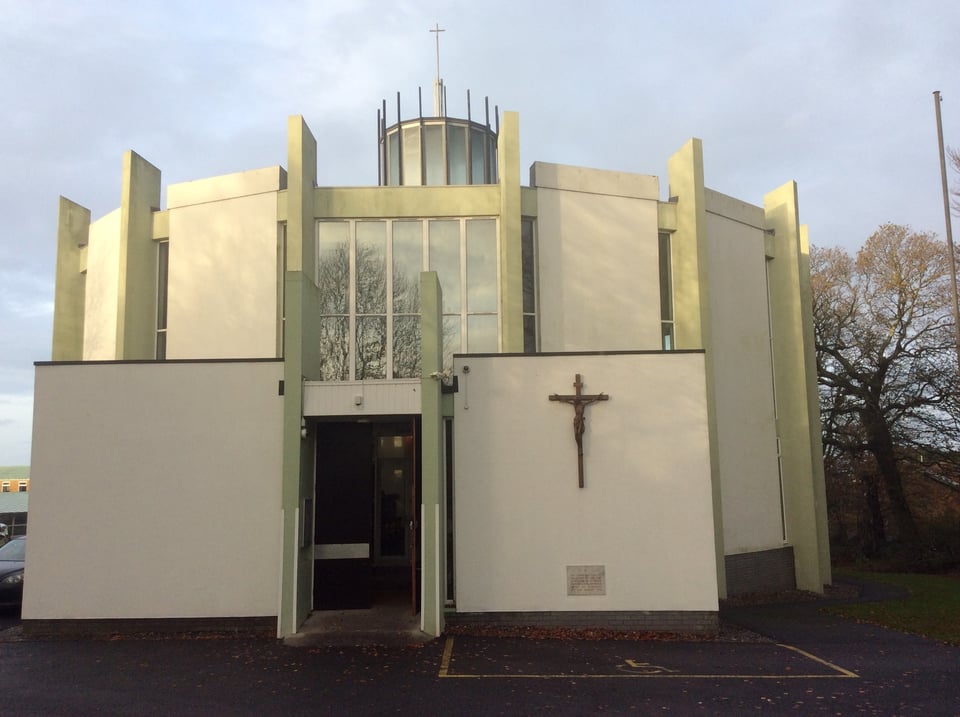
I’ve written before about how modernist buildings in the west country are often small versions of larger concepts from up-country. Here a miniature version of Liverpool’s RC Cathedral hides amid the trees on Crown Hill.
My thanks to Michael West for letting me know the application had gone in. I’ve drawn these notes up based on a handful of sources available in around 24 hours. All errors and omissions are my own.
I’m holding the paid subscription at £3 a month until 31 January. After that, I’ll need to raise the price for new subscribers. Your subs help cover the costs of creating the newsletter. I’ve also set up a discount: buy an annual subscription before 31 January and save £6.
Regent Cinema, Lyme Regis
The remains of the Grade II listed Regent Cinema in Lyme Regis will be converted into retail units when the rest of the site is developed into flats.

The Regent opened in 1937, having been designed by William Henry Watkins of Bristol. Listed in 2000 after a renovation funded by the Heritage Lottery Fund, the auditorium burnt down in 2016. The listing emphasised the Deco elements of the auditorium but also the slightly random use of neoclassical motifs. Pevsner called it a “minor Art Deco gem”.
A combination of factors have made rebuilding the cinema unviable. Lyme Regis does have another C20 cinema, the Marine Theatre, that was retrofitted into a much older building.
In brief
Taunton Debenhams under offer?
The Somerset County Gazette reports that the potential buyer of the huge, empty Debenhams in Taunton was at a community meeting about the building hosted by The Curve. Declining to be named at this stage, the potential buyer confirmed they are thinking very much along the lines of Studio Saar’s prize-winning Apartment Store proposal for reuse.
Events and exhibitions
Beauty in Plainness
The Museum of Somerset in Taunton has an exhibit of William Scott’s large abstract paintings, on loan from the Tate. Scott settled in Somerset in the 1940s and taught at Bath Academy of Art for a decade. The exhibition runs till 7 February. More details at the SW Archives.
‘Bauhaus, Breuer, Bristol’ tour
Last time I mentioned the Bauhaus, Breuer, Bristol exhibition at the Stradling Collection. The lovely people at the Modernist have organised a guided and curated tour of the exhibit on 13 February. More details on their website.
If you have an event or news item you think I should know about, you can contact me on Bluesky. If you’ve received this as an email, you can also just hit reply and the email will reach me.
I’m off for a rather damp brunch.
If you’re enjoying this newsletter, feel free to share it with others.
If someone has sent you this, you can subscribe below.
A free sub will get you the weekly field notes and notice that a deep dive has been published.
A paid sub (currently £3 a month) will unlock the deep dives early, plus occasional bonus content and the warm knowledge that you’re supporting the project.
Just to confuse matters, there is an Anglican St Peter’s in central Plymouth which was rebuilt after being blitzed. ↩
- https://taking-stock.org.uk/building/plymouth-st-peter/
See my deep dive on Tinside for more about interwar Plymouth. ↩
Cherry, Bridget and Pevsner, Nikolaus. The Buildings of England: Devon (Penguin, 1989). Page 646. ↩
- https://www.ltmuseum.co.uk/collections/collections-online/sound-recordings/item/2016-1713
See https://find-and-update.company-information.service.gov.uk/company/05072377 ↩
Archived at https://archive.is/VWzYC#selection-497.0-505.148 ↩
