False Butterfly
Deceivingly useful.

Are you really gonna climb on that? The False Butterfly is a useful knot, but similarity to the (true) Butterfly can be dangerous. Can you tell which is which?
Tree climbers understand the value of an overhand slip knot. At a recent workshop on tall tree rescue techniques, I backed up my rescue system using an overhand slip knot below the system and secured it with a half-hitch finish. At first glance the result may appear to be an alpine butterfly knot (aka butterfly loop), but is instead a false butterfly - a useful knot but one with a deceptive loop that should not be used for critical connections.
Our friend, the Slip Knot
My first exposure to technical rope work was through rock climbing, and in a world of retraced figure 8s, clove hitches and alpine butterflies, the overhand slip knot seemed like a weak, useless and dangerous knot that did not have a place in the vertical world.
But in tree climbing, the simple slip knot is used for so many purposes:
- securing a rope to a gear loop with a quick clip point or tie-off
- preventing the rope from sliding through a pulley or mechanical hitch when resetting a climbing line
- forming a daisy chain with rope or webbing using a series of slip knots
- assembling an improvised mid-line lanyard (the third rope)
- arresting an uncontrolled descent
Beginner climbers first encounter this venerable workhorse as a backup knot placed below a climbing hitch or device. If tied in the correct orientation, the knot will jam against the climbing system in the event of an uncontrolled descent, but can still be easily removed due the slippery nature.
Some climbers refer to a knot placed in this position as a “safety knot” or even a catastrophe knot. In a rock climbing context, catastrophe knot not only refers to the (preventative) function of the knot but usually considered synonymous with an overhand on a bight. A good choice - closed, stable knot that does not consume an excessive amount of rope.
But a slip knot does exactly what it says on the label: it slips. Sometimes we want to secure that slippery end while retaining the ease of untying.
False Butterfly
WARNING! THE FALSE BUTTERFLY IS NOT FOR CRITICAL LIFE-SUPPORTING CONNECTIONS!
Tying
The false butterfly is simply an overhand slip knot with a half-hitch from the slippery end thrown over the bight.

Overhand slip knot, slippery end pictured to the right.
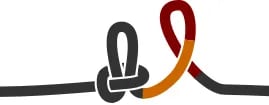
Create a loop in the slippery end.
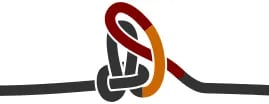
Fold the loop over the slip knot’s bight, trapping the working (free) end of the rope (red) under the standing part (orange).
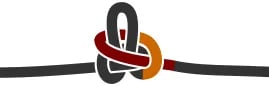
Cinch down by pulling the working end or the slip knot bight.
Use
One reason we use the slip knot is the speed and ease of tying, even one handed. The half-hitch effectively converts the slip knot to a more stable version by securing the slippery end of the line - a task which also can be performed one-handed.
For example, I will use a slip knot to temporarily clip a rope off to myself, but I may not want the bight to cinch down. Securing the slippery end keeps the bight open, sort of like a low-security version of a figure 8 on a bight or other loop knot.
By separating the slippery and stable versions, I can leave the knot in the easily adjusted slippery mode, then secure it when ready to turn my attention elsewhere - something common to recreational climbers who use manual locking carabiners.
The false butterfly does not cinch down tightly, and rope users pushing the limits of their discipline have used this knot to make a rope system more tolerant of shock loads - think climbing on thin ropes & sketchy anchors. Not well a function needed by most tree climbers and definitely not something to learn from an article on the internet. I only mentioned it here for completeness.
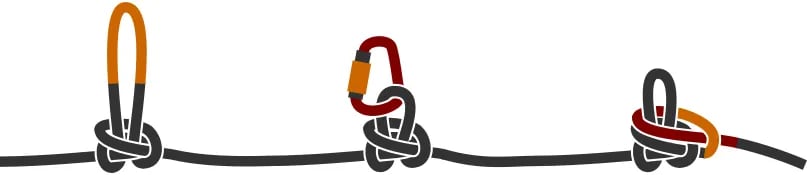
To improve stability or security further, tie the slip knot with a larger bight, clip a carabiner to the bight, and/or throw an additional half-hitch thrown over the bight (forming a clove hitch).
Daisy Chain (half-hitch tie-off)
A daisy chain (aka chain sinnet) is simply a series of slipknots, each one formed through the bight of the previous. This half-hitch technique works beautifully to secure the daisy chain’s slippery end.
As compared to traditional finishes such as passing the working end of the rope through the last bight, the half-hitch finish has two benefits:
- Prevents the chain from inverting/capsizing, which causes frustrating tangles when attempting to untie the chain.
- Permits a chain to be tied “on the bight” - anywhere mid-line on the rope. Additionally, because the user does not need a rope end, they can easily re-secure the daisy chain after removing/adding links to lengthen/shorten the available (unchained) rope.

Locking off a daisy chain using a half-hitch.
Potential Confusion with Alpine Butterfly
The false butterfly looks similar to the more common alpine butterfly loop (true butterfly), but should not be used for critical applications, as it lacks the strength and security of the alpine butterfly.
Visual Appearance
The true butterfly has two clear characteristics which can be used to differentiate it from the false butterfly:
- Interlocked loops
- “Wings” on the same side of the rope
Of the two characteristics mentioned here, the most reliable is looking for those interlocked loops around the central bight/loop. This is what gives the alpine butterfly its security and stability.

Loop Detail
Notice how the true alpine butterfly (left) has two interlocked loops which pass around the large central bight. The loop coming from the left passes under the right loop in the front, then over the right loop in the back.
The loops of the false butterfly (right) do not interlock. The loop coming from the left is entirely under the right/upper loop. Each loop is independent of the other.
The wings of a butterfly knot are the parts which wrap around the standing parts of the rope exiting the knot in either direction. The true butterfly knot has these wings on the same face of the knot (commonly considered the front of the knot), but the false butterfly may as well, depending on how the locking half-hitch was formed. Wings on opposite sides clearly indicate the knot is not a true alpine butterfly.

Wings of an alpine butterfly appear on the same side of the knot.
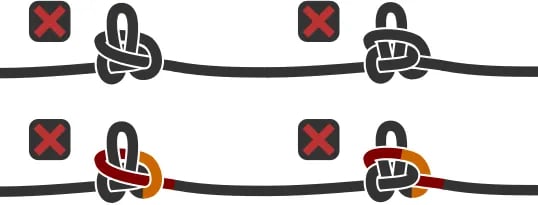
Wings Detail for False Butterfly
The wings for a false butterfly depend on how the half hitch is formed and placed over the slip knot’s bight. Formed in one direction, the wings will present on the same side of the standing part (left). Formed in the other direction, the wings are opposed (right). (top: black & white, bottom: color separated)
Mis-tying
It is possible to form the false butterfly when attempting to tie an alpine butterfly. The alpine butterfly is commonly tied in two ways: in the hand and the twist method.
In the hand

One Method of Tying an Alpine Butterfly in the hand. In practice, the first step can be performed while wrapping palm to fingers: Simply place the last wrap (red) closer to the heel of the palm thumb than the first two wraps (black, orange).
It is difficult to form a false butterfly by mistake when attempting to tie an alpine butterfly in the hand - especially if the knot is formed entirely mid-line without a working end nearby.
Twist method

Twist method to tie an Alpine Butterfly. A bight is twisted twice, forming a loop and a central space between the rope crosses. The bight is brought down, splitting the standing parts and passed back through the central space.
In my experience, the twist method has been more likely to result in a false butterfly.
Both twists must go in the same direction. Reversing the second twist seems like it would cancel the first twist, causing the rope to open back into a bight, but this cannot happen if the climber holds the central space open with their fingers - preventing the twists from resolving.
I have also seen a climber incorrectly recall the twisted form (step 3 in the illustration above) and simply overlap the two sides without ensuring the cross.

Twist Error. Details of twisted form during the step just prior to folding the bight down. Notice that in the error example, the legs of the bight do not wrap around each other - one leg is entirely on top of the second.
Rescue Repercussions
Communication
I find it helpful if my climbing partners have a good idea of my climbing system and approach to climbing. Attentive and knowledgeable partners are better able to keep an eye out for potential issues or assist me in an emergency.
If I purposefully tie a false butterfly, I make sure to inform my climbing partners. I would not want someone to mistake it for an alpine butterfly in the course of their climbing or if needing to perform a rescue involving my ropes or equipment.
Clearing a rope
A key feature of a slip knot is that it can be released remotely - no need to be within arms reach of the knot, just access to the slippery end. We regularly use it in this way to set cambium savers / rope sleeves or perform other rope tricks.
One rescue method involves climbing the tail end of a climber’s rope to access them more quickly than setting a separate line. If a climber ties an overhand slip knot as a backup knot, this can be removed easily - simply pull down on the tail as one would when setting a cambium saver. If that backup knot (or worse, knots) have been converted to false butterfly knots, a rescuer will need to cross each knot during the ascent. Depending on the rescuer’s climbing system and technical skills, crossing a knot may add a significant amount of time and complexity to an already challenging situation. Something to consider.
Further Reading
Rope Lab
Richard Delaney / Rope Lab on the Alpine Butterfly, including tying it rethreaded, bunny ears and more: https://www.ropelab.com.au/the-awesome-alpine-butterfly/
HowNOT2
HowNOT2 pull tested various correct and incorrect butterflies, including the false butterfly: https://www.youtube.com/watch?v=jqlkVuECmPY&t=1190s
Alpine Caving Techniques
A touch dated, but a classic on European caving techniques. Includes use of the false butterfly as a shock absorbing knot.
Marbach & Tourte. Alpine Caving Techniques: A Complete Guide to Safe and Efficient Caving. English Edition 2002. https://verticalsection.caves.org/nh/47/alpine.html