Thursday #4: 18 June 2026
Hello Thursday!
In the summer 2026 Art in America, one of the artworks mentioned in Emily Watlington’s article “All Systems Go” is Tehching Hsieh’s One Year Performance 1980-1981 (Time Clock Piece), in which Hsieh punched a clock every hour for a year, 24/7, and took a photo to document each punch. I had heard of this piece prior to this, and I find this sort of long-duration performance piece fascinating. Whenever I hear about a piece of this sort, I can’t help but ask “why?,” and depending on what the artist is doing for that duration, I find that the answer changes.
I also imagine the consequences of failure. Imagine you’re Hsieh. You’ve been punching a clock, every hour on the hour for eight months when — the horror! — you wake up at 2:15 in the morning, realizing you missed the 2:00 punch. What do you do? Do you start over? Do you just wait and punch in at 3:00, leaving a hole at 2:00? If so, do you include an explanation for the 2:00 lacuna as part of the work? Do you terminate the project, renaming it Eight Month Performance 1980 (Time Clock Piece)? Do you attempt to tamper with the time clock in order to produce a fraudulent 2:00 punch? (And if you are able to do so, what does that do to your soul?)
The other thing I think about with works like this — and the thing that has prevented me from ever doing one — is how doing a work like this means you’re not able to do so many other things during the time that you’re doing this work. I’ve always been acutely (perhaps over-acutely) aware of how limited our time on Earth is, and how many thing we’ll want to do but won’t have time to. One of my earliest memories takes place in the apartment where my mother and I lived from the time I was three until I was six. It was around the time of my fifth birthday, give or take a month or two, and I was sitting on the floor in the alcove between the bedroom door and the bathroom door, crying. We had just returned home from the library, where I had checked out five new books to read. I had been amazed by the number of books in the library, and told my mother that I wanted to read all the books in the world. She told me — not unkindly, but in a factual way — that there wasn’t enough time for anyone to read all the books in the world. I didn’t believe her at first, but once she explained it, I understood, and I sat in the alcove and cried quietly while she fixed dinner. And to be honest, while I understood what she said, to this day I don’t think I’ve ever really accepted it. So much of my life is governed by this drive to learn — I can’t imagine being one of those people who graduate school (at whatever level) and think they’re just done learning.
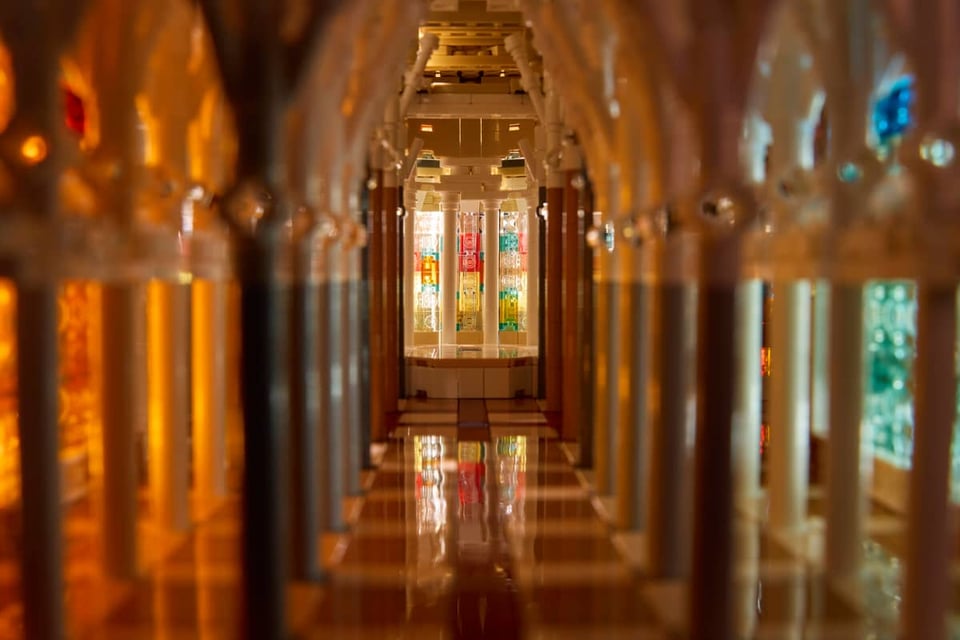
Lego introduces Sagrada Familia set
When I was a junior in high school, I found a copy of The Alan Parsons Project’s Gaudi in the discount bin at one of the local record stores. This was my introduction to Antonio Gaudí in general and to the Sagrada Familia church in particular, which has been kind of a low-key interest for me ever since. His style, which combined elements of Gothic Revival, Art Nouveau, and his own unique ideas, hit a sweet spot for me that nothing else really compares with. Consequently, I was both pleased and skeptical when Lego announced that they were releasing a set of the Sagrada Familia: Pleased because I wanted to see it, skeptical because the curved, organic forms of the Sagrada Familia are so contrary to the usual rectilinear forms of Lego. But I knew that Lego had made a lot of progress in non-brick shapes, particularly in the Lord of the Rings sets, so I was cautiously optimistic. Then this week the set went up on the Lego website. It’s amazing — everything I could have hoped for and then some. At 12,060 pieces, it’s the largest Lego set to date. And at US$800, it’s one of the most expensive Lego sets currently available — only the Millennium Falcon (US$850) and the Death Star (US$1000) are more expensive — so I’m not going to buy one, but I still think it’s a thing of beauty. Look at the picture below, taken from inside the model!
Correction/addendum
In Thursday #2, I said that the QR code in Malo Chapuy’s painting on the cover of Art in America, Summer 2026, “looks enough like a QR code that my phone actually identifies it as a QR code, but it doesn’t seem to actually be a valid QR code when I try to read it.” I later read the profile of Chapuy on page 112 of that issue. He said that the QR code “gives you my name and the date in Latin” but that “[scanning] it only works with some smartphones and at certain angles.” If any of you are able to get it to scan properly, please let me know, including what type of phone you used.
What I’ve been reading:
Since last week I’ve finished reading
Food Wars!: Shokugeki no Soma, vol. 18 (Yuto Tsukuda) — After this I’m really looking forward to volume 19. Volume 18 ended with a twist where, as is often the case in manga, yesterday’s enemy suddenly becomes today’s ally.
I’ve continued reading
Looking for Group (Alexis J. Hall) — This book is so different from the book it would have been had it been written when I was the age the characters in the book are (early 20s): The realization “Oh, I’m gay” isn’t nothing, but at the same time isn’t everything. The characters’ problems aren’t because of their gayness, but instead just because they’re people who view the world differently.
Careless People: a Cautionary Tale of Power, Greed, and Lost Idealism (Sarah Wynn-Williams) — To elaborate on last week’s comment on this book (”The more I read this book, the less I like anyone who appears in it.”): Additionally, the more I read this book, the less confidence I have in the competence of anyone who appears in it. For example, in chapter 19, Joel Kaplan, former Deputy White House Chief of Staff under George W. Bush, gets promoted to Facebook’s Vice President of Global Public Policy. Here’s what Wynn-Williams has to say about him: “Joel is surprised to learn that Taiwan is an island.”
Inkpot Gods (Seanan McGuire).
Art in America, Winter 2025.
and I’ve started reading
Ingredients for Revolution: A History of American Feminist Restaurants, Cafes, and Coffeehouses (Alex D. Ketchum) — I learned about this book at the same time that I learned about My Seven Mothers: Making a Family in the Danish Women's Movement (Pernille Ipsen) and happened to get this one first. If I was teaching a history research class, the first chapter of this book would be one of the reading assignments. In that chapter, Ketchum shows how she uses archival sources, social media, and oral history to research a historically underreported group, and then supplements her writing with databases and GIS (geographic information systems) to tell a story that doesn’t lend itself to a simple narrative.
Food Wars!: Shokugeki no Soma, vol. 19 (Yuto Tsukuda) — As I expected when I finished volume 18, cheering for the characters that I was against in the past is a lot of fun.
And as always, THIS NEWSLETTER CONTAINS 100% HUMAN-CREATED WORDS.
Have a great week, and I’ll see you next Thursday,
Jason
Add a comment: