Thursday #14 — 27 August 2026
Hello Thursday!
One of the ideas I borrowed from Anne-Laure Le Cunff’s Tiny Experiments: How to Live Freely in a Goal-Obsessed World is the idea of a pact. This is a low-pressure way of experimenting with doing something. A pact takes the form “I will [action] for [duration],” where it’s crucial that the action is something that is under your control, i.e. “I will write an article every week” is a good action for a pact, whereas “I will sell an article every week” is not, because this is something that’s out of your control. Over the past couple of weeks, I used a pact to try to get over my anxiety about drawing — I want to be able to draw, but I have trouble working through the phase of learning where you produce lots and lots of drawings that you’re not satisfied it.
I created a pact that I would draw for 10 minutes a day, every day, for 10 days. Then, because I know my tendency to waste time with trying to decide what to draw and what medium to use to draw it, I went ahead and decided it ahead of time — I picked the picture that I would be drawing every day, and decided ahead of time that I would be drawing with pencil and paper. For accountability, I announced by pact on my Bluesky account and said that I’d be posting each day’s drawing there. Below is a collage showing the photograph I chose (it’s Weki Meki Sei wearing a hanbok for Lunar New Year), and the nine drawings I made based on it (I missed one day, because life got in the way).
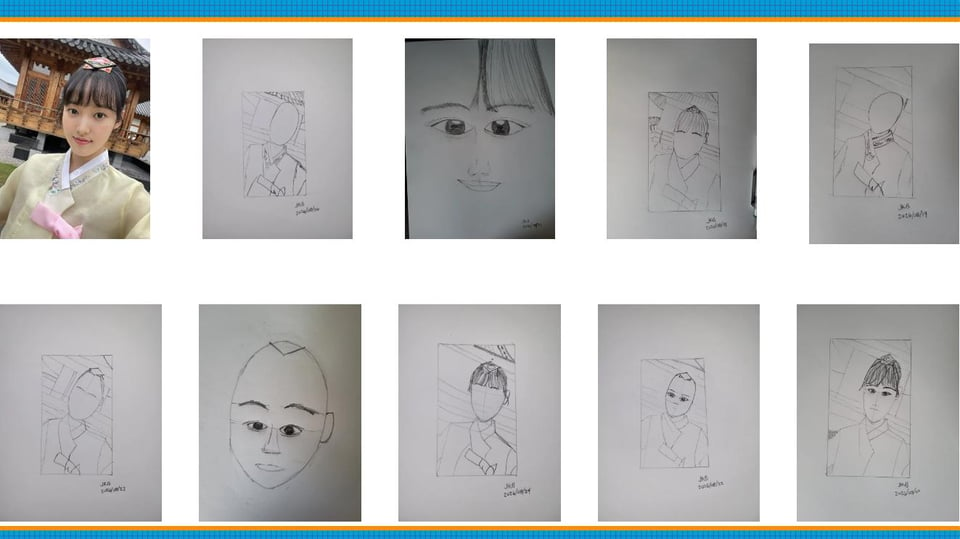
Grace asked me "Why'd you pick something so complicated? Shouldn't you have picked something you could possibly draw in 10 minutes?"
And the short answer is: "No. I deliberately picked something I couldn't draw in 10 minutes."
To expand: If I picked something I COULD draw in 10 minutes, then at the end of 10 minutes, I'd judge myself on the quality of what I drew. By picking something that no one could draw in 10 minutes, I don't have to worry about not finishing, and I’m free to concentrate on producing SOMETHING. Also, if it's something that I could draw in 10 minutes but I don’t manage to finish drawing it in 10 minutes, I'd be unable to resist seeing that as a failure. So in my eyes, by making it impossible to succeed, I made it impossible to fail.
I’m finishing this issue of Thursday just after the announcement of the deaths of Dolly Parton and Tim Curry. I’ve got a lot of feelings about that, but really too many to write about at the moment (especially since 26 August would have been my dad’s 75th birthday). Suffice to say, they will be missed.
Things to check out online
Queen and George Michael performing “Somebody to Love” at the Freddie Mercury Tribute Concert — I don’t know if this was actually new to me, or if I’d just forgotten about it, but either way, it felt new to me, and I really enjoyed (re)discovering it. Of course, the enjoyment of it was also tempered with sadness — we should have had a lot more time with both Freddie Mercury and George Michael.
Former K-Pop Idol Confesses To Almost Jumping Off A Building After Repeated Failures — The “former K-pop idol” in question is Park Hyun Ho, who was a member of the group Topp Dogg under the stage name Seogoong. Since Topp Dogg’s “Arario” was one of the first K-pop songs to catch my attention (the video is here — Park Hyun Ho was the guy with white hair featured at around 1:03 and 2:13), I was particularly interested in this story. I’d long known that the Korean entertainment industry was a brutal place to seek success — there are so many groups being introduced, that it’s difficult for a group to achieve any sort of recognition, and even if a group is successful to any degree, that success may only translate into individual success for 2-3 out of 6-10 members. And Topp Dogg was not a terrifically successful group. The group was together for 4 years (2013-16, inclusive), during which time they released 8 singles, none of which hit the charts. After Topp Dogg disbanded (it was a messy story, not a clean break), Park did his term of military service, then tried to fight his way back into the music industry, working progressively smaller venues. He almost jumped out of a window (not off a building, as the title states), but was stopped by his mother. He has since gotten married and he and his wife have a daughter; working for his wife and daughter provides him with the motivation to keep going, but still . . . the entertainment industry is difficult anywhere, but it seems to be particularly hard in Korea.
What I’ve been reading:
Since last week I’ve finished reading
The Silver Snarling Trumpet: The Birth of the Grateful Dead — The Lost Manuscript of Robert Hunter (Robert Hunter) — I think the publisher can be forgiven the exaggeration in the title — the book doesn’t really show “the birth of the Grateful Dead,” instead merely featuring as a character an even younger Jerry Garcia, several years before he would be involved in forming the Dead (the events of the book took place in 1965, the Grateful Dead were formed in 1965). Likewise, I don’t think I would say the manuscript was really “lost.” But it’s much less exciting — and doesn’t fit as well on a cover — to say “The manuscript that Robert Hunter put in a box in the mid-’60s and his literary executor took out of the box 60 years later.” All snarking at the subtitles aside, I am glad that I read this book, and I really do think that it benefited from spending 60 years in a box. I think that, had Hunter been able to get it published back in the ‘60s, it would have possibly found a small cult following, but largely been dismissed as a late arrival to the Beats, grabbing onto the very end of Kerouac’s coattails, and then swallowed by the sands of time. Instead, by allowing time to pass and allowing Hunter to gain prominence through his association with the Grateful Dead, the book acquires importance as a piece of “Robert Hunter juvenilia” and gains longevity and an audience that it would not otherwise have had. And I think that’s a good think — as I’ve said before, once you allow yourself to accept the style, Hunter really takes you back to that time and place and gives you a real “you are there” feeling.
In the Embrace of Dragons (Lyonne Riley) — And now for something completely different! Seriously, so very, very different that it boggles the mind. I’m just glad that I live in a time and place where I can get both of these books (despite MAGA efforts to the contrary), plus many more of such a wide variety. And sure, maybe there aren’t enough wannabe monsterfuckers for a mainstream publisher to put Riley’s books on the shelves of your local bookstore — or maybe there are and the mainstream publishers just don’t know (or don’t want to admit it) — apparently there are enough of them for Riley to self-publish her books (with all the added effort and expense that that entails) rather than simply posting them to AO3.
Start More Than You Can Finish: A Creative Permission Slip to Unleash Your Best Ideas (Becky Blades) — A lot of this was aimed toward turning your creative idea into a business, but even if you have no intention of starting a business, I think there are still a lot of good things to be taken from this book.
My Dress-up Darling, vol. 15 (Shinichi Fukuda) — I don’t think I’ve ever been more of two minds about a book I’ve read. On one hand I enjoyed it — I liked these characters, so it was nice spending more time with them. On the other hand, there’s a part of me that feels like it would have been a stronger ending if the series had ended immediately after their first kiss, in volume 14. This volume started with them adjusting to the fact they’re dating now, and having to tell their friends that their dating, which felt kind of like the author was flailing to find the story. Then there was a cosplay scene, which was nice but felt kind of extraneous. Chapter 114, there Wakana and Marin go to the beach was better and showed the story finding its feet again. The high point of this volume, for me, was chapter 115, the final chapter, which took place an unspecified time in the future of the rest of the story (maybe a year or so), where Wakana and Marin are newlyweds and Wakana is being featured on the news for his work as a hina doll artist. The side story, where Wakana and Marin tell Marin’s father of their plan to get married was also good, but not quite as good. As a final takeaway from this series, I love this quote from Fukuda in the Afterword: “Even though characters need to face adversity i order to grow, I wondered, ‘Can I make a story in which nothing ugly happens? Would that be unnatural?’ . . . Our daily lives are already riddled with unpleasant things, so I steeled myself: If the alternative was to pile on more misery in the manga people read to relax, it’d be fine for my manga to be nothing but convenient, fun, and pretty, despite how unnatural that’d be.” I think that’s a really good sentiment, and it’s one that a lot of authors could benefit from.
Don’t Call It Art: 10 Ways to Create Like a Kid Again (Austin Kleon) — Austin Kleon does it again. His books always make me feel more creative. I wish he would come out with books more often, but I also recognize that his writing process calls for him to take in and digest a lot of creative material, so it’s not really possible for that to happen. Fortunately, he has his weekly email newsletter (one of the inspirations for Thursday) to tide me over between books. I also sometimes wish he didn’t live so far away from me, but that’s probably also for the best — the fantasy that “if Austin Kleon and I lived nearby, we’d be best buds” is a lot better than the likely reality that “if Austin Kleon and I lived nearby, he’d be busy with his life and I’d be busy with my life and we’d probably never meet.”
I’ve continued reading
Start More Than You Can Finish: A Creative Permission Slip to Unleash Your Best Ideas (Becky Blades)
Food Wars!: Shokugeki no Soma, vol. 21 (Yuto Tsukuda)
The Cozy Cauldron Cab Company (Nathan C. Ashford)
Blue Rose: The AGE Role-Playing Game of Romantic Fantasy — The more I read of this, the more I want to run a game of it, but at the same time the less I feel like I could — it seems to want players who would be willing/able to invest some degree of time/energy in gaining knowledge of the rules and the game world, and the people who would be my likely players just . . . aren’t really that. Perhaps the revised edition, which I’ve already backed on Kickstarter, will include some sort of informational handouts that can be given to players to make things easier to get them started. If not, it’s not so much the rules that I worry about teaching them beforehand as the game world. I suppose I could create an Arrows of the Queen-type scenario, where the players come from an isolated settlement and so have little knowledge of the world, but that (A) would require buy-in from the players on that idea, (B) would mean all the PCs would have to come from the same background, and (C) would mean I’d have to work double-time at integrating the PCs into the game world, so that the NPCs aren’t the only interesting people. It could be done, I just don’t think it’s ideal.
ArtForum, February 2026
Mislaid in Parts Half-Known (Seanan McGuire)
A Red-Rose Chain (Seanan McGuire)
and I’ve started reading
Ritual Income, Witch of the Demesne vol. 1 (B.L. Brown)
Just Another Summer (Tilly & Susan Bridges)
Cells at Work: Baby!, vol. 3 (Yasuhiro Fukuda)
Doughnuts Under a Crescent Moon, vol. 3 (Shio Usui)
If you missed any past Thursdays, you can access the archives here.
And as always, THIS NEWSLETTER CONTAINS 100% HUMAN-CREATED WORDS.
Have a great week, and I’ll see you next Thursday,
Jason
Add a comment: