
When AI Does Math — The Day an AI Solved a 80-Year-Old Problem
The Observation Post
Tech · AI · Cyber · Defence
When AI Does Math — The Day an AI Solved a 80-Year-Old Problem
24 May 2026 · 12 min read
Here's the headline you saw: "An OpenAI model has disproved a central conjecture in discrete geometry."
It sounds like academic jargon designed to exclude normal people. But this is one of the most important AI stories of the year — and it's actually quite simple to understand once you strip away the terminology.
The Problem in Plain English
Imagine you're standing in a large empty field. You have a bucket of pegs and a measuring tape. You start placing pegs in the ground. Your goal: maximise the number of peg-pairs that are exactly 1 metre apart.
How would you arrange them?
Most people would arrange them in a neat grid — like a chessboard pattern. And for 80 years, mathematicians believed the grid was essentially the best you could do. This is called the unit distance problem, first posed by the legendary mathematician Paul Erdős in 1946.
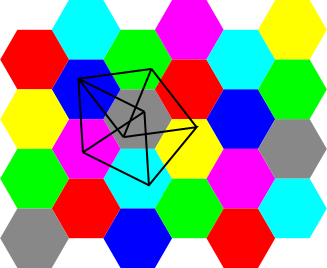
The Hadwiger–Nelson problem — visualizing unit distance graphs in the plane. Each connected point is exactly 1 unit apart. Problems like these have fascinated mathematicians for decades. (Image: David Eppstein, Public Domain)
It sounds almost absurdly simple. Yet it is listed in the 2005 book Research Problems in Discrete Geometry as "possibly the best known (and simplest to explain) problem in combinatorial geometry." Noga Alon, a leading mathematician at Princeton, describes it as "one of Erdős' favourite problems." Erdős even offered a cash prize for solving it.
Nobody solved it for 80 years.
Until last week.
The Beautiful Mathematics Behind It
To understand why this problem is hard, consider this: the number of possible arrangements of points is infinite. The grid is the obvious one, but there are exotic arrangements — spirals, clusters, random scatterings, quasi-crystalline patterns. How do you prove that no possible arrangement anywhere in the universe beats the grid?
That requires deep mathematical machinery. It requires understanding the geometry of numbers, algebraic structures underlying point sets, and the delicate balance between order and chaos in the plane.
The problem sits at the intersection of combinatorial geometry (how points and lines interact) and graph theory (how points connect to each other). The image below shows another classic unit-distance graph — the Pappus graph — which illustrates the kind of structures involved:

The Pappus graph drawn as a unit-distance graph — a beautiful example of graph-theoretic structures involved in distance geometry problems. (Public Domain)
What the AI Actually Did
OpenAI took a general-purpose reasoning model — not a system trained specifically for mathematics, not one given hints about which strategies to try, not one scaffolded with proof-search techniques — and pointed it at a collection of unsolved Erdős problems.
The model returned a result that stunned everyone: the prevailing belief was wrong. The square grid arrangement is not optimal. The model provided a concrete counterexample — an infinite family of better arrangements — and a complete rigorous proof that these arrangements produce more unit-distance pairs than any grid ever could.
Here's the remarkable part: the proof uses algebraic number theory — a branch of pure mathematics dealing with properties of numbers and their deeper algebraic structures — to solve a geometry problem. It's like a carpenter solving a plumbing puzzle using advanced chemistry. The AI made a cross-disciplinary leap that no human mathematician had thought to attempt in 80 years.

Network analysis and graph visualization — representing the mathematical structures and complex problem spaces that AI models navigate when tackling open research problems. (Image: SlvrKy, CC BY-SA 4.0)
Verified by Human Mathematicians
This wasn't the AI making an unchecked claim. The proof was sent to external mathematicians who verified every step. Their reactions are worth reading:
"This has been one of Erdős' favourite problems, I have heard him myself mentioning the problem multiple times in his lectures. I believe it would be fair to say that every mathematician working in Combinatorial Geometry thought about this problem... The solution of the problem by the internal model of OpenAI is, in my opinion, an outstanding achievement, settling a long-standing open problem." — Noga Alon, Princeton
"In my opinion this paper demonstrates that current AI models go beyond just helpers to human mathematicians — they are capable of having original ingenious ideas, and then carrying them out to fruition." — Arul Shankar, leading number theorist
Fields Medalist Tim Gowers called it "a milestone in AI mathematics" and wrote a companion paper explaining the significance of the result.
Why This Is Different From Previous AI Math
AI has done impressive math before. But there's a crucial difference:
- Previous: Systems trained specifically on mathematics (like GPT-4's math capability, or AlphaGeometry for olympiad problems)
- Previous: AI helping human mathematicians check proofs or automate tedious calculations
- Previous: Solving contest-level or textbook problems where the approach is known
- This time: A general reasoning model autonomously solved a central, decades-old open problem in a subfield of mathematics — without being trained on math data, without hints, without scaffolding
As part of the broader effort, the model was evaluated on a collection of Erdős problems. In this case, it produced a proof that resolved an open problem. The result is also notable for how it was found — through general reasoning, not specialised mathematical training.
What This Actually Means for the Future
1. AI is now a research partner, not just a productivity tool. This isn't about writing emails faster. This is AI making genuine contributions to human knowledge.
2. Cross-disciplinary thinking. The AI used algebraic number theory (a field within pure mathematics) to solve a geometry problem. Humans tend to stay within their specialisation. AI doesn't have that limitation — it can draw connections across fields that no individual expert would think to make.
3. Mathematics is the perfect test bed. As OpenAI notes, "mathematics provides a particularly clear testbed for reasoning: the problems are precise, potential proofs can be checked, and a long argument only works if the reasoning holds together from beginning to end." If AI can do this in math, the same reasoning capabilities can be applied to physics, engineering, drug discovery, materials science, and law.
The Catch (There's Always One)
The model produced the proof but cannot explain its reasoning process in a way humans can follow. It's like a chess grandmaster who makes brilliant moves but can't articulate why. Mathematicians had to write companion papers to translate the AI's argument into human-readable mathematics.
This creates an interesting paradox: the AI is brilliant in outcome but opaque in process. The gap between what AI can do and what it can explain is the next frontier — and it's a harder problem than the math itself.
The Bottom Line
An 80-year-old problem that stumped the world's best mathematicians has been solved. The solver wasn't a human — it was a general-purpose AI. The proof has been checked, verified, and celebrated by Fields Medalists.
We are past the point where AI is just a tool for automating routine work. It is now a partner in the act of discovery itself. The question is no longer "can AI think?" — it's "what will AI think of next?"
The Observation Post — daily posts on tech, AI, and what matters.