No Love Like Cat Love
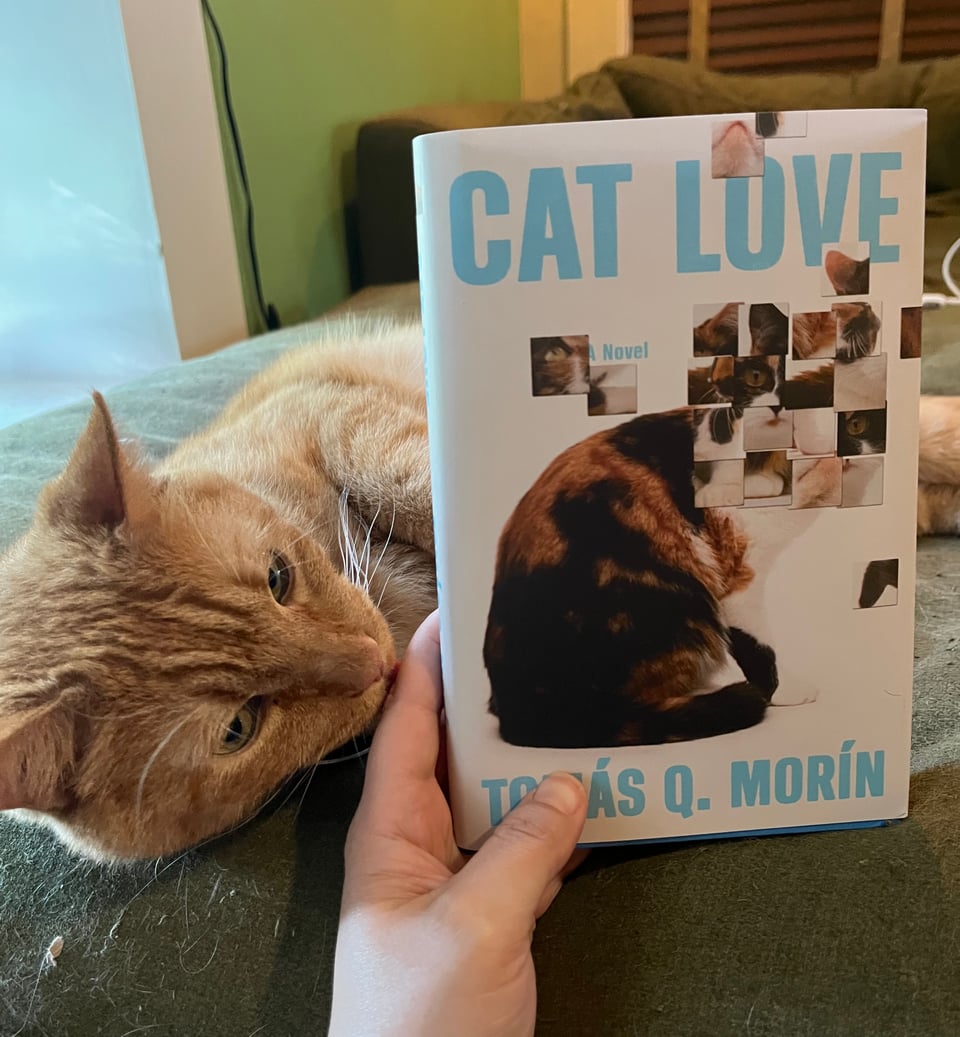
Imagine a quirky little fable of Schrodinger’s cat, narrated by said cat in a near-future dystopia where empathy is quantified and valued enough to become a paid career path. Well, that is the wacky premise of this short book, Cat Love by Tomás Q. Morín. Tomás is primarily a poet, but he’s also published as a translator and memoirist. (He’s also a friend of mine.)
Cat characters in fiction, especially ones that verbalize their thoughts and feelings, have been on my mind recently. On a recent 22+ hour road trip, I listened to the audiobook version of Dungeon Crawler Carl. It’s a vastly different book from Cat Love, but both have smart, snarky calicos who are deliciously funny, keenly observant of humans, and a tiny bit mean. I was recently discussing Karen Russell’s excellent historical novel The Antidote. Among its many narrators is a house cat who finds herself far from her home. After my recent conversation, I returned to the sections of that book told from the cat’s perspective to compare to Cat Love.
It’s fun, imagining how these weird little creatures think of us. In Cat Love, the narrator (the cat in Schrodinger’s box) was cat-napped and desperately wants to return to her easy, comfortable life with “the Mustache,” her human. The narrator truly loves the Mustache. I’ve found that non-cat people (especially those who are dog-only people) often don’t understand how much cats sincerely love their humans. Real-life cat love is something you must experience in order to understand, and what I loved about Cat Love that experience is articulated in the opposite direction: a cat’s love for her human.
One of the pleasures of this novel is how centered it is on a cat’s experience of the world. I’ve lived with cats for over ten years, so I very much enjoyed passages where the narrator discusses befuddling feline behavior. Take, for example, this explanation the narrator gives for why indoor cats sometime run off from their safe, comfortable homes:
“Some humans refer to it as the call of the wild. I never liked that phrase. … It’s a pilgrimage, and the destination is blood. A dog can spend its whole life inside, eating kibble and wet food, and though it may wish it had something different to eat, it’ll never have the same need rise up in the pit of its spirit, a need that compels it to go outside and spend a few days finding its own food.”
After reading that, I suppose I can forgive one of my cats for making his own pilgrimages, despite the intense worry and anxiety it produced.
As I mentioned, Tomás is primarily a poet, and stylistically and structurally, Cat Love reads, to me, as fiction by a poet. It reminded me of Patricia Lockwood’s first novel No One Is Talking About This, another work of fiction from a writer who built their career as a poet. Lockwood’s book is full of beautifully rendered stray lines that hint at narrative, forcing the reader to do some work to figure out the plot. I hated the experience of reading that book. (I made the mistake of reading it on a plane. Never read a difficult, experimental work of fiction on a plane.) I’ll be honest: Cat Love was sometimes frustrating because the plot isn’t obvious or outright stated. For example, years of the Mustache’s life are summed up in a single lovely line in the final section. I can’t say “chapter” because this isn’t the kind of book that has chapters. But it does have distinct sections where the narrative happens within a set amount of time. Sometimes. Like I said, this can be a challenging book to follow.
However, I immensely enjoyed the experience of reading Cat Love. I’ll probably go back and read it again. It’s a short book that can be read in 1-2 sittings. In that way, Cat Love is like a poem that sticks in your mind, forcing you to return and see if it still holds the same meaning that captured you.
Best of all, Cat Love made me stop reading several times so I could cherish moments with my cats.

